
Four moves you make in every meeting
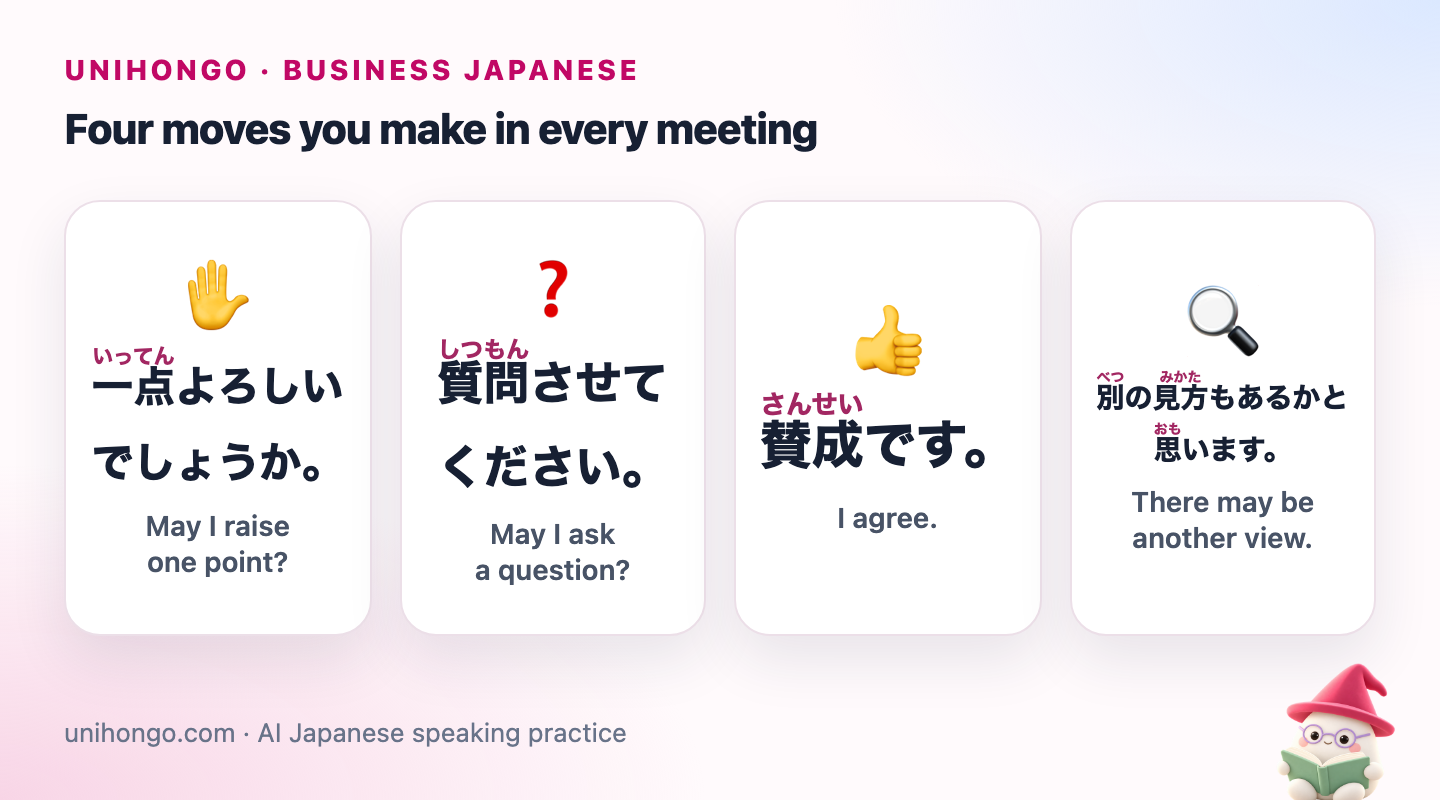
Whatever the meeting is about, your spoken contributions fall into a few moves: taking the floor, asking, agreeing and disagreeing. Japanese has fixed, polite openers for each. Having them ready means you only have to think about the content, not about how to start.
Itten yoroshii deshō ka, literally is one point all right, is the most useful of all. It asks permission to speak, signals that your point is short, and gives everyone a second to turn toward you.
| Japanese | Romaji | Meaning |
|---|---|---|
| 一点よろしいでしょうか。 | Itten yoroshii deshō ka. | May I raise one point? |
| 質問させてください。 | Shitsumon sasete kudasai. | May I ask a question? |
| 賛成です。 | Sansei desu. | I agree. |
| 別の見方もあるかと思います。 | Betsu no mikata mo aru ka to omoimasu. | There may be another view. |
The same moves in three registers
A team chat over lunch, a weekly team meeting and a meeting with a client or senior executives each call for a different level. The plain polite versions below are perfectly correct and normal in many internal meetings. The keigo versions are for meetings with clients, senior managers or anyone you would bow to deeply.
| Japanese | Romaji | Meaning |
|---|---|---|
| ちょっといい? | Chotto ii? | Got a sec? (casual) |
| ちょっといいですか。 | Chotto ii desu ka. | Can I say something? (polite) |
| 一点よろしいでしょうか。 | Itten yoroshii deshō ka. | May I raise one point? (keigo) |
| いいね、それ。 | Ii ne, sore. | Nice, I like it. (casual) |
| いい案だと思います。 | Ii an da to omoimasu. | I think it's a good idea. (polite) |
| 大変良いご提案だと思います。 | Taihen yoi goteian da to omoimasu. | I think it is an excellent proposal. (keigo) |
| それ、違うと思う。 | Sore, chigau to omou. | I don't think that's right. (casual) |
| それは少し違うと思います。 | Sore wa sukoshi chigau to omoimasu. | I think that's a little different. (polite) |
| 恐れ入りますが、私は少し異なる意見を持っております。 | Osoreirimasu ga, watakushi wa sukoshi kotonaru iken o motte orimasu. | Excuse me, but I have a slightly different view. (keigo) |
Asking and clarifying without blaming the speaker
A question in a Japanese meeting should not suggest that the speaker explained badly. Frame it as your own need to confirm: kakunin desu ga, just to confirm. Repeating back what you understood, tsumari ... to iu koto deshō ka, is both a question and a summary, and it is often welcome.
| Japanese | Romaji | Meaning |
|---|---|---|
| 先ほどの点について、もう少し詳しく伺えますか。 | Sakihodo no ten ni tsuite, mō sukoshi kuwashiku ukagaemasu ka. | Could you tell me a little more about that earlier point? |
| 確認ですが、締め切りは月末ということでよろしいでしょうか。 | Kakunin desu ga, shimekiri wa getsumatsu to iu koto de yoroshii deshō ka. | Just to confirm, the deadline is the end of the month? |
| つまり、予算は変わらないということでしょうか。 | Tsumari, yosan wa kawaranai to iu koto deshō ka. | So the budget stays the same, is that right? |
| お話の途中で申し訳ありませんが、 | Ohanashi no tochū de mōshiwake arimasen ga, | Sorry to interrupt, but... |
Agreeing, with or without a condition
Plain agreement is easy: sansei desu, or watakushi mo onaji iken desu. Real meetings often need agreement with a condition, and Japanese has a standard shape for it: kihonteki ni wa sansei desu, I basically agree, followed by tada, just, and your concern. The structure lets you raise a problem while staying on the same side.
| Japanese | Romaji | Meaning |
|---|---|---|
| おっしゃるとおりです。 | Ossharu tōri desu. | You're quite right. (respectful) |
| 私も同じ意見です。 | Watakushi mo onaji iken desu. | I have the same opinion. |
| 基本的には賛成です。ただ、費用の面が少し気になります。 | Kihonteki ni wa sansei desu. Tada, hiyō no men ga sukoshi ki ni narimasu. | I basically agree. I'm just a little concerned about cost. |
Disagreeing politely
Direct disagreement, hantai desu, I object, is used, but mostly by senior people or in formal votes. A junior member usually disagrees in three steps: acknowledge the other view, state the concern softly, and propose an alternative. The softeners ka to omoimasu and kamo shiremasen make the concern sound like a contribution rather than a challenge.
| Japanese | Romaji | Meaning |
|---|---|---|
| おっしゃることはよくわかります。 | Ossharu koto wa yoku wakarimasu. | I fully understand what you're saying. |
| ただ、スケジュールの面で懸念があるかと思います。 | Tada, sukejūru no men de kenen ga aru ka to omoimasu. | However, there may be a concern about the schedule. |
| 別の案として、段階的に進めるのはいかがでしょうか。 | Betsu no an to shite, dankaiteki ni susumeru no wa ikaga deshō ka. | As an alternative, how about proceeding in stages? |
Model dialogue: raising a concern about a schedule
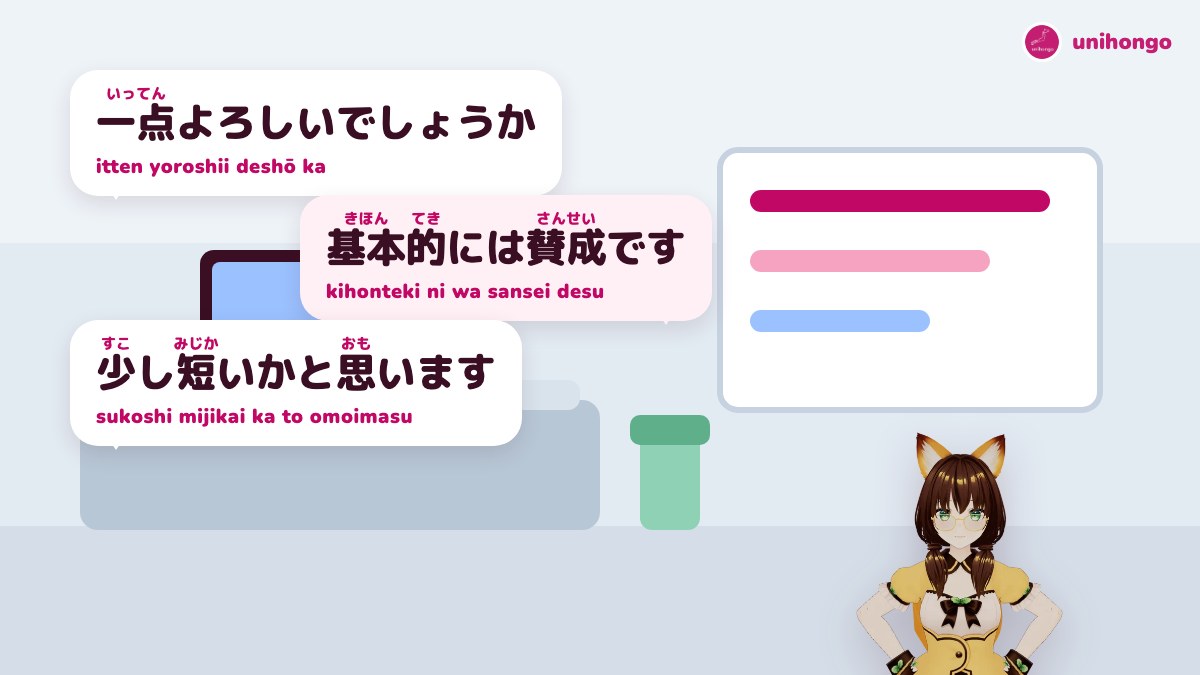
Manager Yamamoto is chairing a team meeting about a new schedule. Lee thinks the testing period is too short. Notice how Lee takes the floor, agrees first, raises the concern with a softener, backs it with experience, and ends by offering to do the work.
| Japanese | Romaji | Meaning |
|---|---|---|
| では、新しいスケジュール案について、ご意見はありますか。 | Dewa, atarashii sukejūru an ni tsuite, goiken wa arimasu ka. | Manager: Any comments on the new schedule draft? |
| 一点よろしいでしょうか。 | Itten yoroshii deshō ka. | You: May I raise one point? |
| どうぞ。 | Dōzo. | Manager: Go ahead. |
| 基本的には賛成です。ただ、テスト期間が一週間というのは少し短いかと思います。 | Kihonteki ni wa sansei desu. Tada, tesuto kikan ga isshūkan to iu no wa sukoshi mijikai ka to omoimasu. | You: I basically agree, but one week of testing may be a little short. |
| なるほど。どのくらい必要だと思いますか。 | Naruhodo. Dono kurai hitsuyō da to omoimasu ka. | Manager: I see. How long do you think we need? |
| 前回の経験から申しますと、二週間あると安心です。 | Zenkai no keiken kara mōshimasu to, nishūkan aru to anshin desu. | You: From last time, two weeks would be safer. |
| 確かに、前回は遅れが出ましたね。 | Tashika ni, zenkai wa okure ga demashita ne. | Colleague: That's true, we had delays last time. |
| もしよろしければ、テスト計画を私のほうでまとめます。 | Moshi yoroshikereba, tesuto keikaku o watakushi no hō de matomemasu. | You: If you like, I'll put the test plan together. |
| ありがとう。では、来週の会議で共有してください。 | Arigatō. Dewa, raishū no kaigi de kyōyū shite kudasai. | Manager: Thanks. Then please share it at next week's meeting. |
| 承知いたしました。 | Shōchi itashimashita. | You: Certainly. |
Misplaced keigo and other meeting mistakes
Meetings mix people of different ranks, so it is easy to point a humble verb at the wrong person. Mōsu is humble: it is for what you or your side said, never for what your manager or a client said. Some evaluating words also sound odd when aimed upward.
| Japanese | Romaji | Meaning |
|---|---|---|
| 部長が申されたとおり、 | Buchō ga mōsareta tōri, | As the manager said (humble verb for a senior: wrong) |
| 部長がおっしゃったとおり、 | Buchō ga osshatta tōri, | As the manager said (correct respectful) |
| 参考になりました。 | Sankō ni narimashita. | That was useful. (can sound evaluative upward) |
| 大変勉強になりました。 | Taihen benkyō ni narimashita. | I learned a great deal. (safer to seniors) |
| 御社のご提案、ありがとうございます。 | Onsha no goteian, arigatō gozaimasu. | Thank you for your company's proposal. (spoken) |
| 弊社としては、前向きに考えております。 | Heisha to shite wa, maemuki ni kangaete orimasu. | Our company is considering it positively. |
- Naruhodo desu ne, repeated to seniors: many listeners find it slightly evaluating. Sō desu ne or ossharu tōri desu are safer.
- Ryōkai desu to a client or senior manager: shōchi itashimashita or kashikomarimashita are safer.
- Saying kisha aloud: kisha is the written form; in speech use onsha.
Closing the meeting and confirming actions
Before people leave, someone usually confirms what was decided and who does what. Offering to do that yourself is a good way for a newer team member to contribute. End with a thank-you to everyone for their time.
| Japanese | Romaji | Meaning |
|---|---|---|
| 本日の決定事項を確認させてください。 | Honjitsu no kettei jikō o kakunin sasete kudasai. | Let me confirm today's decisions. |
| 次回までに、私が議事録をまとめてお送りします。 | Jikai made ni, watakushi ga gijiroku o matomete ookuri shimasu. | Before next time, I'll write up the minutes and send them. |
| 本日はありがとうございました。 | Honjitsu wa arigatō gozaimashita. | Thank you all for today. |
Rehearse your next meeting
Tell Mocchi about an upcoming meeting: the topic, who will attend and the point you want to make. Ask it to write your contribution twice, once for an internal team meeting and once for a meeting with a client, and to explain the differences. Mocchi keeps track of your workplace and role, so later practice uses the same context.
Then practise speaking up in real time. In AI Sensei, ask Yamada-sensei to chair a meeting and present a plan with a weak point. Take the floor, agree with a condition and propose an alternative. Ask the Sensei to react like a slightly sceptical manager so you have to defend your idea politely.