
The short answer, in four cards
Before a meal, most Japanese people put their hands together, palms touching, and say itadakimasu. After the meal they say gochisōsama deshita. The first expresses thanks as you receive the food, the second thanks for the effort of preparing it. Between them, a whole meal is framed by gratitude.
The gesture is small and quick. Some people bow their head slightly, some just say the word, and some only whisper it when they eat alone. Children are usually taught to say both lines clearly, and many adults keep the habit for life.
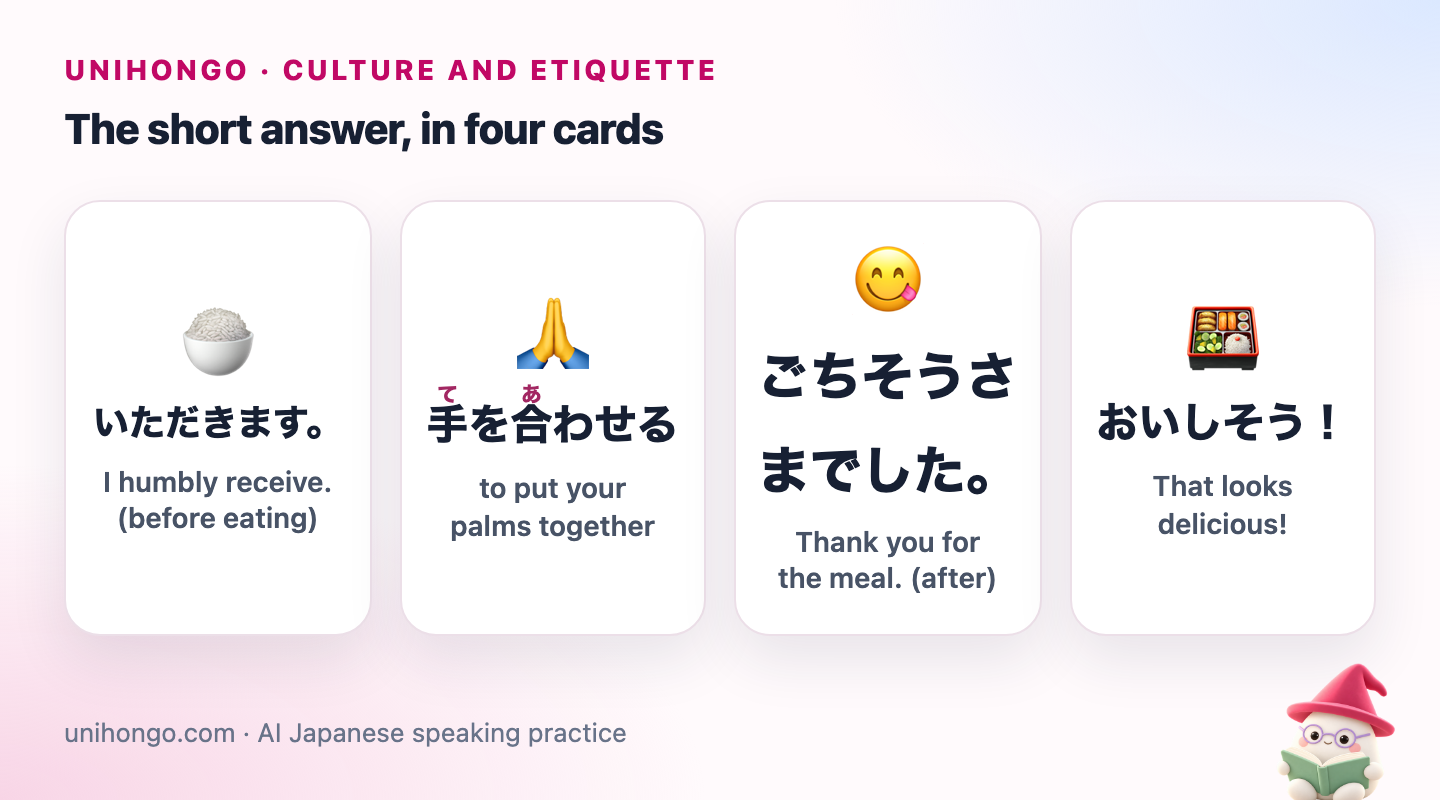
| Japanese | Romaji | Meaning |
|---|---|---|
| いただきます。 | Itadakimasu. | I humbly receive. (before eating) |
| 手を合わせる | te o awaseru | to put your palms together |
| ごちそうさまでした。 | Gochisōsama deshita. | Thank you for the meal. (after) |
| おいしそう! | Oishisō! | That looks delicious! |
What the verb itadaku really means
Itadaku (いただく) is one of the humble verbs of Japanese. It describes receiving something, but in a way that lowers the receiver and raises the giver. The kanji 頂, top or summit, is often used for the word, and a common explanation is that people once raised a precious gift above their heads to receive it. Whether or not every detail of that story is true, the image explains the feeling: you are accepting something valuable with respect.
That is why you hear itadaku far beyond the dinner table. You itadaku a gift from a client, advice from a teacher, or a business card. In shops and offices, staff use it constantly in requests such as could I have your name, literally may I receive your name.
| Japanese | Romaji | Meaning |
|---|---|---|
| 先生からお手紙をいただきました。 | Sensei kara otegami o itadakimashita. | I received a letter from my teacher. (humble) |
| お茶、いただきます。 | Ocha, itadakimasu. | I'll have some tea, thank you. |
| お名前をいただけますか。 | Onamae o itadakemasu ka. | Staff: May I have your name? |
| では、遠慮なくいただきます。 | Dewa, enryo naku itadakimasu. | Then I'll gladly accept, thank you. |
Who are you thanking? The reasons people give
Ask ten Japanese people why they say itadakimasu and you will hear a few overlapping answers. None of them is the single official one, and many people simply say it is what you do. These are the reasons most often given.
| Japanese | Romaji | Meaning |
|---|---|---|
| 命をいただく | inochi o itadaku | to receive a life (as food) |
| 作ってくれた人に感謝する | tsukutte kureta hito ni kansha suru | to thank the person who cooked |
| 残さず食べてね。 | Nokosazu tabete ne. | Parent: Eat it all up, OK? (casual) |
- Thanks to the people: the cook, the farmers, fishers and drivers who brought the ingredients, and the person who paid.
- Thanks to the food itself: the idea that rice, vegetables, fish and meat were living things, and you are receiving their lives. The phrase inochi o itadaku, receiving a life, is often used in schools to explain this.
- A pause of attention: saying a set word before eating marks the start of the meal and stops you from diving in while others are still sitting down.
- Plain manners: for many people it is mainly a habit from childhood, like washing your hands.
The idea of gratitude toward living things is often linked to Buddhist teaching, which has long influenced Japanese food culture. Even so, itadakimasu is not a prayer addressed to a god, and people of every belief say it.
How the habit spread: homes and school lunch
Saying a word of thanks before eating has a long history, but many historians think that the habit of everyone saying itadakimasu together at every meal became widespread fairly recently, in the twentieth century, as family meals around one table and school lunches became normal. Exact dates are debated, so it is safest to say that the custom became universal in modern times rather than giving a year.
School lunch, kyūshoku, is where most Japanese people learned the ritual. In many schools, the pupils on duty stand at the front and lead the class: please put your hands together, then everyone says itadakimasu in chorus. At the end the same leaders lead gochisōsama deshita. Ask a Japanese friend to imitate it and they will usually remember the exact rhythm.
| Japanese | Romaji | Meaning |
|---|---|---|
| 手を合わせてください。 | Te o awasete kudasai. | Pupil on duty: Put your hands together, please. |
| いただきます! | Itadakimasu! | Whole class: Itadakimasu! |
| 給食の時間です。 | Kyūshoku no jikan desu. | It's school lunch time. |
| いただきますは? | Itadakimasu wa? | Parent: What do you say? (prompting a child) |
As a guest at a Japanese table
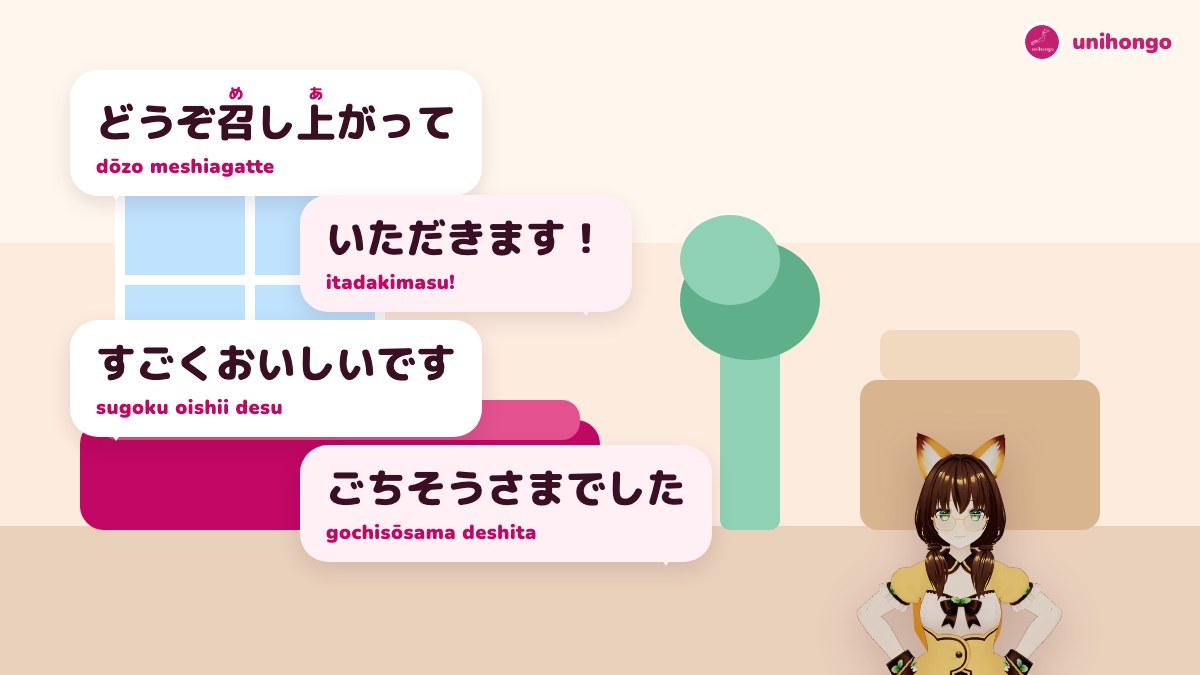
At someone's home, the host usually invites you to start. Wait for that invitation, say itadakimasu, and comment on the food. If the host is still cooking and tells you to start without them, say osaki ni itadakimasu, I'll start before you, which acknowledges that you are eating first.
| Japanese | Romaji | Meaning |
|---|---|---|
| どうぞ召し上がってください。 | Dōzo meshiagatte kudasai. | Host: Please, help yourself. (polite) |
| ありがとうございます。いただきます。 | Arigatō gozaimasu. Itadakimasu. | You: Thank you. Itadakimasu. |
| 冷めないうちにどうぞ。 | Samenai uchi ni dōzo. | Host: Eat it while it's hot. |
| お先にいただきます。 | Osaki ni itadakimasu. | You: I'll start before you, then. |
| すごくおいしいです。 | Sugoku oishii desu. | You: This is really delicious. |
| ごちそうさまでした。 | Gochisōsama deshita. | You: Thank you for the meal. |
| お粗末さまでした。 | Osomatsusama deshita. | Host: It was nothing special. (modest reply) |
Osomatsusama deshita is the host's traditional modest reply to gochisōsama deshita. It sounds a little old-fashioned, and many younger hosts just smile or say did you like it. You do not need to say it yourself unless you are the cook.
Restaurants, bento and when someone else pays
In a restaurant, itadakimasu is said quietly, to yourself or to the people at your table. You are not addressing the staff. When you leave, though, gochisōsama deshita said to the staff or toward the kitchen is a friendly goodbye, especially at small places such as ramen shops and family-run restaurants.
When a boss, a host or a friend is paying, add gochisō ni narimasu before or at the start of the meal. It means roughly I'm being treated, thank you. Itadakimasu then follows naturally. After the meal, gochisōsama deshita is your main thank-you, and many people repeat it in a message later or the next time they meet: senjitsu wa gochisōsama deshita, thank you for the meal the other day.
| Japanese | Romaji | Meaning |
|---|---|---|
| ごちそうになります。 | Gochisō ni narimasu. | Thank you for treating me. (before) |
| 先日はごちそうさまでした。 | Senjitsu wa gochisōsama deshita. | Thanks for the meal the other day. |
| ごちそうさまでした! | Gochisōsama deshita! | Thank you! (to staff as you leave) |
| ありがとうございました。 | Arigatō gozaimashita. | Staff: Thank you very much. |
Mistakes and things not to do
| Japanese | Romaji | Meaning |
|---|---|---|
| ごゆっくりどうぞ。 | Goyukkuri dōzo. | Staff: Please take your time and enjoy. |
| 乾杯! | Kanpai! | Cheers! |
- Using itadakimasu as enjoy your meal to someone else. It is said about yourself. To invite others to eat, the host says dōzo or meshiagatte kudasai, and restaurant staff say goyukkuri dōzo.
- Saying it as a toast. For drinks, the word is kanpai; itadakimasu comes when you start eating.
- Starting before the host invites you. At someone's home, wait for dōzo, unless they clearly tell you to go ahead.
- Saying it very loudly at a restaurant counter. A quiet word with your hands together is enough.
- Worrying that it is religious. It is fine for anyone to say, and many Japanese people are happy to see visitors use it.
Make the meal greeting your own
Habits stick when they are tied to something you already do every day. For one week, say itadakimasu and gochisōsama deshita at every meal, and once a day describe the meal in one Japanese sentence. Type your sentence to Mocchi with /correct, for example /correct 今日はカレーをいただきました, and Mocchi will fix the grammar, check whether the humble verb fits and remember the slips you keep making for your next review.
Then turn the vocabulary of this post into a short round of Sentence Builder on the games page, so that lines such as dōzo meshiagatte kudasai and osaki ni itadakimasu come out in the right order without thinking.