
Thanks that include an apology
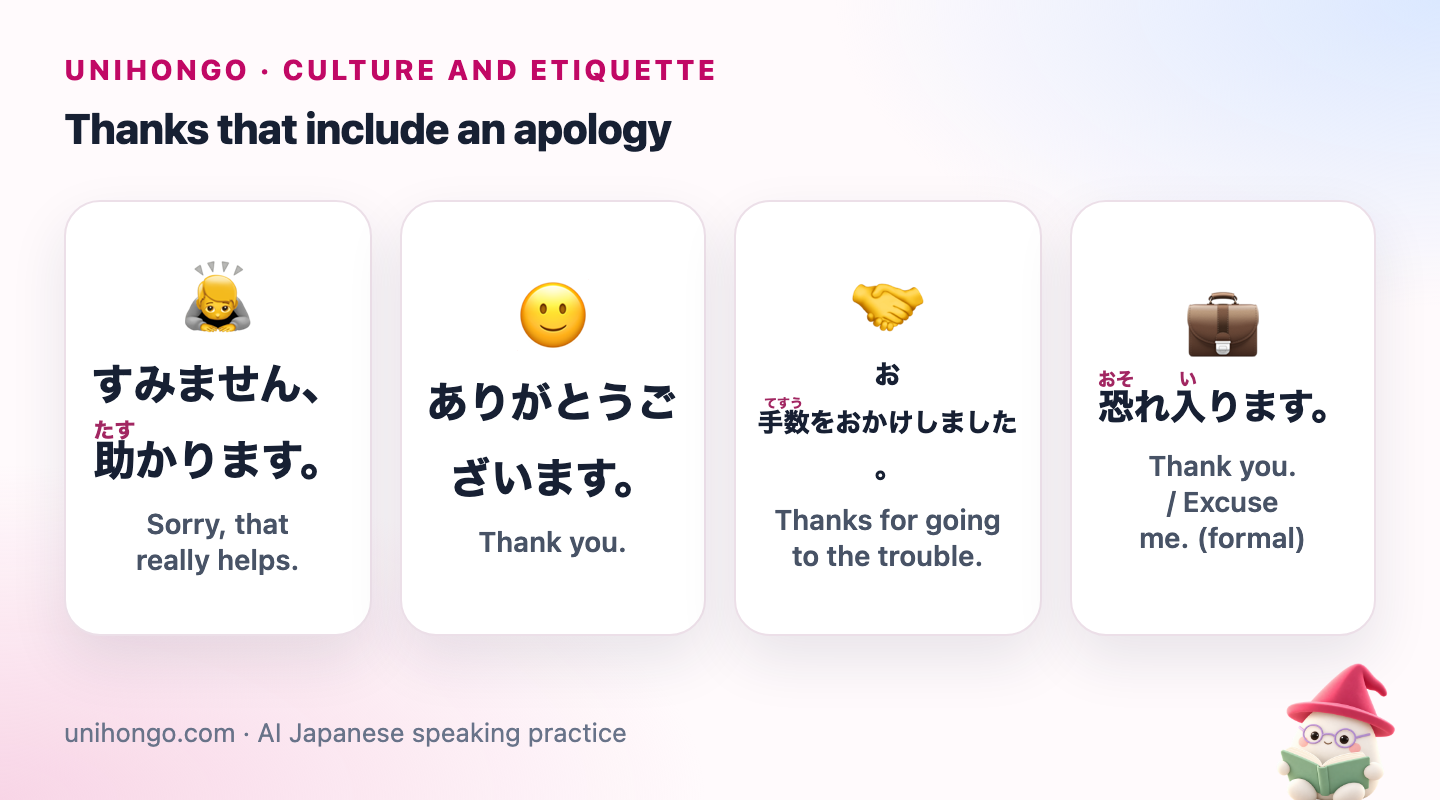
Japanese has many ways to say thanks, and several of them mention the other person's effort or your own debt rather than your happiness. Here are four lines you will hear every day, all of them used as thank you.
| Japanese | Romaji | Meaning |
|---|---|---|
| すみません、助かります。 | Sumimasen, tasukarimasu. | Sorry, that really helps. |
| ありがとうございます。 | Arigatō gozaimasu. | Thank you. |
| お手数をおかけしました。 | Otesū o okake shimashita. | Thanks for going to the trouble. |
| 恐れ入ります。 | Osoreirimasu. | Thank you. / Excuse me. (formal) |
Tasukarimasu, literally I am saved or that helps me, is a natural addition after sumimasen when the help made a real difference. It is warmer than sumimasen alone and very common at work.
The logic: kindness creates a small debt
Sumimasen is the negative of sumu, to be settled or finished. A common way to explain it is it doesn't end: you have received something and have not yet paid it back. In Japanese social life, where people often keep track of favours and return them, receiving help is naturally felt as both pleasant and a little heavy. Mentioning the weight is a way of showing that you do not take the help for granted.
Many Japanese speakers say that arigatō alone can feel a little light or even slightly presumptuous when someone has clearly made an effort for you, especially a stranger or someone senior. Sumimasen shows modesty: I'm sorry you had to do that. Others feel exactly the opposite and prefer the positive arigatō. Both views exist, and age, region and personality all play a part.
| Japanese | Romaji | Meaning |
|---|---|---|
| わざわざすみません。 | Wazawaza sumimasen. | Sorry you went out of your way. |
| 気を遣っていただいて、すみません。 | Ki o tsukatte itadaite, sumimasen. | Sorry you went to such trouble for me. |
| お世話になりました。 | Osewa ni narimashita. | Thank you for all your help. |
When sumimasen fits better than arigatō
Sumimasen tends to be chosen when the help involved the other person stopping, moving, waiting or spending effort for you. These are the classic moments.
| Japanese | Romaji | Meaning |
|---|---|---|
| あ、すみません。 | A, sumimasen. | Oh, thank you. (as they hold the door) |
| すみません、ありがとうございます。 | Sumimasen, arigatō gozaimasu. | Sorry, and thank you so much. |
| どうもすみません。 | Dōmo sumimasen. | Thanks very much. (with a bow) |
- A stranger picks up something you dropped or runs after you with it.
- Someone holds the door or the lift, or moves their bag so you can sit.
- A colleague does a task for you that was not their job.
- A server brings water you did not ask for or refills your tea.
- Someone lets you go ahead in a queue.
When arigatō is the better word
Arigatō is not less polite; it is a different feeling. It focuses on your gratitude rather than the other person's burden. That makes it the better choice whenever apologising would sound strange or gloomy.
| Japanese | Romaji | Meaning |
|---|---|---|
| 褒めてくれてありがとう。 | Homete kurete arigatō. | Thanks for the compliment. (casual) |
| 今日は楽しかった、ありがとう! | Kyō wa tanoshikatta, arigatō! | Today was fun, thank you! (casual) |
- Compliments. If someone says your Japanese is good, sumimasen sounds odd; say arigatō gozaimasu or a modest iie, mada mada desu.
- Gifts and congratulations. Arigatō is the main reply, though you may add an apologetic touch for a generous present.
- Close friends and family, especially for small things.
- Staff serving you as part of their job, such as handing you change; a simple arigatō gozaimasu is warm and natural.
- Thanks for something that was a pleasure, like a fun evening: tanoshikatta, arigatō.
The family of apologetic thanks
Sumimasen has relatives at both ends of the politeness scale. Choosing the right one makes you sound natural rather than just correct.
| Japanese | Romaji | Meaning |
|---|---|---|
| 悪いね、ありがとう。 | Warui ne, arigatō. | Sorry about that, thanks. (casual) |
| ごめんね、ありがとう。 | Gomen ne, arigatō. | Sorry, and thank you. (casual) |
| 恐縮です。 | Kyōshuku desu. | I'm very grateful. (very formal) |
| Expression | Register | Where you hear it |
|---|---|---|
| Warui ne / warui na | Casual; warui na sounds more masculine | Friends, close coworkers, family |
| Gomen ne, arigatō | Casual and warm | Friends and partners after a favour |
| Sumimasen | Polite, neutral | Strangers, shops, coworkers |
| Osoreirimasu | Formal | Business, staff and customers |
| Kyōshuku desu | Very formal | Business letters, speaking to superiors or clients |
Mini dialogue: help at the office
A colleague notices you struggling with a printer jam and fixes it for you. Notice how the thanks moves from apology to gratitude.
| Japanese | Romaji | Meaning |
|---|---|---|
| あ、紙詰まりですか。見ましょうか。 | A, kamizumari desu ka. Mimashō ka. | Colleague: Oh, a paper jam? Shall I look? |
| すみません、お願いできますか。 | Sumimasen, onegai dekimasu ka. | You: Sorry, could you? |
| …はい、直りましたよ。 | …Hai, naorimashita yo. | Colleague: There, it's fixed. |
| すみません、助かりました。ありがとうございます。 | Sumimasen, tasukarimashita. Arigatō gozaimasu. | You: Thanks, that was a big help. Thank you. |
| いえいえ、よくあるんですよ。 | Ie ie, yoku aru n desu yo. | Colleague: Not at all, it happens a lot. |
When someone thanks you with sumimasen
The other half of the exchange is replying. When someone says sumimasen to thank you for a small kindness, you are being thanked, not blamed, so the reply is the same as for thanks: wave it away lightly. Ie ie, often said twice with a small shake of the hand, is the most common answer. Dō itashimashite, the textbook you're welcome, is correct but can sound a little stiff or formal in many everyday moments, and many people prefer ie ie or a smile.
Notice too that one meal in a restaurant can contain three different sumimasen: one to call the server, which means excuse me; one when the server brings extra water, which means thank you; and one if you knock over a glass, which really means sorry. Your tone and the situation tell the listener which one you mean, and the reply changes with it.
For bigger favours, tondemo nai desu, not at all, is a polite, modest reply. Between neighbours or colleagues who help each other, otagaisama desu, we all help each other, turns the debt into something shared.
| Japanese | Romaji | Meaning |
|---|---|---|
| いえいえ、全然。 | Ie ie, zenzen. | Not at all. (casual-polite) |
| どういたしまして。 | Dō itashimashite. | You're welcome. (a little formal) |
| とんでもないです。 | Tondemo nai desu. | Not at all, it was nothing. (polite) |
| お互いさまですよ。 | Otagaisama desu yo. | We all help each other. |
| すみません、お水いただけますか。 | Sumimasen, omizu itadakemasu ka. | Excuse me, could I have some water? |
Mistakes learners make
- Only ever saying arigatō. It is never wrong, but people who also use sumimasen in the right moments sound much more natural.
- Saying sumimasen to every compliment. It can sound as if you are refusing the praise.
- Using a heavy apology such as mōshiwake arimasen to thank someone. It turns gratitude into regret.
- Saying warui na to a senior. It is casual and belongs with friends.
- Forgetting the small nod. A slight bow with sumimasen does half of the work.
Get the reflex into your mouth
Knowing the rule is easy; choosing the word in the half second after someone helps you is the hard part. Ask Mocchi to run a /quiz of quick situations, each one a moment of help, a gift or a compliment, and answer with the phrase you would say. Mocchi explains each choice and notes the situations where you still pick the wrong feeling, so your next review starts there.
For the sound, try the pronunciation coach's sentence intonation drills. A soft, falling sumimasen sounds grateful; a sharp, rising one sounds like you are calling a waiter.