
Four ways to say no without the word no
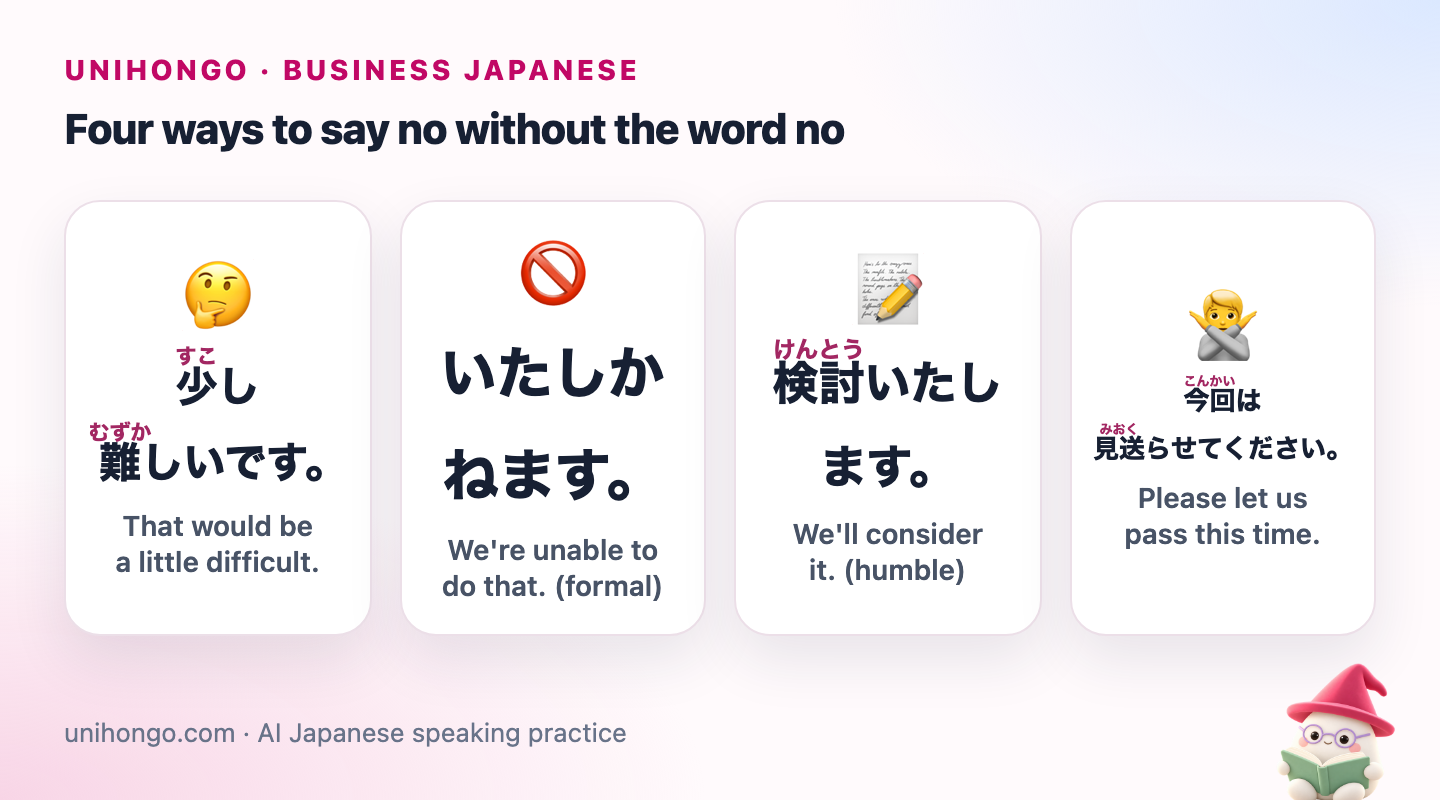
Japanese has a word for no, iie, and a word for cannot, dekimasen, but at work both sound sharper than their English equivalents. Instead, people describe the situation: it is difficult, we are unable to, we will consider it, let us pass this time. The listener understands the answer, and nobody has been flatly turned down.
| Japanese | Romaji | Meaning |
|---|---|---|
| 少し難しいです。 | Sukoshi muzukashii desu. | That would be a little difficult. |
| いたしかねます。 | Itashikanemasu. | We're unable to do that. (formal) |
| 検討いたします。 | Kentō itashimasu. | We'll consider it. (humble) |
| 今回は見送らせてください。 | Konkai wa miokurasete kudasai. | Please let us pass this time. |
One refusal in three registers
Compare a refusal to a friend, to a colleague and to a client. The casual line names the reason and the no directly. The polite line keeps the structure but softens the no. The keigo line adds an apology, frames the reason as a situation, and replaces the verb with a formal impossibility or with difficult.
| Japanese | Romaji | Meaning |
|---|---|---|
| 今週は無理。ごめん。 | Konshū wa muri. Gomen. | This week's impossible. Sorry. (casual) |
| すみません、今週はちょっと難しいです。 | Sumimasen, konshū wa chotto muzukashii desu. | Sorry, this week is a bit difficult. (polite) |
| 大変申し訳ございませんが、今週中の対応は難しい状況です。 | Taihen mōshiwake gozaimasen ga, konshūchū no taiō wa muzukashii jōkyō desu. | I am very sorry, but handling it this week will be difficult. (keigo) |
| 行けない、ごめんね。 | Ikenai, gomen ne. | Can't make it, sorry. (casual) |
| すみません、その日は参加できません。 | Sumimasen, sono hi wa sanka dekimasen. | Sorry, I can't attend that day. (polite) |
| 申し訳ございませんが、あいにく都合がつきません。 | Mōshiwake gozaimasen ga, ainiku tsugō ga tsukimasen. | I'm sorry, but unfortunately I'm not available. (keigo) |
The four-step refusal
A refusal that feels cooperative usually has four steps. First a cushion that apologises. Second, a reason in one short clause; long explanations sound like excuses. Third, the no, stated as a situation. Fourth, an alternative: a later date, a smaller version, or another person. The alternative is what turns a refusal into problem-solving, and in many workplaces it is what people remember.
| Japanese | Romaji | Meaning |
|---|---|---|
| 来週でしたら対応できます。 | Raishū deshitara taiō dekimasu. | I could handle it next week. |
| 半分でしたらお引き受けできます。 | Hanbun deshitara ohikiuke dekimasu. | I could take on half of it. |
| 代わりに、オンラインでの打ち合わせはいかがでしょうか。 | Kawari ni, onrain de no uchiawase wa ikaga deshō ka. | Instead, how about an online meeting? |
| 他の者でよろしければ、すぐに対応いたします。 | Hoka no mono de yoroshikereba, sugu ni taiō itashimasu. | If someone else would do, we can respond right away. |
- Cushion: mōshiwake arimasen ga, or ainiku
- Reason: ima betsu no anken o yūsen shite ite, I am prioritising another project
- Indirect no: kin'yōbi made wa muzukashii desu
- Alternative: raishū deshitara taiō dekimasu, or Satō-san to buntan sureba, or hanbun deshitara
Model dialogue: your manager asks for too much
Here a manager asks Lee to take on a new task by Friday, but Lee is already busy with a priority project. Lee does not say no outright; Lee states the conflict, says Friday is difficult, and offers two options so the manager can decide. The manager speaks casually, which is normal downward.
| Japanese | Romaji | Meaning |
|---|---|---|
| リーさん、この件、金曜までにお願いできる? | Rī san, kono ken, kin'yō made ni onegai dekiru? | Manager: Lee, can you get this done by Friday? |
| 金曜日までですか。申し訳ありません、今、青山電機の資料を優先しておりまして。 | Kin'yōbi made desu ka. Mōshiwake arimasen, ima, Aoyama Denki no shiryō o yūsen shite orimashite. | You: By Friday? I'm sorry, I'm prioritising the Aoyama Electric materials now. |
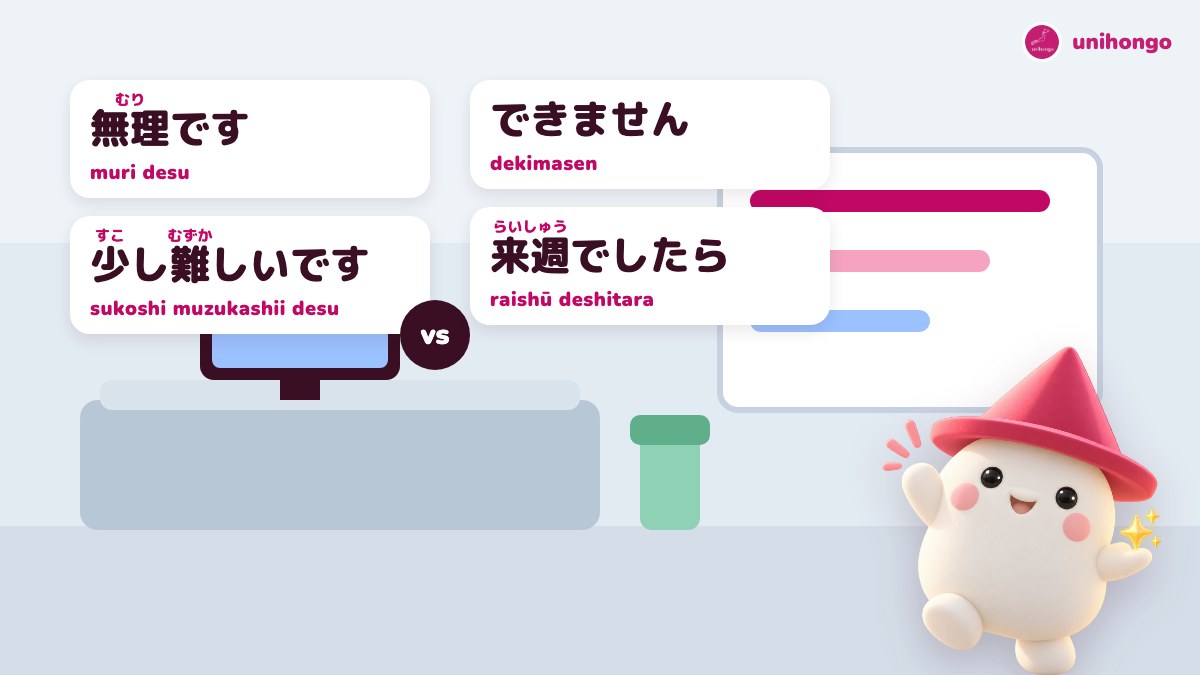
| 金曜日までは少し難しいです。 | Kin'yōbi made wa sukoshi muzukashii desu. | You: Friday would be a little difficult. |
| そうか。いつならできそう? | Sō ka. Itsu nara dekisō? | Manager: I see. When could you do it? |
| 来週の火曜日まででしたら、対応できます。 | Raishū no kayōbi made deshitara, taiō dekimasu. | You: I could do it by next Tuesday. |
| あるいは、佐藤さんと分担すれば金曜日に間に合うかもしれません。 | Arui wa, Satō san to buntan sureba kin'yōbi ni maniau ka mo shiremasen. | You: Or if I split it with Sato, we might make Friday. |
| じゃあ、佐藤さんに相談してみて。 | Jā, Satō san ni sōdan shite mite. | Manager: Then talk it over with Sato. |
| 承知しました。すぐに相談します。 | Shōchi shimashita. Sugu ni sōdan shimasu. | You: Understood. I'll talk to Sato right away. |
Formal refusals for clients
With clients and customers, refusals become more formal and more final, because they speak for the company. Kanemasu forms, itashikanemasu and dekikanemasu, state a firm limit politely. Gokibō ni soikanemasu, we cannot meet your request, is common in email. Always apologise, and add an alternative when one exists.
| Japanese | Romaji | Meaning |
|---|---|---|
| 誠に申し訳ございませんが、ご希望に沿いかねます。 | Makoto ni mōshiwake gozaimasen ga, gokibō ni soikanemasu. | We sincerely apologise, but we cannot meet your request. |
| 価格の変更はいたしかねます。 | Kakaku no henkō wa itashikanemasu. | We are unable to change the price. |
| 今回はお見送りさせていただきます。 | Konkai wa omiokuri sasete itadakimasu. | We will have to pass this time. |
| ご期待に沿えず、申し訳ございません。 | Gokitai ni soezu, mōshiwake gozaimasen. | We are sorry not to meet your expectations. |
| またの機会がございましたら、よろしくお願いいたします。 | Mata no kikai ga gozaimashitara, yoroshiku onegai itashimasu. | We hope to work with you on another occasion. |
Hearing a soft no from others
The same softeners come back at you. When a client or colleague uses one of these, do not assume it is a yes, and do not push for a direct no; ask a gentle follow-up question about the next step instead. Context matters: the same words can be a real maybe from one person and a polite no from another.
| Japanese | Romaji | Meaning |
|---|---|---|
| いつ頃お返事をいただけそうでしょうか。 | Itsu goro ohenji o itadakesō deshō ka. | Around when might we hear back from you? |
| What you hear | Literal meaning | What it often means |
|---|---|---|
| Kentō itashimasu | We will consider it | Maybe; sometimes a polite no. Ask when to expect an answer |
| Zensho shimasu | We will do our best to deal with it | Often a polite no or no promise |
| Chotto... | A little... | No, said without finishing the sentence |
| Muzukashii kamo shiremasen | It might be difficult | Very likely no |
| Kangaete okimasu | I will think about it | Often no in casual settings |
Refusals that go wrong
Most refusal mistakes are about tone: too blunt, or so soft that the listener thinks you agreed. One is pure grammar, and it changes the meaning completely.
| Japanese | Romaji | Meaning |
|---|---|---|
| 無理です。 | Muri desu. | Impossible. (too blunt at work) |
| できません。 | Dekimasen. | I can't. (bare: cold to clients) |
| できかねません。 | Dekikanemasen. | Wrong: this means I might well do it |
| できかねます。 | Dekikanemasu. | I'm unable to. (correct) |
- A five-sentence reason. One clause is enough; more sounds like an excuse and invites negotiation.
- A soft no with no alternative and no follow-up, which can leave the other person unsure what you decided.
- Kentō shimasu when you already know the answer is no. It may buy goodwill now and cost trust later when nothing happens.
- Using itashikanemasu with your own manager about a small task. It sounds like a customer service desk, not a teammate.
Prepare your refusals in advance
Refusals go best when the words are ready before the request comes. Describe a real situation to Mocchi, such as: a client wants a discount we cannot give; write a refusal that keeps the relationship, then a shorter spoken version. Mocchi explains the kanemasu forms and the cushion it used, and if you come back next week it picks up from the situations you already practised.
Then say it to a person. Ask Haru-sensei in AI Sensei to play a manager who keeps adding tasks. Decline one, offer an alternative for another, and accept the third. Ask the Sensei to push back once, so you practise holding your position politely.