
The words of the working day
Four short expressions frame the end of a Japanese working day. Once you know them, you can understand most conversations about hours and leave the office politely.
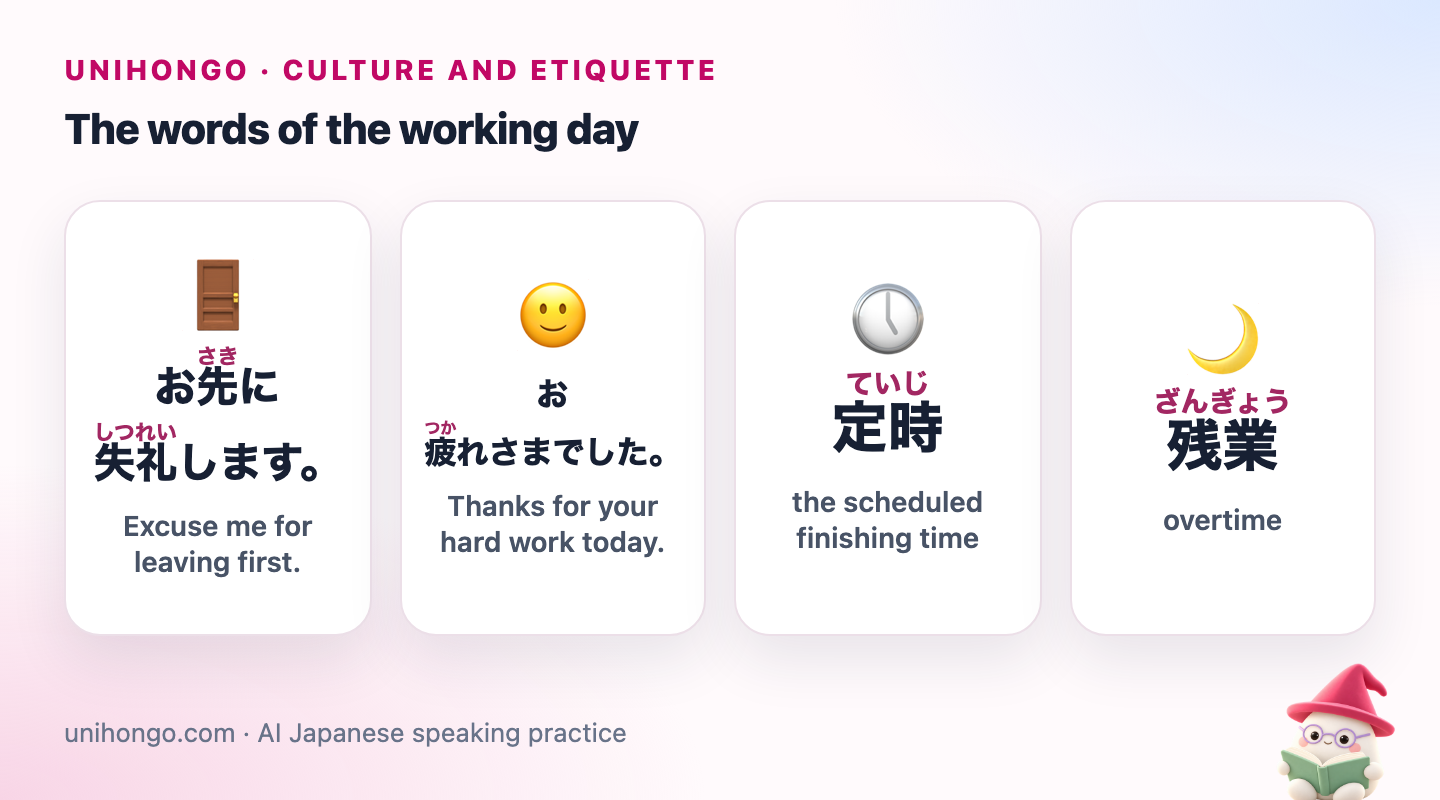
| Japanese | Romaji | Meaning |
|---|---|---|
| お先に失礼します。 | Osaki ni shitsurei shimasu. | Excuse me for leaving first. |
| お疲れさまでした。 | Otsukaresama deshita. | Thanks for your hard work today. |
| 定時 | teiji | the scheduled finishing time |
| 残業 | zangyō | overtime |
Otsukaresama deshita is used all day in many workplaces, as hello in the corridor and as goodbye in the evening. Literally it means you must be tired, but it works as a general thank you for your effort.
Why long hours became normal
Explanations differ, and economists, sociologists and workers themselves each stress different parts. These are the reasons most often mentioned, and in any one workplace some will matter much more than others.
| Japanese | Romaji | Meaning |
|---|---|---|
| 付き合い残業 | tsukiai zangyō | staying late to keep others company |
| サービス残業 | sābisu zangyō | unpaid overtime |
| 過労死 | karōshi | death from overwork |
- Team responsibility. Jobs are often defined loosely, and work belongs to the team, so people stay until the team's work is done rather than until their own task is finished.
- Not leaving first. In traditional workplaces, leaving before the boss or seniors can feel disrespectful, which leads to tsukiai zangyō, staying late to keep others company.
- Effort shown in time. Long hours have sometimes been seen as proof of commitment, especially for young employees.
- Long-term employment. In companies where people expect to stay for decades, reputation inside the team matters a great deal.
- Consensus building. Decisions often involve many meetings and informal checks, which take time.
- High service standards. Fast responses to clients and very careful work add hours.
What is changing
Since the late 2010s, work-style reform has been a constant topic in Japanese news and companies. Many offices now have no-overtime days, encourage people to leave at the scheduled time, allow remote work or flexible hours, and keep a closer eye on overtime. Younger workers in particular often value private time and say so more openly.
At the same time, change is uneven. Some industries, such as parts of healthcare, education, logistics and construction, are still often described as very busy, and habits in a single team can be stronger than company policy. The safest approach is to watch what colleagues do in your first weeks and ask a friendly coworker.
| Japanese | Romaji | Meaning |
|---|---|---|
| 働き方改革 | hatarakikata kaikaku | work-style reform |
| ノー残業デー | nō zangyō dē | no-overtime day |
| 在宅勤務 | zaitaku kinmu | working from home |
| みんな何時ごろ帰りますか。 | Minna nanji goro kaerimasu ka. | What time does everyone usually leave? |
Leaving on time, politely
Leaving on time is not rude in itself. What matters is how you do it. Finish what you promised, check quickly whether someone needs help, tell your manager if anything is left for tomorrow, then say the set phrase and go. Long apologies or excuses make it sound as if you are doing something wrong.
| Japanese | Romaji | Meaning |
|---|---|---|
| 今日は定時で上がります。 | Kyō wa teiji de agarimasu. | I'm leaving on time today. |
| 何か手伝えることはありますか。 | Nanika tetsudaeru koto wa arimasu ka. | Is there anything I can help with? |
| 残りは明日の朝一でやります。 | Nokori wa ashita no asaichi de yarimasu. | I'll do the rest first thing tomorrow. |
| お先に。 | Osaki ni. | I'm off. (casual, to close coworkers) |
| お疲れ! | Otsukare! | Good work today! (casual) |
Agaru, to go up, is the everyday verb for finishing work for the day, as in nanji ni agaru, what time are you finishing. It sounds more natural in conversation than the dictionary word for leaving work, taisha suru.
When the manager asks you to stay
Sometimes overtime really is needed, and helping out now and then builds goodwill. When you cannot stay, decline with the same soft structure used for any refusal: a short apology, a brief reason that does not need detail, and an alternative. Yōji ga atte, I have something on, is enough of a reason.
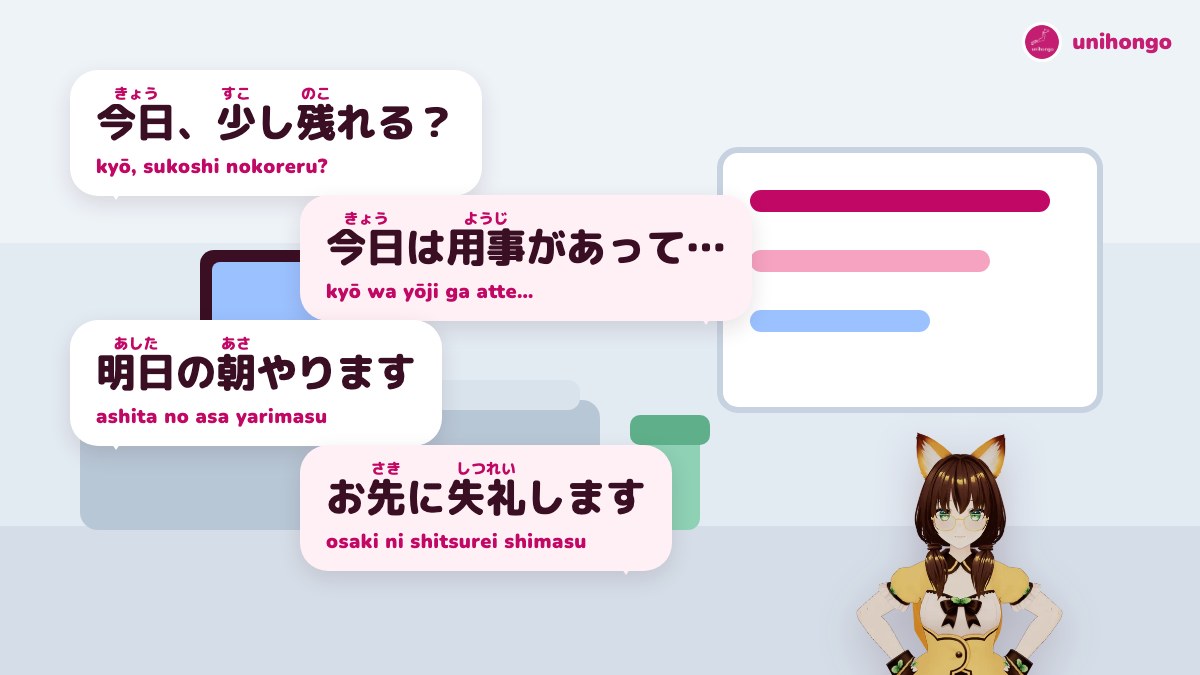
| Japanese | Romaji | Meaning |
|---|---|---|
| 今日、少し残れる? | Kyō, sukoshi nokoreru? | Manager: Can you stay a bit today? (casual) |
| すみません、今日は用事があって…。 | Sumimasen, kyō wa yōji ga atte…. | You: Sorry, I have something on today… |
| 明日の朝、早めに来てやります。 | Ashita no asa, hayame ni kite yarimasu. | You: I'll come in early tomorrow and do it. |
| そっか、じゃあ明日お願い。 | Sokka, jā ashita onegai. | Manager: I see, tomorrow then. (casual) |
| ありがとうございます。お先に失礼します。 | Arigatō gozaimasu. Osaki ni shitsurei shimasu. | You: Thank you. Excuse me for leaving first. |
Talking about hours with friends and at interviews
Hours are a common small-talk topic. Friends ask each other whether work is busy, and job interviews often include a question about overtime. Asking about overtime at an interview is acceptable in Japan if you phrase it neutrally and not as your first question.
| Japanese | Romaji | Meaning |
|---|---|---|
| 最近、仕事忙しい? | Saikin, shigoto isogashii? | Busy at work lately? (casual) |
| 今月は残業が多いです。 | Kongetsu wa zangyō ga ōi desu. | I've had a lot of overtime this month. |
| 残業はどのくらいありますか。 | Zangyō wa dono kurai arimasu ka. | About how much overtime is there? |
| 繁忙期はいつですか。 | Hanbōki wa itsu desu ka. | When is the busy season? |
Taking paid holiday without guilt
Long hours have a twin topic: unused holiday. Many Japanese workers have traditionally taken only part of their paid leave, often saying they did not want to burden colleagues. Companies are now encouraged to make sure staff actually take their days off, and attitudes are changing, especially among younger workers.
Asking for leave is usually simple. Ask early, check the team calendar, arrange a handover, hikitsugi, and tell people who might need you. A short apology for the extra work while you are away is common, and bringing omiyage back from a trip is a familiar way to say thank you.
| Japanese | Romaji | Meaning |
|---|---|---|
| 来週の金曜日、有給を取ってもいいですか。 | Raishū no kin'yōbi, yūkyū o totte mo ii desu ka. | May I take paid leave next Friday? |
| 引き継ぎはしておきます。 | Hikitsugi wa shite okimasu. | I'll prepare a handover. |
| 休み中はご迷惑をおかけします。 | Yasumichū wa gomeiwaku o okake shimasu. | Sorry for the trouble while I'm off. |
| ゆっくり休んでね。 | Yukkuri yasunde ne. | Coworker: Have a good rest. (casual) |
Mistakes to avoid
- Leaving silently. Even in relaxed offices, osaki ni shitsurei shimasu is expected; slipping out without it is what feels rude.
- Saying sayōnara to colleagues. It sounds like a long goodbye; use osaki ni shitsurei shimasu or otsukaresama desu.
- Over-apologising when you leave on time. One small sumimasen at most; you are not doing anything wrong.
- Telling a senior otsukaresama in casual form. Keep otsukaresama deshita or desu with anyone above you.
- Assuming every Japanese workplace is the same. Ask colleagues what is normal in your team.
Practise your exit line before Monday
- Type /kaiwa leaving the office on time to Mocchi; Mocchi suggests a speaking scene built around your level and sends you on to AI Sensei.
- In AI Sensei, choose Yamada-sensei and ask the Sensei to play a slightly old-fashioned section manager who hopes you will stay late.
- Leave on time three times in the conversation, once offering help, once proposing tomorrow morning and once just saying the set phrase.
- Read the session report and add any new expressions to your flashcards.