
The four parts of a customer apology
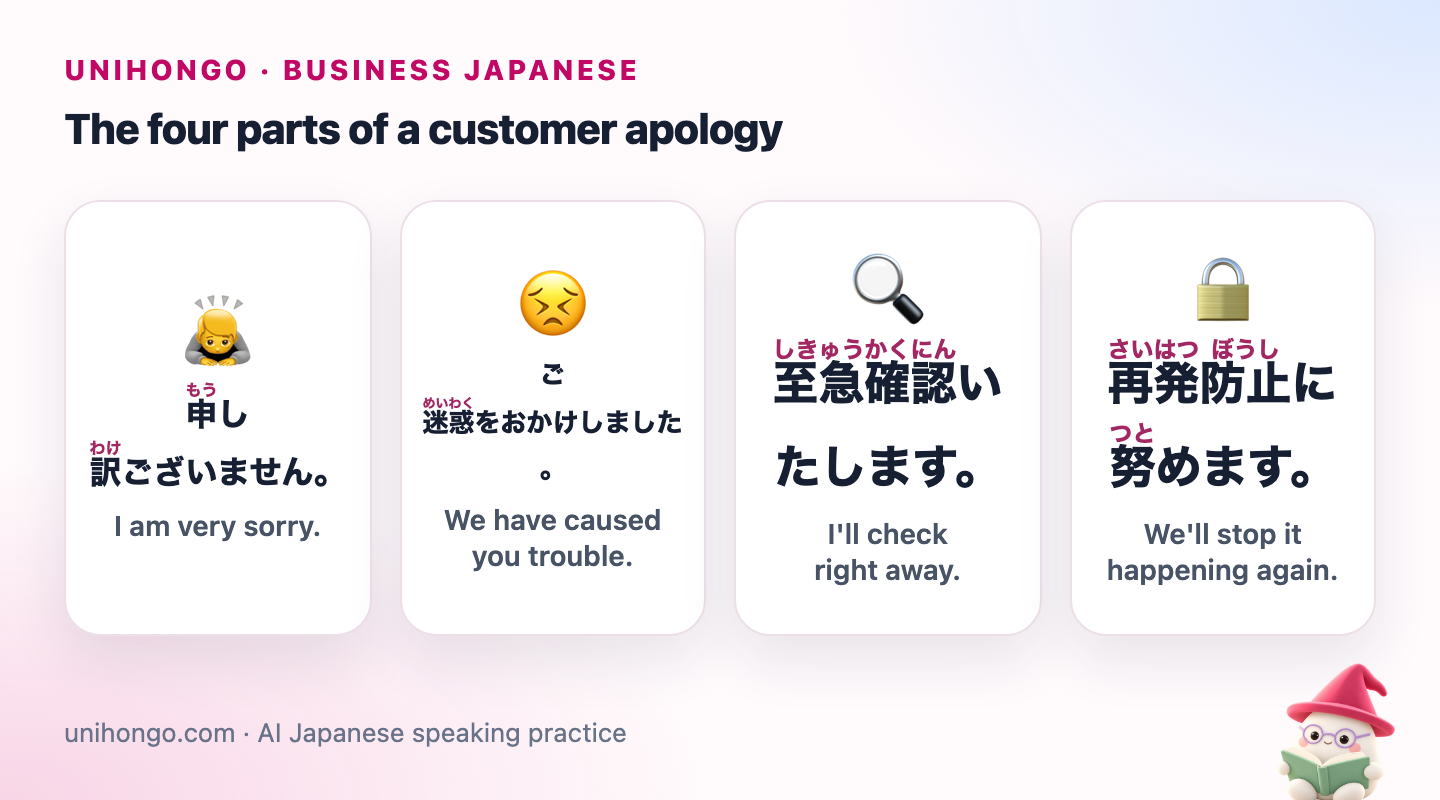
A customer apology that works usually has four parts. The apology itself. Acknowledging the trouble it caused the customer. What you will do now. What you will do so it does not happen again. Each part answers a question the customer has: do you understand, do you care, will you fix it, can I trust you next time.
The four lines below are a complete minimal apology. Fill in the action with the real fix, and the customer hears that someone is in charge.
| Japanese | Romaji | Meaning |
|---|---|---|
| 申し訳ございません。 | Mōshiwake gozaimasen. | I am very sorry. |
| ご迷惑をおかけしました。 | Gomeiwaku o okake shimashita. | We have caused you trouble. |
| 至急確認いたします。 | Shikyū kakunin itashimasu. | I'll check right away. |
| 再発防止に努めます。 | Saihatsu bōshi ni tsutomemasu. | We'll stop it happening again. |
The apology ladder
Japanese apologies come in clear steps, and the step should match the problem. Using the top rung for a tiny slip sounds dramatic; using the bottom rung for a real failure sounds careless. Taihen and makoto ni, very and truly, raise any spoken apology by one step. The written fukaku owabi mōshiagemasu is for serious problems and formal letters, and sounds stiff if spoken across a counter for something small.
| Japanese | Romaji | Meaning |
|---|---|---|
| 大変申し訳ございません。 | Taihen mōshiwake gozaimasen. | I am terribly sorry. |
| 誠に申し訳ございませんでした。 | Makoto ni mōshiwake gozaimasen deshita. | I am truly sorry for what happened. |
| 深くお詫び申し上げます。 | Fukaku owabi mōshiagemasu. | We offer our deepest apologies. (written) |
| Phrase | Typical use | Weight |
|---|---|---|
| Gomen / gomen nasai | Friends and family | Casual; never to customers |
| Sumimasen / shitsurei shimashita | Small slips, making someone wait briefly | Light |
| Mōshiwake arimasen | To your manager, inside the company | Serious, polite |
| Mōshiwake gozaimasen | Customers and clients, spoken and written | The standard customer apology |
| Taihen / makoto ni mōshiwake gozaimasen | Real problems: wrong orders, errors, delays | Strong |
| Fukaku owabi mōshiagemasu | Serious problems, formal email and letters | Very formal |
One apology in three registers
Here are two situations, a delay and a mistake, apologised for to a friend, to a colleague and to a customer. Notice how the customer version changes more than the verb: it names the customer's trouble and describes the mistake as the company's, not as something that happened to you.
| Japanese | Romaji | Meaning |
|---|---|---|
| 遅れてごめん。 | Okurete gomen. | Sorry I'm late. (casual) |
| 遅れてすみません。 | Okurete sumimasen. | Sorry for the delay. (polite) |
| お届けが遅れまして、大変申し訳ございません。 | Otodoke ga okuremashite, taihen mōshiwake gozaimasen. | We are terribly sorry your delivery was late. (keigo) |
| 間違えちゃった。 | Machigaechatta. | Oops, I got it wrong. (casual) |
| 間違えてしまいました。 | Machigaete shimaimashita. | I made a mistake. (polite) |
| こちらの手違いでございました。 | Kochira no techigai de gozaimashita. | It was an error on our part. (keigo) |
Listen before you explain
A customer who is upset wants to be heard first. Explaining the cause too early, even with the best intentions, sounds like an excuse. In Japanese customer service, staff often listen with short formal acknowledgements and an apology for the inconvenience while the customer is still talking, and only then ask for details and explain.
| Japanese | Romaji | Meaning |
|---|---|---|
| さようでございますか。 | Sayō de gozaimasu ka. | I see. (very formal acknowledgement) |
| ご不便をおかけしております。 | Gofuben o okake shite orimasu. | We are sorry for the inconvenience. |
| おっしゃるとおりでございます。 | Ossharu tōri de gozaimasu. | You are quite right. |
| お気持ちは大変よくわかります。 | Okimochi wa taihen yoku wakarimasu. | I completely understand how you feel. |
Model call: the wrong item arrived
A customer phones because the item they received is the wrong colour, and they need it next week. Follow how the staff member listens, apologises, asks for the order number, checks, takes ownership, offers a concrete fix and closes with prevention.
| Japanese | Romaji | Meaning |
|---|---|---|
| 昨日届いた商品が、注文したものと違うんですけど。 | Kinō todoita shōhin ga, chūmon shita mono to chigau n desu kedo. | Customer: The item that came yesterday isn't what I ordered. |
| 大変申し訳ございません。ご注文番号を伺ってもよろしいでしょうか。 | Taihen mōshiwake gozaimasen. Gochūmon bangō o ukagatte mo yoroshii deshō ka. | Staff: I'm terribly sorry. May I have your order number? |
| 12345です。 | Ichi ni san yon go desu. | Customer: It's 12345. |
| ありがとうございます。確認いたしますので、少々お待ちいただけますか。 | Arigatō gozaimasu. Kakunin itashimasu node, shōshō omachi itadakemasu ka. | Staff: Thank you. Could you hold a moment while I check? |
| お待たせいたしました。こちらの手違いで、別の色の商品をお送りしてしまいました。 | Omatase itashimashita. Kochira no techigai de, betsu no iro no shōhin o ookuri shite shimaimashita. | Staff: Thank you for waiting. Due to our error, we sent the wrong colour. |
| ご迷惑をおかけして、誠に申し訳ございません。 | Gomeiwaku o okake shite, makoto ni mōshiwake gozaimasen. | Staff: We are truly sorry for the trouble. |
| 来週使うつもりだったので、困るんですよ。 | Raishū tsukau tsumori datta node, komaru n desu yo. | Customer: I was going to use it next week, so this is a problem. |
| さようでございますか。ご不便をおかけしております。 | Sayō de gozaimasu ka. Gofuben o okake shite orimasu. | Staff: I understand. We are sorry for the inconvenience. |
| 正しい商品を本日発送いたしますので、明後日にはお届けできます。 | Tadashii shōhin o honjitsu hassō itashimasu node, asatte ni wa otodoke dekimasu. | Staff: We'll ship the right item today; it will arrive the day after tomorrow. |
| お手元の商品は、着払いでご返送いただけますか。 | Otemoto no shōhin wa, chakubarai de gohensō itadakemasu ka. | Staff: Could you return the item you have, cash on delivery? |
| わかりました。 | Wakarimashita. | Customer: All right. |
| 今後このようなことがないよう、確認を徹底いたします。 | Kongo kono yō na koto ga nai yō, kakunin o tettei itashimasu. | Staff: We will check thoroughly so this does not happen again. |
| このたびは誠に申し訳ございませんでした。 | Konotabi wa makoto ni mōshiwake gozaimasen deshita. | Staff: Once again, we are truly sorry. |
Lines that make an apology worse
The words below are not wrong Japanese, but in a complaint they send the wrong signal. Most of them shift responsibility away from the company or make the problem sound smaller than the customer feels it is.
| Japanese | Romaji | Meaning |
|---|---|---|
| すみません。 | Sumimasen. | Sorry. (too light for a real complaint) |
| でも、システムの問題でして。 | Demo, shisutemu no mondai deshite. | But it was a system problem. (excuse first) |
| 担当者のミスです。 | Tantōsha no misu desu. | It was that staff member's mistake. (blames a colleague) |
| こちらの不手際でございました。 | Kochira no futegiwa de gozaimashita. | It was our mishandling. (takes ownership) |
| 申し訳ないです。 | Mōshiwake nai desu. | Sorry about that. (casual-sounding to customers) |
- Opening with demo or tada, but, before you have apologised. Explanations come after the apology and only if they help.
- Over-stacked forms such as owabi sasete itadakimasu in every sentence. Once is fine; repeated, it sounds like a script.
- Promising what you cannot guarantee, such as nido to arimasen, it will never happen again. Doryoku itashimasu or tettei itashimasu, we will work to prevent it, is honest and still strong.
The written apology
When the apology goes by email, the order is the same, but the lines are longer and more formal. Put the apology at the very start, after the customer's name and a one-line opener, and repeat it at the end. Keep the explanation of the cause short and factual.
| Japanese | Romaji | Meaning |
|---|---|---|
| このたびは、多大なるご迷惑をおかけし、深くお詫び申し上げます。 | Konotabi wa, tadai naru gomeiwaku o okake shi, fukaku owabi mōshiagemasu. | We deeply apologise for the great inconvenience we have caused. |
| ご不快な思いをさせてしまい、誠に申し訳ございません。 | Gofukai na omoi o sasete shimai, makoto ni mōshiwake gozaimasen. | We are truly sorry to have caused you such displeasure. |
| 今後は再発防止に努めてまいります。 | Kongo wa saihatsu bōshi ni tsutomete mairimasu. | We will work to prevent this from happening again. |
Practise the hard version, not the easy one
Apologies are easy to read and hard to say to someone who is annoyed. Start by asking Mocchi for help with your own case: a customer received a late order and wants compensation we cannot give; write my spoken apology and a short email. Mocchi drafts both, explains which rung of the ladder it used and why, and remembers your line of work for the next session.
Then take it to AI Sensei and try the Handle a Customer Complaint mission, with Hana-sensei as the customer. Listen first, apologise at the right level, offer the fix and close properly. Ask the Sensei to stay upset for longer on the second run, so you practise staying calm and polite.