
The softest no: four signals
When a Japanese speaker wants to say no without saying it, a few signals do most of the work: a pause, a sharp intake of breath, an unfinished sentence and a vague word. These four lines are the ones learners meet first.
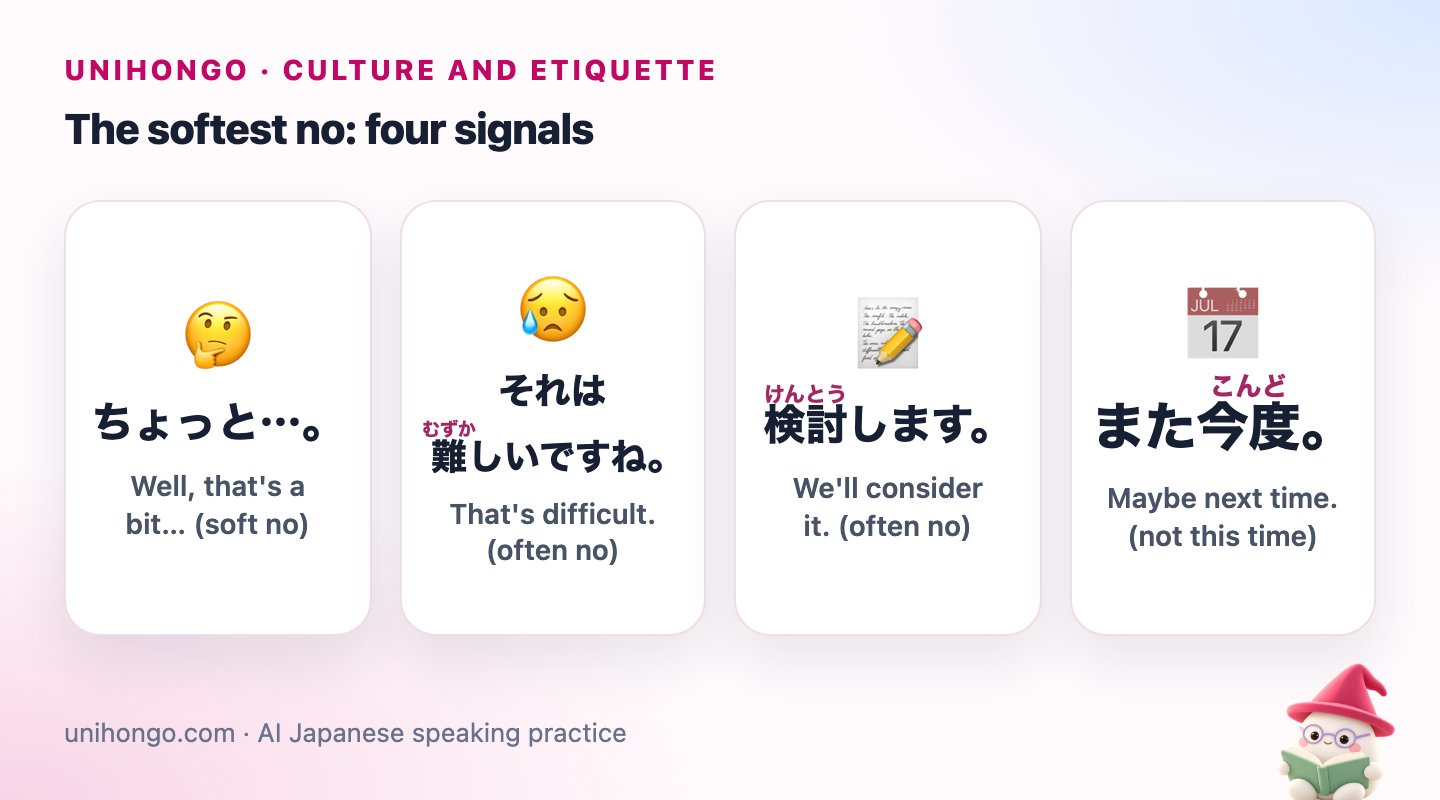
| Japanese | Romaji | Meaning |
|---|---|---|
| ちょっと…。 | Chotto…. | Well, that's a bit… (soft no) |
| それは難しいですね。 | Sore wa muzukashii desu ne. | That's difficult. (often no) |
| 検討します。 | Kentō shimasu. | We'll consider it. (often no) |
| また今度。 | Mata kondo. | Maybe next time. (not this time) |
The trailing chotto is the classic example. The speaker says sono hi wa chotto, that day is a little…, and stops. The missing end of the sentence is the message, and asking what the problem is would put them on the spot.
Why a direct no is avoided
People who study Japanese communication usually describe it as high-context: a lot of meaning is carried by the situation and the relationship rather than by the words. In that kind of communication, a direct no is not wrong, but it is loud. The reasons most often given for softening it are these.
| Japanese | Romaji | Meaning |
|---|---|---|
| 空気を読む | kūki o yomu | to read the air, sense the mood |
| はっきり言う | hakkiri iu | to say something clearly |
| 角が立つ | kado ga tatsu | to cause friction, ruffle feathers |
- Protecting the relationship. Many relationships, at work or in a neighbourhood, are long-term, and a refusal that stings can last.
- Saving face on both sides. A soft refusal lets the asker withdraw without being openly rejected, and lets the refuser avoid sounding unkind.
- Group harmony. Openly disagreeing in front of others can feel disruptive, so concerns are often raised privately first.
- Shared expectations. Because most people read the signals, there is less need to be explicit, and being too explicit can sound childish or aggressive.
These are general tendencies. Plenty of Japanese people are very direct, younger people and some regions are often described as more straightforward, and workplaces with international teams may expect clearer answers.
Soft refusals and what they usually mean
Each of these can be genuine in the right context, so listen to the tone and what comes next. A real maybe is usually followed by specifics, such as a date or a condition. A polite no usually is not.
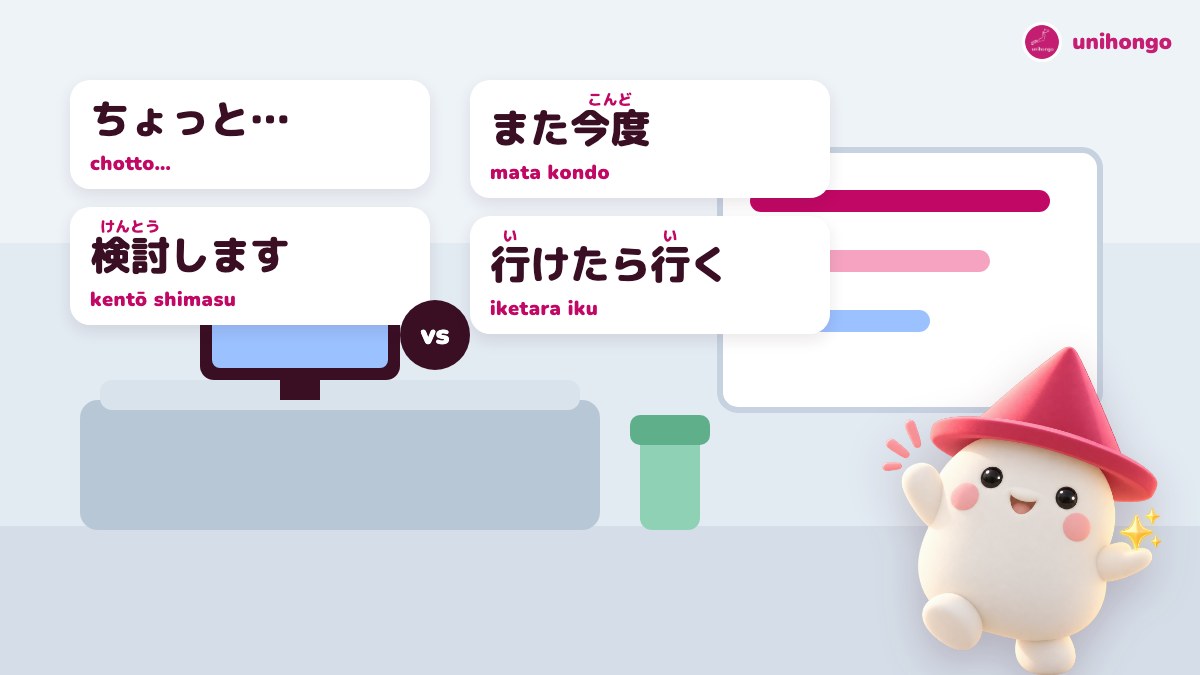
| Japanese | Romaji | Meaning |
|---|---|---|
| 考えておきます。 | Kangaete okimasu. | I'll think about it. |
| 行けたら行くね。 | Iketara iku ne. | I'll come if I can. (casual, often no) |
| 前向きに検討します。 | Maemuki ni kentō shimasu. | We'll consider it positively. |
| What you hear | What it often means | Sign of a real maybe |
|---|---|---|
| Chotto… | No, but I don't want to say it | Chotto, kakunin shite mimasu: they will check |
| Muzukashii desu ne | No, or almost certainly no | They explain what would make it possible |
| Kentō shimasu | Often no, sometimes undecided | They give a date for the answer |
| Kangaete okimasu | Polite brush-off in many cases | They ask you follow-up questions |
| Mata kondo | Not this time, maybe never | They suggest a specific other day |
| Iketara iku | Probably not coming | They ask about the time and place |
Watch out for daijōbu and kekkō
Two short words confuse learners in both directions. Daijōbu desu, it's fine, is often used to refuse an offer: when a clerk asks if you need a bag, daijōbu desu means no thanks. Kekkō desu literally means it's fine or good, but on its own as a reply to an offer it almost always means no thank you. Kekkō desu ne said about something, as in that's quite good, is praise. Context and intonation decide.
| Japanese | Romaji | Meaning |
|---|---|---|
| 袋はご利用ですか。 | Fukuro wa goriyō desu ka. | Clerk: Would you like a bag? |
| 大丈夫です。 | Daijōbu desu. | You: No, thank you. (I'm fine) |
| いえ、結構です。 | Ie, kekkō desu. | No, thank you. (firm, polite) |
| お願いします。 | Onegai shimasu. | Yes, please. |
How to check without putting anyone on the spot
If you really need to know, avoid the yes-or-no question are you coming or not. Ask an open question that offers an easy way out, or suggest a concrete alternative. If the answer is still vague, accept it as a no and move on kindly.
| Japanese | Romaji | Meaning |
|---|---|---|
| 難しそうですか。 | Muzukashisō desu ka. | Does it look difficult? |
| 別の日はどうですか。 | Betsu no hi wa dō desu ka. | How about another day? |
| お返事はいつごろいただけますか。 | Ohenji wa itsu goro itadakemasu ka. | Around when could I have your answer? |
| 無理しないでくださいね。 | Muri shinaide kudasai ne. | Please don't push yourself. |
How to say no yourself, kindly and clearly
As a visitor or a newcomer, you will be forgiven for being a little more direct than a Japanese speaker, but a softened refusal will still go down better. The pattern that works almost everywhere has three parts: appreciation, a soft reason, an alternative or a wish for next time. The reason can stay vague: yotei ga atte, I have plans, is enough.
| Japanese | Romaji | Meaning |
|---|---|---|
| せっかくですが、 | Sekkaku desu ga, | It's very kind of you, but |
| その日はちょっと予定があって…。 | Sono hi wa chotto yotei ga atte…. | I have something on that day… |
| また誘ってください。 | Mata sasotte kudasai. | Please invite me again. |
| 今回は見送らせていただきます。 | Konkai wa miokurasete itadakimasu. | We'll pass this time. (business) |
| ごめん、今週は無理かも。 | Gomen, konshū wa muri kamo. | Sorry, this week might not work. (casual) |
Notice the last line: among friends, muri, impossible, softened with kamo, maybe, is a clear but friendly no. Between close friends, a direct answer is often welcome; the softening matters most with seniors, clients and new acquaintances.
Soft refusals in business meetings
In business, a direct no to a client or partner is especially rare in a meeting. Decisions are often made after informal consultation, called nemawashi, and a person in the room may not have the authority to say yes or no on the spot. Phrases such as we'll check internally are often literally true, and the real answer comes later, by email or through a contact.
When the answer is finally no, it usually comes with an apology for not meeting expectations and, if possible, a reason that does not blame anyone, such as conditions not matching. If you are the one making the proposal, a gracious reply keeps the door open for next time.
| Japanese | Romaji | Meaning |
|---|---|---|
| 社内で確認してからお返事します。 | Shanai de kakunin shite kara ohenji shimasu. | We'll reply after checking internally. |
| 上の者と相談いたします。 | Ue no mono to sōdan itashimasu. | I'll consult my superiors. (humble) |
| 今回は条件が合わず…。 | Konkai wa jōken ga awazu…. | This time the conditions didn't match… |
| ご期待に沿えず申し訳ありません。 | Gokitai ni soezu mōshiwake arimasen. | Sorry we can't meet your hopes. |
| また機会がありましたら、ぜひ。 | Mata kikai ga arimashitara, zehi. | If there's another chance, we'd love to. |
Mistakes learners make
- Taking kentō shimasu as a promise and waiting for weeks. Follow up once, politely, then read silence as an answer.
- Pressing for a reason after chotto. The trailing sentence is meant to end the topic.
- Saying iie, ikimasen with no softening to a senior's invitation. It is grammatical but can sound blunt.
- Giving long, detailed excuses. A short, vague reason sounds more natural than a full explanation.
- Answering daijōbu desu when you meant yes. Use onegai shimasu to accept.
Rehearse a refusal out loud
Declining feels awkward mostly because it happens in real time. Type a situation to Mocchi, such as /correct with your draft refusal to a coworker's drinks invitation, and Mocchi will adjust the politeness, point out where you sound too blunt or too vague and remember which patterns you rely on too much.
Then say it for real: open AI Sensei, choose Hana-sensei and ask the Sensei to play a friendly senior colleague who invites you to three events in a row. Accept one and decline two, then read the session report to see how your refusals came across.