
Four openers that start every report
Most conversations with a manager about work start with one of a few lines. You announce a report, ask to consult, share an update, or jump straight to the result. Each has the go- or o- honorific prefix on the noun, because the report or consultation is directed at your manager.
Ketsuron kara mōshimasu to uses mōsu, the humble verb for say. It is the cleanest way to signal that you are starting with the bottom line, which many Japanese managers explicitly ask for.
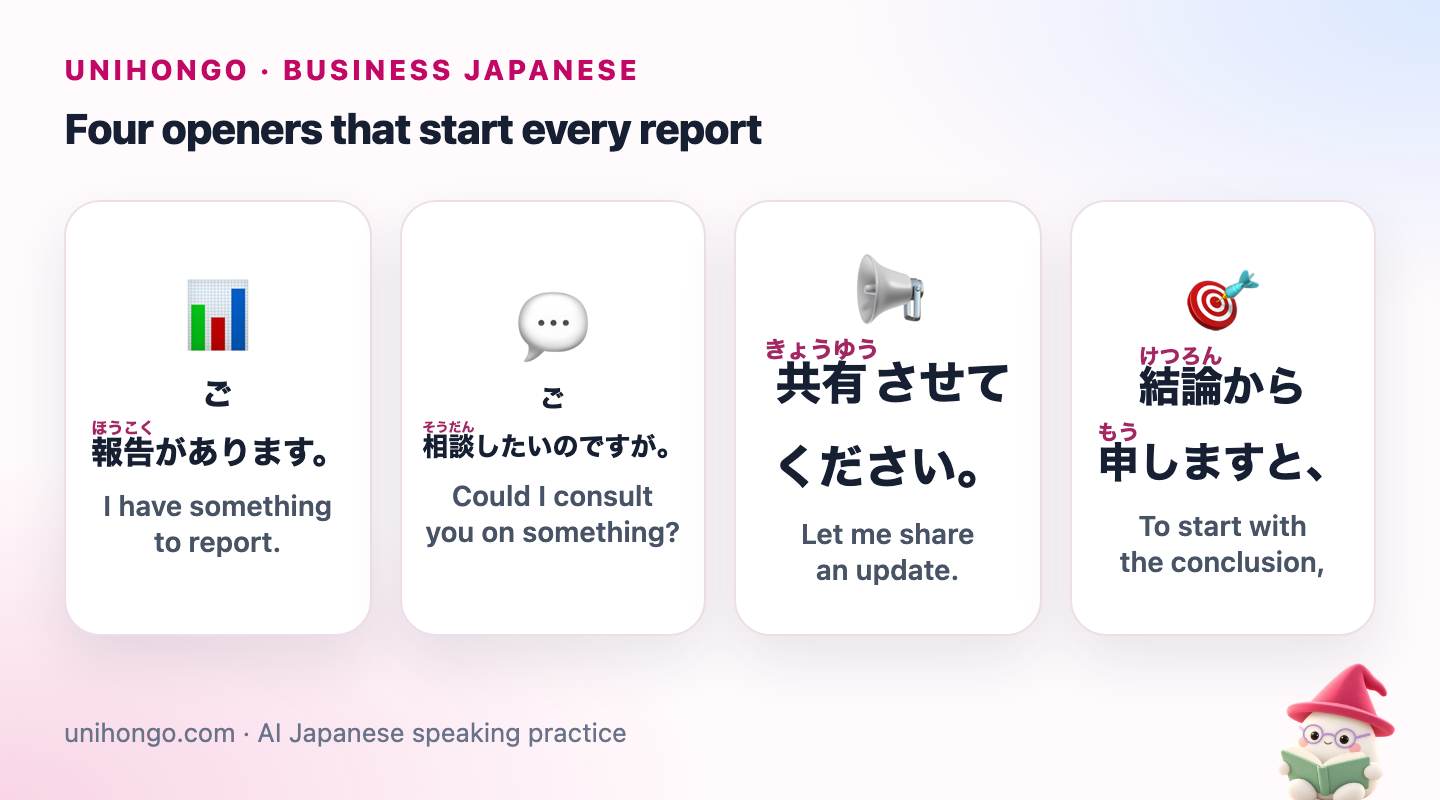
| Japanese | Romaji | Meaning |
|---|---|---|
| ご報告があります。 | Gohōkoku ga arimasu. | I have something to report. |
| ご相談したいのですが。 | Gosōdan shitai no desu ga. | Could I consult you on something? |
| 共有させてください。 | Kyōyū sasete kudasai. | Let me share an update. |
| 結論から申しますと、 | Ketsuron kara mōshimasu to, | To start with the conclusion, |
Reporting in three registers
The same report sounds different to a teammate, your manager and a senior executive. With a teammate, plain polite or even casual is normal. With your direct manager, most people use polite Japanese with humble forms for their own actions. With a manager two levels up, or in a formal setting, the humble forms become fuller.
| Japanese | Romaji | Meaning |
|---|---|---|
| あれ、終わったよ。 | Are, owatta yo. | That thing's done. (casual, to a teammate) |
| 例の資料、完成しました。 | Rei no shiryō, kansei shimashita. | The materials are finished. (polite) |
| ご依頼の資料が完成いたしましたので、ご報告いたします。 | Goirai no shiryō ga kansei itashimashita node, gohōkoku itashimasu. | I'm reporting that the materials you asked for are finished. (keigo) |
| ちょっと相談していい? | Chotto sōdan shite ii? | Can I ask your advice? (casual) |
| 少し相談してもいいですか。 | Sukoshi sōdan shite mo ii desu ka. | Could I ask your advice? (polite) |
| 少しご相談してもよろしいでしょうか。 | Sukoshi gosōdan shite mo yoroshii deshō ka. | Might I consult you briefly? (keigo) |
| ちょっと遅れそう。 | Chotto okuresō. | It's going to be a bit late. (casual) |
| 少し遅れそうです。 | Sukoshi okuresō desu. | It looks like it'll be a little late. (polite) |
| 申し訳ございません。納期が遅れる見込みです。 | Mōshiwake gozaimasen. Nōki ga okureru mikomi desu. | I'm very sorry; the delivery is expected to be late. (keigo) |
Conclusion first, then reason, then next step
Many learners start a report with background, as one might in a story. Japanese managers, like managers anywhere, usually want the result first. A dependable shape is: topic, conclusion, reason, next step. If the report needs a decision, add the sōdan step at the end: what you need from your manager.
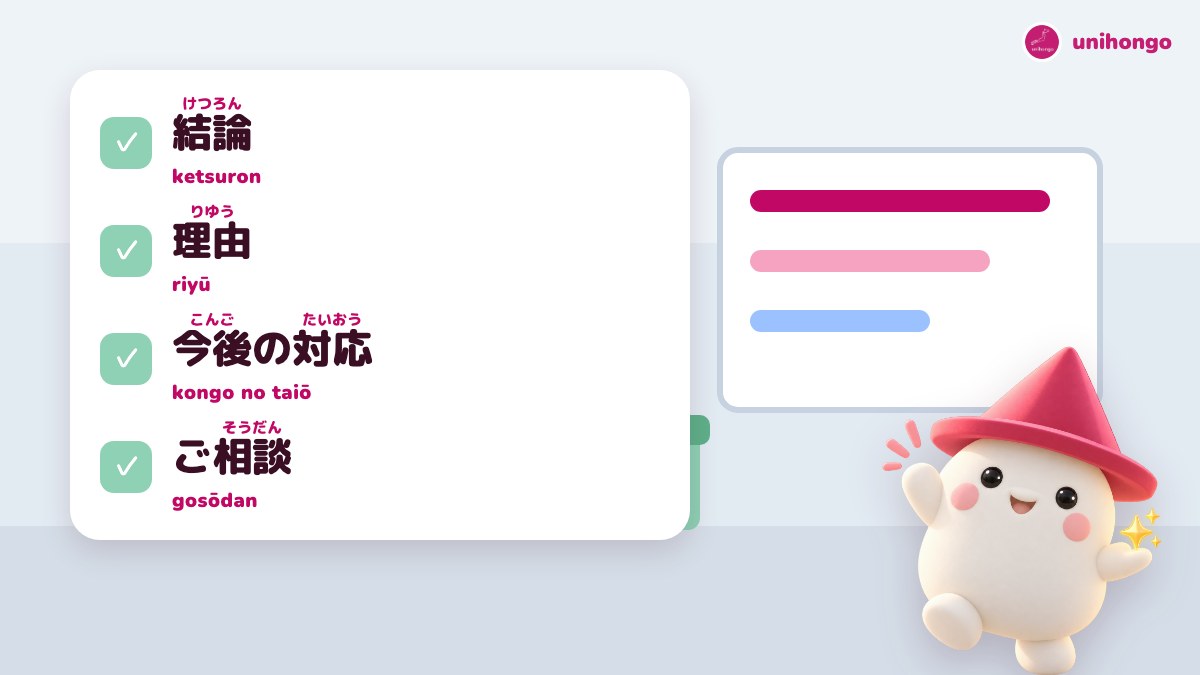
| Japanese | Romaji | Meaning |
|---|---|---|
| 青山電機の件でご報告があります。 | Aoyama Denki no ken de gohōkoku ga arimasu. | I have a report on the Aoyama Electric matter. |
| 結論から申しますと、予定どおり金曜日に納品できます。 | Ketsuron kara mōshimasu to, yotei dōri kin'yōbi ni nōhin dekimasu. | In short, we can deliver on Friday as planned. |
| 理由は二つあります。 | Riyū wa futatsu arimasu. | There are two reasons. |
| 今後は、木曜日に最終確認を行う予定です。 | Kongo wa, mokuyōbi ni saishū kakunin o okonau yotei desu. | Next, we plan to do a final check on Thursday. |
Hōkoku and renraku: progress and information
Hōkoku is reporting on your own work: progress, results, problems. Renraku is passing on facts that others need, such as a client's message or a schedule change. In renraku you often relay what someone else said, and the ending to no koto desu, I am told that, marks it as their information, not your opinion.
| Japanese | Romaji | Meaning |
|---|---|---|
| 進捗をご報告します。現在、七割ほど完成しております。 | Shinchoku o gohōkoku shimasu. Genzai, nanawari hodo kansei shite orimasu. | A progress report: it's about seventy percent done. |
| 先方から返事がありまして、来週の月曜日なら可能とのことです。 | Senpō kara henji ga arimashite, raishū no getsuyōbi nara kanō to no koto desu. | The client replied; they say next Monday is possible. |
| 念のため、お知らせしておきます。 | Nen no tame, oshirase shite okimasu. | Just so you know. |
| 明日は午後から外出いたします。 | Ashita wa gogo kara gaishutsu itashimasu. | I'll be out of the office from tomorrow afternoon. |
Sōdan: consulting before you decide
A consultation is not handing your manager a problem. It goes best when you bring the situation, two or three options and your own preference, then ask for their view. Asking dochira ga yoroshii deshō ka, which would be better, invites a decision without making your manager do all the thinking.
| Japanese | Romaji | Meaning |
|---|---|---|
| ご相談したいことがあるのですが、十分ほどお時間をいただけますか。 | Gosōdan shitai koto ga aru no desu ga, juppun hodo ojikan o itadakemasu ka. | I'd like your advice; could I have about ten minutes? |
| 二つの案で迷っております。 | Futatsu no an de mayotte orimasu. | I'm torn between two options. |
| 私としては、一つ目の案がよいと考えております。 | Watakushi to shite wa, hitotsume no an ga yoi to kangaete orimasu. | Personally, I think the first option is better. |
| どちらがよろしいでしょうか。 | Dochira ga yoroshii deshō ka. | Which would you prefer? |
Model dialogue: a delivery will be late
Lee has learned that a delivery to Aoyama Electric will be three days late. Lee reports it the same day, before telling the client, and brings two options. The manager answers in casual Japanese, which is normal downward. Lee uses polite Japanese with humble forms throughout.
| Japanese | Romaji | Meaning |
|---|---|---|
| 部長、今少しよろしいでしょうか。青山電機の件でご報告があります。 | Buchō, ima sukoshi yoroshii deshō ka. Aoyama Denki no ken de gohōkoku ga arimasu. | You: Do you have a moment? I have a report on Aoyama Electric. |
| うん、どうした? | Un, dō shita? | Manager: Sure, what is it? |
| 結論から申しますと、納品が三日遅れる見込みです。 | Ketsuron kara mōshimasu to, nōhin ga mikka okureru mikomi desu. | You: In short, the delivery will probably be three days late. |
| え、何があったの? | E, nani ga atta no? | Manager: What happened? |
| 昨日、先方から仕様の変更がありまして、その対応に時間がかかっております。 | Kinō, senpō kara shiyō no henkō ga arimashite, sono taiō ni jikan ga kakatte orimasu. | You: The client changed the specs yesterday, and the changes are taking time. |
| 先方にはもう伝えた? | Senpō ni wa mō tsutaeta? | Manager: Have you told them yet? |
| まだです。お伝えする前に、部長にご相談したいと思いまして。 | Mada desu. Otsutae suru mae ni, buchō ni gosōdan shitai to omoimashite. | You: Not yet. I wanted to consult you first. |
| 対応案は二つございます。人を一人増やすか、先方に分割納品をお願いするかです。 | Taiōan wa futatsu gozaimasu. Hito o hitori fuyasu ka, senpō ni bunkatsu nōhin o onegai suru ka desu. | You: There are two options: add one person, or ask the client for split delivery. |
| 私としては、分割納品がよいと考えております。 | Watakushi to shite wa, bunkatsu nōhin ga yoi to kangaete orimasu. | You: I think split delivery is better. |
| わかった。分割納品で行こう。先方には今日中に連絡して。 | Wakatta. Bunkatsu nōhin de ikō. Senpō ni wa kyōjū ni renraku shite. | Manager: OK, let's split it. Contact them today. |
| 承知しました。連絡しましたら、またご報告いたします。 | Shōchi shimashita. Renraku shimashitara, mata gohōkoku itashimasu. | You: Understood. I'll report back once I've contacted them. |
Replies and habits many managers dislike
Reports can go wrong in the opening, the order or the reply. These are the habits that come up most often in Japanese workplace training, together with safer alternatives. Workplaces differ, so watch what your colleagues say to your manager.
| Japanese | Romaji | Meaning |
|---|---|---|
| 了解です。 | Ryōkai desu. | Got it. (many find it too casual upward) |
| 承知しました。 | Shōchi shimashita. | Understood. (safe to a manager) |
| ご苦労さまです。 | Gokurōsama desu. | Thanks for your work. (usually to juniors) |
| お疲れさまです。 | Otsukaresama desu. | Thanks for your work. (safe upward) |
| ご報告させていただきます。 | Gohōkoku sasete itadakimasu. | Allow me to report. (fine once, heavy if repeated) |
- Waiting to be asked. A short report before your manager asks is part of the habit; silence on a problem tends to worry managers more than the problem itself.
- Starting with ten seconds of background. Say the result first; offer details if asked.
- Bringing bad news with no plan. Even one rough option shows that you are on top of it.
- Reporting a client's words as your own view. Add to no koto desu to mark it as their information.
Turn this week's work into a report
Give Mocchi the raw facts of something you are working on and ask: turn this into a conclusion-first report for my manager, then into a sōdan with two options, and explain the keigo. Mocchi shapes both versions, explains why it chose each humble form, and remembers the project details, so you can come back later and ask for the next update in the same context.
For the speaking side, ask Ibuki-sensei in AI Sensei to act as your manager. Give the late-delivery report from this post, then a real one of your own. Ask the Sensei to interrupt with questions, as busy managers do, and check the session report for the places where your conclusion came too late.