
Four lines for the front desk
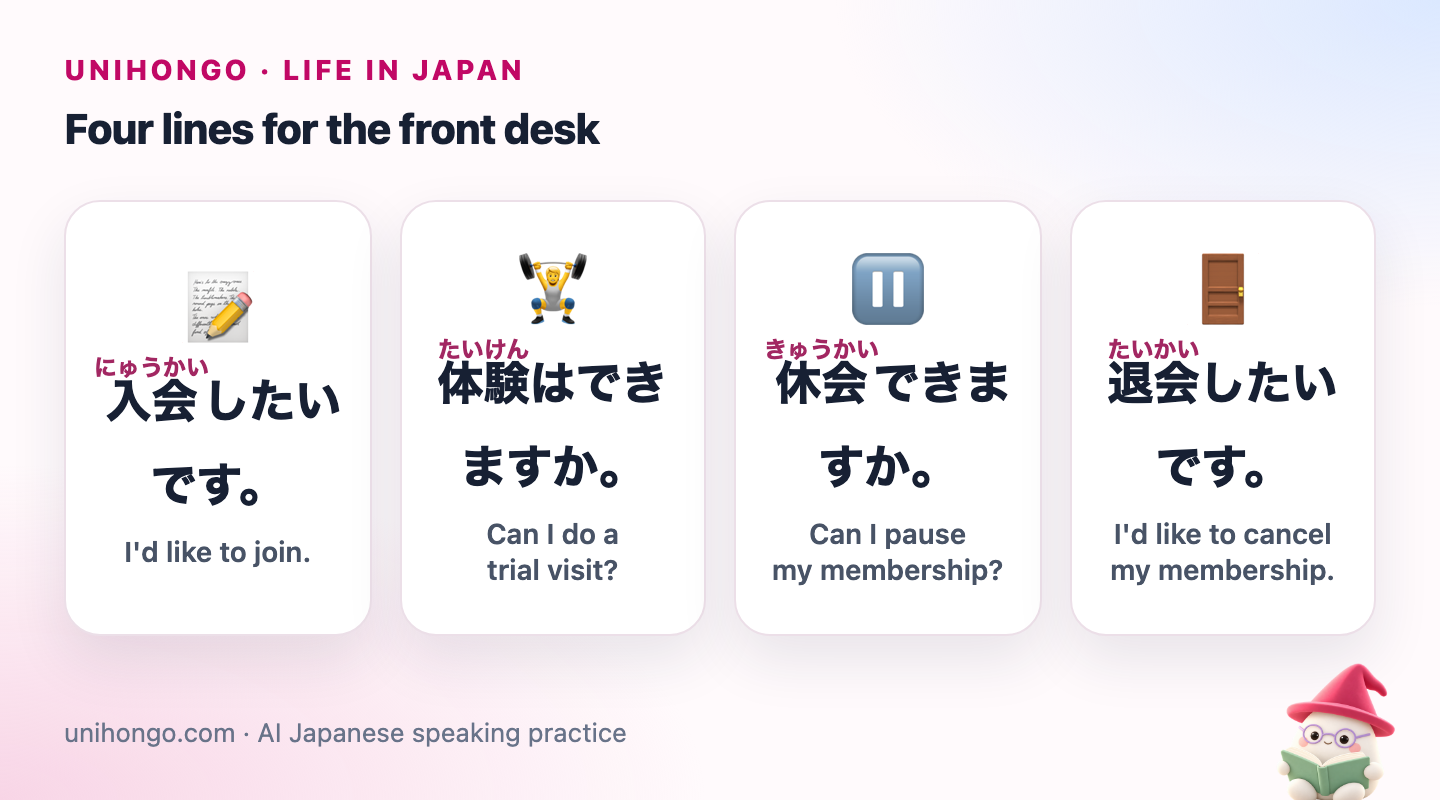
Membership words are built on the kanji 会 (kai, meeting or membership) with a verb in front: 入 (enter) for joining, 休 (rest) for pausing, 退 (withdraw) for cancelling. Once you see the pattern, the signs and forms at any gym become easy to read.
| Japanese | Romaji | Meaning |
|---|---|---|
| 入会したいです。 | Nyūkai shitai desu. | I'd like to join. |
| 体験はできますか。 | Taiken wa dekimasu ka. | Can I do a trial visit? |
| 休会できますか。 | Kyūkai dekimasu ka. | Can I pause my membership? |
| 退会したいです。 | Taikai shitai desu. | I'd like to cancel my membership. |
Trial visits and tours
Many gyms offer a trial (taiken) for a fee or free, often with a short orientation, and a tour (kengaku) without training. Bring sportswear and indoor shoes; staff will usually tell you on the phone or website. Asking about busy times is useful too, because the after-work rush can be very different from mornings.
| Japanese | Romaji | Meaning |
|---|---|---|
| 見学だけでもいいですか。 | Kengaku dake demo ii desu ka. | Is it OK just to look around? |
| 体験の予約をしたいです。 | Taiken no yoyaku o shitai desu. | I'd like to book a trial. |
| 何を持ってくればいいですか。 | Nani o motte kureba ii desu ka. | What should I bring? |
| 混む時間帯はいつですか。 | Komu jikantai wa itsu desu ka. | When is it busiest? |
Joining: ID, payment and the application form
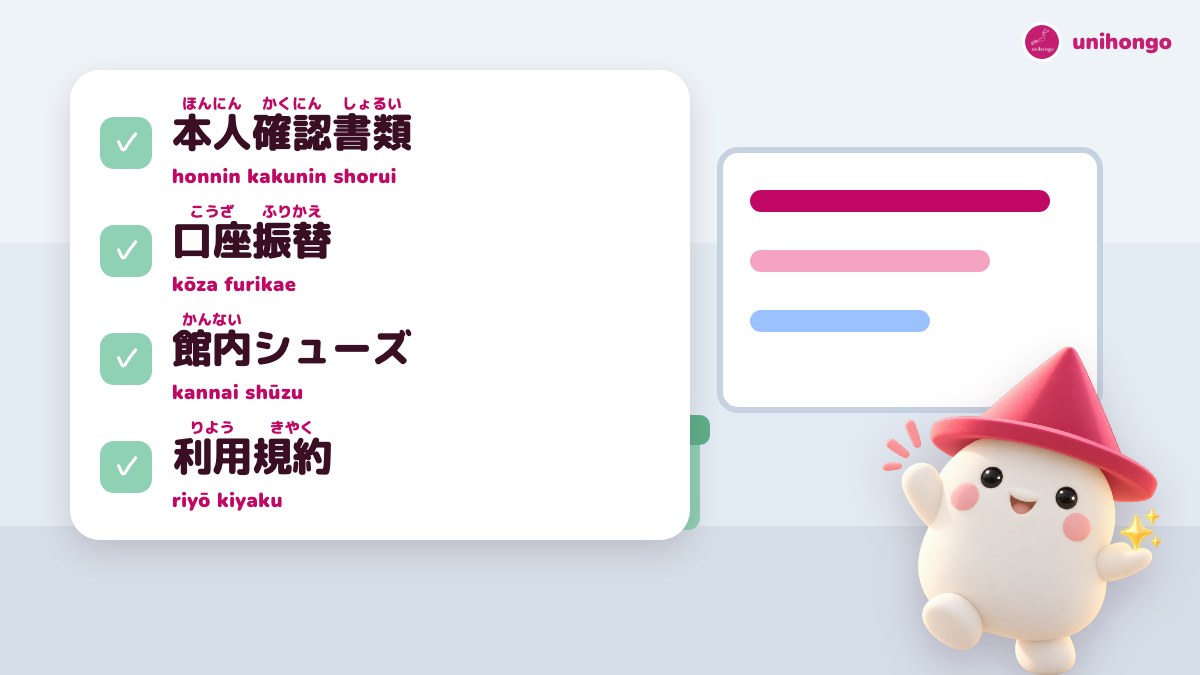
The application form (入会申込書, nyūkai mōshikomisho) asks for the usual details, plus an emergency contact and sometimes a short health questionnaire. Staff check your photo ID, and many gyms set up monthly payment by bank direct debit (口座振替, kōza furikae) or credit card. Some take a photo for your member card or register your face or a key fob for entry.
Payment schedules can be confusing: there may be a joining fee, the rest of this month, and next month paid in advance. Ask staff to show you on paper which months you are paying today.
| Japanese | Romaji | Meaning |
|---|---|---|
| 本人確認書類をお願いします。 | Honnin kakunin shorui o onegai shimasu. | Staff: Some photo ID, please. |
| 在留カードでいいですか。 | Zairyū kādo de ii desu ka. | Is my residence card OK? |
| 支払いは口座振替ですか。 | Shiharai wa kōza furikae desu ka. | Is payment by bank direct debit? |
| クレジットカードでも払えますか。 | Kurejitto kādo demo haraemasu ka. | Can I pay by credit card too? |
| 今日払うのはどの月の分ですか。 | Kyō harau no wa dono tsuki no bun desu ka. | Which months am I paying for today? |
| キャッシュカードと印鑑が必要ですか。 | Kyasshu kādo to inkan ga hitsuyō desu ka. | Do I need my bank card and a seal? |
Some banks still require a personal seal (inkan) to set up direct debit on paper, while many gyms now use online registration with just a bank card. Ask before you go so you bring the right thing.
Choosing a plan
Chains often offer several plans: unlimited use, daytime only, weekends only, or one branch versus all branches. Plan names vary, but the words below come up everywhere. Staff will explain the differences; ask about the times each plan covers.
| Japanese | Romaji | Meaning |
|---|---|---|
| プランの違いを教えてください。 | Puran no chigai o oshiete kudasai. | Please explain the differences between the plans. |
| ほかの店舗も使えますか。 | Hoka no tenpo mo tsukaemasu ka. | Can I use other branches too? |
| 途中でプランを変更できますか。 | Tochū de puran o henkō dekimasu ka. | Can I change plans later? |
| Word | Meaning | What to check |
|---|---|---|
| フル会員 (furu kaiin) | Full member, any time | Whether it covers all branches |
| デイタイム会員 (deitaimu kaiin) | Daytime member | The exact hours it covers |
| ホリデー会員 (horidē kaiin) | Weekends and holidays | Whether national holidays count |
| 全店利用 (zenten riyō) | Use at all branches | Whether it costs extra |
| 月会費 (gekkaihi) | Monthly fee | When it is charged each month |
House rules: shoes, towels and tattoos
Japanese gyms usually ask you to change into clean indoor shoes (館内シューズ, kannai shūzu) that you do not wear outside, and many require a towel on benches. Some ban taking photos or filming in changing rooms and on the floor. Tattoo rules differ widely: some gyms refuse visible tattoos, some allow them if covered, and some do not mind. If you have one, ask before you join, not after.
| Japanese | Romaji | Meaning |
|---|---|---|
| 館内シューズは必要ですか。 | Kannai shūzu wa hitsuyō desu ka. | Do I need indoor shoes? |
| タオルは借りられますか。 | Taoru wa kariraremasu ka. | Can I rent a towel? |
| タトゥーがあるんですが、利用できますか。 | Tatū ga aru n desu ga, riyō dekimasu ka. | I have a tattoo; can I use the gym? |
| ラッシュガードで隠せば大丈夫ですか。 | Rasshu gādo de kakuseba daijōbu desu ka. | Is it OK if I cover it with a rash guard? |
| 友達を連れてきてもいいですか。 | Tomodachi o tsurete kite mo ii desu ka. | Can I bring a friend? |
Pausing, changing and cancelling
Changes to a membership usually follow the calendar. Many gyms set a deadline in the month before the change takes effect, for example a set date by which you must submit a cancellation form, and some only accept it in person at the desk. Pausing (休会) often has a small monthly fee and a minimum or maximum length. Read the terms of use (利用規約, riyō kiyaku) or simply ask.
| Japanese | Romaji | Meaning |
|---|---|---|
| 退会の締め切りはいつですか。 | Taikai no shimekiri wa itsu desu ka. | What's the deadline for cancelling? |
| 来月から休会したいです。 | Raigetsu kara kyūkai shitai desu. | I'd like to pause from next month. |
| 休会は何か月までできますか。 | Kyūkai wa nankagetsu made dekimasu ka. | For up to how many months can I pause? |
| オンラインで手続きできますか。 | Onrain de tetsuzuki dekimasu ka. | Can I do it online? |
| 引っ越すので、退会したいです。 | Hikkosu node, taikai shitai desu. | I'm moving, so I'd like to cancel. |
Common learner mistakes
- Assuming you can cancel at the end of the month. Many gyms need notice by an earlier date; ask on the day you join.
- Walking in with outdoor shoes. Bring separate indoor shoes, or ask whether you can buy or borrow a pair.
- Confusing kengaku (looking around) with taiken (trying it). A tour does not include training.
- Not asking which months today's payment covers. Two months paid in advance is common and surprises people.
- Raising a tattoo only after joining. Ask first, with n desu ga, to avoid an awkward conversation later.
Rehearse the desk conversation
Paste the cancellation section of your gym's terms of use into the Mocchi chat with /explain. Mocchi breaks the sentences down, pulls out the dates and conditions, and can then give you a short /quiz on nyūkai, kyūkai, taikai and the other contract words.
For speaking, open AI Sensei, choose Ibuki-sensei and the gym and fitness topic, and ask Ibuki-sensei to play the front-desk staff. Join, ask about the rules and the tattoo policy, and then come back as a member who wants to pause for two months.