
The four rooms every listing mentions
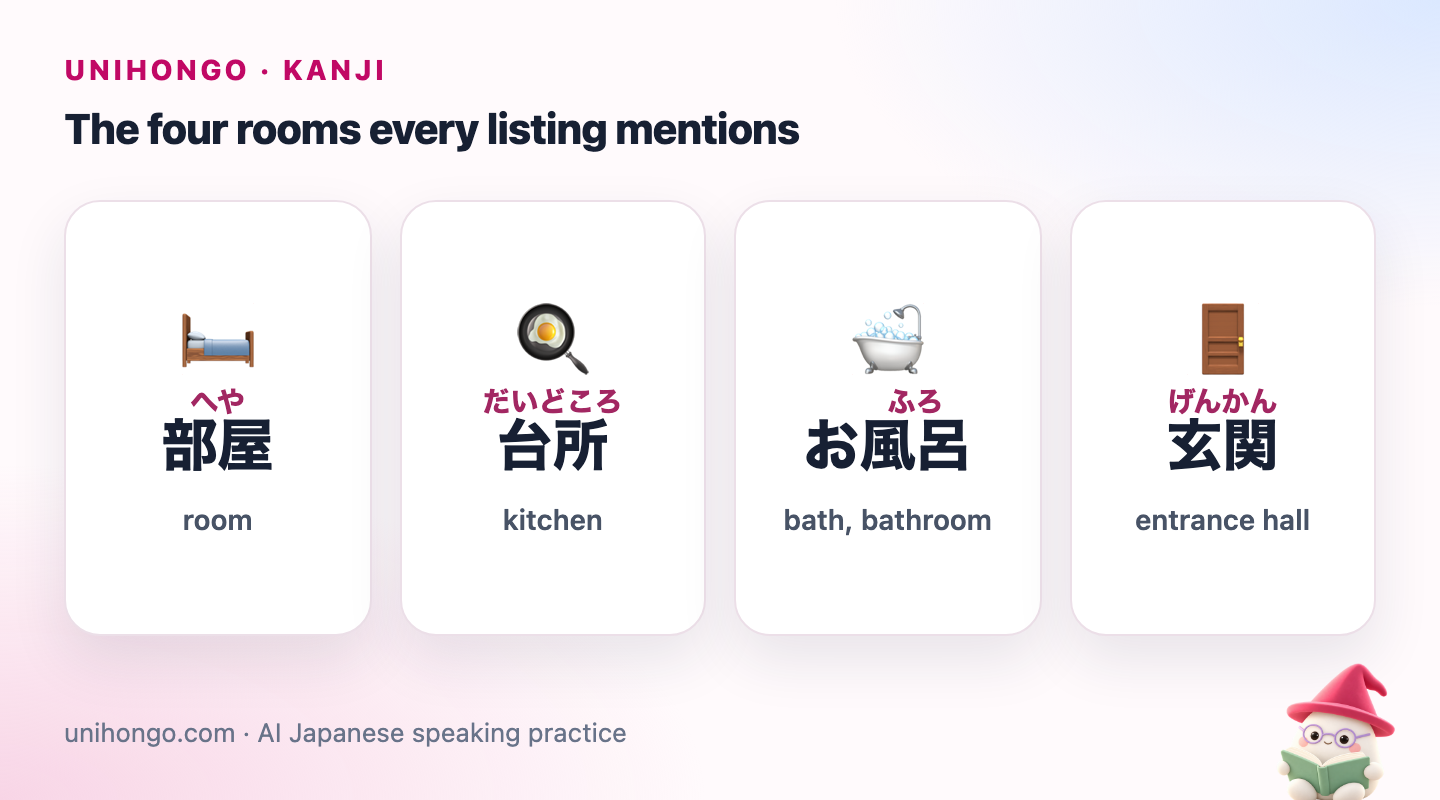
Start with the four words you will see on every floor plan and hear on every flat viewing. All four are read as fixed words, so learn the sound and the shape together rather than trying to build them from single kanji.
| Japanese | Romaji | Meaning |
|---|---|---|
| 部屋 | heya | room |
| 台所 | daidokoro | kitchen |
| お風呂 | ofuro | bath, bathroom |
| 玄関 | genkan | entrance hall |
お風呂 usually takes the polite prefix お in conversation. On a floor plan the bathroom is more often written 浴室, yokushitsu, and the room where you wash your face and keep the washing machine is 洗面所, senmenjo. The toilet is almost always written in katakana, トイレ.
More home words, kanji by kanji
These words cover the rest of an ordinary house or flat. Several kanji repeat: 室 for rooms on a plan, 間 for spaces, 階 for floors.
| Japanese | Romaji | Meaning |
|---|---|---|
| 窓 | mado | window |
| 階段 | kaidan | stairs |
| 二階 | nikai | second floor, upstairs |
| 庭 | niwa | garden, yard |
| 和室 | washitsu | tatami room |
| 洋室 | yōshitsu | Western-style room |
| 寝室 | shinshitsu | bedroom |
| 居間 | ima | living room |
| 浴室 | yokushitsu | bathroom (on plans) |
| 押し入れ | oshiire | built-in futon cupboard |
| 収納 | shūnō | storage |
| 家賃 | yachin | rent |
Readings of the key home kanji
Here are the main readings. Notice how often a home kanji is read differently inside a fixed word: 家 is ie in 家, ya in 家賃 and ka in 家族.
| Kanji | Kun reading | On reading | Common word |
|---|---|---|---|
| 家 | ie, uchi, ya | ka, ke | 家族 kazoku, family |
| 部 | (none common) | bu | 部屋 heya, room (special reading) |
| 屋 | ya | oku | 屋上 okujō, rooftop |
| 台 | (none common) | dai, tai | 台所 daidokoro, kitchen |
| 所 | tokoro | sho, jo | 住所 jūsho, address |
| 風 | kaze | fū, fu | 風呂 furo, bath |
| 呂 | (none) | ro | 風呂 furo, bath |
| 玄 | (none common) | gen | 玄関 genkan, entrance |
| 関 | seki | kan | 関西 Kansai, western Japan |
| 窓 | mado | sō | 窓口 madoguchi, service counter |
| 室 | muro | shitsu | 教室 kyōshitsu, classroom |
| 階 | (none) | kai | 階段 kaidan, stairs |
| 庭 | niwa | tei | 家庭 katei, household |
Two words borrow home kanji for other places. 窓口, madoguchi, literally window mouth, is the service counter at a bank, post office or city hall. 屋 as ya ends shop names: 本屋, hon'ya, bookshop, and 花屋, hanaya, florist.
Reading a floor plan: 1LDK, 6畳 and friends
Japanese floor plans, 間取り (madori), use a compact code. The number is the count of rooms besides the shared space, and the letters stand for L living, D dining and K kitchen. So 1K is one room with a small kitchen, 1DK adds a dining area, and 2LDK is two rooms plus a living, dining and kitchen space.
Each room is labelled with its type and its size in 畳, jō, the number of tatami mats it would hold, even when the floor is wood. A 6畳 room is a typical small bedroom. Many listings also give the area in square metres, which is safer to compare because mat sizes vary a little by region and building.
| Japanese | Romaji | Meaning |
|---|---|---|
| 間取り | madori | floor plan, room layout |
| 洋室6畳 | yōshitsu rokujō | Western-style room, six mats |
| 南向き | minamimuki | south-facing |
| バス・トイレ別 | basu toire betsu | bath and toilet in separate rooms |
| 駅から徒歩5分 | eki kara toho gofun | five minutes' walk from the station |
Look-alikes around the house
Home kanji have some tricky neighbours. The gate radical 門 is the most important: once you see the gate, look at what is inside it.
- 関 (seki, barrier; kan) vs 開 (open) vs 閉 (close): all share the gate 門. 開 and 閉 are on lift buttons and doors, so this trio matters.
- 窓 (window) vs 空 (sky): both have the hole radical 穴 on top. 窓 has a heart-like part 心 underneath.
- 室 (room) vs 屋 (building, shop): 室 has the roof 宀 on top; 屋 has the flag-like 尸 on the left.
- 家 (house) has a pig 豕 under a roof. It is a good memory hook, and the pig under the roof really is the origin many dictionaries give.
- 庭 (garden) vs 店 (shop): both sit under the 广 cliff-and-roof shape; read the inside part.
Inside a Japanese flat
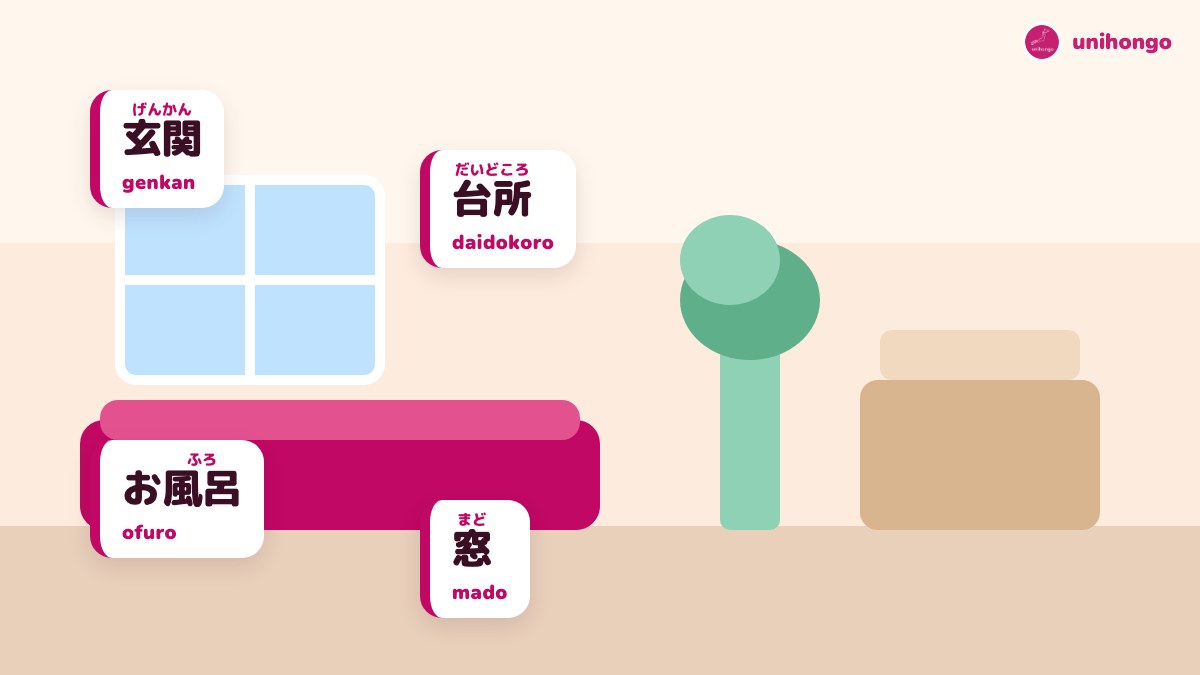
Picture walking through a typical small flat. You step into the 玄関 and take off your shoes. A short corridor passes the 洗面所 and the お風呂, then opens into the main room, often a 洋室 with a big 窓 and a balcony. The 台所 may be a small kitchen along one wall. Older or family homes often keep one 和室 with tatami and an 押し入れ for futons.
| Japanese | Romaji | Meaning |
|---|---|---|
| 玄関で靴を脱いでください。 | Genkan de kutsu o nuide kudasai. | Please take your shoes off at the entrance. |
| お風呂が沸きました。 | Ofuro ga wakimashita. | The bath is ready (heard from a bath panel). |
| 窓を開けてもいいですか。 | Mado o akete mo ii desu ka. | May I open the window? |
| 台所を使ってもいいですか。 | Daidokoro o tsukatte mo ii desu ka. | May I use the kitchen? |
| 部屋は二階です。 | Heya wa nikai desu. | The room is on the second floor. |
Mini dialogue: at a flat viewing
Estate agents speak politely and quickly. These lines are the core of a viewing; the agent's lines are polite, and yours are plain polite desu/masu.
| Japanese | Romaji | Meaning |
|---|---|---|
| こちらが玄関です。 | Kochira ga genkan desu. | Agent: This is the entrance. |
| 収納はどこですか。 | Shūnō wa doko desu ka. | You: Where is the storage? |
| 寝室にクローゼットがございます。 | Shinshitsu ni kurōzetto ga gozaimasu. | Agent: There is a wardrobe in the bedroom. |
| お風呂とトイレは別ですか。 | Ofuro to toire wa betsu desu ka. | You: Are the bath and toilet separate? |
| はい、別になっています。 | Hai, betsu ni natte imasu. | Agent: Yes, they are separate. |
| 窓が大きくて明るいですね。 | Mado ga ōkikute akarui desu ne. | You: The windows are big, so it's bright. |
| 南向きなので日当たりがいいですよ。 | Minamimuki na node hiatari ga ii desu yo. | Agent: It faces south, so it gets good sun. |
Writing tips for home kanji
- Write the gate 門 first, then the inside, for 関, 開 and 閉. The gate's right side ends with a hook.
- For 窓, keep the top 穴 small and wide; the bottom part takes most of the height.
- 風 starts with its outer frame, a left stroke and a right stroke that curves out at the bottom, and only then the inside part.
- 部屋 and 台所 are worth writing as pairs, since you will almost never see 呂 or 玄 outside 風呂 and 玄関.
Rehearse the viewing before you go
Make picture cards from this post with Mocchi: type /create-flashcards and list 玄関, 台所, 浴室, 和室 and 収納, then pick a photo for each. Mocchi reviews them with you at spaced intervals, so the room words are ready before your first viewing.
When you can read them, say them. In AI Sensei, ask Yamada-sensei to play the estate agent in the View an Apartment mission and walk you round a 1LDK. Ask your questions about storage, sunlight and the bath, then check the session report for the words you hesitated on.