
Colour kanji you see every day
Colour kanji turn up first on the street and in shops. These four everyday words already show the main surprises of the set: green lights are blue, and yellow needs 色.
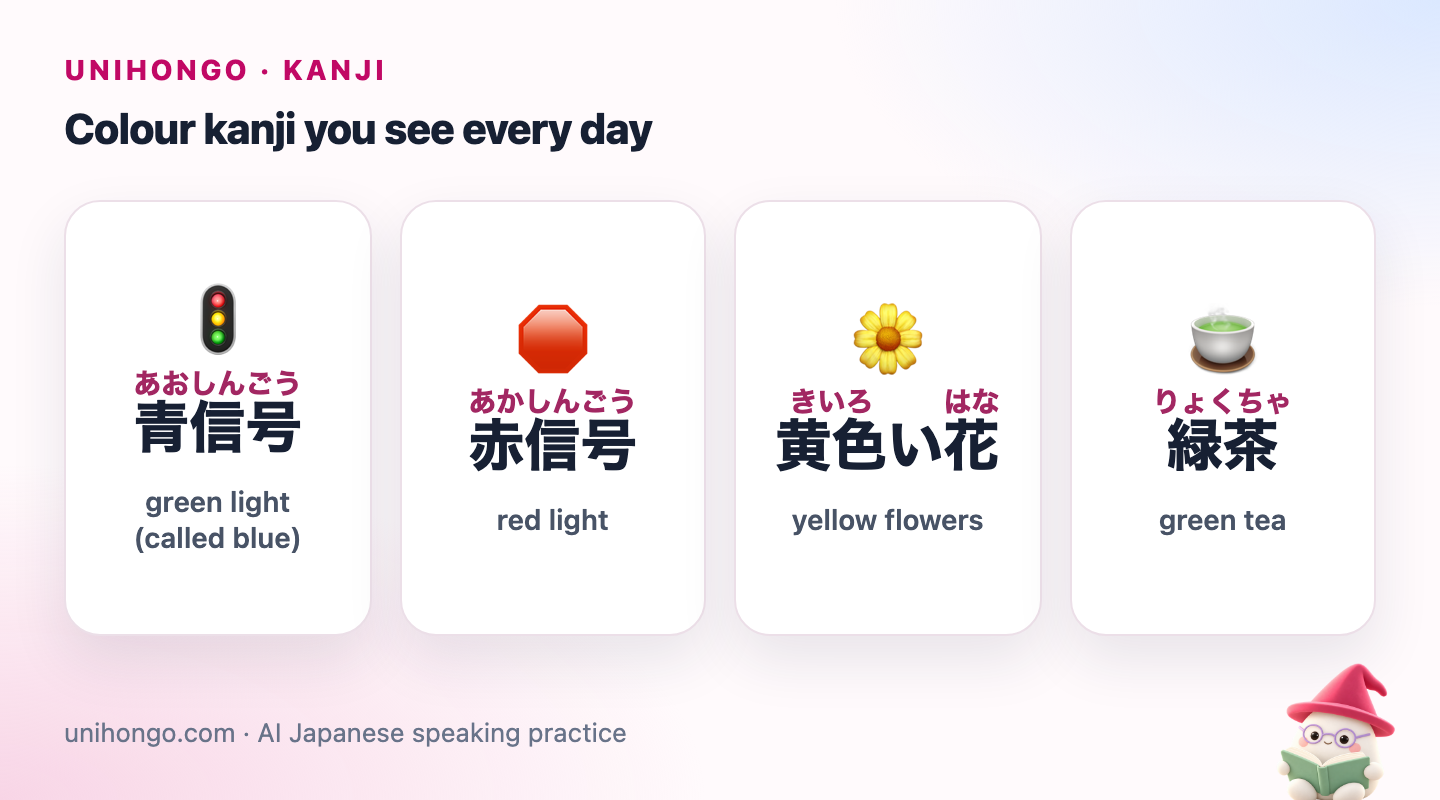
| Japanese | Romaji | Meaning |
|---|---|---|
| 青信号 | ao shingō | green light (called blue) |
| 赤信号 | aka shingō | red light |
| 黄色い花 | kiiroi hana | yellow flowers |
| 緑茶 | ryokucha | green tea |
The twelve colour kanji and their readings
Each colour has a kun'yomi used on its own and an on'yomi used in compounds. Learn the colour word first, then one compound.
| Kanji | Colour word | On'yomi | Compound |
|---|---|---|---|
| 赤 | 赤 (aka), 赤い | seki | 赤十字 (sekijūji, Red Cross) |
| 青 | 青 (ao), 青い | sei, shō | 青年 (seinen, young person) |
| 白 | 白 (shiro), 白い | haku, byaku | 白鳥 (hakuchō, swan) |
| 黒 | 黒 (kuro), 黒い | koku | 黒板 (kokuban, blackboard) |
| 緑 | 緑 (midori) | ryoku, roku | 緑茶 (ryokucha, green tea) |
| 黄 | 黄色 (kiiro), 黄色い | kō, ō | 黄金 (ōgon, gold) |
| 茶 | 茶色 (chairo), 茶色い | cha, sa | 喫茶店 (kissaten, coffee shop) |
| 紫 | 紫 (murasaki) | shi | 紫外線 (shigaisen, UV rays) |
| 色 | 色 (iro) | shoku, shiki | 景色 (keshiki, scenery) |
| 灰 | 灰色 (haiiro) | kai | 灰皿 (haizara, ashtray) |
| 金 | 金色 (kin'iro) | kin, kon | 金曜日 (kin'yōbi, Friday) |
| 銀 | 銀色 (gin'iro) | gin | 銀行 (ginkō, bank) |
Grey, gold and silver all add 色 in the same way as yellow and brown, but they behave as nouns: 灰色の雲 (grey clouds), 金色の紙 (gold paper), 銀色の車 (a silver car). In fashion and on product labels you often see katakana instead, such as グレー, ゴールド and シルバー, and many people use グレー in conversation more often than 灰色. Both are correct; the kanji version sounds a little more descriptive or literary.
い, 色い or の? The grammar of colours
Colour words fall into three groups. Getting the group right is the difference between sounding natural and sounding like a textbook translation.
| Japanese | Romaji | Meaning |
|---|---|---|
| 白い車 | shiroi kuruma | a white car |
| 茶色いかばん | chairoi kaban | a brown bag |
| 紫のスカーフ | murasaki no sukāfu | a purple scarf |
| その黒いのをください。 | Sono kuroi no o kudasai. | I'll take that black one, please. |
| Group | Colours | Before a noun | Example |
|---|---|---|---|
| i-adjective | red, blue, white, black | add い | 赤い傘 (red umbrella) |
| 色 + い | yellow, brown | add 色い | 茶色い靴 (brown shoes) |
| noun + の | green, purple, grey, gold, silver | add の | 緑の葉 (green leaves) |
The first four can also be nouns: 赤が好きです, I like red. To say something is completely that colour, add 真っ (ma) with a sound change: 真っ赤 (makka), 真っ青 (massao), 真っ白 (masshiro), 真っ黒 (makkuro). These take な or の before a noun, as in 真っ赤な顔, a bright red face.
Why green things are sometimes blue
In older Japanese, 青 covered a band of colours from blue to green, and 緑 originally described fresh young shoots. Modern Japanese separates blue and green much as English does, but older words kept 青. That is why fresh vegetables, unripe fruit and young leaves are still called ao.
青 also carries the sense of young and inexperienced: 青年 is a young person, and calling someone 青い can mean they are still green, naive. 顔が真っ青 means someone has gone pale with fear or shock, not literally blue.
| Japanese | Romaji | Meaning |
|---|---|---|
| 青りんご | ao ringo | green apple |
| 青葉 | aoba | fresh green leaves |
| 青になったら渡ろう。 | Ao ni nattara watarō. | Let's cross when it turns green. (casual) |
| 顔が真っ青だよ。大丈夫? | Kao ga massao da yo. Daijōbu? | You've gone pale. Are you OK? (casual) |
Colour words in money, work and daily life
Several colour words have meanings that have nothing to do with paint. These are the ones you will meet in news, at work and on forms.
| Japanese | Romaji | Meaning |
|---|---|---|
| 赤字 | akaji | deficit, loss |
| 黒字 | kuroji | surplus, profit |
| 白紙 | hakushi | blank paper; a clean slate |
| 赤ちゃん | akachan | baby (from a newborn's red face) |
| 今年は黒字になりました。 | Kotoshi wa kuroji ni narimashita. | Colleague: This year we made a profit. |
| 計画は白紙に戻りました。 | Keikaku wa hakushi ni modorimashita. | The plan went back to square one. |
Mini dialogue: choosing a colour in a shop
| Japanese | Romaji | Meaning |
|---|---|---|
| このシャツ、ほかの色はありますか。 | Kono shatsu, hoka no iro wa arimasu ka. | You: Does this shirt come in other colours? |
| 白と紺と緑がございます。 | Shiro to kon to midori ga gozaimasu. | Clerk: We have white, navy and green. (very polite) |
| 緑のを見せてください。 | Midori no o misete kudasai. | You: Please show me the green one. |
| こちらです。明るい緑ですね。 | Kochira desu. Akarui midori desu ne. | Clerk: Here you are. It's a bright green. |
| うーん、もう少し暗い色がいいです。 | Ūn, mō sukoshi kurai iro ga ii desu. | You: Hmm, I'd prefer a slightly darker colour. |
Shop staff often use katakana colour names for clothes, such as ベージュ (beige), ネイビー (navy) and カーキ (khaki), alongside the kanji ones. If you do not catch a colour, point and ask この色は何といいますか, what is this colour called? It is a natural question, and staff are used to it from tourists and locals alike.
Look-alikes and writing tips
- 白 (white) vs 百 (hundred) vs 自 (self): 百 is 白 with a line on top; 自 has three inner spaces.
- 黒 (black) vs 里 (village): 黒 looks like 里 with two small dots inside the box and four dots of fire below.
- 青 (blue) vs 清 (clean) vs 晴 (clear weather): 青 sits inside both and gives them the same on'yomi, sei.
- 緑 (green) vs 録 (record, as in 録音): 緑 has the thread radical 糸, 録 has the metal radical 金.
- 茶 (tea) vs 菜 (vegetable): both have the grass radical 艹 on top, a reminder that both come from plants.
- Writing tip: 青 is 8 strokes; the bottom part is 月 in modern print, and the top is like 主 without the dot.
Common learner mistakes with colour words
Colour words feel easy, which is exactly why small errors survive for years. Check yourself against this list.
- Adding い to every colour. 緑い and 紫い are not words; use 緑の and 紫の.
- Dropping 色 from yellow and brown. 黄い and 茶い are not used; say 黄色い and 茶色い.
- Calling a green traffic light 緑. People will understand you, but 青信号 and 青になった are what you will hear.
- Mixing up 赤字 and 黒字. Red is a loss, black is a profit, the opposite of what some learners guess.
- Reading 白 as shiro in every word. It is haku in 白鳥 and 白紙, while 面白い (omoshiroi, interesting) keeps shiro even though it has nothing to do with colour.
Make the colour grammar automatic
Type /kanji 緑 into the Mocchi chat to see its readings, its thread radical and common compounds, then ask Mocchi to describe five things in your room in Japanese and leave the colour word blank for you to fill in. Mocchi notes whether you still add い to 緑 by mistake and returns to it later.
For speed, make a small flashcard deck of colour phrases such as 緑のシャツ and 茶色い靴, then play Quick Flip in Unihongo's games with your own cards until the right form comes without thinking.