
Family kanji at a glance
Start with the four words you will need most often. They are all the modest, plain words you use when you talk about your own family to someone outside it, and the same compounds appear on school forms, hospital forms and in the news.
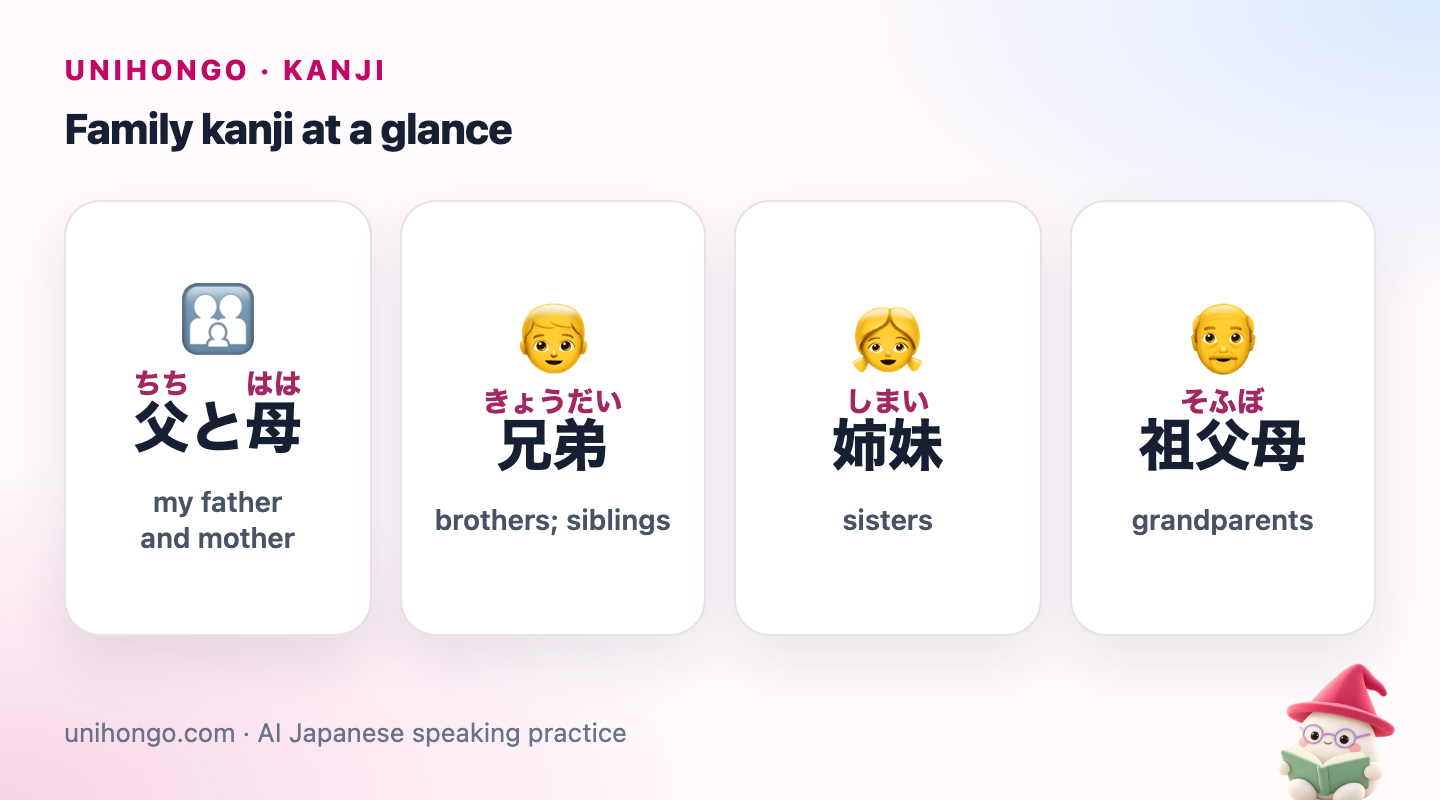
| Japanese | Romaji | Meaning |
|---|---|---|
| 父と母 | chichi to haha | my father and mother |
| 兄弟 | kyōdai | brothers; siblings |
| 姉妹 | shimai | sisters |
| 祖父母 | sofubo | grandparents |
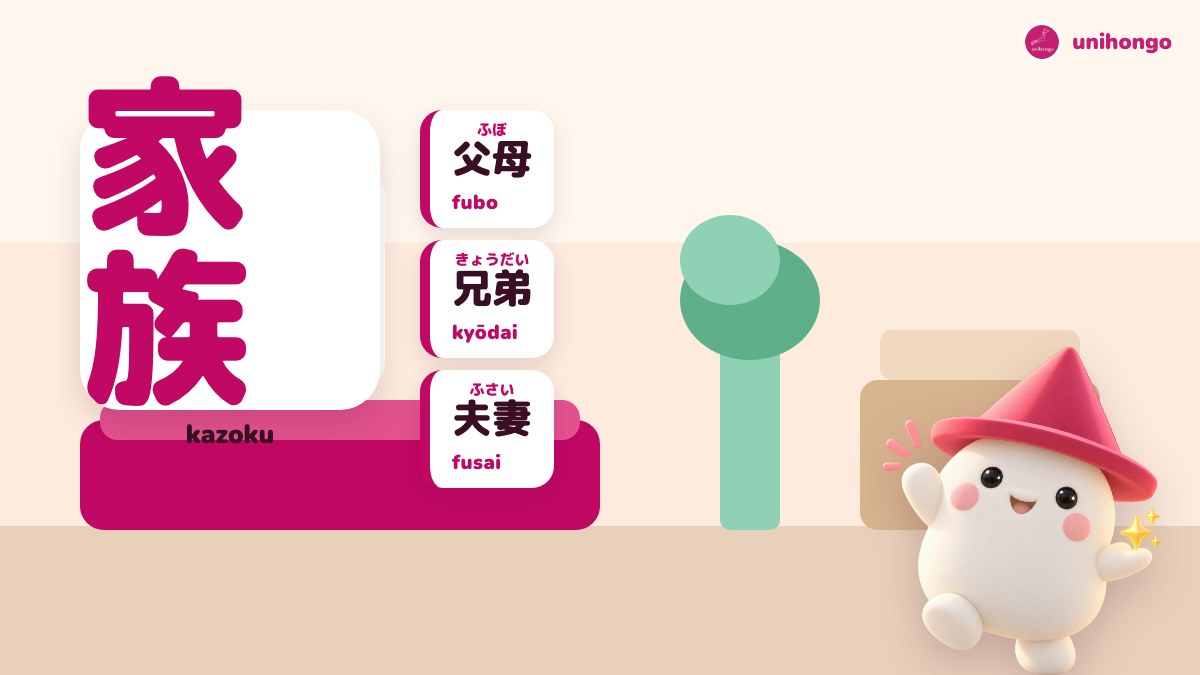
| 家族 | kazoku | family |
Notice how often these kanji switch to their Chinese-derived on'yomi inside compounds: 父 becomes fu in 祖父 and 父母, and 母 becomes bo in 祖母 and 母国 (bokoku, home country). On their own, the same kanji take their native kun'yomi, chichi and haha.
The ten kanji and their readings
Here are the ten kanji with their main readings. You do not need every reading on day one; learn the word in the right-hand column first, then notice the reading inside new words as you meet them.
| Japanese | Romaji | Meaning |
|---|---|---|
| 祖父 | sofu | my grandfather |
| 祖母 | sobo | my grandmother |
| 夫婦 | fūfu | married couple |
| 子ども | kodomo | child; children |
| 息子と娘 | musuko to musume | son and daughter |
| Kanji | Meaning | Main readings | Word to learn first |
|---|---|---|---|
| 父 | father | chichi, fu | 父 (chichi), 祖父 (sofu) |
| 母 | mother | haha, bo | 母 (haha), 祖母 (sobo) |
| 兄 | older brother | ani, kyō, kei | 兄 (ani), 兄弟 (kyōdai) |
| 弟 | younger brother | otōto, dai, tei | 弟 (otōto), 兄弟 (kyōdai) |
| 姉 | older sister | ane, shi | 姉 (ane), 姉妹 (shimai) |
| 妹 | younger sister | imōto, mai | 妹 (imōto), 姉妹 (shimai) |
| 祖 | ancestor | so | 祖父 (sofu), 祖先 (sosen) |
| 夫 | husband | otto, fu, fū | 夫 (otto), 夫婦 (fūfu) |
| 妻 | wife | tsuma, sai | 妻 (tsuma), 夫妻 (fusai) |
| 子 | child | ko, shi | 子ども (kodomo), 息子 (musuko) |
My family vs your family
Japanese has two sets of family words. The plain kanji words, such as 父 and 母, are modest and are used for your own family when you speak to someone outside it. The polite words, mostly with お〜さん, are used for other people's families. Inside your own home, you usually call your parents and older siblings with the polite-looking forms too: children say お母さん, not 母, to their mother.
Mixing these up is the most common family-word mistake. Saying 私のお父さんは医者です to your manager sounds childish, a little like saying my daddy, while asking 田中さんの父は? sounds blunt and slightly rude.
| Japanese | Romaji | Meaning |
|---|---|---|
| 父は会社員です。 | Chichi wa kaishain desu. | My father is an office worker. |
| お父さんは何をしていますか。 | Otōsan wa nani o shite imasu ka. | What does your father do? |
| 姉が一人います。 | Ane ga hitori imasu. | I have one older sister. |
| ご両親はお元気ですか。 | Goryōshin wa ogenki desu ka. | Are your parents well? (polite) |
| Person | Your own family (modest) | Someone else's family (polite) |
|---|---|---|
| father | 父 (chichi) | お父さん (otōsan) |
| mother | 母 (haha) | お母さん (okāsan) |
| older brother | 兄 (ani) | お兄さん (onīsan) |
| older sister | 姉 (ane) | お姉さん (onēsan) |
| younger brother | 弟 (otōto) | 弟さん (otōtosan) |
| younger sister | 妹 (imōto) | 妹さん (imōtosan) |
| grandfather | 祖父 (sofu) | おじいさん (ojiisan) |
| grandmother | 祖母 (sobo) | おばあさん (obāsan) |
| parents | 両親 (ryōshin) | ご両親 (goryōshin) |
Husband, wife and couple
夫 (otto) and 妻 (tsuma) are the neutral words for your own husband and wife, and they are now common in conversation as well as writing. 夫婦 (fūfu) is a married couple. 夫妻 (fusai) means the same thing but is formal: you see it after a surname in news and on invitations, as in 田中夫妻, Mr and Mrs Tanaka.
For other people's spouses, 奥さん (okusan) and ご主人 (goshujin) are still the everyday polite words, and 旦那さん (dannasan) is a friendlier way to say husband. Some people prefer to avoid these because of their old meanings of inner room and master; using the person's name or saying パートナー is always safe. Usage varies by person and generation, so follow the speaker's lead.
| Japanese | Romaji | Meaning |
|---|---|---|
| 妻と二人で住んでいます。 | Tsuma to futari de sunde imasu. | I live with my wife, just the two of us. |
| 夫は料理が上手です。 | Otto wa ryōri ga jōzu desu. | My husband is good at cooking. |
| 奥さんによろしくお伝えください。 | Okusan ni yoroshiku otsutae kudasai. | Please give my regards to your wife. |
| 田中夫妻 | Tanaka fusai | Mr and Mrs Tanaka (formal) |
Mini dialogue: talking about your family at work
A colleague asks about your family during a lunch break. Listen for the switch: you use modest kanji words for your own family, and your colleague uses polite words for yours.
| Japanese | Romaji | Meaning |
|---|---|---|
| ご家族は何人ですか。 | Gokazoku wa nannin desu ka. | Colleague: How many people are in your family? |
| 四人です。父と母と妹がいます。 | Yonin desu. Chichi to haha to imōto ga imasu. | You: Four. I have my father, mother and a younger sister. |
| 妹さんはおいくつですか。 | Imōtosan wa oikutsu desu ka. | Colleague: How old is your sister? |
| 二十歳で、大学生です。 | Hatachi de, daigakusei desu. | You: She's twenty, a university student. |
| ご両親は近くに住んでいるんですか。 | Goryōshin wa chikaku ni sunde iru n desu ka. | Colleague: Do your parents live nearby? |
| いいえ、祖父母と一緒に田舎に住んでいます。 | Iie, sofubo to issho ni inaka ni sunde imasu. | You: No, they live in the countryside with my grandparents. |
Where you meet these kanji
| Japanese | Romaji | Meaning |
|---|---|---|
| 保護者 | hogosha | parent or guardian (on forms) |
| 続柄 | tsuzukigara | relationship (on forms) |
| 姉妹都市 | shimai toshi | sister city |
| 母の日 | haha no hi | Mother's Day |
- School and kindergarten forms: 父母 or the more inclusive 保護者 (hogosha, parent or guardian) on letters home.
- Registration and hospital forms: a field for 続柄 (tsuzukigara, relationship), where you write 父, 母, 妻, 夫 or 子.
- Sister cities: 姉妹都市 (shimai toshi) on town hall signs and tourist leaflets.
- News headlines: 〜夫妻 for couples, and 兄弟 for brothers or siblings in sport and business stories.
- Seasonal events: 父の日 (chichi no hi, Father's Day) and 母の日 (haha no hi, Mother's Day) in shop displays.
Look-alikes and reading traps
- 夫 (husband) vs 天 (heaven) vs 大 (big): 夫 has two horizontal lines and the top one is crossed by the vertical stroke; in 天 the top line sits above the vertical.
- 母 (mother) vs 毎 (every): 毎 is 母 with an extra stroke on top, which is why 毎日 can look like a mother at first.
- 姉 (older sister) vs 妹 (younger sister): both start with 女; 姉 ends with 市 (city) and 妹 with 未 (not yet). A memory hook: the younger sister is not yet grown up.
- 弟 (younger brother) vs 第 (ordinal prefix in 第一): 第 has the bamboo radical on top.
- 兄弟 is kyōdai in everyday speech; the reading keitei is rare and formal, so do not use it in conversation.
- Writing tip: in 母 the two dots inside go top to bottom, and the long horizontal stroke is written before the final short one.
Common learner mistakes with family words
Family words are personal, so mistakes can feel awkward. These are easy to avoid once you know them.
- Calling your own mother お母さん when talking to your boss. Use 母 with outsiders.
- Asking about someone's 妻 or 夫. For other people's spouses, use 奥さん, ご主人, or the person's name.
- Reading 祖父 as sochichi. Inside the compound 父 is fu: sofu.
- Counting siblings with 兄弟 and forgetting sisters. 兄弟は何人ですか usually includes sisters, so answer with everyone.
Make the family words automatic
Recognising 父 is easy; choosing between chichi and otōsan in the middle of a conversation is the real skill. In the Mocchi chat, try typing /kanji 祖 to see how the ancestor kanji builds 祖父, 祖母 and 祖先, then ask Mocchi to quiz you with ten sentences where you choose the modest or the polite family word. Mocchi keeps notes on the pairs you miss and brings them back in later reviews.
Then say it out loud. Ask Ibuki-sensei in AI Sensei to play a new colleague who asks about your family over lunch, and answer with your real family. The session report afterwards lists any family words you used in the wrong register.