
Questions, answers and homework
Start with the four words that turn up on every worksheet. They are the language of any class, from primary school to a language course for adults.
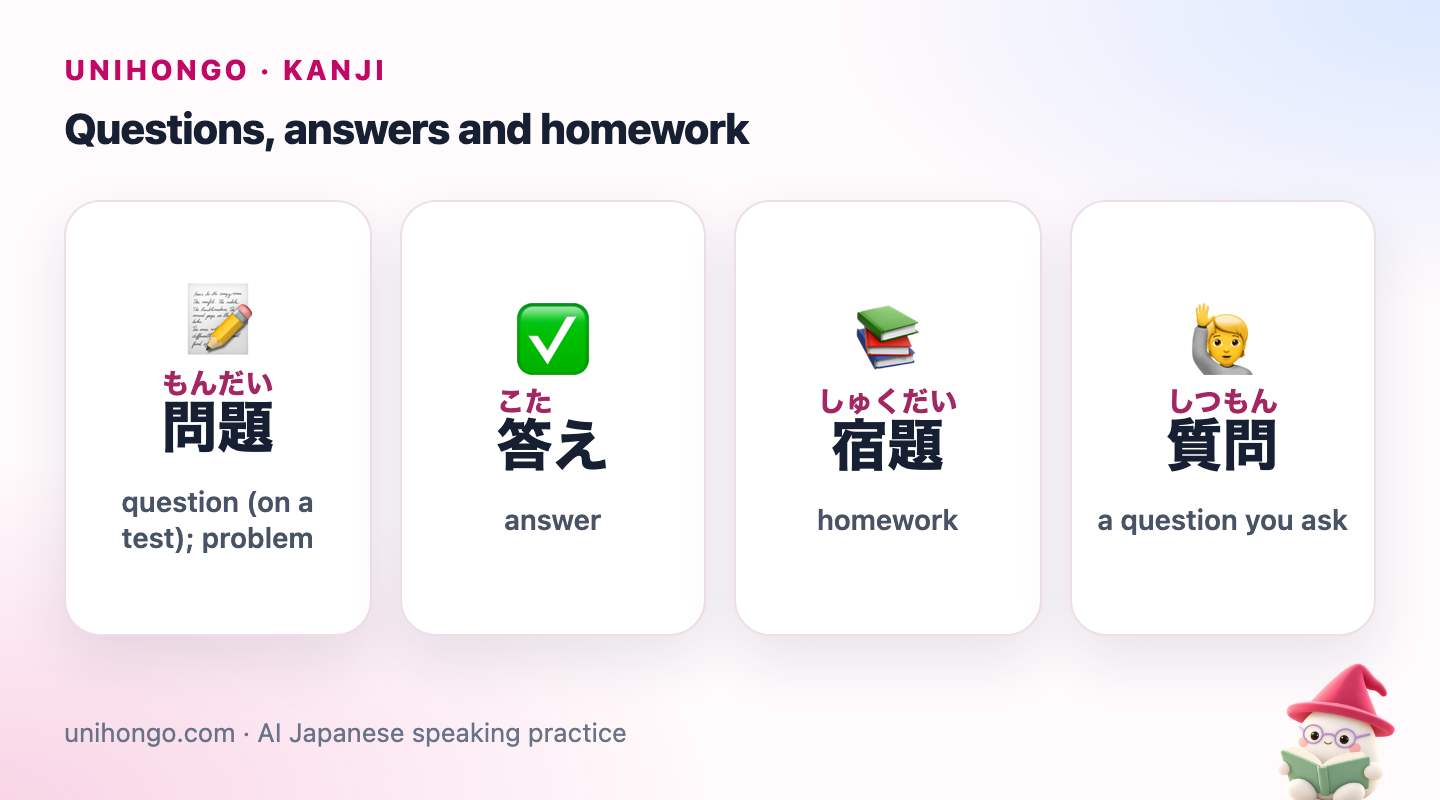
| Japanese | Romaji | Meaning |
|---|---|---|
| 問題 | mondai | question (on a test); problem |
| 答え | kotae | answer |
| 宿題 | shukudai | homework |
| 質問 | shitsumon | a question you ask |
問題 and 質問 both translate as question, but they are different. 問題 is a question set for you to answer, on a test or in a workbook, or a problem in life. 質問 is a question you ask someone: 質問はありますか, are there any questions?
The thirteen kanji and their readings
| Kanji | Meaning | Main readings | Word |
|---|---|---|---|
| 学 | learn | gaku, mana(bu) | 学生 (gakusei, student) |
| 校 | school | kō | 学校 (gakkō) |
| 教 | teach | kyō, oshi(eru) | 教科書 (kyōkasho, textbook) |
| 室 | room | shitsu | 教室 (kyōshitsu, classroom) |
| 先 | ahead, previous | sen, saki | 先週 (senshū, last week) |
| 生 | life, birth | sei, shō, i(kiru), u(mareru) | 先生 (sensei) |
| 勉 | effort | ben | 勉強 (benkyō) |
| 強 | strong | kyō, tsuyo(i) | 強い (tsuyoi) |
| 問 | ask, question | mon, to(u) | 質問 (shitsumon) |
| 題 | topic, title | dai | 話題 (wadai, topic of talk) |
| 宿 | lodging | shuku, yado | 宿題 (shukudai) |
| 答 | answer | tō, kota(eru) | 回答 (kaitō, reply) |
| 習 | practise | shū, nara(u) | 練習 (renshū) |
Notice that 学校 is read gakkō, not gakukō: the ku of gaku becomes a small tsu before k. The same happens in 学期 (gakki, school term).
People and places at school
Most school words combine one place or role kanji with 学, 生 or 室. These are the ones you will hear on day one.
| Japanese | Romaji | Meaning |
|---|---|---|
| 学生 | gakusei | student (especially university) |
| 生徒 | seito | pupil (junior and senior high) |
| 先生 | sensei | teacher |
| 教室 | kyōshitsu | classroom |
| 職員室 | shokuinshitsu | staff room |
| 図書室 | toshoshitsu | school library |
| 高校 | kōkō | senior high school |
| 大学 | daigaku | university |
Japanese schools use different words for students at different stages: 児童 (jidō) for primary pupils, 生徒 for junior and senior high, and 学生 for university, although in casual speech 学生 is used broadly. 教室 also means a class or course for adults, as in 料理教室 (cooking class) or 日本語教室 (Japanese class).
Classroom instructions: polite and strict
Teachers speaking to adults use 〜てください. Teachers speaking to children, and printed tests, use 〜なさい. Both are standard; just know which one you are hearing.
| Japanese | Romaji | Meaning |
|---|---|---|
| 教科書を開いてください。 | Kyōkasho o hiraite kudasai. | Teacher: Please open your textbooks. |
| もう一度言ってください。 | Mō ichido itte kudasai. | Please say that once more. |
| 宿題を出してください。 | Shukudai o dashite kudasai. | Teacher: Please hand in your homework. |
| 次の問題に答えなさい。 | Tsugi no mondai ni kotaenasai. | Answer the following questions. (test paper) |
| 正しいものを一つ選びなさい。 | Tadashii mono o hitotsu erabinasai. | Choose the one correct answer. (test paper) |
| 先生、質問があります。 | Sensei, shitsumon ga arimasu. | Student: Teacher, I have a question. |
You will also hear short instructions in class that use plain verbs or nouns. 静かに (shizuka ni) means be quiet, ペアで (pea de) means in pairs, and 時間です (jikan desu) means time is up. In a language school these are usually friendly, and the teacher may add ね or よ to soften them: 時間ですよ. On a written test, the instruction 書きなさい often comes with a box: write the answer in the box, 解答欄 (kaitōran), not on the question sheet.
Inside the word 問題
問題 is a good example of how two kanji build a meaning. 問 is a mouth 口 at the gate 門: someone asking at the door. 題 is a topic or title, the word on the front of something. Together, a question set on a topic. The same 題 gives 宿題, homework, built from lodging and topic, and 話題, a topic of conversation.
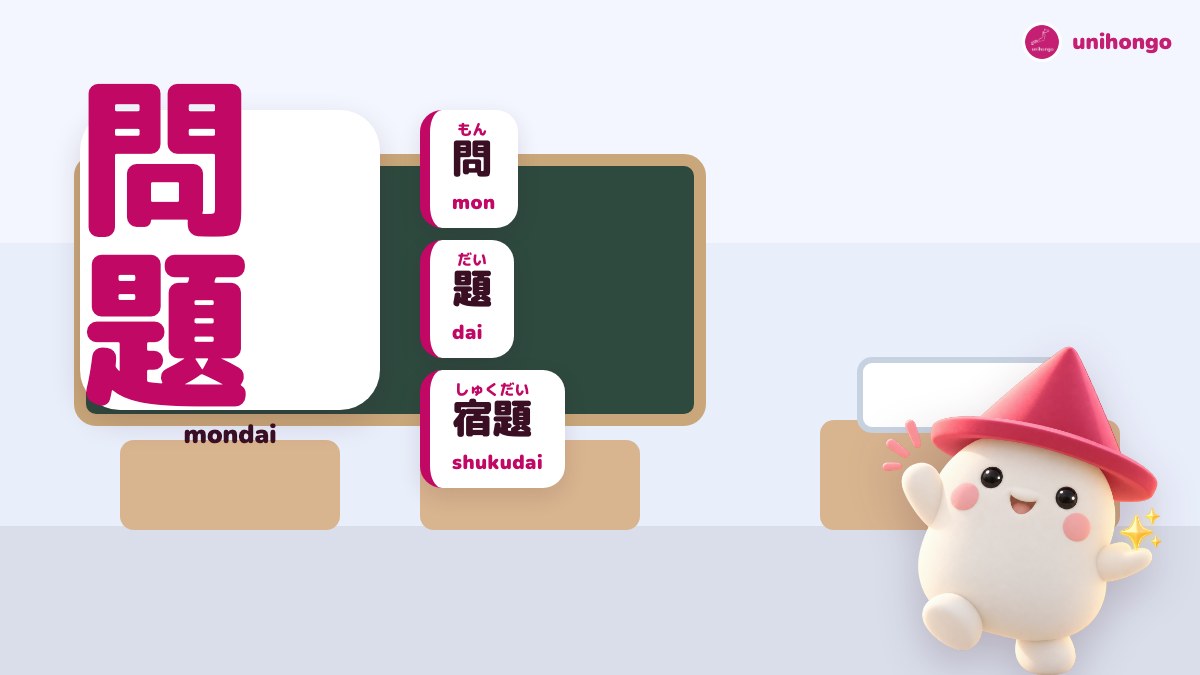
| Japanese | Romaji | Meaning |
|---|---|---|
| 問題ない | mondai nai | no problem (casual) |
| それは大きな問題です。 | Sore wa ōkina mondai desu. | That's a big problem. |
| 話題を変えよう。 | Wadai o kaeyō. | Let's change the subject. (casual) |
| 題名 | daimei | title (of a book or song) |
問題ない (no problem) is casual. At work, 問題ありません or 大丈夫です sound more polite.
Mini dialogue: after class
| Japanese | Romaji | Meaning |
|---|---|---|
| 今日の宿題、もう終わった? | Kyō no shukudai, mō owatta? | Mia: Have you finished today's homework yet? |
| まだ。三番の問題が難しくて。 | Mada. Sanban no mondai ga muzukashikute. | Ren: Not yet. Question three is hard. |
| 先生に質問してみたら? | Sensei ni shitsumon shite mitara? | Mia: Why not ask the teacher? |
| そうする。明日の朝、職員室に行くよ。 | Sō suru. Ashita no asa, shokuinshitsu ni iku yo. | Ren: I will. I'll go to the staff room tomorrow morning. |
| 一緒に勉強しようか。 | Issho ni benkyō shiyō ka. | Mia: Shall we study together? |
Notice the casual register between classmates: 終わった instead of 終わりましたか, and 行くよ instead of 行きます. With a teacher, the same student would switch to polite forms: 先生、三番の問題がわかりません, teacher, I don't understand question three.
Look-alikes that cost exam points
- 問 (ask) vs 間 (interval) vs 聞 (listen) vs 門 (gate): 問 has 口 (mouth) inside, 間 has 日 (sun), 聞 has 耳 (ear), and 門 is the empty gate.
- 題 (topic) vs 頭 (head): both have 頁 on the right; 題 has 是 on the left, 頭 has 豆.
- 校 (school) vs 交 (mix): 校 is 交 with 木 (tree) on the left.
- 学 (learn) vs 字 (character): both have a child 子 under a roof; 学 has three short strokes on top, 字 has the plain roof 宀.
- 教 (teach) vs 孝 (filial piety): 教 adds 攵 (a hand with a stick) on the right.
- Writing tip: in 強, the 弓 (bow) on the left is written first, then the top 厶, then 虫 (insect) underneath it.
Common learner mistakes with school words
These are the slips teachers correct most often in the classroom, and some cost marks on tests.
- Saying 問題があります when you mean you have a question. That means there is a problem; say 質問があります.
- Using 勉強 for practising a skill. You 練習する the piano or pronunciation, and 勉強する a subject.
- Reading 学校 as gakukō. The small tsu makes it gakkō.
- Calling yourself 先生. It is a title others give you; introduce yourself as 日本語の教師です, I am a Japanese teacher.
- Answering a test instruction with を: 問題を答える. The correct pattern is 問題に答える.
Study the study words
The fastest way to master instruction words is to meet them inside real questions. Type /jlpt in the Mocchi chat and ask for N5 or N4 practice questions; Mocchi sets questions in the real format, checks your answers and keeps a note of the instruction words you misread. Ask /kanji 題 when a kanji keeps slipping, and Mocchi shows its parts, readings and example words.
When you feel ready, sit a full practice paper on Unihongo's JLPT mock test, which follows the real sections and time limits and gives you an estimated score, and see whether the instructions still slow you down.