
Four work words to know first
These four words cover the basics: what you do, who you are at work, and the two titles you will hear most in an office.
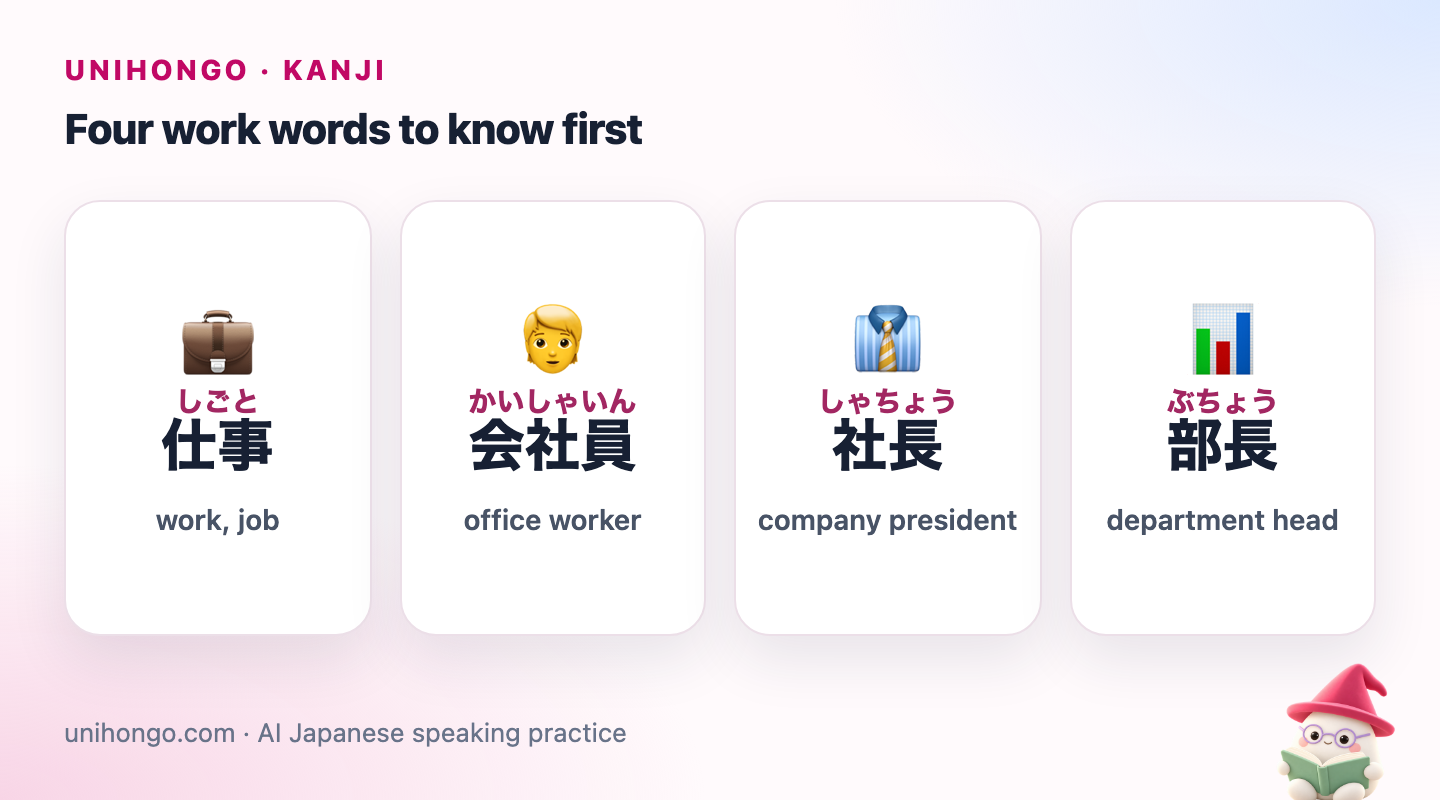
| Japanese | Romaji | Meaning |
|---|---|---|
| 仕事 | shigoto | work, job |
| 会社員 | kaishain | office worker |
| 社長 | shachō | company president |
| 部長 | buchō | department head |
The eleven kanji and their readings
| Kanji | Meaning | Main readings | Word |
|---|---|---|---|
| 仕 | serve | shi, tsuka(eru) | 仕事 (shigoto) |
| 事 | thing, matter | koto, ji | 事務 (jimu, office work) |
| 会 | meet | kai, a(u) | 会議 (kaigi, meeting) |
| 社 | company, shrine | sha, yashiro | 本社 (honsha, head office) |
| 員 | member | in | 店員 (ten'in, shop clerk) |
| 働 | work | dō, hatara(ku) | 労働 (rōdō, labour) |
| 長 | head, long | chō, naga(i) | 社長 (shachō) |
| 部 | department, part | bu | 部署 (busho, department) |
| 課 | section, lesson | ka | 課長 (kachō) |
| 職 | employment | shoku | 職場 (shokuba, workplace) |
| 業 | business, industry | gyō, waza | 営業 (eigyō, sales) |
社 also means shrine, as in 神社 (jinja); context always makes the meaning clear. 課 also means lesson: 第一課 is Lesson 1 in a textbook.
The ladder of job titles
Japanese companies differ, but a common structure runs from the president down to sections. Titles are used as forms of address, so learning them is practical, not just vocabulary.
| Japanese | Romaji | Meaning |
|---|---|---|
| 上司 | jōshi | boss, superior |
| 部下 | buka | subordinate, team member |
| 同僚 | dōryō | colleague |
| 部長、少しよろしいですか。 | Buchō, sukoshi yoroshii desu ka. | Do you have a moment? (to a department head) |
| Title | Reading | Typical role |
|---|---|---|
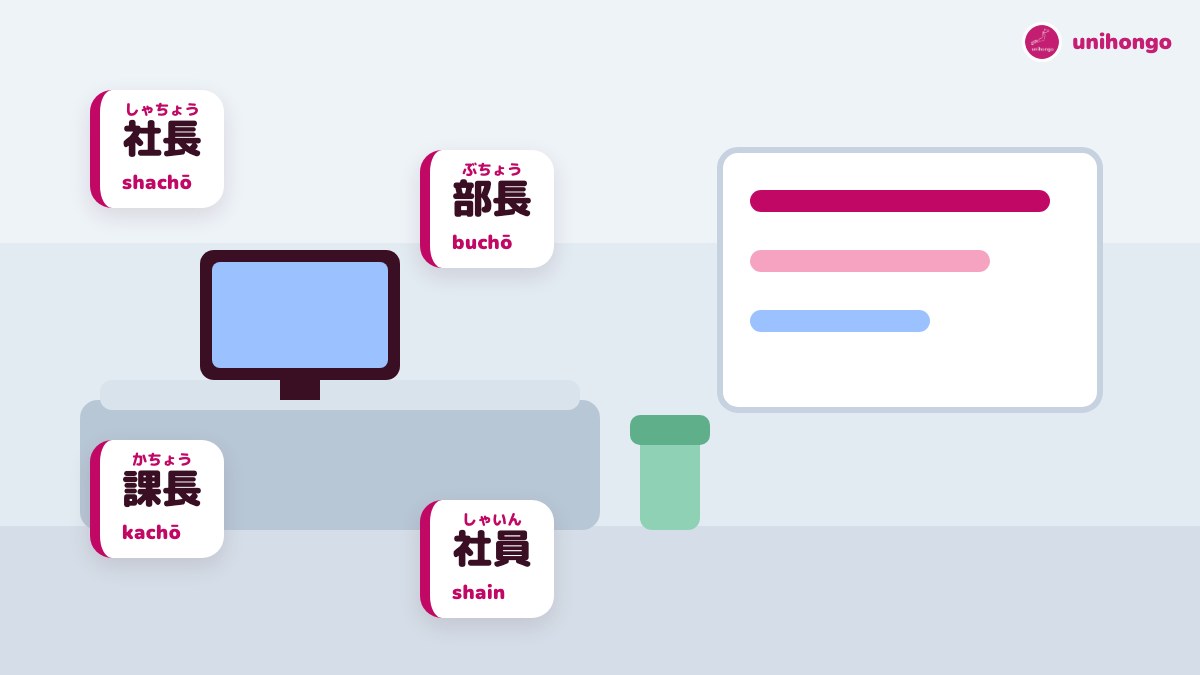
| 社長 | shachō | president, head of the company |
| 部長 | buchō | head of a department (部) |
| 課長 | kachō | head of a section (課) within a department |
| 係長 | kakarichō | supervisor of a small team |
| 店長 | tenchō | manager of a shop or restaurant |
In front of people from other companies, Japanese speakers refer to their own manager without honorifics, as in 部長の山本 rather than 山本部長, because their own company counts as the in-group. This is a classic point in business manners training.
Job ads and types of work
Job adverts and contracts use a fixed set of words for types of employment. These are the ones that matter when you read a listing.
| Japanese | Romaji | Meaning |
|---|---|---|
| 正社員 | seishain | regular full-time employee |
| 契約社員 | keiyaku shain | contract employee |
| アルバイト | arubaito | part-time job (often students) |
| 職種 | shokushu | type of job (on job ads) |
| 営業職 | eigyōshoku | sales position |
| 事務職 | jimushoku | office or admin position |
| 共働き | tomobataraki | both partners working |
パート (pāto) is also part-time work, often used for adults working shorter hours, while アルバイト is associated with students, although the line is blurry. These are written in katakana because they come from foreign words: arbeit from German and part from English.
Talking about your job
When you meet someone new, the conversation often turns to work. Here is a natural exchange at a networking event or a party.
| Japanese | Romaji | Meaning |
|---|---|---|
| お仕事は何をされていますか。 | Oshigoto wa nani o sarete imasu ka. | Guest: What do you do for work? (polite) |
| メーカーでエンジニアをしています。 | Mēkā de enjinia o shite imasu. | You: I'm an engineer at a manufacturer. |
| どのぐらい働いているんですか。 | Dono gurai hataraite iru n desu ka. | Guest: How long have you worked there? |
| 三年になります。今は開発部にいます。 | Sannen ni narimasu. Ima wa kaihatsubu ni imasu. | You: It's been three years. I'm in the development department now. |
| お忙しいでしょう。 | Oisogashii deshō. | Guest: You must be busy. |
| ええ、でも仕事は楽しいです。 | Ee, demo shigoto wa tanoshii desu. | You: Yes, but I enjoy the work. |
If you are between jobs or studying, you can say 今は仕事を探しています (I'm looking for work now) or 学生です (I'm a student). For a part-time job, アルバイトをしています is natural. Japanese speakers often name the company or industry before the role, so 銀行で働いています (I work at a bank) is a perfectly good answer even if you do not give your title.
Words you hear in the office every day
| Japanese | Romaji | Meaning |
|---|---|---|
| 会議室 | kaigishitsu | meeting room |
| 出社 | shussha | coming into the office |
| 退社 | taisha | leaving the office; leaving the company |
| お先に失礼します。 | Osaki ni shitsurei shimasu. | Excuse me for leaving before you. |
| お疲れさまです。 | Otsukaresama desu. | Thanks for your hard work. (greeting) |
退社 is a trap: it can mean leaving the office for the day or leaving the company for good. Context and time words usually make it clear: 六時に退社 is leaving at six, while 来月退社します means quitting next month.
お疲れさまです is used far beyond the end of the day. Colleagues say it when they pass in the corridor, at the start of a phone call between coworkers and when someone returns from a meeting. With people from outside your company it can sound too familiar, so use お世話になっております in business emails and calls instead.
Look-alikes and writing tips
- 働 (work) vs 動 (move): 働 adds 亻 (person) to 動. It is a kokuji, a kanji created in Japan.
- 社 (company) vs 初 (first): 社 has the altar radical 礻 with one dot, 初 has the clothing radical 衤 with two.
- 員 (member) vs 貝 (shell) vs 買 (buy): 員 has 口 on top of 貝.
- 部 (department) vs 都 (capital): both end with ⻏ on the right; 部 has 立 and 口 on the left, 都 has 者.
- 長 (head, long) vs 張 (stretch): 張 adds 弓 (bow), as in 出張 (shutchō, business trip).
- Writing tip: 事 is a single tall kanji with a long vertical stroke that passes through everything and ends with a hook. Write that vertical stroke last.
Common learner mistakes with work words
Work vocabulary is full of near-synonyms. These are the mix-ups that come up most often.
- Saying 私は社長です when you mean an employee. 社長 is the head of the company; 社員 or 会社員 is an employee.
- Calling your own manager 山本部長 in front of a client. With outsiders, say 部長の山本, without honorifics.
- Using 働く and 仕事 the same way. 働く is a verb, to work; 仕事 is a noun, work or a job. 仕事をする is also correct.
- Reading 会社 as kaisya. In Hepburn it is kaisha, and the sha sound is the same as in 社長.
- Using 退社 to mean leaving for the day and confusing a colleague. When the meaning could be unclear, 帰ります (I'm going home) is simpler.
Prepare for your first week at a Japanese workplace
Start with the self-introduction. Paste yours into the Mocchi chat with /correct and ask Mocchi to make it suitable for a first day at a Japanese company; Mocchi explains each change and remembers your job and department for later practice.
Then rehearse it aloud with Yamada-sensei in AI Sensei, asking the Sensei to play your new department head. Introduce yourself, ask a question about the team and close with お先に失礼します; the session report flags any title or greeting you used in the wrong place.