
Your routine in four lines
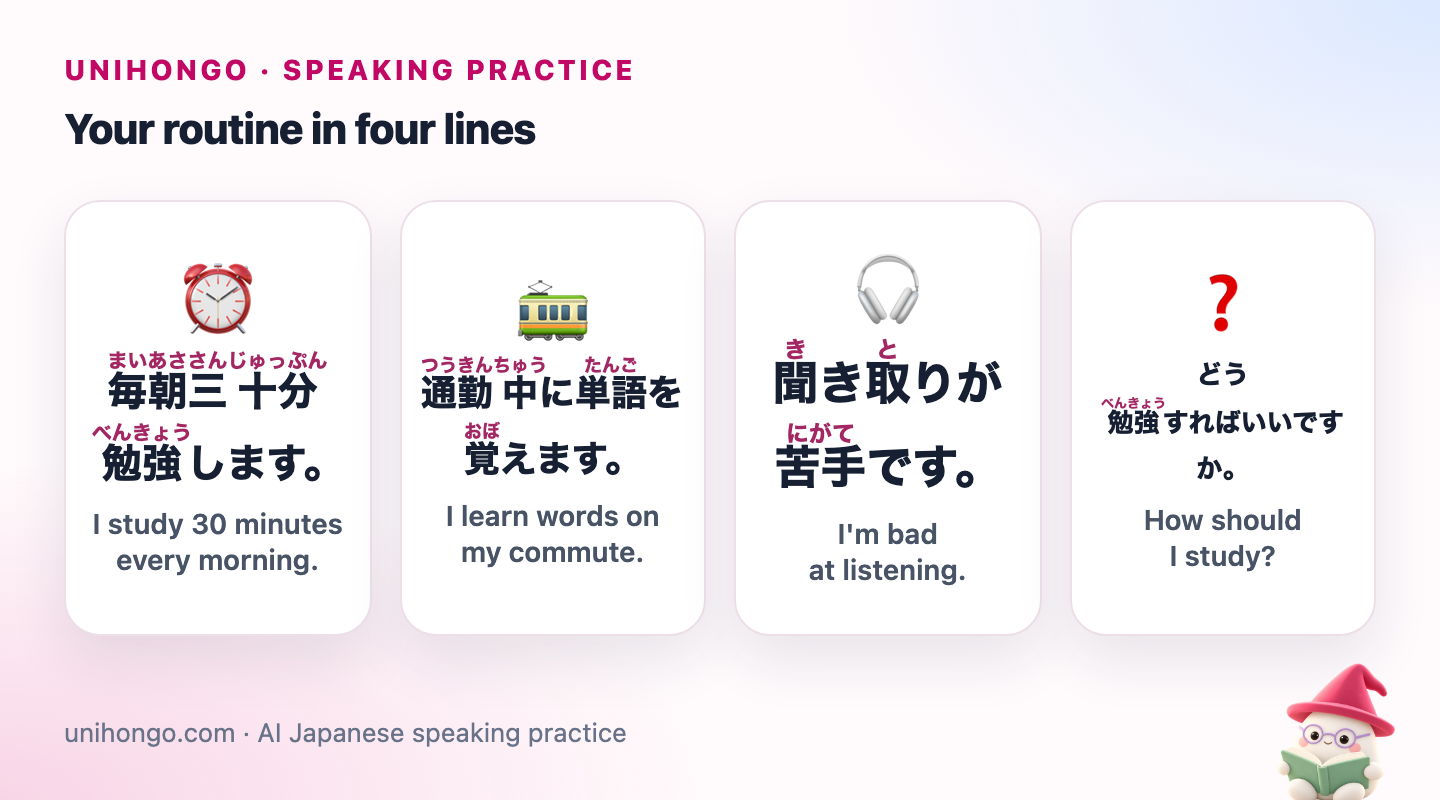
These four sentences describe when you study, where you squeeze it in, what you find hard and how you ask for help. Maiasa, every morning, and sanjuppun, thirty minutes, fit before the verb with no particle. Tsūkinchū, during the commute, uses the suffix chū, in the middle of, which also gives benkyōchū and shigotochū. Kikitori, listening comprehension, is the noun you need for the most common weak point.
| Japanese | Romaji | Meaning |
|---|---|---|
| 毎朝三十分勉強します。 | Maiasa sanjuppun benkyō shimasu. | I study 30 minutes every morning. |
| 通勤中に単語を覚えます。 | Tsūkinchū ni tango o oboemasu. | I learn words on my commute. |
| 聞き取りが苦手です。 | Kikitori ga nigate desu. | I'm bad at listening. |
| どう勉強すればいいですか。 | Dō benkyō sureba ii desu ka. | How should I study? |
The question you'll hear
Dō yatte, how, in what way, is the question word for method. Friends drop particles and the i of imasu: mainichi benkyō shiteru? The question nani de, with what, asks about your tools; be careful, because written 何で can also be read nande, why. In speech the two are distinguished by sound and context, and the answer is a tool: apuri de, with an app, hon de, with a book.
| Japanese | Romaji | Meaning |
|---|---|---|
| どうやって日本語を勉強していますか。 | Dō yatte nihongo o benkyō shite imasu ka. | How do you study Japanese? |
| 毎日勉強してる? | Mainichi benkyō shiteru? | Friend: Do you study every day? (casual) |
| 一日どのくらい勉強しますか。 | Ichinichi dono kurai benkyō shimasu ka. | How long do you study a day? |
| 何で勉強してるの? | Nani de benkyō shiteru no? | Friend: What do you study with? |
| 学校に通っていますか。 | Gakkō ni kayotte imasu ka. | Do you go to a language school? |
Three model answers
The beginner answer states frequency and tool. The intermediate answer separates weekdays from weekends with wa, and admits a weak point with nigate. The upper answer gives a reason with node and uses yō ni shite imasu, I make a point of, and to kimete imasu, I have decided to, which are the two patterns that make a routine sound like a deliberate choice.
| Japanese | Romaji | Meaning |
|---|---|---|
| 毎日三十分勉強します。 | Mainichi sanjuppun benkyō shimasu. | Beginner: I study 30 minutes every day. |
| アプリで単語を勉強します。 | Apuri de tango o benkyō shimasu. | Beginner: I study vocabulary with an app. |
| 平日は朝、三十分ぐらい勉強しています。 | Heijitsu wa asa, sanjuppun gurai benkyō shite imasu. | Intermediate: On weekdays I study about 30 minutes in the morning. |
| 週末は日本のドラマを見て、聞き取りの練習をしています。 | Shūmatsu wa Nihon no dorama o mite, kikitori no renshū o shite imasu. | Intermediate: At weekends I watch Japanese dramas to practise listening. |
| 文法は得意ですが、話すのはまだ苦手です。 | Bunpō wa tokui desu ga, hanasu no wa mada nigate desu. | Intermediate: Grammar is my strength, but speaking is still hard. |
| 仕事が忙しいので、通勤時間を使って単語を覚えるようにしています。 | Shigoto ga isogashii node, tsūkin jikan o tsukatte tango o oboeru yō ni shite imasu. | Upper: Work is busy, so I make a point of learning words during my commute. |
| 続けるのが一番難しいので、短くても毎日やると決めています。 | Tsuzukeru no ga ichiban muzukashii node, mijikakute mo mainichi yaru to kimete imasu. | Upper: Keeping it up is the hardest part, so I've decided to do a little every day. |
Hanasu no wa, speaking, turns a verb into a noun with no, so it can be the topic of nigate. The same trick works for anything: kaku no, writing, kanji o oboeru no, memorising kanji.
How often and how long: the words of a routine
Frequency words sit at the start of the sentence or just before the verb. Durations take no particle. Gurai or kurai, about, goes after the number and is used far more than in English, because it softens the claim.
| Japanese | Romaji | Meaning |
|---|---|---|
| 週に三回、オンラインレッスンを受けています。 | Shū ni sankai, onrain ressun o ukete imasu. | I take online lessons three times a week. |
| 一時間ぐらいです。 | Ichijikan gurai desu. | About an hour. |
| 毎日少しずつやっています。 | Mainichi sukoshi zutsu yatte imasu. | I do a little every day. |
| 漢字が苦手です。 | Kanji ga nigate desu. | Kanji is my weak point. |
| 敬語がまだよく分かりません。 | Keigo ga mada yoku wakarimasen. | I still don't really get keigo. |
| Japanese | Romaji | Meaning |
|---|---|---|
| 毎日 / ほとんど毎日 | mainichi / hotondo mainichi | every day / almost every day |
| 週に三回 | shū ni sankai | three times a week |
| 時々 / たまに | tokidoki / tama ni | sometimes / once in a while |
| 三十分 / 一時間 | sanjuppun / ichijikan | thirty minutes / one hour |
| 〜ぐらい | gurai | about (after a number) |
| 朝 / 昼休み / 寝る前 | asa / hiruyasumi / neru mae | morning / lunch break / before bed |
Tokui and nigate, strength and weak point, are the pair to use about yourself. Jōzu and heta judge skill, and claiming jōzu about yourself sounds boastful; nigate about yourself sounds honest.
Your day in order: mazu, sorekara, neru mae ni
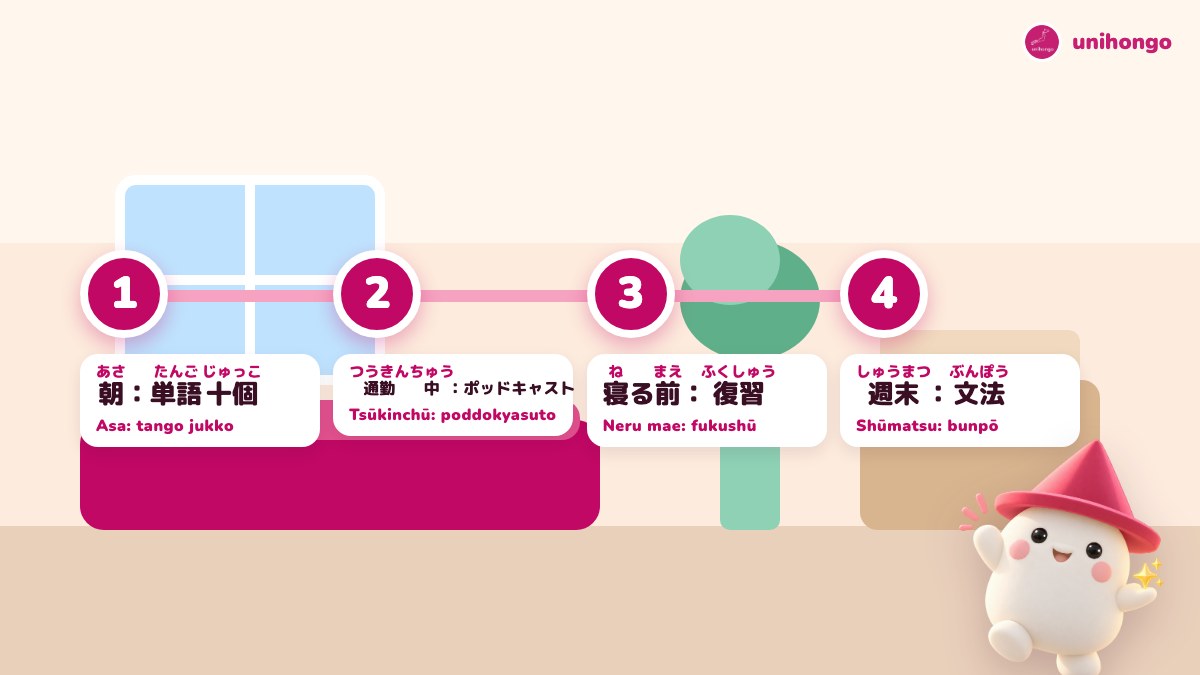
A routine is a sequence, and three connectors carry it: mazu, first, sorekara, and then, and a time phrase such as neru mae ni, before going to bed. Keep each step to one clause and the listener can follow even at speed. Shūmatsu wa, as for the weekend, switches the frame, and matomete, all in one go, describes the weekend block many learners keep for grammar.
| Japanese | Romaji | Meaning |
|---|---|---|
| まず、朝に単語を十個覚えます。 | Mazu, asa ni tango o jukko oboemasu. | First, I learn ten words in the morning. |
| それから、通勤中にポッドキャストを聞きます。 | Sorekara, tsūkinchū ni poddokyasuto o kikimasu. | Then I listen to a podcast on my commute. |
| 寝る前に、その日の単語を復習します。 | Neru mae ni, sono hi no tango o fukushū shimasu. | Before bed, I review the day's words. |
| 週末はまとめて文法をやります。 | Shūmatsu wa matomete bunpō o yarimasu. | At the weekend I do grammar in one block. |
| できない日もあります。 | Dekinai hi mo arimasu. | There are days I can't manage it. |
Saying what's hard and asking for advice
Admitting a weak point is the move that makes Japanese speakers open up, because most of them have a weak point in English and will tell you about it. Then ask: dō sureba, if I do what, plus ii desu ka, is it good, is the standard request for advice. Expect an answer with to ii yo, it would be good if, and reply with naruhodo, I see, and yatte mimasu, I'll give it a try.
| Japanese | Romaji | Meaning |
|---|---|---|
| 聞き取りが一番難しいです。 | Kikitori ga ichiban muzukashii desu. | Listening is the hardest for me. |
| どうすれば話せるようになりますか。 | Dō sureba hanaseru yō ni narimasu ka. | What should I do to become able to speak? |
| おすすめの勉強法はありますか。 | Osusume no benkyōhō wa arimasu ka. | Is there a study method you recommend? |
| 何かコツはありますか。 | Nanika kotsu wa arimasu ka. | Any tips? |
| 毎日続けるのが大変です。 | Mainichi tsuzukeru no ga taihen desu. | Keeping it up daily is tough. |
| 日本のドラマを見るといいよ。 | Nihon no dorama o miru to ii yo. | Friend: You should watch Japanese dramas. |
| なるほど。やってみます。 | Naruhodo. Yatte mimasu. | I see. I'll give it a try. |
Kotsu is the knack or trick of doing something well. Asking for kotsu is lighter than asking for a method, and people enjoy sharing one.
Mistakes and register notes
- Watashi wa nihongo ga jōzu desu. Use tokui for your strengths; jōzu is praise you give to others.
- Sanjūfun for thirty minutes. It is sanjuppun; and ten minutes is juppun.
- Benkyō shimasu for a habit. It is correct, but benkyō shite imasu tells the listener it is ongoing.
- Narau for self-study. Narau means learning from a teacher; alone you benkyō suru or oboeru.
- Turning the routine into a list of complaints. One nigate is honest; three in a row asks the listener to comfort you.
- Register: dō sureba ii desu ka to a teacher or senior; dō shitara ii? to a friend.
Say the routine, then let it run
Describe your real week to Mocchi in Japanese, the good days and the ones you skip, and type /adjust-plan: it reshapes your personal study plan around the time you actually said you have, and since it keeps track of your weak points, the daily tasks lean towards listening if that is what you called nigate. Then open AI Sensei, choose Yamada-sensei and ask Yamada-sensei to play a teacher at a first lesson who asks how you study; practise the sequence with mazu and sorekara, admit one weak point and ask for a tip.
If you have not tried it yet, a free account at unihongo.com/login gets you to the chat where the plan lives.
Your turn
- Describe your weekday routine in three steps with mazu, sorekara and neru mae ni.
- Say how often and how long, with gurai.
- Name one strength with tokui and one weak point with nigate.
- Ask for a recommended method and reply to the suggestion with naruhodo.
- Describe a day when you could not study, and what you did instead.