
Changing jobs in four cards
Four words cover the whole journey. Tenshoku is the change itself. Naitei is a job offer, and taishoku is leaving your current job. Nyūsha is joining the new company.
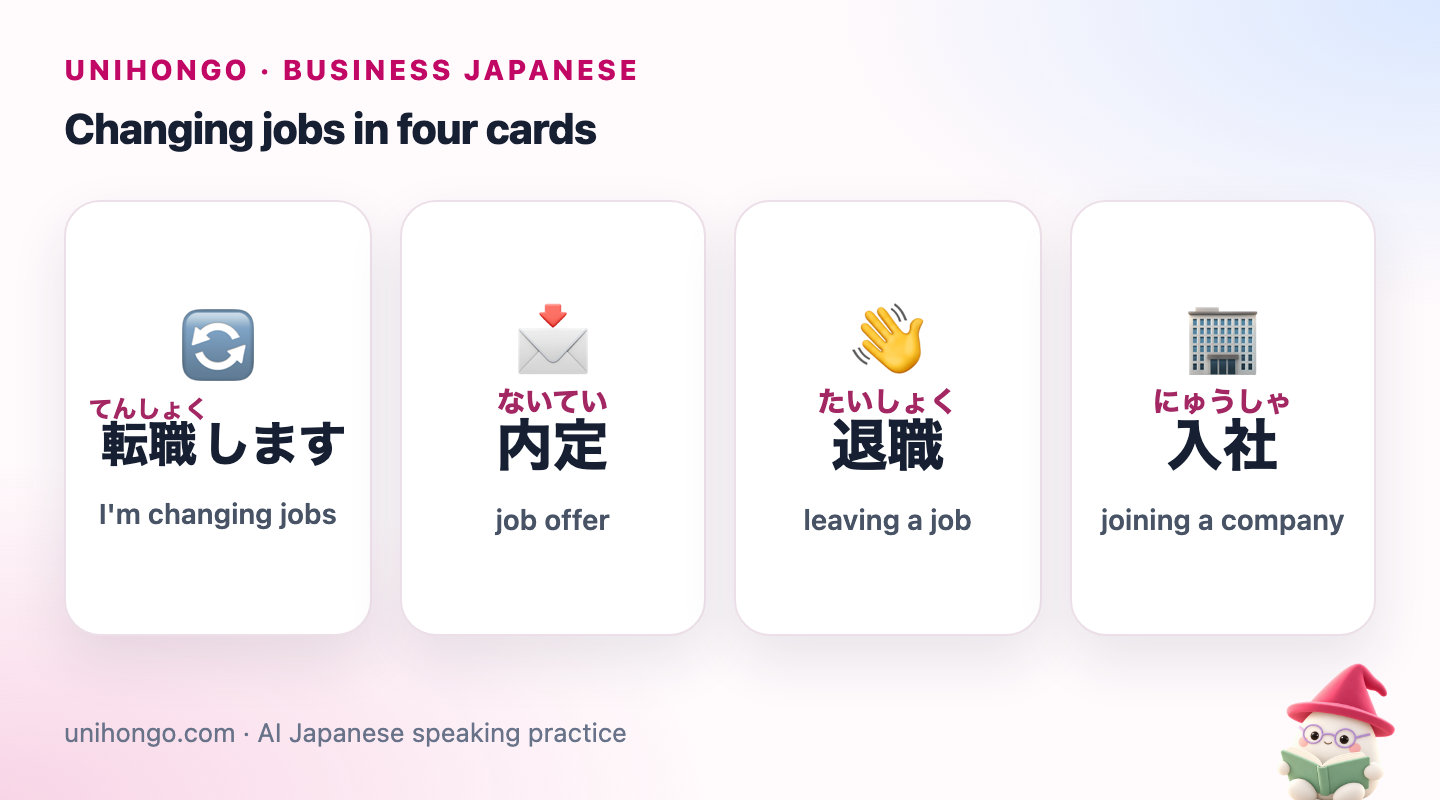
| Japanese | Romaji | Meaning |
|---|---|---|
| 転職します | Tenshoku shimasu | I'm changing jobs |
| 内定 | naitei | job offer |
| 退職 | taishoku | leaving a job |
| 入社 | nyūsha | joining a company |
You will also hear chūto saiyō, mid-career hiring, which is the category you apply under once you have work experience, as opposed to shinsotsu saiyō, the hiring of new graduates every spring.
Where people find jobs
Most people combine two or three channels. Each suits a different kind of search.
| Japanese | Romaji | Meaning |
|---|---|---|
| 転職エージェント | tenshoku ējento | recruitment agent |
| 求人 | kyūjin | job opening |
| 応募したいです。 | Ōbo shitai desu. | I'd like to apply. |
| 日本語のレベルはどのくらい必要ですか。 | Nihongo no reberu wa dono kurai hitsuyō desu ka. | What level of Japanese is needed? |
| Channel | How it works | Fits when |
|---|---|---|
| Recruitment agent (tenshoku ējento) | A consultant matches you to roles and arranges interviews; usually free for the job seeker | You want guidance and introductions |
| Job sites (kyūjin saito) | You search and apply yourself | You know what you want and want many options |
| Direct application | Apply on a company's careers page | You have a target company |
| Referral (riferaru) | A friend or former colleague introduces you | You have a network in the field |
| Hello Work | The public employment service, with job listings and advice | You want public support, including help for foreign residents in some offices |
The documents: rirekisho and shokumu keirekisho
A Japanese application usually has two documents. The rirekisho is a standard form with your personal details, education, work history in date order, qualifications and a short motivation section. The shokumu keirekisho is a free-format work history, often two pages, describing your roles, projects, results and skills in more detail. For mid-career hiring, the second one often matters more.
Many companies accept typed documents, and templates are easy to find. Dates on Japanese forms may use either the Western calendar or the Japanese era; use one consistently.
| Japanese | Romaji | Meaning |
|---|---|---|
| 履歴書 | rirekisho | CV form |
| 職務経歴書 | shokumu keirekisho | detailed work history |
| 志望動機 | shibō dōki | motivation for applying |
| 自己PR | jiko piāru | self-promotion section |
Answering why you are leaving
Almost every interview asks tenshoku riyū, your reason for changing jobs. Interviewers listen for two things: whether the same problem will make you leave them too, and whether you can speak about your employer respectfully. The best answers point forward: what you want to do, why it is hard in your current role, and how this company fits.
| Japanese | Romaji | Meaning |
|---|---|---|
| 転職理由を教えてください。 | Tenshoku riyū o oshiete kudasai. | Interviewer: Please tell us why you're changing jobs. |
| より海外の顧客と関わる仕事がしたいと考えました。 | Yori kaigai no kokyaku to kakawaru shigoto ga shitai to kangaemashita. | I want work that involves overseas clients more. |
| 今の職場では経験を積ませていただきました。 | Ima no shokuba de wa keiken o tsumasete itadakimashita. | My current workplace gave me good experience. |
| 御社の国際プロジェクトに魅力を感じています。 | Onsha no kokusai purojekuto ni miryoku o kanjite imasu. | I'm drawn to your company's international projects. |
| いつから入社できますか。 | Itsu kara nyūsha dekimasu ka. | Interviewer: When can you start? |
| 引き継ぎがあるので、一か月半後を考えています。 | Hikitsugi ga aru node, ikkagetsu han go o kangaete imasu. | I'll need a handover, so in about six weeks. |
The steps and timing
The order matters. Resign only after you have accepted a written offer, because an offer can still change before it is signed. Once you accept, tell your manager first, before colleagues, and agree on a leaving date and a handover plan.
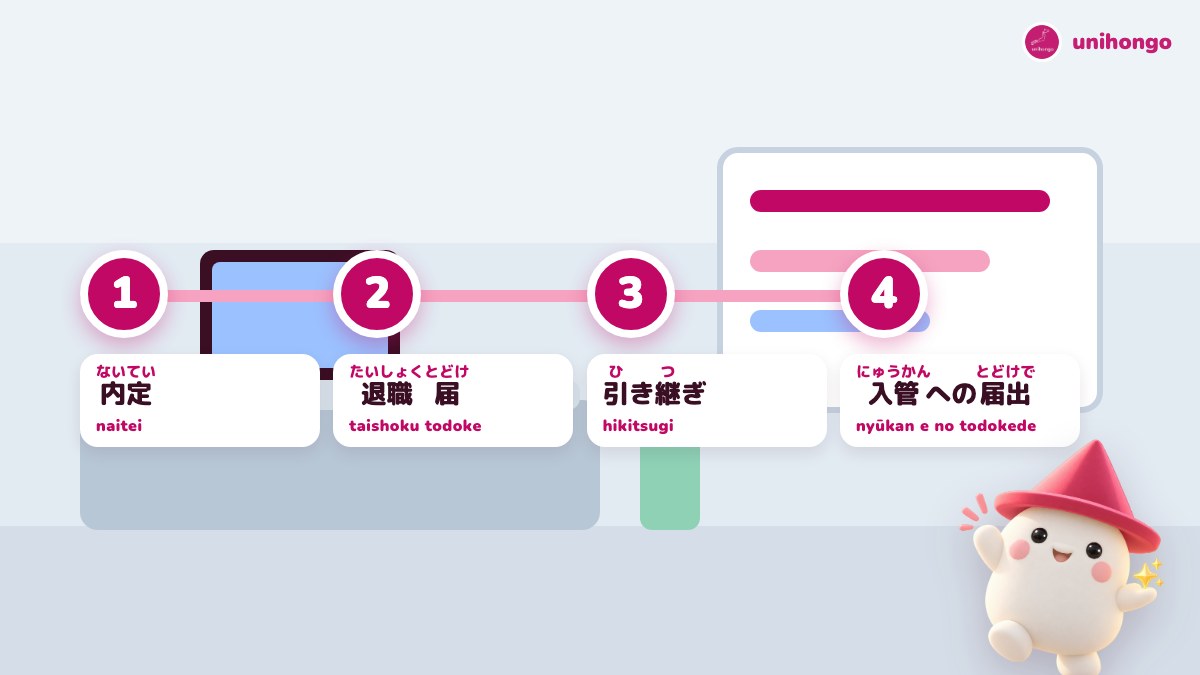
- Search and apply: one to several months, depending on the field.
- Interviews: often two or three rounds, the last with a senior manager.
- Offer, naitei: read the offer letter, naitei tsūchisho, and the working conditions before accepting.
- Resignation: tell your manager, then submit the resignation letter. Under the Civil Code, open-ended contracts can generally end two weeks after notice, but company rules often ask for a month or more.
- Handover, hikitsugi: document your work and introduce your successor.
- Leaving: collect your withholding slip, gensen chōshūhyō, and other papers, and return your company items.
- Joining: submit your documents to the new HR, including the withholding slip for the year-end tax adjustment.
Residence status: the 14-day notifications
If you hold a work-based status of residence such as Engineer/Specialist in Humanities/International Services, the Immigration Services Agency requires two notifications when you change jobs: one within 14 days after your contract with the old employer ends, and one within 14 days after you sign with the new employer. You can submit them online, by post, or at a regional immigration office. Missing them can cause problems at your next renewal.
Your new job must fit the activities allowed by your status. If it does not, you need a change of status before you start. Some statuses work differently: for example, Specified Skilled Worker and Highly Skilled Professional status are linked to a specific employer or field, and a change usually needs permission first. A long gap without the work your status allows can also be a problem. Because these rules are specific, confirm your case with the agency or an immigration lawyer, and keep copies of what you submit.
| Japanese | Romaji | Meaning |
|---|---|---|
| 所属機関に関する届出 | shozoku kikan ni kansuru todokede | notification about your affiliated organisation |
| 在留資格 | zairyū shikaku | status of residence |
| 就労資格証明書 | shūrō shikaku shōmeisho | certificate of authorised employment |
| 転職したので、届出をしたいです。 | Tenshoku shita node, todokede o shitai desu. | I changed jobs, so I'd like to file a notification. |
| 新しい仕事は今の在留資格で大丈夫ですか。 | Atarashii shigoto wa ima no zairyū shikaku de daijōbu desu ka. | Is my new job fine under my current status? |
Mistakes that make a job change harder
- Resigning before the offer is confirmed in writing.
- Criticising your current employer in interviews. Interviewers hear it as a warning sign.
- Telling colleagues before your manager. Your manager should hear it from you first.
- Forgetting the immigration notifications, or assuming the new employer files them for you.
- Leaving without your withholding slip and pension and insurance papers, which you need for tax and enrolment at the new job.
Rehearse the interview that decides it
Interview answers improve fastest when you say them aloud to someone who asks follow-up questions. Write your reason for leaving and your motivation, and ask Mocchi to make them sound natural with /correct. Mocchi remembers which polite forms you struggle with and brings them back in later quizzes.
Then go to AI Sensei, choose Yamada-sensei and ask for a mid-career interview in polite Japanese, with questions about why you are leaving, what you achieved and when you can start. The Japanese Job Interview mission is another option if you want a set scenario.