
Four sentences that explain why you are there
City office staff need to know one thing first: what changed. You arrived, you moved, you joined a company scheme, or you want to talk about premiums. These four sentences cover the most common reasons, and each points staff to the right form.
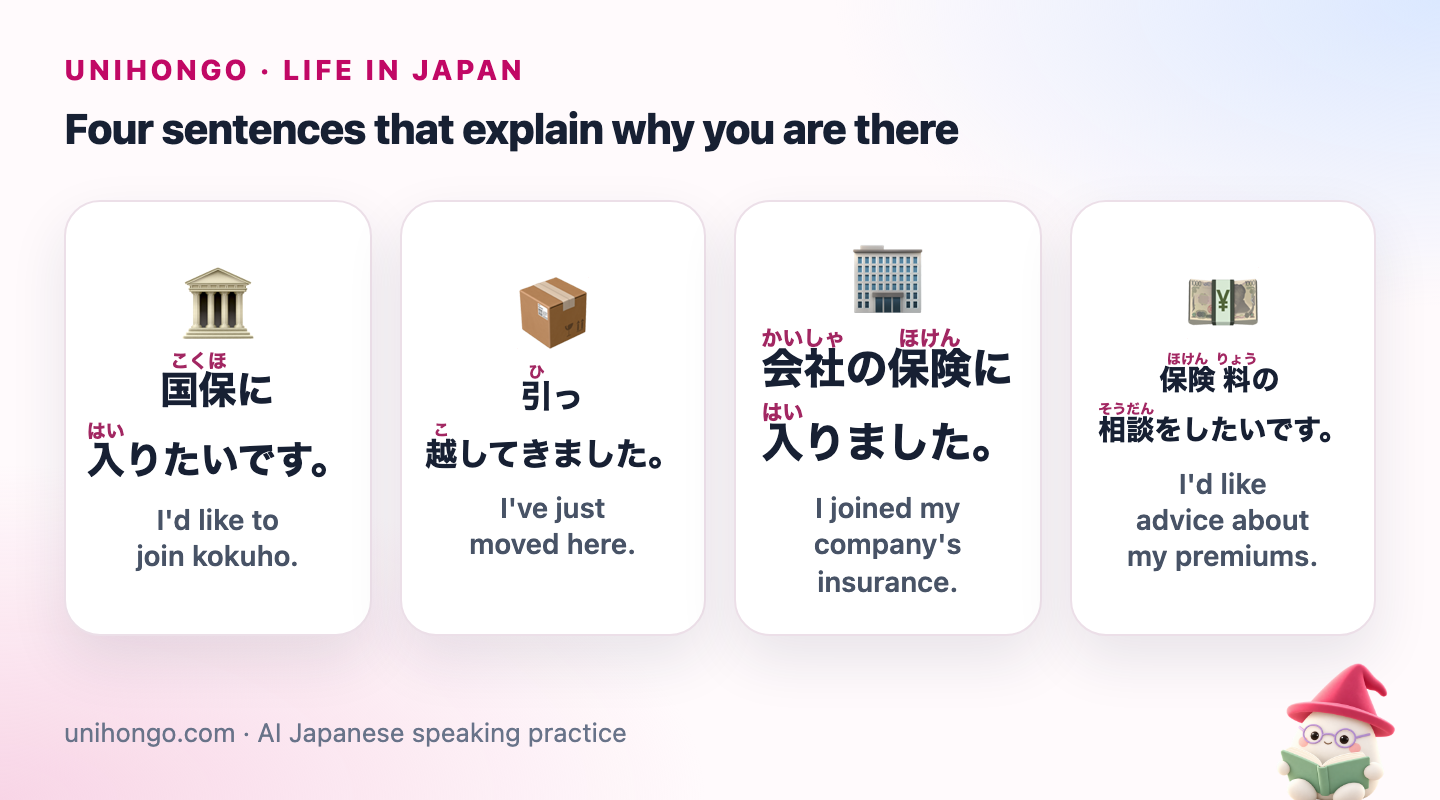
| Japanese | Romaji | Meaning |
|---|---|---|
| 国保に入りたいです。 | Kokuho ni hairitai desu. | I'd like to join kokuho. |
| 引っ越してきました。 | Hikkoshite kimashita. | I've just moved here. |
| 会社の保険に入りました。 | Kaisha no hoken ni hairimashita. | I joined my company's insurance. |
| 保険料の相談をしたいです。 | Hokenryō no sōdan o shitai desu. | I'd like advice about my premiums. |
Two systems: employer insurance and kokuho
Most people in Japan belong to one of two kinds of public health insurance. The table shows the general picture; exceptions exist, for example for some part-time workers and for people aged 75 and over, who have a separate scheme.
| Point | Employer insurance | National Health Insurance |
|---|---|---|
| Japanese name | 健康保険, often called 社保 (shaho) | 国民健康保険, often called 国保 (kokuho) |
| Who it covers | Employees who meet the conditions, and dependants | Residents not in an employer scheme |
| Who handles joining | Usually the employer | You, at the city or ward office |
| How you pay | Deducted from salary | Payment slips, bank debit or other methods |
| Family members | Dependants may be covered | Each member is counted in the household |
Kokuho is calculated by household, and the bills are usually sent to the head of household (setainushi). If you live with family, ask how your household is counted.
At the counter: what to bring and what staff ask
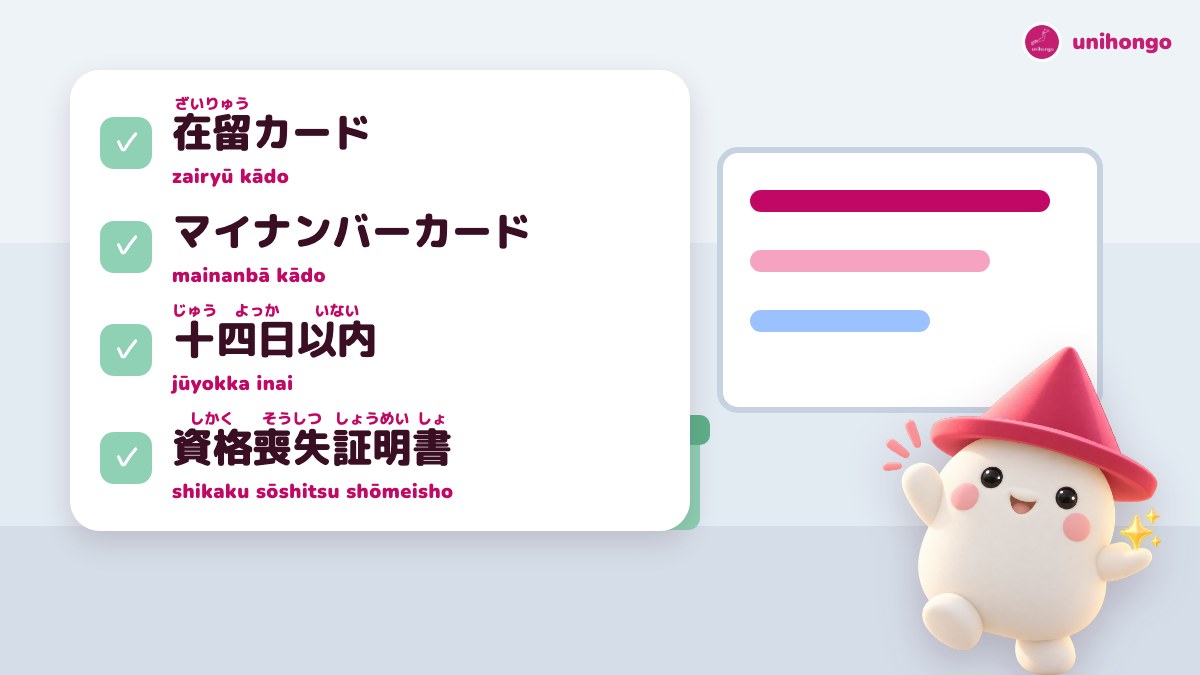
Bring your residence card if you have one, your My Number card or number, and any document showing what changed, such as proof that you have left an employer's insurance (資格喪失証明書, shikaku sōshitsu shōmeisho). Some offices ask for more; check the city website or phone first. Many offices give you a numbered ticket and call the number on a screen.
Staff may ask when the change happened, your household members, your income in the previous year and how you would like to pay. Answer briefly; they fill in most of the form with you.
| Japanese | Romaji | Meaning |
|---|---|---|
| 国保の窓口はどこですか。 | Kokuho no madoguchi wa doko desu ka. | Where is the kokuho counter? |
| 在留カードを持ってきました。 | Zairyū kādo o motte kimashita. | I've brought my residence card. |
| いつ日本に来ましたか。 | Itsu Nihon ni kimashita ka. | Staff: When did you arrive in Japan? |
| 先月の十日に来ました。 | Sengetsu no tōka ni kimashita. | I arrived on the 10th of last month. |
| 会社を辞めたのはいつですか。 | Kaisha o yameta no wa itsu desu ka. | Staff: When did you leave your company? |
| 資格喪失証明書はこれです。 | Shikaku sōshitsu shōmeisho wa kore desu. | Here's the proof I left my work insurance. |
Premiums, payment slips and reductions
Kokuho premiums (保険料, hokenryō) are generally based on your household's income in the previous year, plus fixed amounts per person, and each municipality sets its own rates. You usually receive payment slips (納付書, nōfusho) to pay at a bank, a convenience store or by smartphone, or you can set up bank debit. The year often runs on a schedule of instalments.
If paying is hard, for example after losing a job, many municipalities have reductions or payment plans, and there are special rules for some people who lost their job involuntarily. Do not just leave the slips unpaid; go to the counter and ask. Staff deal with these questions every day.
| Japanese | Romaji | Meaning |
|---|---|---|
| 保険料はどうやって決まりますか。 | Hokenryō wa dō yatte kimarimasu ka. | How are the premiums decided? |
| コンビニで払えますか。 | Konbini de haraemasu ka. | Can I pay at a convenience store? |
| 口座振替にしたいです。 | Kōza furikae ni shitai desu. | I'd like to pay by bank debit. |
| 仕事を失って、払うのが難しいです。 | Shigoto o ushinatte, harau no ga muzukashii desu. | I've lost my job and paying is difficult. |
| 減免の制度はありますか。 | Genmen no seido wa arimasu ka. | Is there a reduction scheme? |
Your insurance card after the change to My Number
Japan has moved to using the My Number card as the health insurance card, often called mainā hokenshō. People without one, or who have not linked it, are generally sent a document called a shikaku kakunin sho (資格確認書) to show at clinics instead. Transitional rules have changed over the last few years, so ask your city office what you should use and what will arrive by post.
| Japanese | Romaji | Meaning |
|---|---|---|
| マイナ保険証の登録はどうすればいいですか。 | Maina hokenshō no tōroku wa dō sureba ii desu ka. | How do I register my My Number card as an insurance card? |
| 資格確認書はいつ届きますか。 | Shikaku kakunin sho wa itsu todokimasu ka. | When will the eligibility certificate arrive? |
| 病院では何を見せればいいですか。 | Byōin de wa nani o misereba ii desu ka. | What should I show at the clinic? |
Leaving kokuho: new job, moving, leaving Japan
Three changes usually mean leaving or transferring kokuho. When you join a company scheme, you normally tell the city yourself and bring your new insurance details. When you move to another municipality, you leave kokuho in the old one with your moving-out notice and join again in the new one. When you leave Japan, the moving-out notice usually ends it. In each case, any remaining premiums are recalculated, so ask whether you will receive a refund or a final bill.
| Japanese | Romaji | Meaning |
|---|---|---|
| 国保をやめる手続きをしたいです。 | Kokuho o yameru tetsuzuki o shitai desu. | I'd like to leave kokuho. |
| 新しい保険証の情報はこれです。 | Atarashii hokenshō no jōhō wa kore desu. | Here are my new insurance details. |
| 来月、帰国します。 | Raigetsu, kikoku shimasu. | I'm leaving Japan next month. |
| 払いすぎた分は返ってきますか。 | Haraisugita bun wa kaette kimasu ka. | Will I get back any overpayment? |
On forms you will see datai (脱退, withdrawal) or shikaku sōshitsu (資格喪失, loss of eligibility) for leaving kokuho. In speech, yameru is fine.
Common learner mistakes
- Not telling the city office after joining a company scheme. Kokuho bills keep coming until you do, and sorting it out later takes time.
- Waiting months to join after arriving. Premiums are usually charged back to the date you became eligible, and medical bills in the gap may not be covered at the usual rate.
- Confusing hokenryō (premium) with iryōhi (medical costs). Ask about the one you mean.
- Ignoring payment slips during a hard month. Go to the counter and ask about reductions or a plan instead.
- Expecting the pension counter to handle insurance. They are often side by side but separate; check the sign for 国保.
Walk into the city office prepared
Tell Mocchi your situation in a sentence or two and ask Help me prepare what to say at the kokuho counter, with the documents I should mention. Mocchi drafts a short polite script, explains words such as nōfusho and shikaku sōshitsu, and remembers your situation, so you can come back after the visit and ask about the letters that arrive.
For the live conversation, choose Haru-sensei in AI Sensei with the city hall topic and ask Haru-sensei to play the clerk at the insurance counter. Give your dates, hand over imaginary documents and ask about payment. Haru-sensei can slow down whenever you ask.