
Welcome and farewell in four cards
Both parties share the same core vocabulary. The kanji, written 幹事, is the organiser who books the place and collects the money. The aisatsu is the short speech. The shuyaku is the star of the evening, the person being welcomed or seen off.
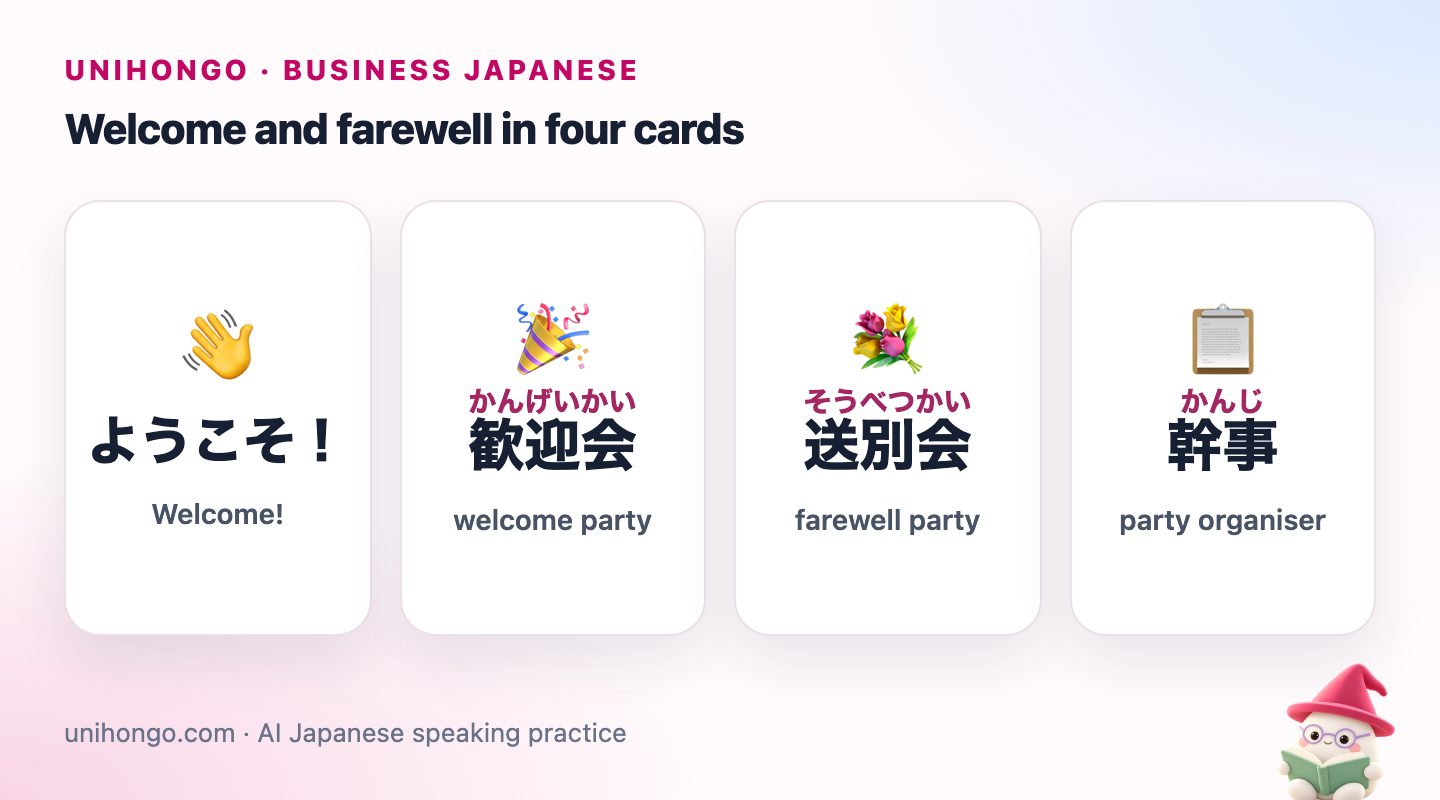
| Japanese | Romaji | Meaning |
|---|---|---|
| ようこそ! | Yōkoso! | Welcome! |
| 歓迎会 | kangeikai | welcome party |
| 送別会 | sōbetsukai | farewell party |
| 幹事 | kanji | party organiser |
Note that kanji here means organiser, not Chinese characters; the two words sound the same but are written differently. In April, when new graduates join, many teams hold a combined party, kansōgeikai (歓送迎会), that welcomes newcomers and sees off people who are transferring.
How the evening runs
The structure is predictable, which helps if your Japanese is still growing. Most parties last about two hours, often with an all-you-can-drink course, and a second round, nijikai, for those who want it.
| Japanese | Romaji | Meaning |
|---|---|---|
| いつ挨拶すればいいですか。 | Itsu aisatsu sureba ii desu ka. | When should I give my speech? |
| 二次会 | nijikai | the second party |
| 乾杯の音頭 | kanpai no ondo | leading the toast |
| Stage | Who speaks | What happens |
|---|---|---|
| Opening | The organiser | A short welcome and an outline of the evening |
| Opening words | A manager or senior person | Welcomes newcomers or thanks the person leaving |
| Toast | Often the manager or a senior colleague | Everyone raises a glass and says kanpai |
| Eating and talking | Everyone | People move around and talk to the guest of honour |
| Guest of honour speech | The new or leaving person | A short self-introduction or a thank-you speech |
| Closing | A senior person or the organiser | A closing word, sometimes a round of rhythmic clapping |
The order changes from team to team; in some groups the newcomer speaks right after the toast. Ask the organiser beforehand when you will speak, so you are ready.
Your welcome speech, line by line
The welcome speech is short and warm. Colleagues want to know who you are and that you are friendly, not your full career. Say your name, your team, one line about your background, one personal detail that gives people something to ask about later, and close with the standard request. Polite desu and masu forms are right for this speech even in a relaxed team.
| Japanese | Romaji | Meaning |
|---|---|---|
| 本日はありがとうございます。 | Honjitsu wa arigatō gozaimasu. | Thank you for tonight. |
| 営業部に配属されたマリアです。 | Eigyōbu ni haizoku sareta Maria desu. | I'm Maria, newly assigned to the sales team. |
| 前はスペインのIT企業で働いていました。 | Mae wa Supein no IT kigyō de hataraite imashita. | Before this I worked at an IT company in Spain. |
| 趣味はハイキングです。 | Shumi wa haikingu desu. | My hobby is hiking. |
| ご迷惑をおかけするかもしれませんが、 | Gomeiwaku o okake suru kamo shiremasen ga, | I may cause you some trouble, but |
| 精一杯頑張ります。 | Sei ippai ganbarimasu. | I'll do my very best. |
| よろしくお願いいたします。 | Yoroshiku onegai itashimasu. | I look forward to working with you. |
At the table: questions you will hear
After the speeches, people will come over to talk. As the guest of honour, expect the same questions many times; preparing two-sentence answers makes the evening far easier. You will also be poured drinks. Accept the first with thanks; if you do not drink, a soft drink is fine.
| Japanese | Romaji | Meaning |
|---|---|---|
| 日本は何年目ですか。 | Nihon wa nan nen me desu ka. | Colleague: How many years have you been in Japan? |
| 三年目です。 | San nen me desu. | This is my third year. |
| どうして日本に来たんですか。 | Dōshite Nihon ni kita n desu ka. | Colleague: Why did you come to Japan? |
| 休みの日は何をしていますか。 | Yasumi no hi wa nani o shite imasu ka. | Colleague: What do you do on your days off? |
| ぜひ色々教えてください。 | Zehi iroiro oshiete kudasai. | Please teach me all sorts of things. |
The farewell party: thanks, a memory and a gift
At a sōbetsukai the person leaving gives a thank-you speech, usually near the end. It follows a simple shape: thanks for everything, one specific memory, what you will do next if you want to share it, and a wish for the team. Colleagues often present a bouquet, hanataba, and sometimes a small gift and a card with messages from everyone, yosegaki. The gift is usually paid for from the shared party money.
Farewells in Japan often happen at the end of March, when transfers and retirements take effect, so you may attend several sōbetsukai in one season.
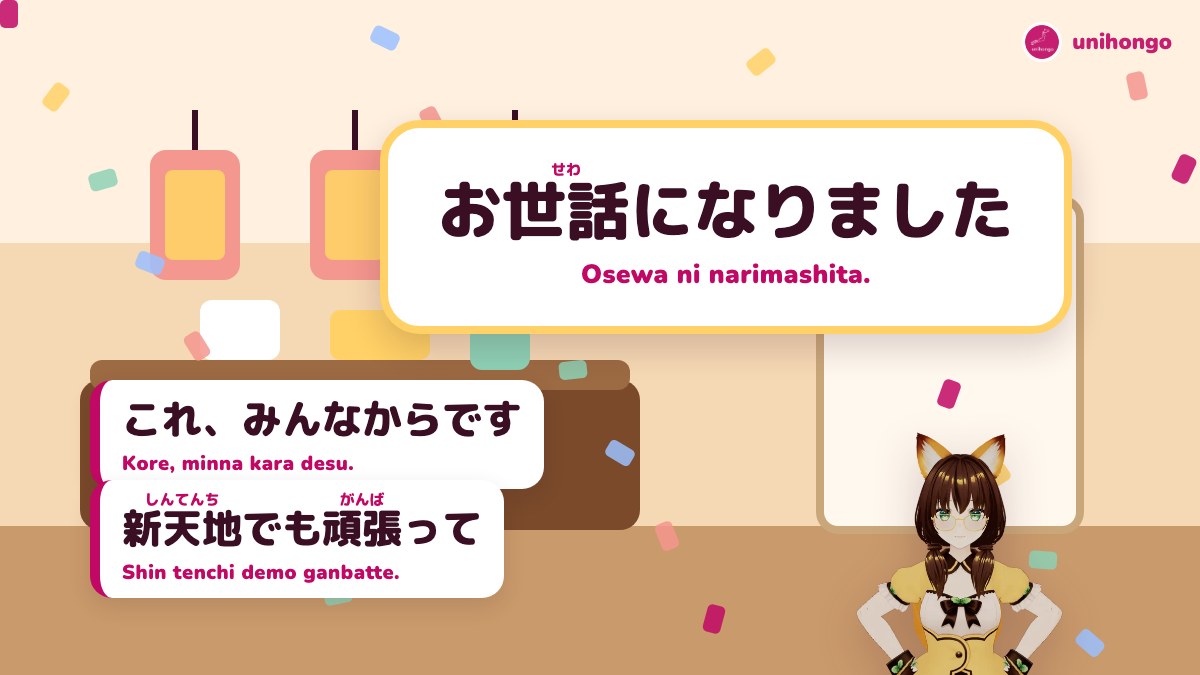
| Japanese | Romaji | Meaning |
|---|---|---|
| 大変お世話になりました。 | Taihen osewa ni narimashita. | Thank you for all your help. |
| 最初のプロジェクトが一番の思い出です。 | Saisho no purojekuto ga ichiban no omoide desu. | My first project is my best memory. |
| 新天地でも頑張ってください。 | Shin tenchi demo ganbatte kudasai. | Good luck in your new place. |
| これ、みんなからです。 | Kore, minna kara desu. | This is from all of us. |
| 皆さんもお元気で。 | Minasan mo ogenki de. | Take care, all of you. |
Money, seats and other quiet rules
| Japanese | Romaji | Meaning |
|---|---|---|
| 私も払いましょうか。 | Watashi mo haraimashō ka. | Shall I pay too? |
| 今日は主役だから、いいよ。 | Kyō wa shuyaku dakara, ii yo. | Organiser: You're the guest of honour today, it's fine. |
| 昨日はありがとうございました。 | Kinō wa arigatō gozaimashita. | Thank you for yesterday. |
- Who pays: guests of honour are often treated, and the rest split the cost, sometimes with senior staff paying more. Some teams split evenly. Ask the organiser quietly rather than reaching for your wallet at the end.
- Seats: the seat furthest from the door, kamiza, traditionally goes to the most senior person or the guest of honour. Wait to be shown where to sit.
- Drinks: wait for the toast before drinking. If you do not drink alcohol, order oolong tea or a soft drink and join the toast with it.
- Leaving: you may leave after the first party; the second round is optional. Thank the organiser before you go.
- The next morning: thank the organiser and your manager again, for example sakujitsu wa arigatō gozaimashita.
Common mistakes
- Giving a five-minute speech. People are hungry and the drinks are poured; aim for under a minute.
- Only talking to the one colleague who speaks your language. The point of the party is to meet the team.
- Forgetting to thank the organiser, who gave up time to plan the evening.
- Treating a farewell as the moment to air complaints about the company. Keep it warm and forward-looking.
- Assuming everyone goes to the second party. It is fine to say you will leave after the first one.
Say your speech to a real listener
A speech you have only read silently tends to come out too fast. Write your four lines, then ask Mocchi to check them with /correct and to suggest one friendlier phrase for your personal detail.
Next, open AI Sensei with Haru-sensei and ask the Sensei to play a team manager who welcomes you, listens to your self-introduction and asks two follow-up questions about your background. Repeat it until you can give the speech without your notes, then ask the Sensei to switch to the farewell party.