
The words in four cards
Japanese uses short English-based words for the main kinds of workplace harassment, and everyone from HR to the news uses them. Harasumento is the full word, often shortened to hara.
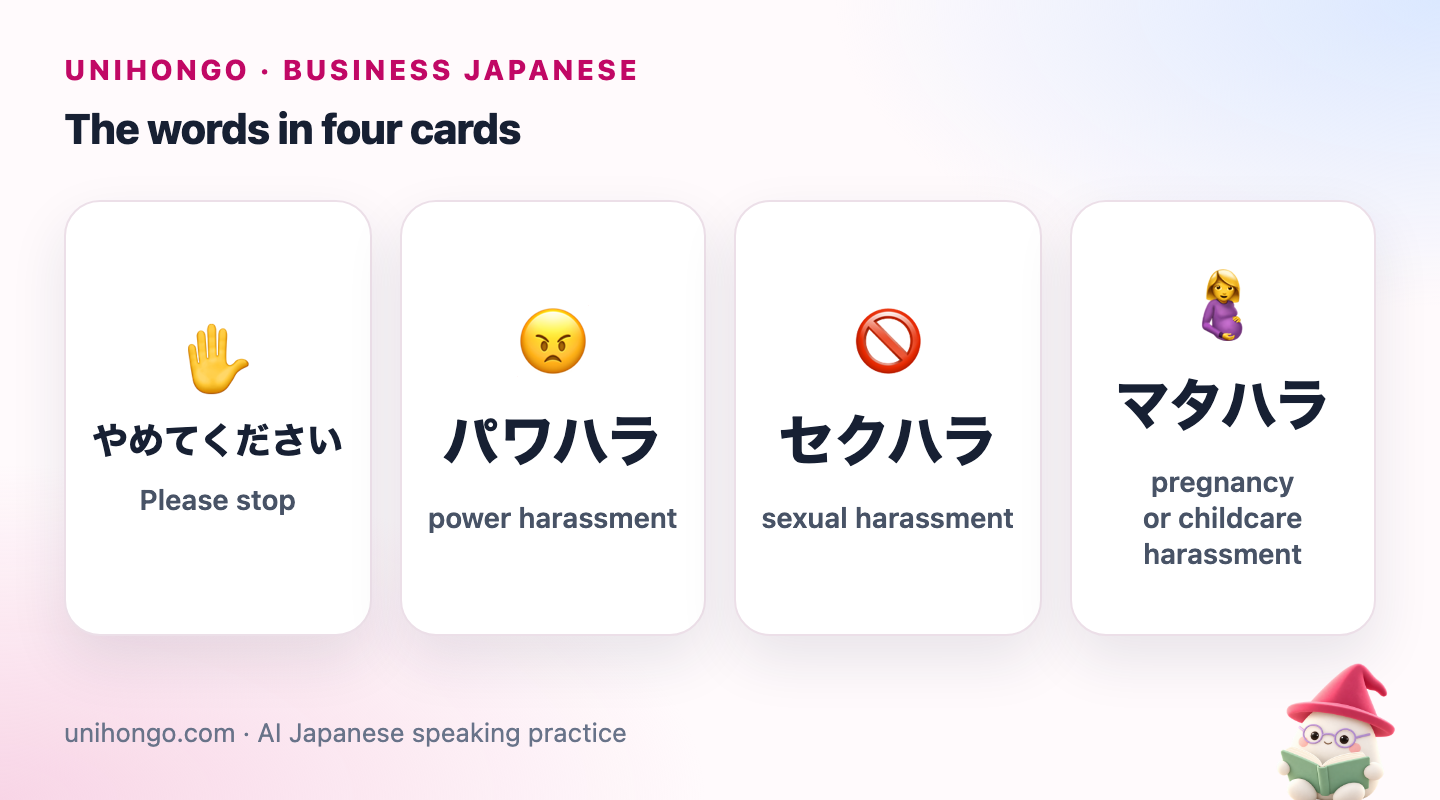
| Japanese | Romaji | Meaning |
|---|---|---|
| やめてください | Yamete kudasai | Please stop |
| パワハラ | pawahara | power harassment |
| セクハラ | sekuhara | sexual harassment |
| マタハラ | matahara | pregnancy or childcare harassment |
You will also see patahara for harassment of fathers who take childcare leave, kasuhara for abuse by customers, and arahara for pressure to drink. The formal legal terms are longer, such as pawā harasumento, but the short forms are fine in conversation and in a consultation.
What employers are expected to do
Japanese law requires employers to take measures against power harassment, sexual harassment and harassment over pregnancy, childbirth and childcare leave. For power harassment this has applied to all employers, including small companies, since 2022. In practice the measures usually include a clear company policy, training, a consultation desk, sōdan madoguchi, prompt investigation, protection of privacy, and a ban on unfavourable treatment of people who consult.
Government guidelines describe power harassment by three elements: it uses a superior position or relationship, it goes beyond what is necessary and appropriate for the work, and it harms the working environment. A clear instruction or fair criticism of your work is not harassment; repeated insults in front of others, threats, or excluding you from the team can be. Guidelines list six typical kinds.
| Type | Japanese term | Example |
|---|---|---|
| Physical attack | shintaiteki na kōgeki | Hitting, kicking, throwing objects |
| Mental attack | seishinteki na kōgeki | Insults, threats, humiliation in front of others |
| Isolation | ningen kankei kara no kirihanashi | Being shut out of meetings or ignored on purpose |
| Excessive demands | kadai na yōkyū | Clearly impossible work unrelated to the job |
| Too little work | kashō na yōkyū | Being given no work or meaningless tasks as punishment |
| Intrusion into private life | ko no shingai | Prying into family, health or relationships |
Company systems and how well they work differ a lot. Read your work rules, shūgyō kisoku, or the intranet page on harassment to see who the contact is.
Keep a record others can understand
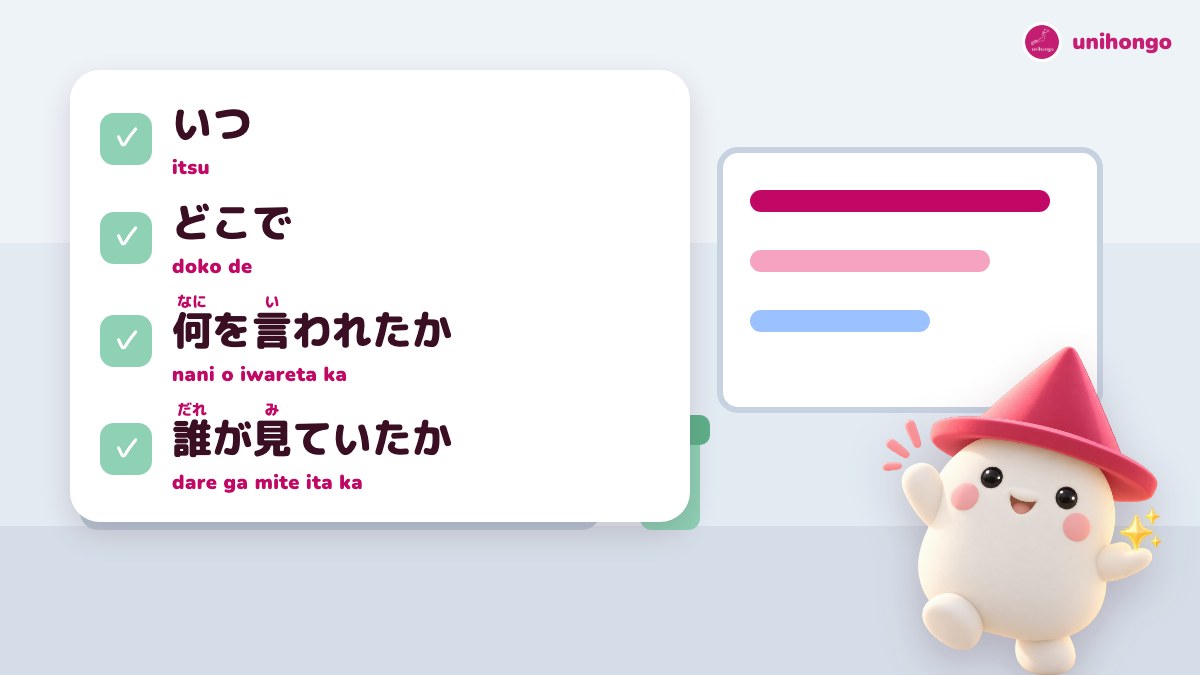
Whoever you ask for help will want facts. A short, dated log written soon after each incident is much more useful than a long description of how bad things feel overall. Write it in the language you are comfortable with; you can translate key points later.
| Japanese | Romaji | Meaning |
|---|---|---|
| いつ、どこで、何を言われたか | Itsu, doko de, nani o iwareta ka | When, where and what was said |
| 記録を残しています。 | Kiroku o nokoshite imasu. | I'm keeping a record. |
| その場に同僚もいました。 | Sono ba ni dōryō mo imashita. | A colleague was there too. |
| メールが残っています。 | Mēru ga nokotte imasu. | I still have the emails. |
- Date, time and place of each incident.
- Exactly what was said or done, as close to the words as you can remember.
- Who was present or might have seen or heard it.
- How it affected you or your work, including any doctor visits.
- Emails, chat messages and documents, saved outside work devices if company rules allow.
Saying no in the moment
You do not have to respond in the moment, and staying safe matters more than finding the perfect words. If you can, a short, calm boundary said clearly is often enough to show that the behaviour is not acceptable. Polite Japanese does not make it weaker: a quiet, firm sentence in desu form is serious.
| Japanese | Romaji | Meaning |
|---|---|---|
| やめてください。 | Yamete kudasai. | Please stop. |
| そういう発言は困ります。 | Sō iu hatsugen wa komarimasu. | Comments like that are not OK with me. |
| それは仕事に関係ないと思います。 | Sore wa shigoto ni kankei nai to omoimasu. | I don't think that's related to work. |
| 触らないでください。 | Sawaranaide kudasai. | Please don't touch me. |
| 今のは不快でした。 | Ima no wa fukai deshita. | What you just said made me uncomfortable. |
Komarimasu, literally it troubles me, is a common, clear way to object in Japanese. It is not a sign of weakness; at work it means you will not accept something.
Asking for help inside the company
The first stop is usually the company's harassment consultation desk, HR, or a manager you trust who is not involved. Ask for a private meeting, give your record, and say what you want: for the behaviour to stop, a change of seat or team, an investigation. Ask how your privacy will be protected and what happens next.
| Japanese | Romaji | Meaning |
|---|---|---|
| ご相談したいことがあります。 | Gosōdan shitai koto ga arimasu. | There is something I'd like to consult you about. |
| 二人でお話しできますか。 | Futari de ohanashi dekimasu ka. | Could we talk in private? |
| 上司の言動について相談したいです。 | Jōshi no gendō ni tsuite sōdan shitai desu. | I'd like to consult about my boss's behaviour. |
| 相談したことは秘密にしてもらえますか。 | Sōdan shita koto wa himitsu ni shite moraemasu ka. | Can you keep this consultation confidential? |
| 今後どうなりますか。 | Kongo dō narimasu ka. | What happens next? |
Outside help: where to ask
If the company does not respond, or the person harassing you is the person you would normally report to, you can ask outside services. These are the main options; contact details change, so search for the current page.
| Japanese | Romaji | Meaning |
|---|---|---|
| 総合労働相談コーナー | sōgō rōdō sōdan kōnā | labour consultation corner |
| 労働局 | rōdōkyoku | prefectural labour bureau |
| 相談は無料ですか。 | Sōdan wa muryō desu ka. | Is the consultation free? |
| 英語で相談できますか。 | Eigo de sōdan dekimasu ka. | Can I consult in English? |
- Comprehensive labour consultation corners, sōgō rōdō sōdan kōnā, at each prefectural labour bureau and labour standards inspection office: free, confidential advice on harassment and other workplace problems, by phone or in person. The labour bureau can also give advice to the company or offer mediation in some cases.
- Consultation for foreign workers: the Ministry of Health, Labour and Welfare lists phone lines and corners in several languages. Check the ministry's or your labour bureau's website for current numbers.
- A labour union, rōdō kumiai, if your company has one or if you join an outside union.
- Lawyers and the Japan Legal Support Center, Hō Terasu, which gives information on legal services.
- Your city's consultation services for residents, including foreign resident support centres in many cities.
- For violence, threats or sexual assault: the police on 110.
Things that surprise people
- Strict feedback is not always harassment. Clear instructions and fair criticism of your work are part of the job; the line is personal attacks, threats, humiliation and excessive treatment.
- Drinking events count. Pressure to drink, comments at a party and messages after work can all be raised with the consultation desk.
- Customers too. Many employers now have policies for abusive customers, and staff are allowed to ask a manager to take over.
- You may consult before deciding anything. Asking for advice does not commit you to a formal complaint.
- Retaliation is itself a problem. If you are moved, ignored or threatened after consulting, add it to your record and tell the advisor.
Find the words while you are calm
Writing to HR is easier when you are not starting from a blank page. You could ask Mocchi: help me write a short, polite email in Japanese asking HR for a private consultation about my manager's comments. Mocchi drafts it with you, explains the polite forms and checks your edits with /correct.
To sound calm even when you do not feel it, try the sentence intonation drills in the pronunciation coach: they train the steady, even tone that polite requests need.