
The commuter pass in four words
Teiki is short for teikiken, a fixed-period ticket. You choose a starting station and an end station, the railway prints that section on the pass, and for the whole period you can ride it as often as you like. For a daily commute the pass usually costs much less than paying each fare, which is why almost every worker and student in a city has one.
There are two kinds. A tsūkin teiki is for commuting to work and anyone can buy it. A tsūgaku teiki is the cheaper student pass for people enrolled at an eligible school. On the gate display and on receipts you will also see the section, kukan, which is the stretch of line the pass covers.
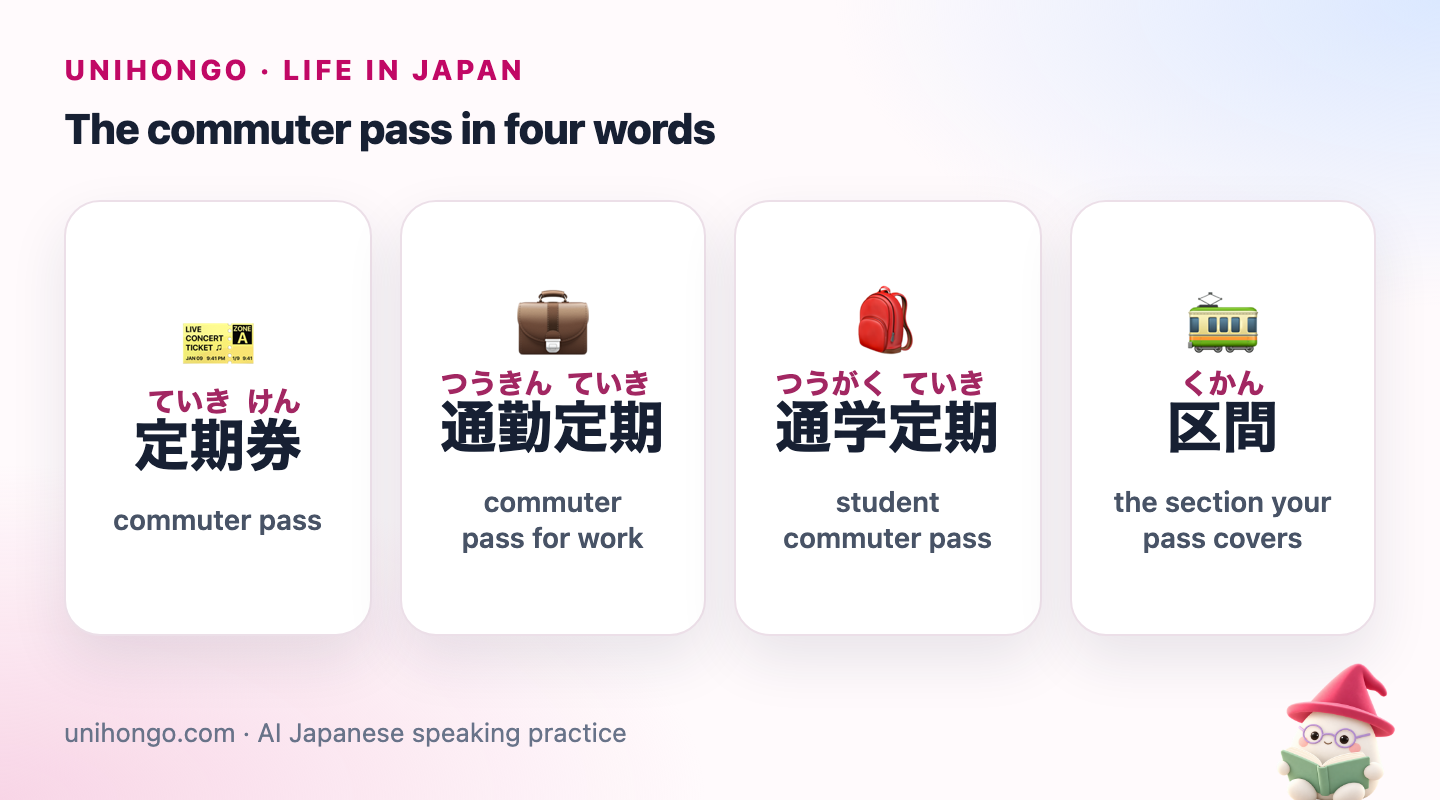
| Japanese | Romaji | Meaning |
|---|---|---|
| 定期券 | teikiken | commuter pass |
| 通勤定期 | tsūkin teiki | commuter pass for work |
| 通学定期 | tsūgaku teiki | student commuter pass |
| 区間 | kukan | the section your pass covers |
| 定期、持ってる? | Teiki, motteru? | Friend: Do you have a pass? (casual) |
Route, period and the words on the screen
When you buy a pass, the machine or the clerk asks for five things: the two stations, the route if there is more than one way between them, the period, the start date, and whether this is a new pass or a renewal. The route matters because the pass is valid only on the lines you choose. If two lines connect your stations, the pass names the one it goes via, keiyu, and the other line is not covered.
| Japanese | Romaji | Meaning |
|---|---|---|
| 新規 | shinki | new pass |
| 継続 | keizoku | renewal of the same pass |
| 経由 | keiyu | via (the route) |
| 使用開始日 | shiyō kaishi bi | start date |
| 有効期限 | yūkō kigen | expiry date |
| 一か月 | ikkagetsu | one month |
| 三か月 | sankagetsu | three months |
| 六か月 | rokkagetsu | six months |
| Choice | Usual options | What to think about |
|---|---|---|
| Period | 1, 3 or 6 months | Longer periods cost less per month but tie you to the route |
| Start date | Today or a later date | Match it to your first working day or the day the old pass ends |
| Route | Via one named line or station | Pick the route your company approved for the allowance |
| New or renewal | New pass or continue the old one | Renewing keeps the same section and starts the day after it expires |
Buying a pass at the machine, the counter or on your phone
There are three common ways to buy a pass, and which ones you can use depends on the railway and the kind of pass.
| Japanese | Romaji | Meaning |
|---|---|---|
| 定期券売り場はどこですか。 | Teikiken uriba wa doko desu ka. | Where is the commuter pass office? |
| この機械で定期は買えますか。 | Kono kikai de teiki wa kaemasu ka. | Can I buy a pass at this machine? |
| 通勤定期を買いたいんですが。 | Tsūkin teiki o kaitai n desu ga. | I'd like to buy a commuter pass for work. |
| スイカに定期を入れたいです。 | Suika ni teiki o iretai desu. | I want to put a pass on my Suica. |
- At a ticket machine that sells passes. Not every machine does; look for a machine labelled for passes or a multi-function machine, choose the pass button, and follow the steps. Many machines have an English mode.
- At the pass office, teikiken uriba, or a staffed ticket office. This is the safest choice for your first student pass, a route with transfers between companies, or anything unusual.
- In a mobile app such as Mobile Suica or Mobile PASMO, if your phone supports it. A pass on your phone works at the gate like a card. Student passes on a phone often need extra registration first.
On an IC card the pass and the stored value live together. Inside your section the gate uses the pass; if you ride further, it takes the extra fare from the stored value. You can also use the stored value in shops and on other lines, just as before. A pass printed on a paper magnetic ticket still exists in some places, but IC passes are the norm in big cities.
Student passes: the certificate and who can get one
A tsūgaku teiki is much cheaper than a work pass, so the railway checks that you really are a student at an eligible school. For a first purchase you normally bring a commuting certificate, tsūgaku shōmeisho, issued by your school, or a student ID that includes the railway's required details, plus the form you fill in at the counter. The pass covers the route between your home and the school's nearest station.
Universities, high schools and many vocational schools are eligible. Japanese-language schools vary: some are recognised for student passes and some are not. Ask your school office before you go to the station, and ask whether they issue the certificate or whether the student ID is enough.
| Japanese | Romaji | Meaning |
|---|---|---|
| 通学証明書をください。 | Tsūgaku shōmeisho o kudasai. | Please give me a commuting certificate. (at school) |
| 学生証を見せてください。 | Gakuseishō o misete kudasai. | Clerk: Please show me your student ID. |
| うちの学校は通学定期の対象ですか。 | Uchi no gakkō wa tsūgaku teiki no taishō desu ka. | Is our school eligible for student passes? |
Mini dialogue at the pass office
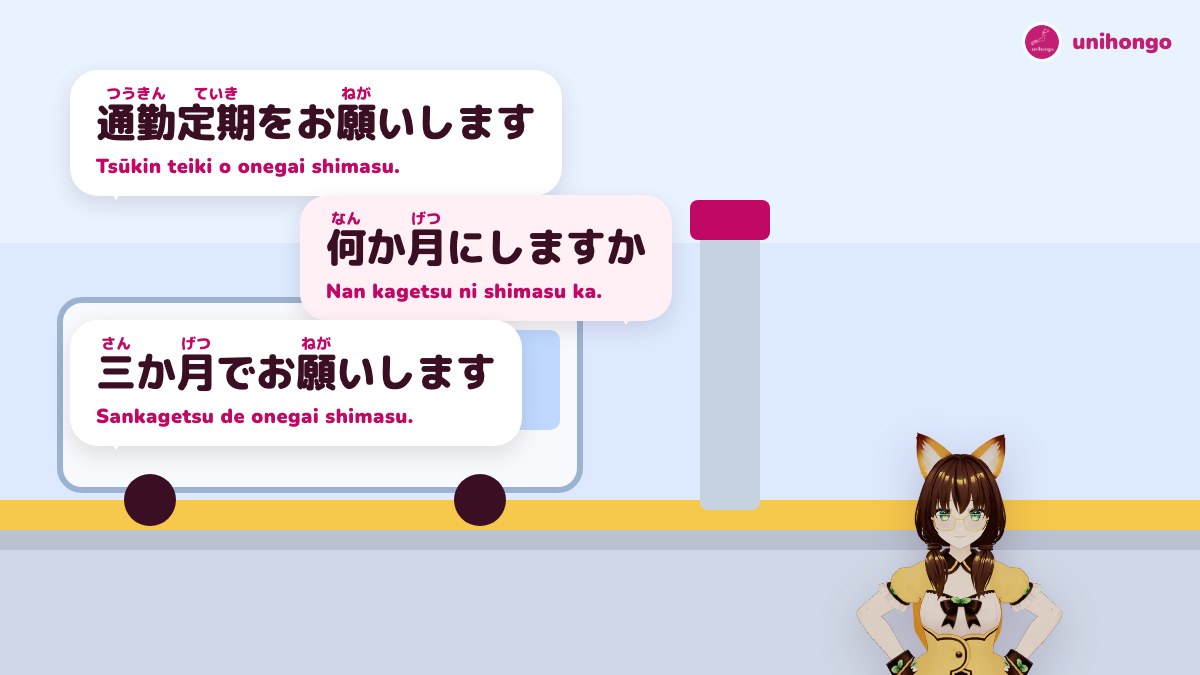
Here is a typical first purchase at a staffed counter. The clerk speaks polite Japanese and follows the same order as the machine: section, route, period, start date. Listen for nan kagetsu, how many months, and itsu kara, from when.
| Japanese | Romaji | Meaning |
|---|---|---|
| 通勤定期をお願いします。 | Tsūkin teiki o onegai shimasu. | You: A commuter pass for work, please. |
| どちらからどちらまでですか。 | Dochira kara dochira made desu ka. | Clerk: From which station to which station? |
| 中野から新宿までです。 | Nakano kara Shinjuku made desu. | You: From Nakano to Shinjuku. |
| 何か月にしますか。 | Nan kagetsu ni shimasu ka. | Clerk: How many months would you like? |
| 三か月でお願いします。 | Sankagetsu de onegai shimasu. | You: Three months, please. |
| いつからお使いになりますか。 | Itsu kara otsukai ni narimasu ka. | Clerk: From when will you use it? |
| 来週の月曜日からです。 | Raishū no getsuyōbi kara desu. | You: From next Monday. |
| こちらのカードに入れますか。 | Kochira no kādo ni iremasu ka. | Clerk: Shall I put it on this card? |
The company commuting allowance
Many Japanese employers pay a commuting allowance, tsūkin teate, on top of your salary. When you join, HR usually asks you to submit your route, tsūkin keiro, on a form or in an online system: home station, work station, lines and the pass price. Companies normally pay for the most reasonable route, not necessarily the one you would prefer, and some set an upper limit. Some pay the six-month pass price once, others add a monthly amount to your payslip, and part-time and contract workers may have different rules.
The allowance usually appears on your payslip as its own line. Up to a limit it is generally treated differently from salary for income tax, but rules on tax and social insurance are technical, so ask HR or the tax office if you need the details. What matters day to day: if your route changes, tell HR before you change the pass, because the allowance is based on the route you registered.
| Japanese | Romaji | Meaning |
|---|---|---|
| 通勤手当 | tsūkin teate | commuting allowance |
| 通勤経路 | tsūkin keiro | commuting route |
| 通勤経路の申請を出しました。 | Tsūkin keiro no shinsei o dashimashita. | I've submitted my commuting route. |
| 定期代は会社から出ますか。 | Teikidai wa kaisha kara demasu ka. | Does the company pay for the pass? |
| 領収書は必要ですか。 | Ryōshūsho wa hitsuyō desu ka. | Do you need the receipt? |
Moving, changing jobs and getting a refund
When your route changes, you have two options. You can change the section, kukan henkō, at the pass office, or cancel the pass and buy a new one. To cancel, ask for a refund, haraimodoshi. On most railways the refund is calculated by charging the months you have already used at the normal pass rate, subtracting a handling fee, and returning the rest. If less than a month is left, there is often nothing to refund. The exact rules differ by company, so ask at the counter.
If you lose a named IC pass, go to the station office quickly. A registered pass can usually be stopped and reissued, saihakkō, for a fee, and you need ID. That is one reason commuter passes are always issued in your name.
| Japanese | Romaji | Meaning |
|---|---|---|
| 定期を払い戻したいんですが。 | Teiki o haraimodoshitai n desu ga. | I'd like a refund on my pass. |
| 区間を変更できますか。 | Kukan o henkō dekimasu ka. | Can I change the section? |
| 引っ越すので、経路が変わります。 | Hikkosu node, keiro ga kawarimasu. | I'm moving, so my route will change. |
| 定期をなくしてしまいました。 | Teiki o nakushite shimaimashita. | I've lost my commuter pass. |
| 手数料がかかります。 | Tesūryō ga kakarimasu. | Clerk: There is a handling fee. |
Mistakes newcomers make with a teiki
- Choosing the wrong route. If two lines run between your stations, a pass via one line does not cover the other, and the gate will charge you.
- Buying a six-month pass in your probation period or right before a move. The refund rules mean you can lose more than you expect.
- Changing your route without telling HR. The allowance follows the registered route, and the company may ask you to pay back the difference.
- Forgetting the expiry date. The gate warns you shortly before the pass ends; renew it, keizoku, before the last day to keep the same section.
- Using a student pass after graduation or for a part-time job. It is valid only between home and school while you are enrolled.
Rehearse the counter before your first day
The words on the pass are a small, closed set, which makes them ideal for a quick drill. Ask Mocchi something like: quiz me on the words on a Japanese commuter pass machine, and Mocchi asks you one word at a time, explains the ones you miss and remembers them for your next review.
Then practise the spoken part. In AI Sensei, choose Hana-sensei and ask the Sensei to play the pass office clerk who asks for the section, the period and the start date, and to speak at natural speed. Your session report lists the counter phrases you used and anything to fix.