
The delay in four words
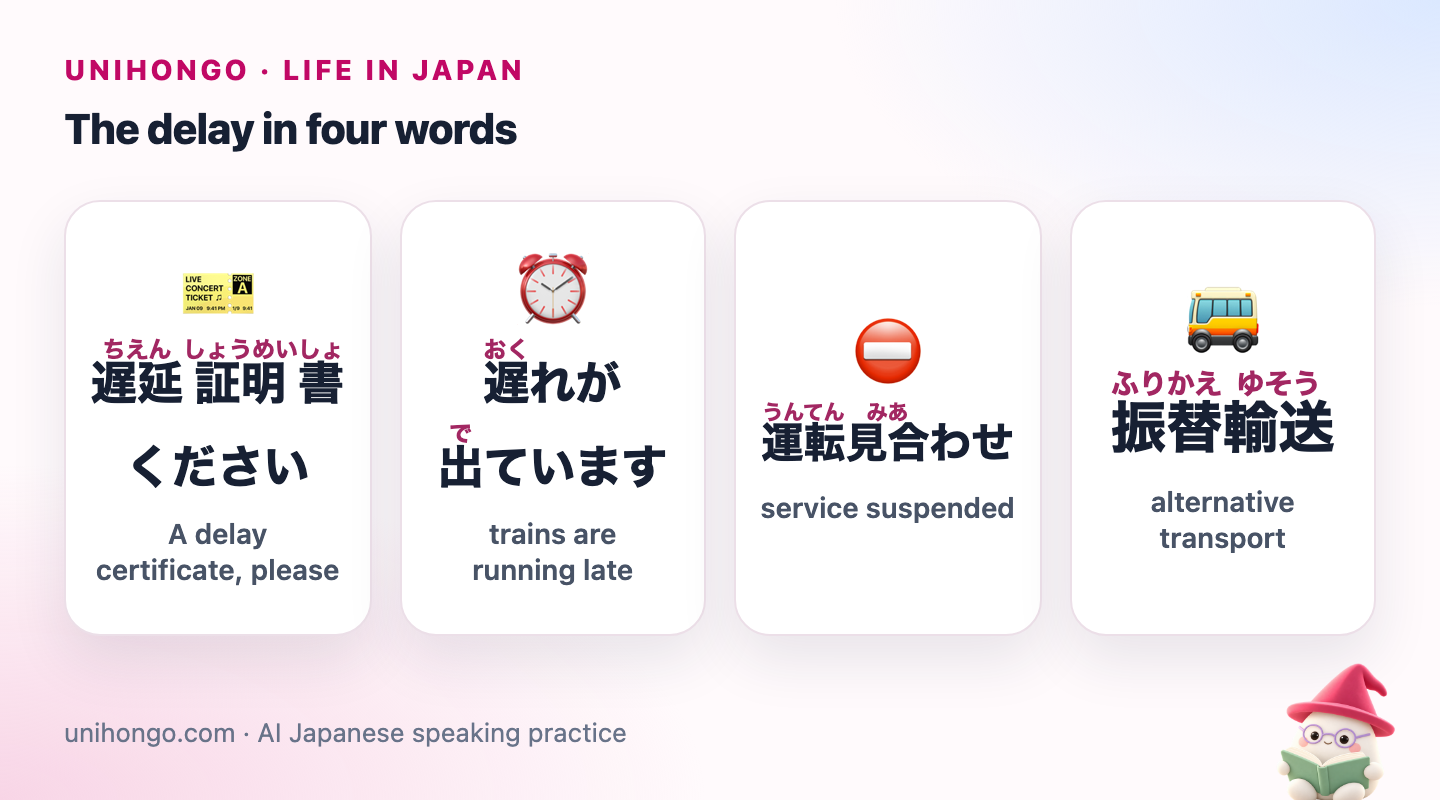
A delay unfolds in a familiar order: the certificate you will need, the announcement that trains are running late, the suspension of service, and the alternative transport you may be told to use. These four words cover most of what you will hear and read.
| Japanese | Romaji | Meaning |
|---|---|---|
| 遅延証明書ください | Chien shōmeisho kudasai | A delay certificate, please |
| 遅れが出ています | okure ga dete imasu | trains are running late |
| 運転見合わせ | unten miawase | service suspended |
| 振替輸送 | furikae yusō | alternative transport |
What the certificate is, and what it is not
The certificate states the line, the date, the direction in some cases and the length of the delay, often in ranges, such as up to ten minutes. It does not show your name or your journey, so it proves that the line was late, not that you were on it. Companies and schools accept it on that understanding.
It is not compensation. Japanese railways generally do not refund ordinary fares or commuter passes for delays. For limited express and Shinkansen tickets, separate rules may refund the express charge after a long delay; ask at the ticket office.
| Situation | What helps | What to ask for |
|---|---|---|
| Late for work after a delay | Delay certificate | Chien shōmeisho |
| Train stopped, need another route | Alternative transport ticket check at the gate | Furikae yusō |
| Limited express arrived very late | Ticket office rules on refunds | Haraimodoshi |
| Late for an exam | The certificate and the exam's own instructions | Chien shōmeisho and the exam office |
Getting a paper slip at the station
When a delay is long enough, staff stand at the ticket gates with stacks of small slips, or put them in a box beside the gate. Take one as you pass; no need to ask. If no one is handing them out, ask the attendant at the manned gate window. During major disruptions, the slips may only be available at certain stations.
If you change trains, the delay often happened on the first line, not the one you exit from. Station staff can only give certificates for their own company's lines, so take one from the delayed line or use the web version.
| Japanese | Romaji | Meaning |
|---|---|---|
| 遅延証明書はありますか。 | Chien shōmeisho wa arimasu ka. | You: Do you have delay certificates? |
| こちらからお取りください。 | Kochira kara otori kudasai. | Staff: Please take one from here. |
| 本日はウェブでの発行になります。 | Honjitsu wa webu de no hakkō ni narimasu. | Staff: Today they are issued on the website. |
| 何線の遅れですか。 | Nanisen no okure desu ka. | Staff: Which line was delayed? |
Getting it online
Most large railways publish delay certificates on their websites, listed by date, line and time slot. You pick the line and the time, then save or print the page. They usually cover the last several days, and show delays in ranges such as five minutes or more. Many people screenshot it on the phone and send it to their manager directly.
Search the railway's name with 遅延証明書 to find the page. Some railways list early-morning and late-night slots separately, so choose the slot that matches your journey.
| Japanese | Romaji | Meaning |
|---|---|---|
| 遅延証明書(ウェブ発行) | chien shōmeisho (webu hakkō) | delay certificate (web version) |
| 路線を選択 | rosen o sentaku | choose your line |
| 時間帯 | jikantai | time slot |
| 遅延時間 | chien jikan | length of delay |
Announcements that mean a certificate is coming
Delay announcements follow a pattern: what happened, which section is affected, the current state and the expected restart. These words appear on platform screens and in the railway's app too.
| Japanese | Romaji | Meaning |
|---|---|---|
| 人身事故の影響で | jinshin jiko no eikyō de | due to an accident involving a person |
| 信号トラブルのため | shingō toraburu no tame | because of a signal problem |
| 車両点検のため | sharyō tenken no tame | for a train inspection |
| 安全確認を行っております | anzen kakunin o okonatte orimasu | we are carrying out safety checks |
| 運転再開の見込みは未定です | unten saikai no mikomi wa mitei desu | the restart time is not yet known |
| 振替輸送を実施しております | furikae yusō o jisshi shite orimasu | alternative transport is available |
Furikae yusō means that your ticket or pass is accepted on other lines for the affected section. Ask at the gate for the route, and keep your IC card or ticket; the rules for IC card users differ by railway, so check with staff.
Telling work or school
Contact your manager or school as soon as you know you will be late, then submit the certificate as they prefer. Your message should say the line, the cause if you know it, and your expected arrival time. Apologise briefly; the delay is not your fault, but being late still affects others.
| Japanese | Romaji | Meaning |
|---|---|---|
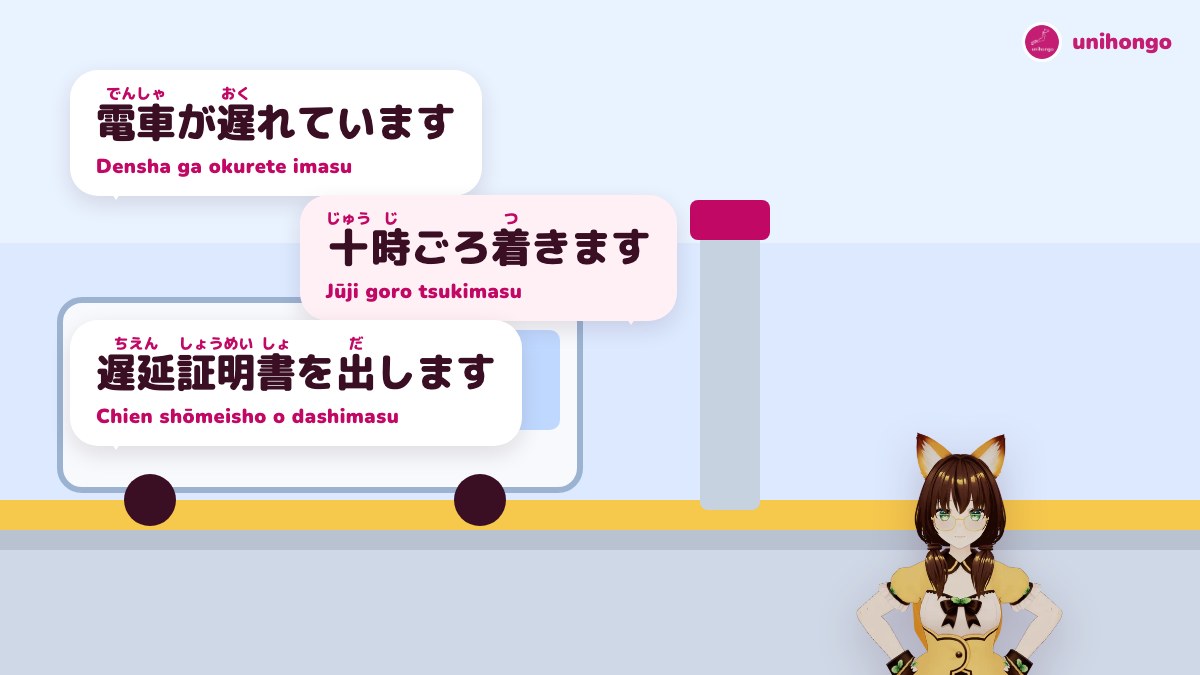
| 電車が遅れていて、十時ごろ着きます。 | Densha ga okurete ite, jūji goro tsukimasu. | You: My train is delayed; I'll arrive around ten. |
| 中央線で人身事故がありました。 | Chūōsen de jinshin jiko ga arimashita. | You: There was an accident on the Chūō Line. |
| わかりました。気をつけて来てください。 | Wakarimashita. Ki o tsukete kite kudasai. | Manager: OK. Come carefully. |
| 遅延証明書を提出します。 | Chien shōmeisho o teishutsu shimasu. | You: I'll submit a delay certificate. |
| ご迷惑をおかけしてすみません。 | Gomeiwaku o okake shite sumimasen. | You: Sorry for the inconvenience. |
For entrance exams and certification tests, the organiser usually publishes rules for train delays, such as a later start for affected candidates. Keep the certificate and follow the instructions on your admission ticket.
Mini dialogue: at the gate during a suspension
When a line stops, the manned gate window gets busy with the same three questions: is there a certificate, how do I get there another way, and when will it restart. Keep your question short and have your IC card or pass ready, because staff may need to see it to let you through for alternative transport.
| Japanese | Romaji | Meaning |
|---|---|---|
| すみません、遅延証明書はありますか。 | Sumimasen, chien shōmeisho wa arimasu ka. | You: Excuse me, are there delay certificates? |
| はい、どうぞ。三十分の遅れです。 | Hai, dōzo. Sanjuppun no okure desu. | Staff: Here you are. A thirty-minute delay. |
| 新宿へ行きたいんですが、振替輸送はありますか。 | Shinjuku e ikitain desu ga, furikae yusō wa arimasu ka. | You: I need Shinjuku. Is there alternative transport? |
| 地下鉄をご利用ください。 | Chikatetsu o goriyō kudasai. | Staff: Please use the subway. |
| 運転再開はいつごろですか。 | Unten saikai wa itsu goro desu ka. | You: Roughly when will it restart? |
| まだわかりません。 | Mada wakarimasen. | Staff: We don't know yet. |
Goriyō kudasai, please use, is the polite instruction you hear in every station. When the answer is mada wakarimasen, it is honest, not unhelpful: the restart depends on the cause. Decide quickly whether to wait or switch routes, and send your manager an update either way.
Things that surprise newcomers
- Certificates are routine, not a complaint. Nobody at the station minds giving one.
- Leaving later than usual and blaming a small delay does not work well; the certificate shows only the line's delay range.
- Some workplaces ask for certificates every time, others never. Ask once, and follow the local habit.
- A suspended line can mean a long walk to another line. Check alternative transport before queueing.
Make the late call sound calm
The phone call to your manager is the hardest part, because you are standing on a crowded platform. Unihongo's Call Work About a Train Delay mission puts AI Sensei in the role of your manager: you explain the delay, give your arrival time and apologise, until every objective is ticked. Pick Ibuki-sensei, and ask for a busy manager who replies quickly once you are comfortable.
Before that, ask Mocchi to explain the delay announcement words, unten miawase, furikae yusō and unten saikai, with an example for each, and to quiz you on them later.