
The four lines that matter most
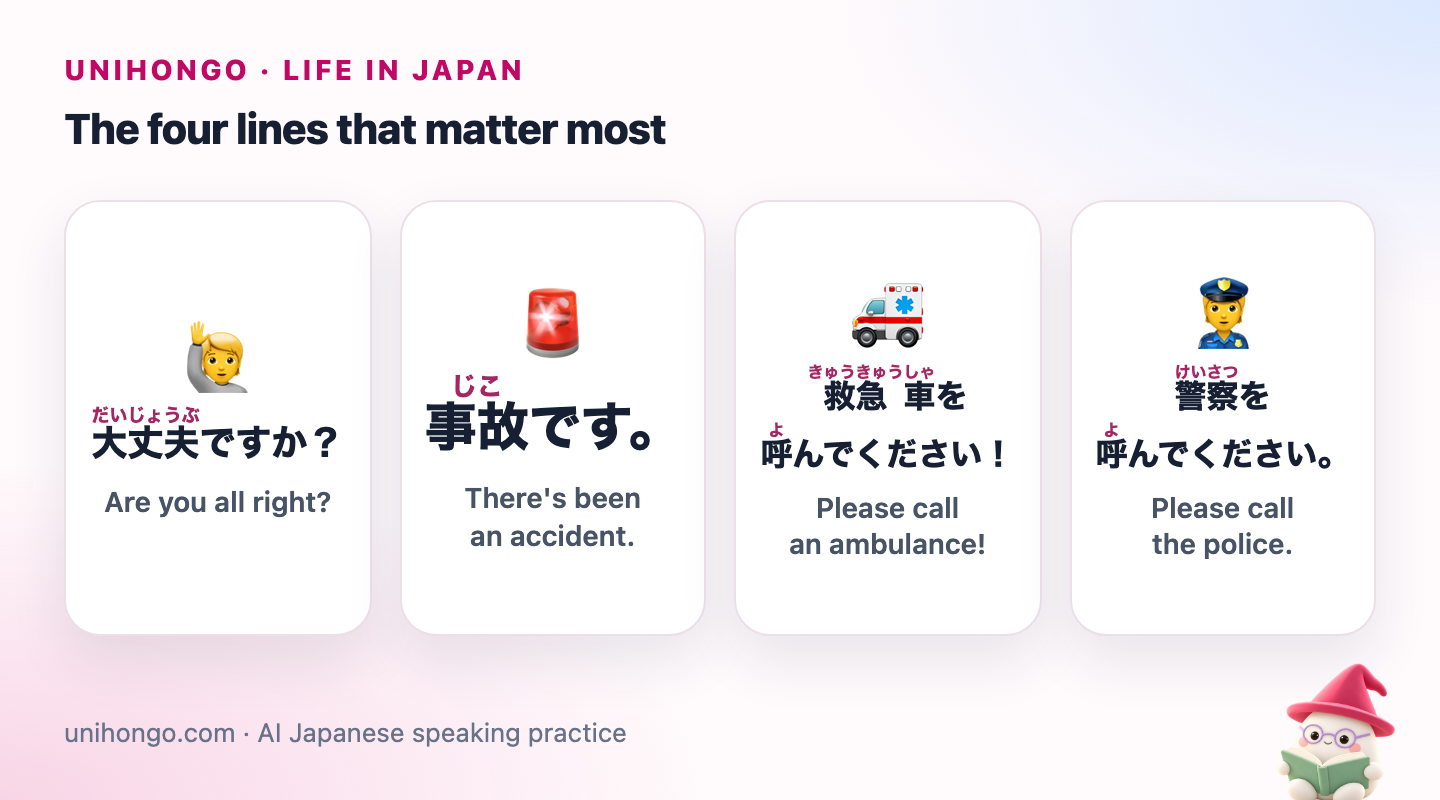
In the first minute you need only a few words: to check on the other person, to report an accident, to ask for an ambulance and to ask someone to call the police. Short, clear words are better than perfect sentences.
| Japanese | Romaji | Meaning |
|---|---|---|
| 大丈夫ですか? | Daijōbu desu ka? | Are you all right? |
| 事故です。 | Jiko desu. | There's been an accident. |
| 救急車を呼んでください! | Kyūkyūsha o yonde kudasai! | Please call an ambulance! |
| 警察を呼んでください。 | Keisatsu o yonde kudasai. | Please call the police. |
The steps, in order
Japanese law sets out the duties of a driver involved in an accident: stop, help the injured, prevent further danger and report to the police. In practice the order looks like this.
- Stop the vehicle where it is safe, switch on the hazard lights, and set up a warning triangle if you have one, especially on fast roads. On an expressway, get behind the barrier.
- Check for injuries. If anyone is hurt, call 119. Do not move an injured person unless there is immediate danger.
- Call 110 and report the accident, even if it is small.
- Exchange details with the other party and take photos of the vehicles, the position and the road.
- Wait for the police, answer their questions and note the officer's police station.
- Call your insurance company's accident line, which usually works around the clock.
- See a doctor if you feel any pain, even the next day, and keep the receipts.
Calling 119 and 110
Both lines start with a question that sorts the call. Answer with the key word, then the location. If you do not know the address, give a landmark, a shop name, a road number or a junction name, and stay on the line.
| Japanese | Romaji | Meaning |
|---|---|---|
| 火事ですか、救急ですか。 | Kaji desu ka, kyūkyū desu ka. | 119: Is it a fire or an ambulance? |
| 救急です。交通事故でけが人がいます。 | Kyūkyū desu. Kōtsū jiko de keganin ga imasu. | You: Ambulance. A traffic accident with an injured person. |
| 事件ですか、事故ですか。 | Jiken desu ka, jiko desu ka. | 110: Is it an incident or an accident? |
| 事故です。車と自転車の事故です。 | Jiko desu. Kuruma to jitensha no jiko desu. | You: An accident, between a car and a bicycle. |
| 場所はどこですか。 | Basho wa doko desu ka. | Operator: Where are you? |
| コンビニの前の交差点です。 | Konbini no mae no kōsaten desu. | You: At the junction in front of a convenience store. |
| 日本語があまり話せません。 | Nihongo ga amari hanasemasen. | You: I don't speak much Japanese. |
Exchanging details with the other party
Write down or photograph the other driver's licence and plate, and give your own details in return. If the other vehicle is a company car, note the company too. Collect a witness's name and phone number if someone saw what happened.
| Japanese | Romaji | Meaning |
|---|---|---|
| 連絡先を交換しましょう。 | Renrakusaki o kōkan shimashō. | Let's exchange contact details. |
| 免許証を見せてもらえますか。 | Menkyoshō o misete moraemasu ka. | May I see your driving licence? |
| 保険会社はどこですか。 | Hoken gaisha wa doko desu ka. | Which insurance company are you with? |
| ここで示談はできません。 | Koko de jidan wa dekimasen. | I can't settle it here. |
| Detail | Japanese word | Why it matters |
|---|---|---|
| Name and address | Shimei, jūsho | For the police report and the insurers |
| Phone number | Denwa bangō | Your insurer will contact them |
| Plate number | Nanbā | Identifies the vehicle |
| Insurance company | Hoken gaisha | The insurers handle the claim between them |
| Vehicle owner or employer | Shoyūsha, kinmusaki | The driver may not be the owner |
If the other party offers cash to keep the police out of it, decline politely. Jidan, a private settlement, should go through your insurer, and skipping the police report leaves you without the certificate you will need.
When the police arrive
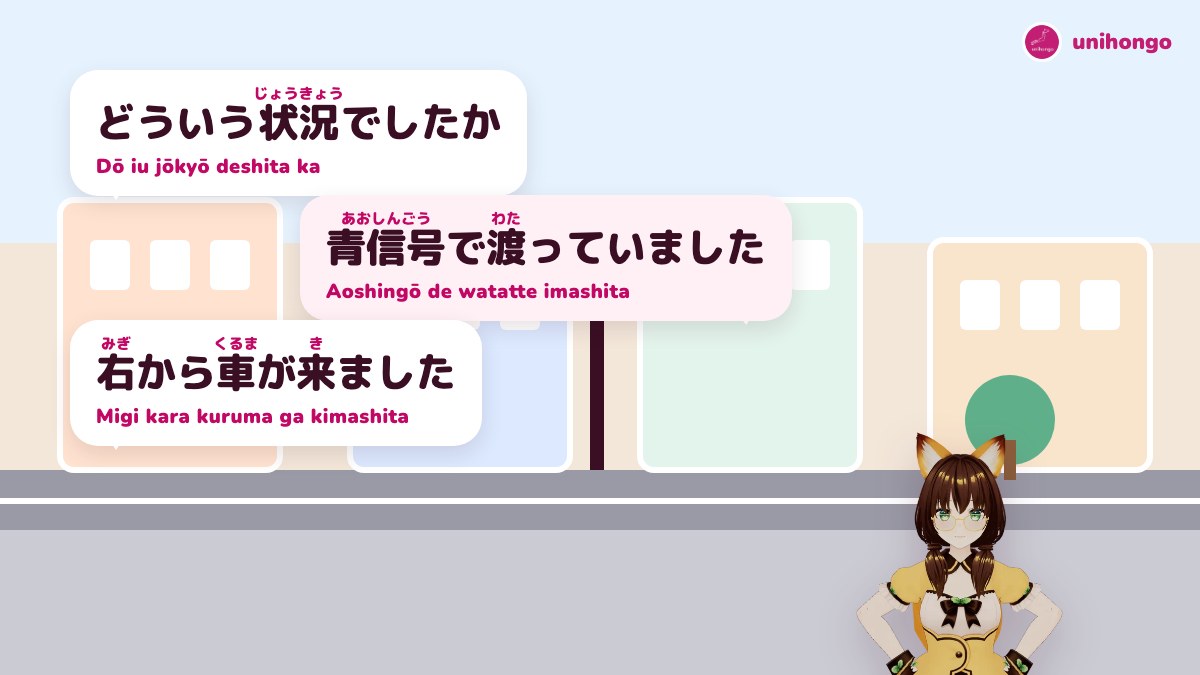
The officers check everyone's ID and licences, ask what happened and examine the scene. If someone is injured, the case becomes an injury accident and the police carry out a more detailed on-site inspection, a jikkyō kenbun, which can take time. Answer in short sentences, say when you do not understand, and do not guess at speeds or distances you are not sure of.
| Japanese | Romaji | Meaning |
|---|---|---|
| どういう状況でしたか。 | Dō iu jōkyō deshita ka. | Officer: What happened? |
| 青信号で渡っていました。 | Aoshingō de watatte imashita. | You: I was crossing on a green light. |
| 右から車が来ました。 | Migi kara kuruma ga kimashita. | You: A car came from the right. |
| もう一度ゆっくりお願いします。 | Mō ichido yukkuri onegai shimasu. | You: Once more, slowly, please. |
| 人身事故 | jinshin jiko | accident with injury |
| 物損事故 | busson jiko | accident with property damage only |
Whether an accident is recorded as injury or property damage affects how it is handled. If you are injured and see a doctor later, the police can explain how to change the record, which usually needs a medical certificate, a shindansho.
Calling your insurance company
Your voluntary insurer's accident desk takes over most of the work: contacting the other party, assessing fault and paying claims. Have your policy number, the time and place, the other party's details and the police station ready. Many insurers offer English support; ask when you sign up.
| Japanese | Romaji | Meaning |
|---|---|---|
| 事故の連絡をしたいです。 | Jiko no renraku o shitai desu. | I'd like to report an accident. |
| 証券番号はこちらです。 | Shōken bangō wa kochira desu. | Here is my policy number. |
| 警察にはもう届けました。 | Keisatsu ni wa mō todokemashita. | I've already reported it to the police. |
| 過失割合 | kashitsu wariai | share of fault (between the parties) |
On a bicycle or on foot
| Japanese | Romaji | Meaning |
|---|---|---|
| 自転車とぶつかりました。 | Jitensha to butsukarimashita. | I collided with a bicycle. |
| 今は痛くないけど、病院に行きます。 | Ima wa itakunai kedo, byōin ni ikimasu. | It doesn't hurt now, but I'll go to hospital. |
- A bicycle is a vehicle under Japanese traffic law. A cyclist in an accident has the same duty to stop, help and report to the police as a driver.
- Many prefectures and cities require cyclists to carry personal liability insurance. Check your local rule and whether your home or car insurance already includes cover.
- As a pedestrian hit by a vehicle, insist that the police are called even if you feel fine, take the driver's details, and see a doctor the same day or the next. Some injuries show up later.
- If a child is involved, call the police and the parents. Small collisions in parking areas and on pavements still count as accidents.
The days after: paperwork that follows
Once the scene is cleared, most of the work moves to your insurer. Keep a simple file with the date, place, police station, the officer's name if you have it, the other party's details, photos and every receipt. Your insurer will ask for these and may request the official accident certificate for you.
| Japanese | Romaji | Meaning |
|---|---|---|
| 交通事故証明書 | kōtsū jiko shōmeisho | official accident certificate |
| 診断書 | shindansho | medical certificate |
| 修理の見積もり | shūri no mitsumori | repair estimate |
- The accident certificate, kōtsū jiko shōmeisho, is issued by the Japan Safe Driving Center based on the police report.
- If you were injured, keep your medical certificate and receipts for treatment, medicine and transport to the clinic.
- For repairs, the insurer usually wants an estimate from the garage before work starts.
- If your car is off the road, ask whether your policy covers a loan or rental car.
Rehearse the calls before you ever need them
Accident calls are a good case for speaking practice, because you want the words without searching for them. Open AI Sensei on the travel emergency topic and ask Haru-sensei to play first the 119 operator, then a police officer at the scene. Practise giving a location from a landmark and describing what happened in three short sentences, and ask the Sensei to slow down when you need it. The session report shows which words you hesitated over.
To make the vocabulary stick, ask Mocchi to quiz you on jinshin jiko, busson jiko, jidan and kashitsu wariai, and to explain any you miss.