

The text: 週末の予定 (My weekend plans)
Read once without the English. Sort the plans in your head into three groups: things the writer will do, will not do and wants to do.
| Japanese | Romaji | Meaning |
|---|---|---|
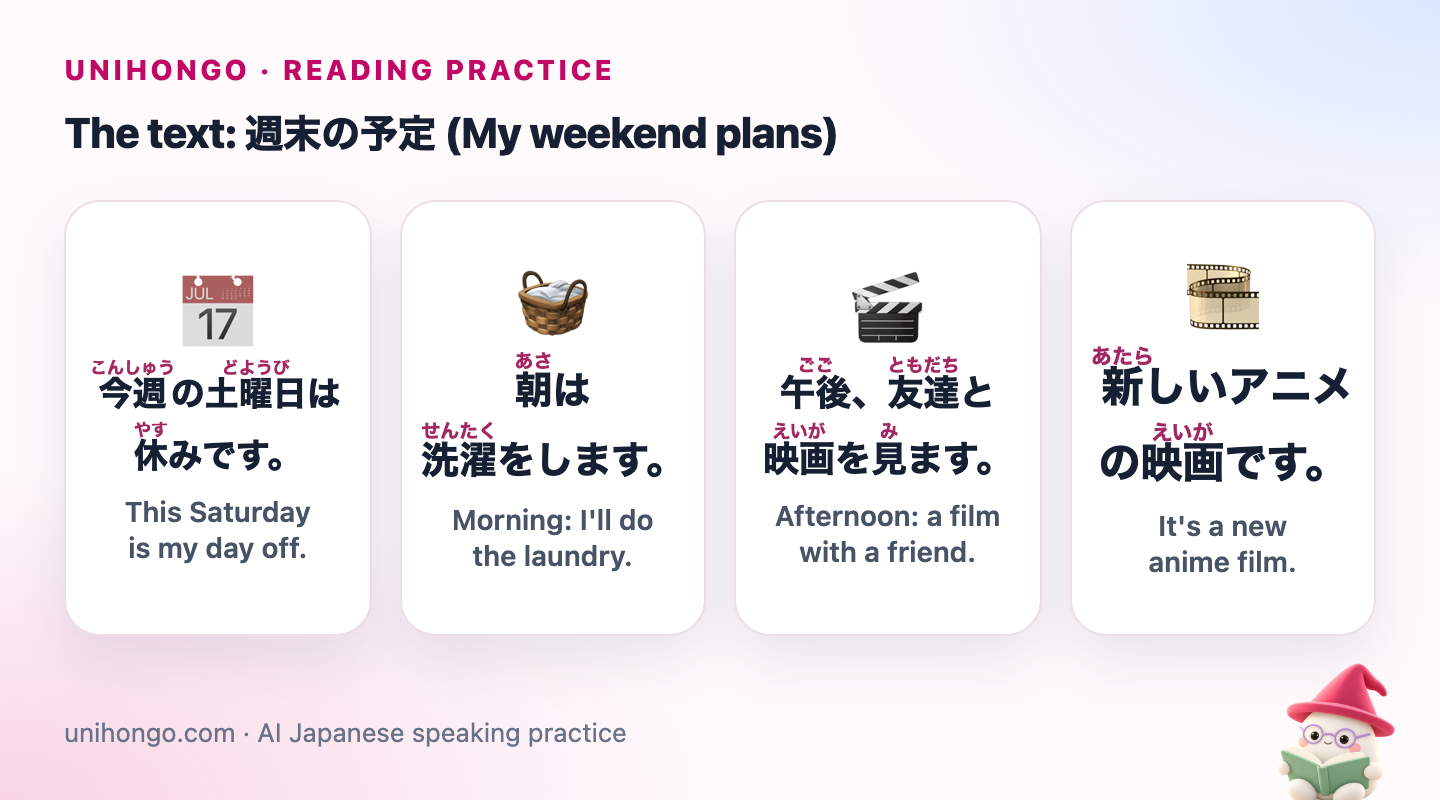
| 今週の土曜日は休みです。 | Konshū no doyōbi wa yasumi desu. | This Saturday is my day off. |
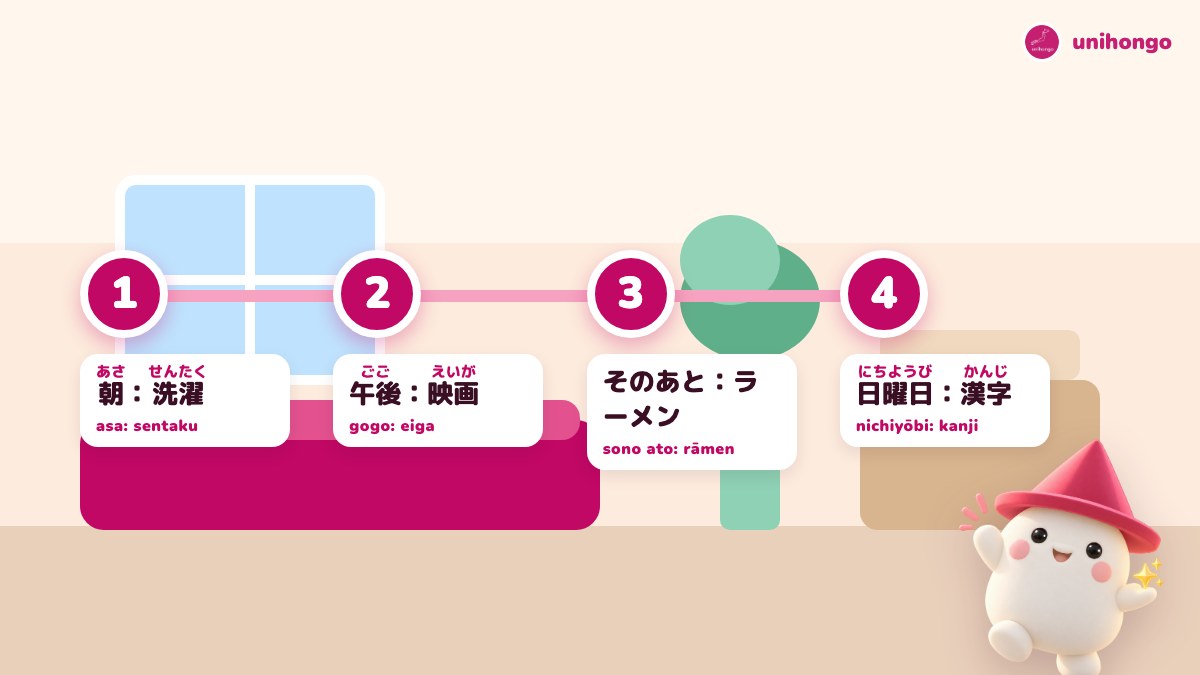
| 朝は洗濯をします。 | Asa wa sentaku o shimasu. | Morning: I'll do the laundry. |
| 午後、友達と映画を見ます。 | Gogo, tomodachi to eiga o mimasu. | Afternoon: a film with a friend. |
| 新しいアニメの映画です。 | Atarashii anime no eiga desu. | It's a new anime film. |
| 映画のあとで、ラーメンを食べたいです。 | Eiga no ato de, rāmen o tabetai desu. | After the film, I want to eat ramen. |
| 日曜日は出かけません。 | Nichiyōbi wa dekakemasen. | On Sunday I won't go out. |
| 家で日本語を勉強します。 | Ie de nihongo o benkyō shimasu. | I'll study Japanese at home. |
| 漢字を二十個覚えたいです。 | Kanji o nijukko oboetai desu. | I want to learn twenty kanji. |
| 夜は母に手紙を書きます。 | Yoru wa haha ni tegami o kakimasu. | In the evening I'll write a letter to my mother. |
| 月曜日はテストがありますから、お酒は飲みません。 | Getsuyōbi wa tesuto ga arimasu kara, osake wa nomimasen. | There's a test on Monday, so I won't drink. |
| 早く寝たいです。 | Hayaku netai desu. | I want to go to bed early. |
| 週末が楽しみです。 | Shūmatsu ga tanoshimi desu. | I'm looking forward to the weekend. |
In sentence 3, と after a person means together with: 友達と, with a friend. Do not confuse it with the と in 父と母, which means and between nouns.
Vocabulary notes
These words cover most weekend small talk. The verbs are given in the ます form, as they appear in the text.
| Japanese | Romaji | Meaning |
|---|---|---|
| 今週 | konshū | this week |
| 休み | yasumi | day off, holiday, rest |
| 洗濯をします | sentaku o shimasu | to do the laundry |
| 映画 | eiga | film, movie |
| あとで | ato de | after, later |
| 出かけます | dekakemasu | to go out |
| 覚えます | oboemasu | to memorise, to learn by heart (N4) |
| 手紙 | tegami | letter |
| お酒 | osake | alcohol, also Japanese sake |
| 週末 | shūmatsu | weekend |
| 楽しみです | tanoshimi desu | I'm looking forward to it |
休み is a flexible word: 今日は休みです can mean I have the day off, the shop is closed or school is out, depending on who says it. 出かけます means to go out in general, without saying where; when you name the place, use 行きます: 公園に行きます.
Grammar notes: four patterns in the text
Each pattern is shown with its line from the text and one new example.
| Japanese | Romaji | Meaning |
|---|---|---|
| 友達と映画を見ます。 | Tomodachi to eiga o mimasu. | ます for a plan. (text) |
| あした、京都に行きます。 | Ashita, Kyōto ni ikimasu. | I'm going to Kyoto tomorrow. (new example) |
| 日曜日は出かけません。 | Nichiyōbi wa dekakemasen. | ません for a plan not to do something. (text) |
| 今晩はテレビを見ません。 | Konban wa terebi o mimasen. | I won't watch TV tonight. (new example) |
| ラーメンを食べたいです。 | Rāmen o tabetai desu. | Verb stem + たいです: want to. (text) |
| 日本で働きたいです。 | Nihon de hatarakitai desu. | I want to work in Japan. (new example) |
| テストがありますから、お酒は飲みません。 | Tesuto ga arimasu kara, osake wa nomimasen. | Reason + から, result. (text) |
| 雨ですから、家にいます。 | Ame desu kara, ie ni imasu. | It's raining, so I'll stay home. (new example) |
To make たいです negative, change it like an い-adjective: 食べたくないです, I don't want to eat. Many learners say 食べたいじゃないです, which is a very common mistake.
With たいです, the object particle を can change to が: ラーメンが食べたいです. Both are correct and common in speech; を is a safe default.
Comprehension questions
Answer each question with a short Japanese sentence first.
- Who is the writer seeing a film with?
- What does the writer want to eat after the film?
- Why will the writer not drink alcohol this weekend?
| Japanese | Romaji | Meaning |
|---|---|---|
| 友達と見ます。 | Tomodachi to mimasu. | Answer 1: With a friend. |
| ラーメンを食べたいです。 | Rāmen o tabetai desu. | Answer 2: Ramen. |
| 月曜日にテストがありますから。 | Getsuyōbi ni tesuto ga arimasu kara. | Answer 3: Because there's a test on Monday. |
Answer 3 changes 月曜日は to 月曜日に. The text uses は to contrast Monday with the weekend; in a stand-alone answer, に simply marks the day. Both are fine, and noticing the switch is good reading practice.
From plans to invitations
Once you can say your plans, the next step is inviting someone to join. This is where many learners reach for たいですか, which sounds like a survey rather than an invitation. Use ませんか to invite and ましょう to agree. Here is a short exchange built from the text.
| Japanese | Romaji | Meaning |
|---|---|---|
| 土曜日、一緒に映画を見ませんか。 | Doyōbi, issho ni eiga o mimasen ka. | You: Would you like to see a film with me on Saturday? |
| いいですね。何の映画ですか。 | Ii desu ne. Nan no eiga desu ka. | Friend: Sounds good. What film is it? |
| 新しいアニメの映画です。 | Atarashii anime no eiga desu. | You: It's the new anime film. |
| 見たいです!何時ですか。 | Mitai desu! Nanji desu ka. | Friend: I want to see it! What time? |
| 二時からです。そのあとで、ラーメンを食べましょう。 | Niji kara desu. Sono ato de, rāmen o tabemashō. | You: It starts at two. Let's have ramen afterwards. |
| 日曜日はちょっと…。 | Nichiyōbi wa chotto... | Friend: Sunday's a bit... (a soft no) |
Common mistakes with plans and wishes
- Saying 食べたいじゃないです for I don't want to eat. たい behaves like an い-adjective, so the negative is 食べたくないです.
- Inviting with たいですか: 映画を見たいですか sounds like a question about feelings. Invite with 見ませんか.
- Using たいです about someone else: 友達は映画を見たいです. At N5, keep たいです for yourself and for questions to the listener.
- Adding に after 今週の土曜日 or あした. Relative time words such as あした, 今週 and 来週 do not take に; days of the week can, as in 土曜日に.
- Forgetting that ません is also future: 日曜日は出かけません means I won't go out on Sunday, not only I never go out.
A read-aloud routine for this text
- Read the verbs alone first, in pairs: shimasu and shimasen, mimasu and mimasen, tabetai desu and tabetakunai desu.
- Read the text slowly. Lift your voice slightly on the time word at the start of each sentence: Asa wa, Gogo, Nichiyōbi wa. It signals a new part of the plan.
- Read it at natural speed. Keep the long vowels in shūmatsu, benkyō and rāmen.
- Record yourself and check that ません is clear: a swallowed ません turns your plan upside down.
- Retell the weekend from the timeline in the scene above, then tell your own real weekend plans.
Plan a real weekend in Japanese
Use the text as a template for your own weekend and ask Mocchi, Unihongo's study assistant, to /explain anything that still confuses you, such as why あとで follows の in 映画のあとで. You can also type /read and ask for another N5 text about plans to see the same forms in a new setting; Mocchi keeps track of the forms you mix up, like たいじゃない, and brings them back in your next review.
Then make the invitation for real. In AI Sensei, Ibuki-sensei can play a friend from your class: tell Ibuki-sensei your weekend plans, invite Ibuki-sensei to one of them with ませんか, and ask Ibuki-sensei to turn you down once with ちょっと… so you practise suggesting another day.