

The text: 私の家族 (My family)
Read it once without the English. As you read, try to note one fact about each family member: a job, an age or a hobby.
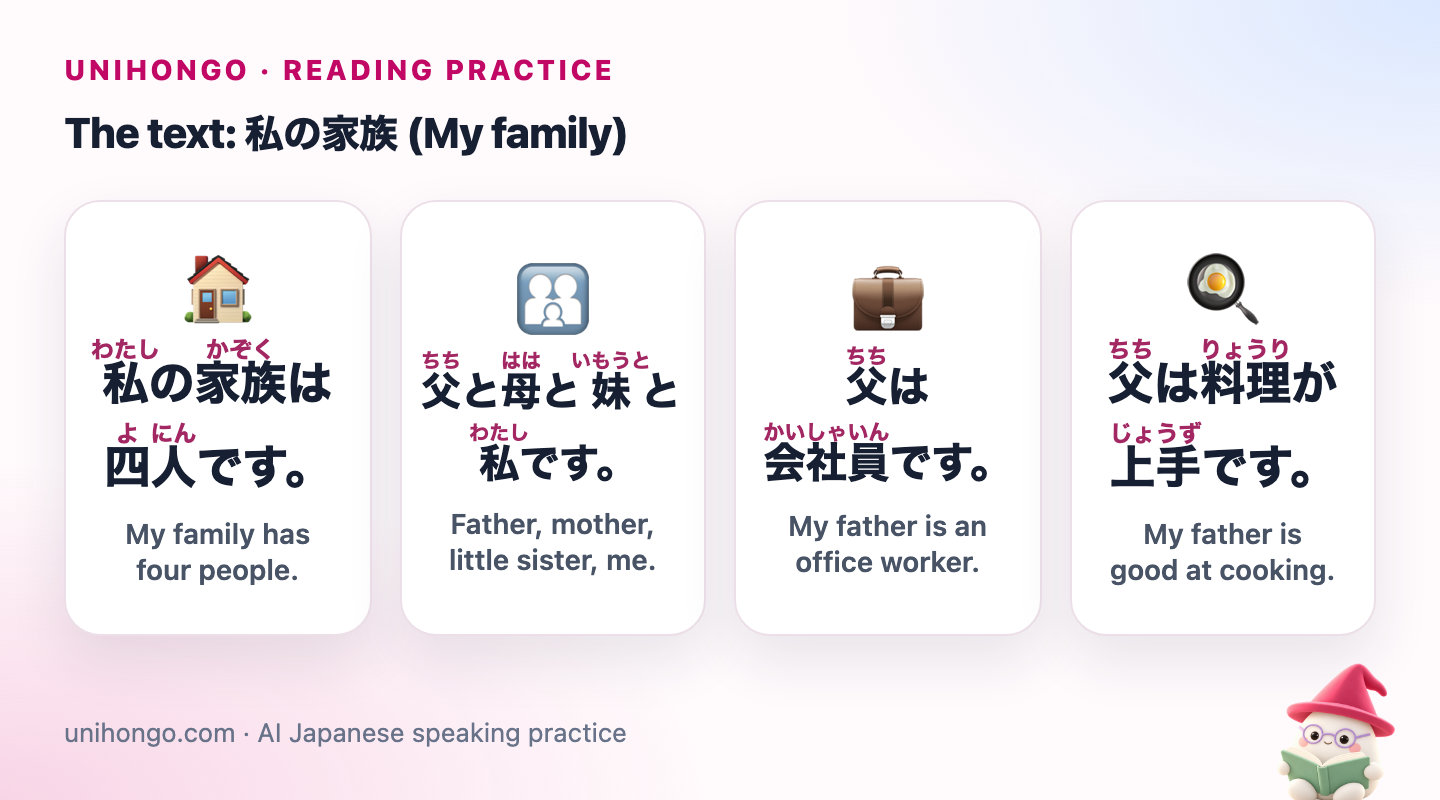
| Japanese | Romaji | Meaning |
|---|---|---|
| 私の家族は四人です。 | Watashi no kazoku wa yonin desu. | My family has four people. |
| 父と母と妹と私です。 | Chichi to haha to imōto to watashi desu. | Father, mother, little sister, me. |
| 父は会社員です。 | Chichi wa kaishain desu. | My father is an office worker. |
| 父は料理が上手です。 | Chichi wa ryōri ga jōzu desu. | My father is good at cooking. |
| 母は高校の先生です。 | Haha wa kōkō no sensei desu. | My mother is a high school teacher. |
| 母は英語を教えています。 | Haha wa eigo o oshiete imasu. | She teaches English. |
| 妹は十五歳です。 | Imōto wa jūgosai desu. | My younger sister is fifteen. |
| 妹はテニスが好きです。 | Imōto wa tenisu ga suki desu. | My sister likes tennis. |
| 毎週土曜日に練習します。 | Maishū doyōbi ni renshū shimasu. | She practises every Saturday. |
| 私は大学生です。 | Watashi wa daigakusei desu. | I am a university student. |
| 今、東京に住んでいます。 | Ima, Tōkyō ni sunde imasu. | I live in Tokyo now. |
| 家族は大阪にいます。 | Kazoku wa Ōsaka ni imasu. | My family is in Osaka. |
| 毎週日曜日に電話をします。 | Maishū nichiyōbi ni denwa o shimasu. | I phone them every Sunday. |
| 早く家族に会いたいです。 | Hayaku kazoku ni aitai desu. | I want to see my family soon. |
The last sentence uses たいです, want to, with 会います. Notice that you meet someone with に: 家族に会います. Many learners say 家族を会います, which sounds wrong to Japanese ears.
Vocabulary notes: two sets of family words
Japanese has a humble word for your own family members and a polite word for other people's. The text only uses the humble words. Learn them in pairs.
| Japanese | Romaji | Meaning |
|---|---|---|
| 会社員 | kaishain | office worker, company employee |
| 料理 | ryōri | cooking, a dish |
| 上手 | jōzu | good at (about others, not yourself) |
| 高校 | kōkō | high school |
| 練習します | renshū shimasu | to practise |
| 大学生 | daigakusei | university student |
| 住んでいます | sunde imasu | to live (somewhere) |
| 電話をします | denwa o shimasu | to phone, to make a call |
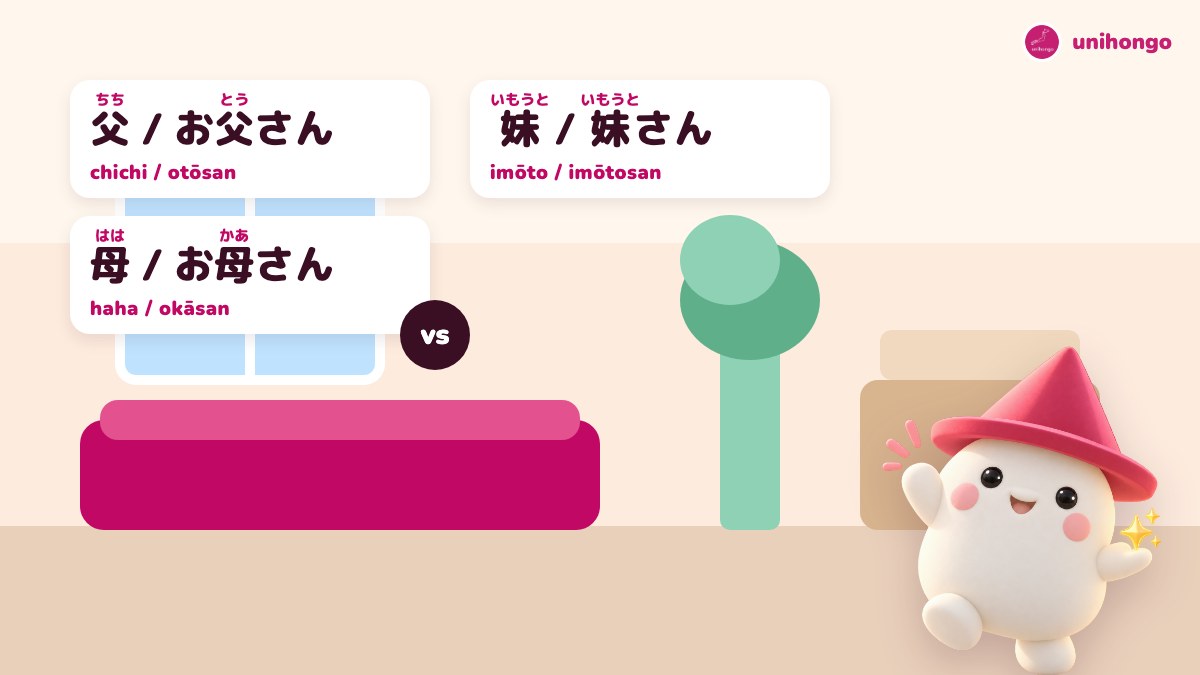
| Family member | Your own (humble) | Someone else's (polite) |
|---|---|---|
| father | 父 (chichi) | お父さん (otōsan) |
| mother | 母 (haha) | お母さん (okāsan) |
| older brother | 兄 (ani) | お兄さん (onīsan) |
| older sister | 姉 (ane) | お姉さん (onēsan) |
| younger brother | 弟 (otōto) | 弟さん (otōtosan) |
| younger sister | 妹 (imōto) | 妹さん (imōtosan) |
| family | 家族 (kazoku) | ご家族 (gokazoku) |
上手 is a compliment, so Japanese speakers avoid using it about themselves: 私は料理が上手です can sound boastful. About yourself, 得意です (I'm good at it, it's my strong point) or a modest まあまあです is more natural. Saying it about your own father, as the text does, is fine in a family introduction.
Grammar notes: four patterns in the text
Each pattern comes with its sentence from the text and one new example.
| Japanese | Romaji | Meaning |
|---|---|---|
| 私の家族は四人です。 | Watashi no kazoku wa yonin desu. | Number of people + です. (text) |
| 兄弟は三人です。 | Kyōdai wa sannin desu. | There are three of us siblings. (new example) |
| 父は料理が上手です。 | Chichi wa ryōri ga jōzu desu. | A は B が 上手/好き. (text) |
| 弟はゲームが好きです。 | Otōto wa gēmu ga suki desu. | My younger brother likes games. (new example) |
| 母は英語を教えています。 | Haha wa eigo o oshiete imasu. | ています for a job or state. (text) |
| 姉は銀行で働いています。 | Ane wa ginkō de hataraite imasu. | My older sister works at a bank. (new example) |
| 家族は大阪にいます。 | Kazoku wa Ōsaka ni imasu. | People + に + います. (text) |
| 祖母は北海道にいます。 | Sobo wa Hokkaidō ni imasu. | My grandmother is in Hokkaido. (new example) |
Use います for people and animals and あります for things. 家族は大阪にあります would sound as if your family were a building. Also notice that 住んでいます, live, uses ています even though living is not an action you are doing at this moment: it describes a continuing state.
Comprehension questions
Answer in short Japanese sentences, then check the model answers.
- How many people are in the writer's family?
- What is the mother's job?
- When does the writer phone the family?
| Japanese | Romaji | Meaning |
|---|---|---|
| 四人です。 | Yonin desu. | Answer 1: Four people. |
| 高校の先生です。英語を教えています。 | Kōkō no sensei desu. Eigo o oshiete imasu. | Answer 2: She is a high school English teacher. |
| 毎週日曜日です。 | Maishū nichiyōbi desu. | Answer 3: Every Sunday. |
The text says 母 because the writer is talking about their own mother. When you talk about the writer's mother, she is someone else's mother, so in conversation you would say お母さんは高校の先生です. Short answers without a subject, like the models above, avoid the question altogether.
Your family or theirs: switching words
The most useful skill from this text is switching between the two sets of words. Here is a short exchange where a new friend asks about your family. Notice how each speaker uses humble words for their own family and polite words for the other person's.
| Japanese | Romaji | Meaning |
|---|---|---|
| 何人家族ですか。 | Nannin kazoku desu ka. | Friend: How many people are in your family? |
| 四人家族です。父と母と妹がいます。 | Yonin kazoku desu. Chichi to haha to imōto ga imasu. | You: Four. I have a father, a mother and a younger sister. |
| お父さんは何をしていますか。 | Otōsan wa nani o shite imasu ka. | Friend: What does your father do? |
| 会社員です。料理が上手ですよ。 | Kaishain desu. Ryōri ga jōzu desu yo. | You: He's an office worker. He's a good cook. |
| いいですね。妹さんは何歳ですか。 | Ii desu ne. Imōtosan wa nansai desu ka. | Friend: Nice. How old is your sister? |
| 十五歳です。 | Jūgosai desu. | You: She's fifteen. |
Common mistakes when introducing a family
- Using お母さん for your own mother when talking to a teacher or colleague. It is not rude, but it sounds childish or unpolished in formal settings; use 母 outside the family.
- Saying よんにん or よっにん for four people. The reading is yonin, with one n sound before nin.
- Using あります for family members: 妹があります. People always take います: 妹がいます, I have a younger sister.
- Calling your own family member 上手 too often. A short, modest description, such as 父は料理が好きです, often sounds more natural than praise.
- Forgetting that 家族は四人です counts you too. Japanese speakers include themselves in the number.
A read-aloud routine for this text
- Start with the family words alone: chichi, haha, imōto, kazoku. Say each three times, keeping the long ō in imōto.
- Read the text slowly, sentence by sentence, and point to each person on a family tree as you mention them.
- Read it again at natural speed. Join the particles to the word before them: chichi-wa, haha-wa, so the sentence moves in chunks.
- Read it a third time, changing every humble word to the polite one, as if you were describing a friend's family: お父さん, お母さん, 妹さん.
- Finish by introducing your real family aloud in six sentences without looking.
Jūgosai and kōkō both have long vowels that matter: kōkō is high school, while koko means here. If you rush, the listener may hear a different word.
Introduce your own family next
Write six sentences about your own family, using the text as a model, and send them to Mocchi, Unihongo's study assistant, with /correct. Mocchi points out any place where you used お母さん for your own mother or を instead of に with 会います, and remembers those slips so it can bring them back in a later quiz. If a sentence from the text is still unclear, /explain it first.
- Read your corrected version aloud twice.
- Open AI Sensei and choose Hana-sensei; ask Hana-sensei to play a new classmate who wants to know about your family.
- Tell her about your family from memory, then answer her follow-up questions about jobs and hobbies.
- Read the session report and add any new words to your family tree.