
Two ways to leave and keep your status
Your status of residence lives on your residence card, but it only survives a departure if you leave with a re-entry arrangement. There are two, and they share most of their vocabulary.
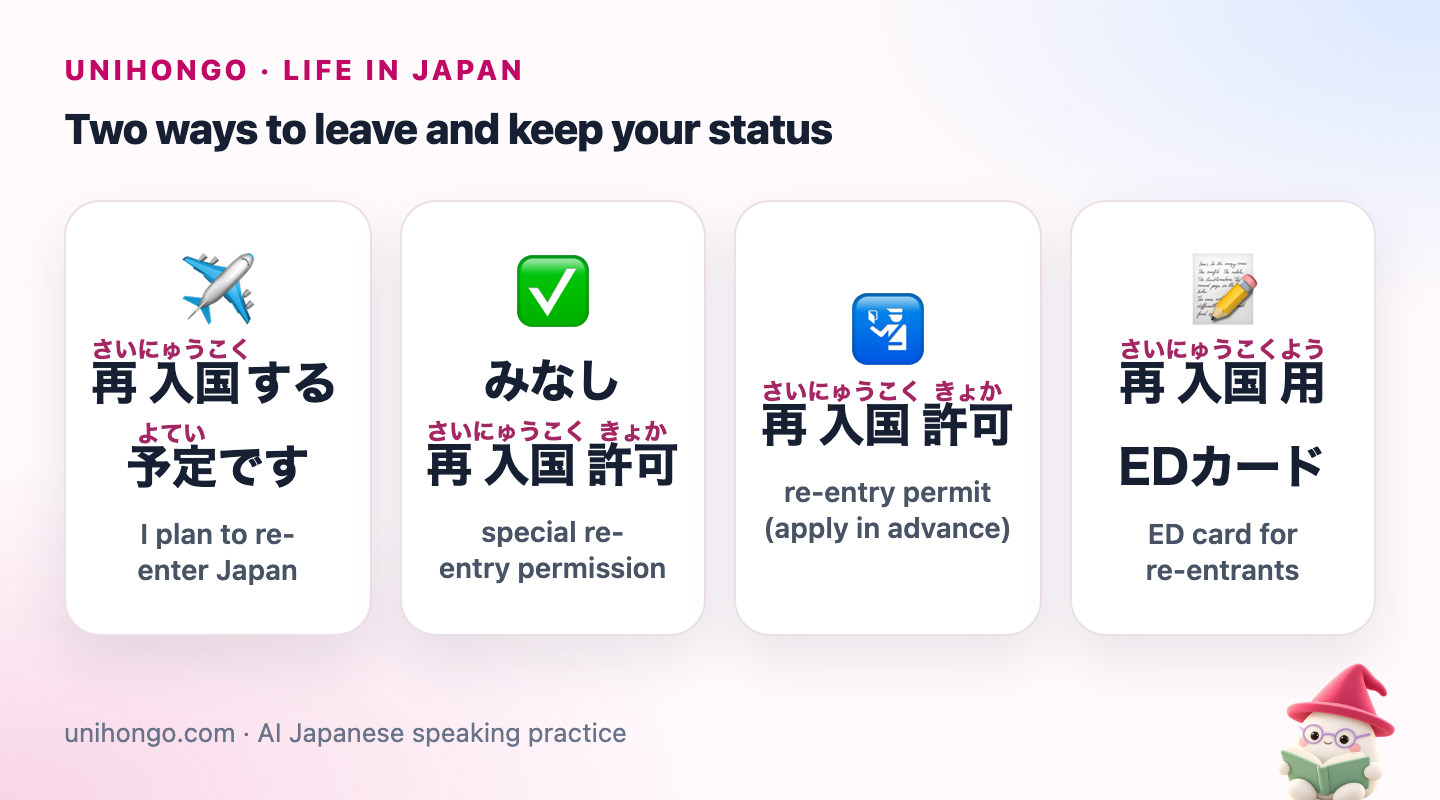
| Japanese | Romaji | Meaning |
|---|---|---|
| 再入国する予定です | Sainyūkoku suru yotei desu | I plan to re-enter Japan |
| みなし再入国許可 | minashi sainyūkoku kyoka | special re-entry permission |
| 再入国許可 | sainyūkoku kyoka | re-entry permit (apply in advance) |
| 再入国用 EDカード | sainyūkoku yō ii dii kādo | ED card for re-entrants |
Minashi means deemed: by ticking the box you are treated as if you held a permit. Sainyūkoku is re-entry, made of sai (again), nyū (enter) and koku (country).
Special re-entry or a re-entry permit?
Most residents use the special re-entry system for holidays, family visits and business trips. The ordinary permit is for longer absences such as study abroad, a long secondment or caring for family overseas.
| Japanese | Romaji | Meaning |
|---|---|---|
| 一年以内に戻ります。 | Ichinen inai ni modorimasu. | I will be back within a year. |
| 一年以上、日本を離れます。 | Ichinen ijō, Nihon o hanaremasu. | I'll be away from Japan for over a year. |
| 再入国許可の申請をしたいです。 | Sainyūkoku kyoka no shinsei o shitai desu. | I'd like to apply for a re-entry permit. |
| 数次でお願いします。 | Sūji de onegai shimasu. | Multiple re-entry, please. |
| Point | Special re-entry (minashi) | Re-entry permit |
|---|---|---|
| How you get it | Tick the box on the ED card and show your residence card at departure | Apply in advance at a regional immigration office |
| How long you may stay away | Up to one year, or until your period of stay ends if sooner | Up to five years, within your period of stay |
| Cost | No fee | A fee, paid with a revenue stamp; check the current amount |
| Single or multiple trips | One departure and return | Single or multiple, as you apply |
| If plans change abroad | Cannot be extended from abroad | Ask immigration or a Japanese embassy about your case |
Special permanent residents have a longer special re-entry window than other residents. People with a period of stay of less than three months and temporary visitors are not covered at all. If your case does not fit the common pattern, ask immigration before you book flights.
At the airport: the ED card line
When you leave, you fill in the ED card for re-entrants, available near the departure immigration counters. Besides your name, birth date, nationality and passport details, it has a box declaring that this is a temporary departure and that you will re-enter. Tick it only if you are using special re-entry and plan to return. Leave it unticked if you hold an ordinary re-entry permit, and leave it unticked if you are leaving for good.
At the counter, hand over your passport, your residence card and the ED card. The officer stamps your passport, and your card is handed back. Procedures at airports change, including electronic options, so follow the signs and ask staff if a different counter or gate is in use.
| Japanese | Romaji | Meaning |
|---|---|---|
| 一時的な出国であり、再入国する予定です。 | Ichijiteki na shukkoku de ari, sainyūkoku suru yotei desu. | Form: This is a temporary departure and I plan to re-enter. |
| 在留カードを見せてください。 | Zairyū kādo o misete kudasai. | Officer: Please show your residence card. |
| いつ戻られますか。 | Itsu modoraremasu ka. | Officer: When will you be back? |
| 来月戻ります。 | Raigetsu modorimasu. | You: I'll be back next month. |
Applying for a re-entry permit in advance
Apply at the regional immigration office that covers your address, before you leave Japan. You fill in an application form, show your passport and residence card, and pay the fee with a revenue stamp when the permit is issued. Waiting times vary with the season and office, so leave a margin before your flight.
| Japanese | Romaji | Meaning |
|---|---|---|
| 申請書はどこにありますか。 | Shinseisho wa doko ni arimasu ka. | Where are the application forms? |
| 渡航期間は二年の予定です。 | Tokō kikan wa ninen no yotei desu. | I plan to be abroad for two years. |
| 留学のためです。 | Ryūgaku no tame desu. | It is for study abroad. |
| 収入印紙はどこで買えますか。 | Shūnyū inshi wa doko de kaemasu ka. | Where can I buy the revenue stamp? |
| 今日中に受け取れますか。 | Kyōjū ni uketoremasu ka. | Can I receive it today? |
Leaving Japan for good, step by step
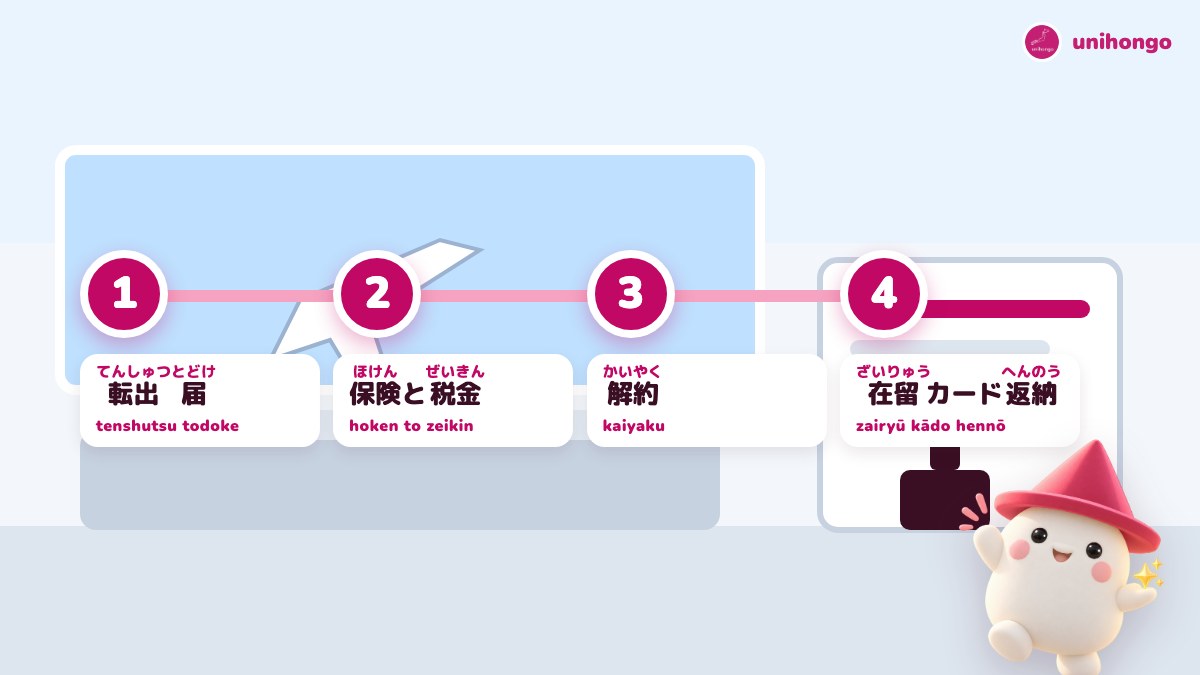
Leaving permanently involves your city office, your employer, your landlord and finally immigration at the airport. The order below is a common pattern; individual circumstances, such as a family staying behind, change the details.
| Japanese | Romaji | Meaning |
|---|---|---|
| 転出届を出したいです。 | Tenshutsu todoke o dashitai desu. | I'd like to file a moving-out notice. |
| 国外に転出します。 | Kokugai ni tenshutsu shimasu. | I'm moving out of Japan. |
| 出国予定日は三月十日です。 | Shukkoku yoteibi wa sangatsu tōka desu. | My departure date is 10 March. |
| もう日本には戻りません。 | Mō Nihon ni wa modorimasen. | I'm not coming back to Japan. |
- A month or more ahead: give notice to your landlord and employer as your contracts require, and arrange the move.
- Before you leave: file a moving-out notice, tenshutsu todoke, at your city office. Many offices accept it up to about two weeks before your departure date; ask yours.
- At the same visit: ask about ending national health insurance and national pension, and about resident tax still to be paid. If tax will fall due after you leave, you may need to appoint a tax representative, nōzei kanrinin.
- Close or settle your phone contract, utilities and any regular payments. Ask your bank what happens to your account once you are a non-resident.
- If you paid into the Japanese pension, look up the lump-sum withdrawal payment on the Japan Pension Service site; you normally claim it after leaving.
- At the airport: do not tick the special re-entry box. The immigration officer takes or invalidates your residence card.
Mini dialogue: the moving-out notice
| Japanese | Romaji | Meaning |
|---|---|---|
| 国外転出の手続きをお願いします。 | Kokugai tenshutsu no tetsuzuki o onegai shimasu. | You: I'd like to do the procedure for moving abroad. |
| 転出予定日と行き先の国を書いてください。 | Tenshutsu yoteibi to ikisaki no kuni o kaite kudasai. | Clerk: Please write the date and the destination country. |
| 国民健康保険にも入っています。 | Kokumin kenkō hoken ni mo haitte imasu. | You: I'm also on national health insurance. |
| では、保険の窓口にも寄ってください。 | Dewa, hoken no madoguchi ni mo yotte kudasai. | Clerk: Then please stop by the insurance window too. |
| 住民税はどうなりますか。 | Jūminzei wa dō narimasu ka. | You: What happens to my resident tax? |
| 税務課でご確認ください。 | Zeimuka de gokakunin kudasai. | Clerk: Please check with the tax section. |
Mistakes that cost people their status
- Booking a long stay abroad on special re-entry. A day past the year, or past your period of stay, and the status is gone.
- Forgetting that the period of stay is the real limit. If your card expires in four months, special re-entry covers four months, not a year.
- Ticking the box when leaving for good. It does no good and can confuse your records; leave it blank and hand in the card.
- Travelling with a renewal or change application in progress without asking. The rules for that situation are specific; ask immigration before you go.
- Leaving without the moving-out notice. Your city keeps you registered, and bills for insurance or tax can keep arriving.
Make the airport words automatic
Type to Mocchi: Quiz me on the Japanese words for re-entry, departure and moving abroad, then explain the difference between minashi sainyūkoku kyoka and sainyūkoku kyoka. Mocchi asks one question at a time, explains every miss and remembers the words that gave you trouble for the next quiz.
For the spoken side, open AI Sensei on the airport topic and ask Ibuki-sensei to play a departure immigration officer, then a city office clerk handling a moving-out notice. Answer when you are coming back, or say that you are leaving for good, and read the session report for the corrections.