
Outages in four words
Teiden and dansui are built the same way: 停 and 断 both mean stopping or cutting, followed by 電 (electricity) and 水 (water). You will see them on notices, on the news and in the utility's app.
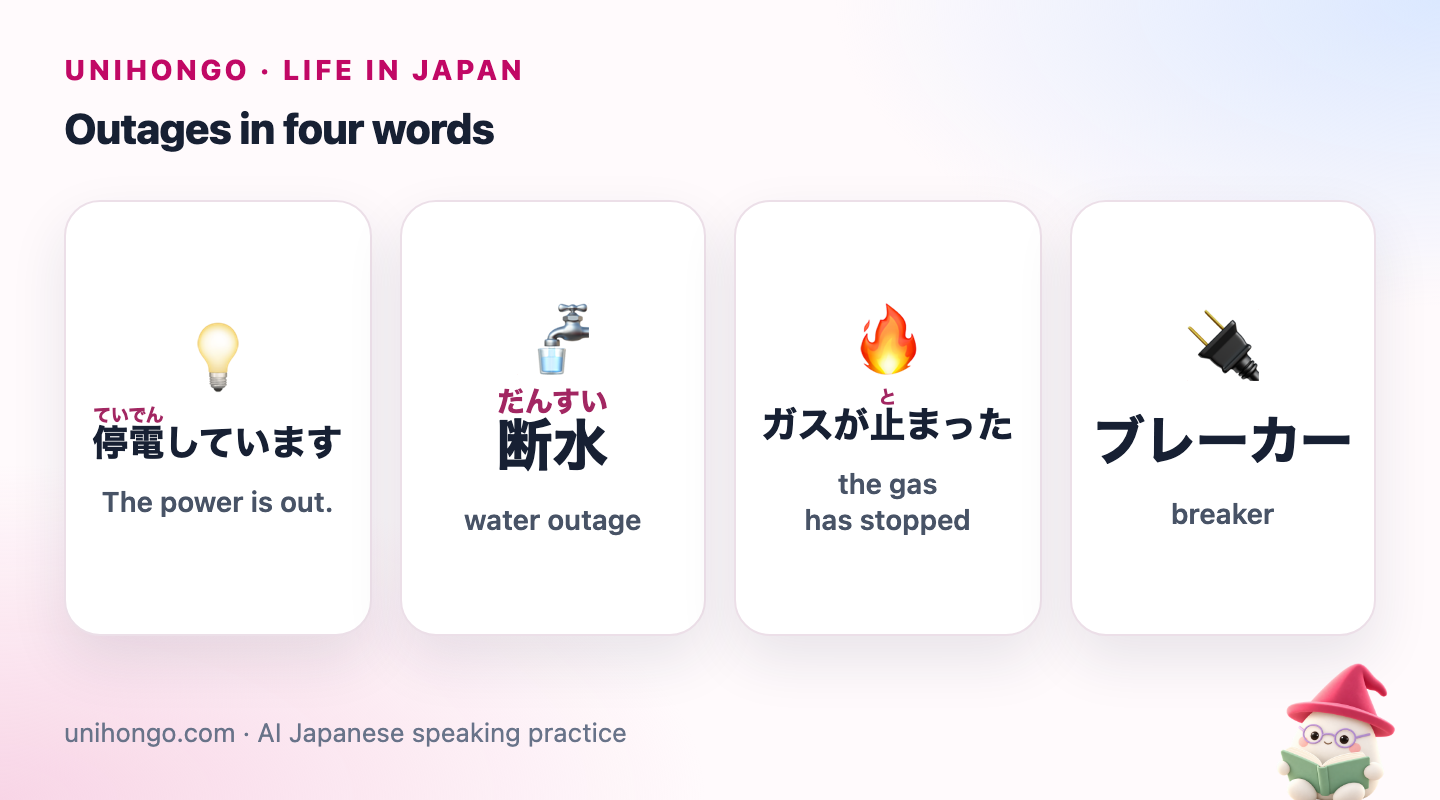
| Japanese | Romaji | Meaning |
|---|---|---|
| 停電しています | Teiden shite imasu. | The power is out. |
| 断水 | dansui | water outage |
| ガスが止まった | gasu ga tomatta | the gas has stopped |
| ブレーカー | burēkā | breaker |
Is it just you, or the whole area?
| Japanese | Romaji | Meaning |
|---|---|---|
| うちだけですか、それとも地域全体ですか。 | Uchi dake desu ka, soretomo chiiki zentai desu ka. | Is it just us, or the whole area? |
| 廊下の電気はついています。 | Rōka no denki wa tsuite imasu. | The corridor light is on. |
| 停電情報 | teiden jōhō | outage information |
- Look outside: are the street lights and the neighbours' windows dark? Is the corridor light on?
- Check the breaker panel, bunden ban (分電盤), usually near the front door or in the washroom. A switch in the down position has tripped.
- If the area is out, check the power company's outage information on its website or app, and keep your phone battery for updates.
- If only your flat is out and the breaker will not stay on, contact the management company.
During an area outage, keep the fridge and freezer closed to hold the cold, unplug sensitive electronics so a surge on restoration does not damage them, and use a battery light rather than candles. In buildings with water pumps, an outage can also stop the water on upper floors, and lifts stop too, so take the stairs and check on elderly neighbours if you can.
Mobile networks may be busy after a big outage. Keep calls short, use text or messaging apps, and save your phone battery for official updates from the power company, your city or emergency alerts.
The breaker panel
A typical Japanese breaker panel has three kinds of switch. Which ones you have depends on the building and the power company: in some areas there is no main ampere breaker.
| Japanese | Romaji | Meaning |
|---|---|---|
| ブレーカーが落ちました。 | Burēkā ga ochimashita. | The breaker has tripped. |
| ブレーカーを上げる | burēkā o ageru | to switch the breaker back on |
| 漏電しているかもしれません。 | Rōden shite iru kamo shiremasen. | There may be an electrical leak. |
| Switch | Japanese | Trips when |
|---|---|---|
| Main ampere breaker | アンペアブレーカー anpea burēkā | Total use exceeds your contract, e.g. heater, microwave and dryer at once |
| Earth leakage breaker | 漏電遮断器 rōden shadanki | Electricity leaks, e.g. from a faulty or wet appliance |
| Circuit breakers | 安全ブレーカー anzen burēkā | One room or circuit is overloaded |
If the ampere breaker trips, turn off a few appliances and switch it back up. If the earth leakage breaker trips, switch all small circuit breakers down, raise the leakage breaker, then raise the circuits one by one; the one that trips it again has the fault. Unplug what is on that circuit and call the management company or an electrician. Do not keep forcing it.
Resetting the gas meter after an earthquake
City gas meters in Japan, called maikon mētā (マイコンメーター), automatically shut off the gas when they detect strong shaking, around shindo 5 or more, a large gas flow or a possible leak. A red lamp flashes on the meter. If you do not smell gas, you can usually reset it yourself. The steps below are the common procedure; follow the instructions printed on your own meter.
If you smell gas: do not reset the meter, do not touch light switches or plugs, do not use fire, open windows and doors, and call the gas company from outside. LP gas, propane delivered in cylinders, has a different procedure; contact your LP gas supplier.
| Japanese | Romaji | Meaning |
|---|---|---|
| ガス臭いです。 | Gasu kusai desu. | It smells of gas. |
| 復帰ボタン | fukki botan | gas meter reset button |
| ランプが点滅しています。 | Ranpu ga tenmetsu shite imasu. | The lamp is flashing. |
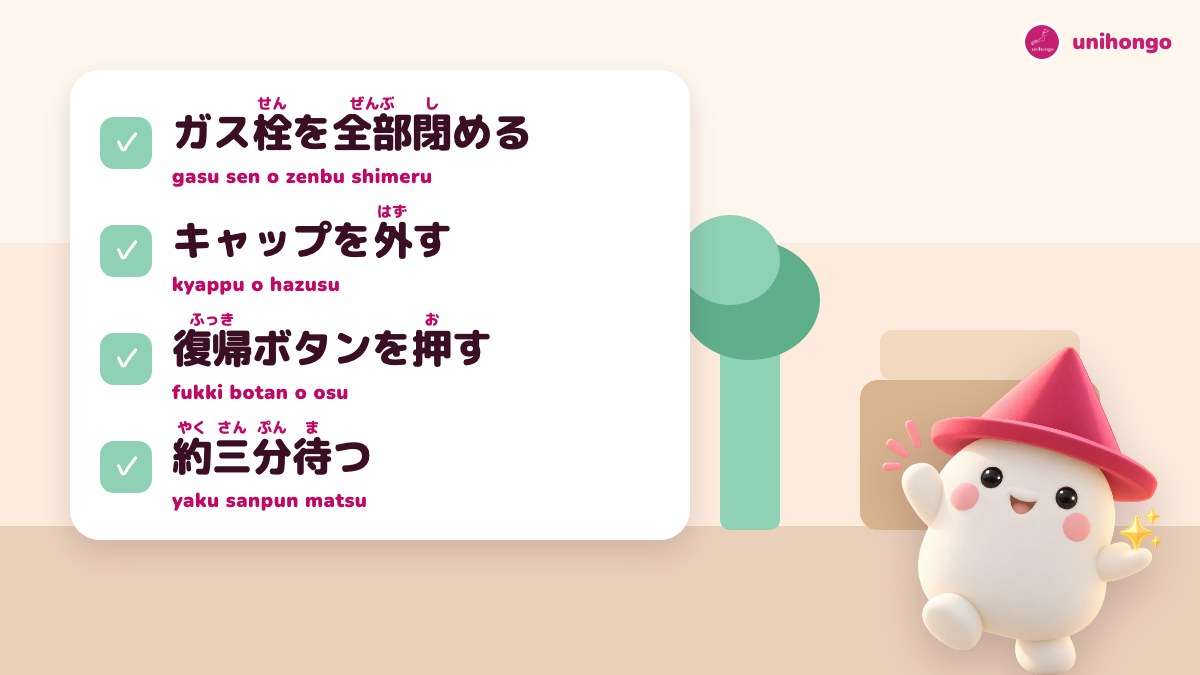
- Turn off every gas appliance and close every gas tap, including outdoor ones such as a water heater.
- Remove the cap on the reset button, fukki botan (復帰ボタン).
- Press the button firmly all the way in, then release it. The lamp will flash.
- Wait about three minutes without using any gas while the meter checks for leaks.
- When the lamp stops flashing, gas can be used. If it keeps flashing, check that every tap is closed; if it still flashes, call the gas company.
Water outages and planned notices
Planned outages are announced with a notice in the lobby, on the lift or in your mailbox. Common reasons are inspection of the building's electrical equipment, denki setsubi tenken (電気設備点検), and cleaning of the water tank, jusuisō seisō (受水槽清掃). The notice gives the date, the time window and what to do: fill a pot or the bath, switch off a computer, or avoid using water on upper floors.
When water returns, the first water may be cloudy or rusty, nigorimizu (濁り水). Run the tap until it is clear before drinking or using the washing machine. In cold regions, pipes can freeze in winter, suidōkan no tōketsu; leaving a tap slightly running at night or following your building's advice helps.
| Japanese | Romaji | Meaning |
|---|---|---|
| 断水のお知らせ | dansui no oshirase | water outage notice |
| 給水停止 | kyūsui teishi | water supply stopped |
| 作業時間中は水が使えません。 | Sagyō jikan chū wa mizu ga tsukaemasen. | Water cannot be used during the work. |
| 濁り水が出ます。 | Nigorimizu ga demasu. | Cloudy water is coming out. |
After a quake: the power-restoration fire risk
When power returns after a big earthquake, damaged wiring or a heater lying against something flammable can start a fire, tsūden kasai (通電火災). Japanese fire departments advise switching off the main breaker before you leave home after a strong quake, and checking appliances and cords before turning power back on. Some homes have a seismic breaker, kanshin burēkā (感震ブレーカー), that does this automatically.
| Japanese | Romaji | Meaning |
|---|---|---|
| 避難する時はブレーカーを落とします。 | Hinan suru toki wa burēkā o otoshimasu. | When evacuating, switch off the breaker. |
| 通電火災 | tsūden kasai | fire when the power comes back |
| 感震ブレーカー | kanshin burēkā | breaker that trips in a quake |
Calling for help: a short dialogue
| Japanese | Romaji | Meaning |
|---|---|---|
| 二〇五号室ですが、うちだけ電気がつきません。 | Nimarugo gōshitsu desu ga, uchi dake denki ga tsukimasen. | You: This is room 205. Only my flat has no power. |
| ブレーカーは確認されましたか。 | Burēkā wa kakunin saremashita ka. | Staff: Have you checked the breaker? |
| はい、漏電遮断器がすぐ落ちてしまいます。 | Hai, rōden shadanki ga sugu ochite shimaimasu. | You: Yes, the leakage breaker trips straight away. |
| 危ないので、そのままにしておいてください。業者を手配します。 | Abunai node, sono mama ni shite oite kudasai. Gyōsha o tehai shimasu. | Staff: It's dangerous, so please leave it. We'll arrange a technician. |
Sono mama ni shite oite kudasai, please leave it as it is, is a common instruction from staff; it means do not keep trying. Gyōsha (業者) is a contractor or technician.
Common mistakes during outages
- Resetting the gas meter when you can smell gas. Ventilate and call the gas company instead.
- Using gas during the three-minute check. The meter may shut off again.
- Repeatedly forcing a tripping leakage breaker. Find the faulty circuit or call for help.
- Ignoring a planned outage notice and losing work on a desktop computer or a freezer full of food.
- Using candles in an earthquake outage. Aftershocks can knock them over; use battery lights.
Read the notice in your lobby
Next time a notice appears in your building, take a photo and type it into Mocchi with /explain. Mocchi breaks the sentences down, picks out the date, time and instruction, and can add the new words to your flashcards so the next notice is quicker to read.
If the breaker and meter words are what trip you up, play a quick round of Listen & Pick with them on the games page, so you recognise the words when the management company says them on the phone.