
The four services, at a glance
Registered post is ordinary mail with an extra service added. You pay the normal postage plus a charge for the service, and you receive a receipt with a tracking number, the otoiawase bangō. These are the four words printed on the counter menu that matter most.
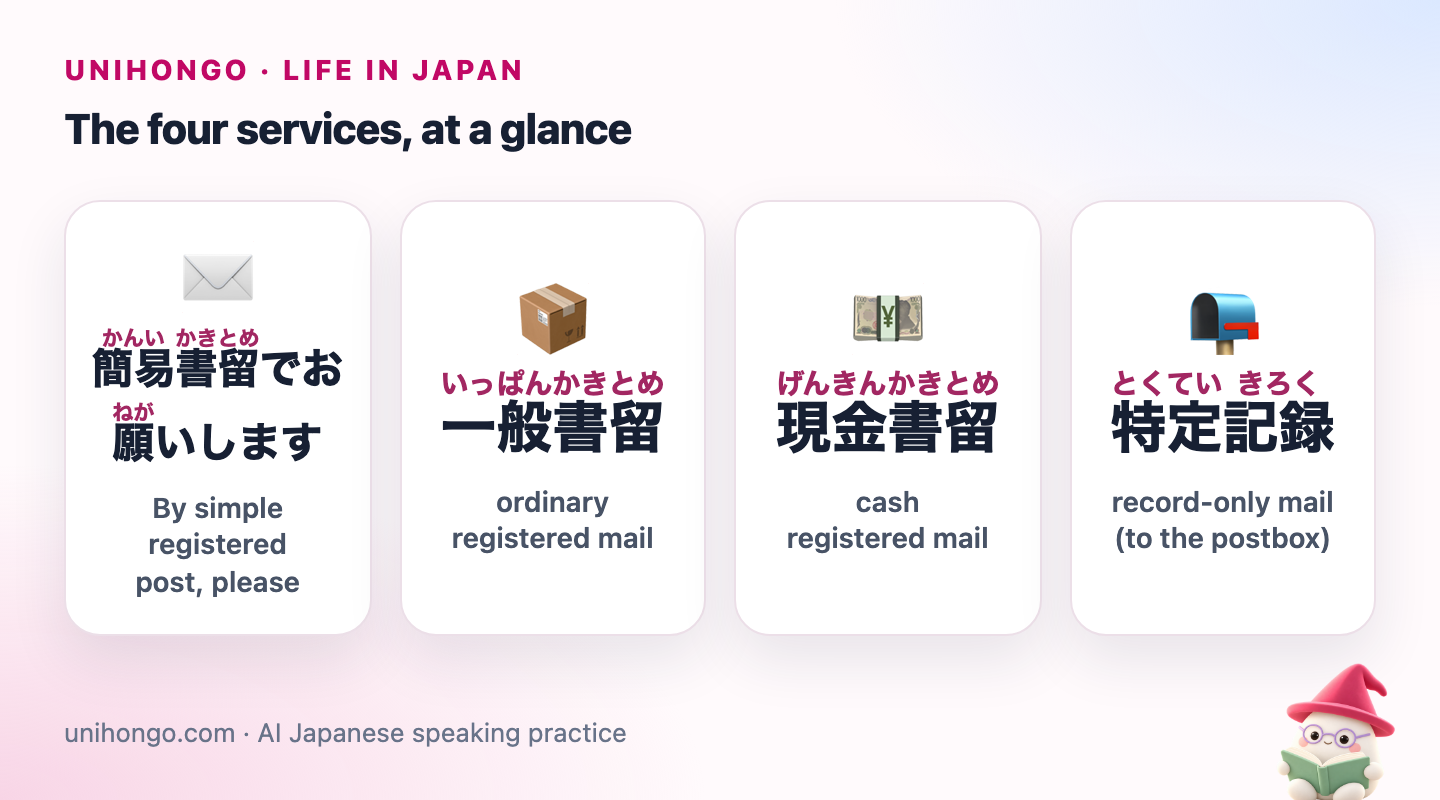
| Japanese | Romaji | Meaning |
|---|---|---|
| 簡易書留でお願いします | Kan'i kakitome de onegai shimasu | By simple registered post, please |
| 一般書留 | ippan kakitome | ordinary registered mail |
| 現金書留 | genkin kakitome | cash registered mail |
| 特定記録 | tokutei kiroku | record-only mail (to the postbox) |
Which one to choose
Choose by two questions: does the item have value that you would want compensated, and does the recipient need to sign for it? The table describes the usual pattern; compensation limits and charges are on Japan Post's site.
| Service | How it is delivered | Compensation | Typical use |
|---|---|---|---|
| Ippan kakitome (ordinary) | In person, signature or stamp | Higher, up to a declared value | Valuables, contracts, items that need proof of delivery |
| Kan'i kakitome (simple) | In person, signature or stamp | Lower, fixed limit | Documents, tickets, applications |
| Genkin kakitome (cash) | In person, signature or stamp | Up to the declared cash amount | Sending cash or gift money |
| Tokutei kiroku (record only) | Into the postbox, delivery recorded | None | Documents that only need a record |
Two add-ons are worth knowing. Haitatsu shōmei, proof of delivery, gives the sender a postcard confirming the date it was delivered, and naiyō shōmei, certified contents, proves what a letter said and when it was sent; it is used for formal notices such as contract cancellations. Both are added to ordinary registered mail. Honnin gentei uketori, recipient-only delivery, is something you meet as a recipient: card companies use it so that only you, with the right ID, can receive the item.
Letter Pack Plus, the red prepaid envelope, is also handed over in person with a signature or stamp, but it is not registered mail and has no compensation.
Sending registered post at the counter
Registered items cannot go in a postbox: take them to a post office counter. Write the addresses as usual; the counter adds the label and the tracking number. For cash, buy the cash envelope at the counter, put the money inside, seal it and write the amount on the envelope.
| Japanese | Romaji | Meaning |
|---|---|---|
| これを書留で送りたいです。 | Kore o kakitome de okuritai desu. | I'd like to send this by registered mail. |
| 簡易書留と一般書留、どちらになさいますか。 | Kan'i kakitome to ippan kakitome, dochira ni nasaimasu ka. | Clerk: Simple or ordinary registered? |
| 中身は書類です。 | Nakami wa shorui desu. | The contents are documents. |
| 現金書留の封筒をください。 | Genkin kakitome no fūtō o kudasai. | A cash registered envelope, please. |
| いつ届きますか。 | Itsu todokimasu ka. | When will it arrive? |
| こちらが控えです。 | Kochira ga hikae desu. | Clerk: Here is your receipt copy. |
Keep the receipt, the hikae or uketorishō, until the item has arrived. Its number lets you track the item online and is needed for any claim.
Receiving registered post
The carrier rings your bell and hands the item to you or someone at the address, asking for a signature or a personal seal. If you have a seal, a hanko, you can use it; a signature is fine. For recipient-only items, the carrier checks your ID, and the name must match exactly.
Registered post is not left in the postbox or at the door, and safe-place delivery does not apply to it. That is why so much of it ends up as a slip.
| Japanese | Romaji | Meaning |
|---|---|---|
| 書留です。 | Kakitome desu. | Carrier: Registered mail for you. |
| こちらにサインかハンコをお願いします。 | Kochira ni sain ka hanko o onegai shimasu. | Carrier: Please sign or stamp here. |
| サインでいいですか。 | Sain de ii desu ka. | You: Is a signature OK? |
| 本人限定受取郵便 | honnin gentei uketori yūbin | recipient-only mail (ID required) |
The missed-delivery slip for registered mail
If you are out, you get a missed-delivery slip, the fuzai renraku hyō, in your postbox. It shows the kind of item, the tracking number and the last day the post office will keep it. You can book a redelivery online, by app or by phone, or collect it at the counter of the post office named on the slip.
To collect it, take the slip and ID, and your seal if you use one. If someone else collects it for you, check the slip for what they need, which usually includes your authorisation and their ID; recipient-only items generally cannot be collected by anyone else.
| Japanese | Romaji | Meaning |
|---|---|---|
| 不在連絡票 | fuzai renraku hyō | missed-delivery slip |
| 保管期限 | hokan kigen | last day it will be kept |
| 再配達 | sai haitatsu | redelivery |
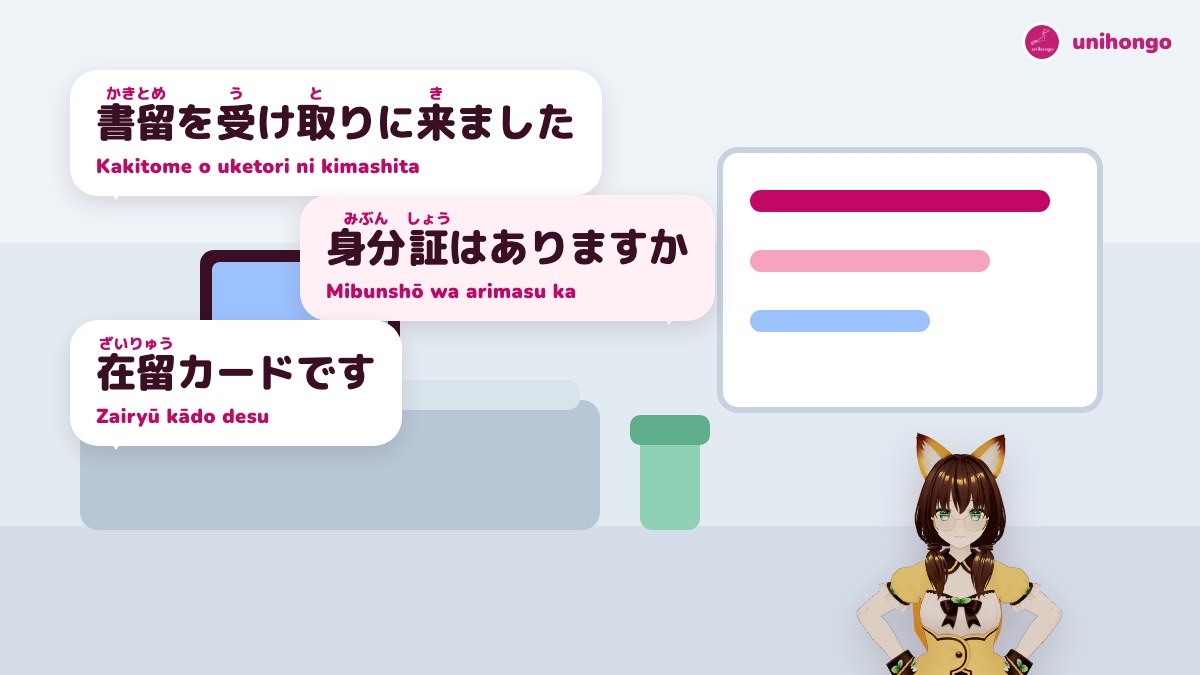
| 不在票の書留を受け取りに来ました。 | Fuzaihyō no kakitome o uketori ni kimashita. | You: I've come for registered mail, here's the slip. |
| 身分証明書はお持ちですか。 | Mibun shōmeisho wa omochi desu ka. | Clerk: Do you have ID? |
| はい、在留カードです。 | Hai, zairyū kādo desu. | You: Yes, my residence card. |
Sending important documents: a practical choice
When an office, school or company asks you to send documents, read their instructions first; many say which service to use. If they say only by post, a sensible default is simple registered post for originals you cannot replace easily, and record-only for copies. For a contract cancellation or a formal complaint, ask the other party or a consultation service whether certified contents mail is expected.
| Japanese | Romaji | Meaning |
|---|---|---|
| 簡易書留で送ってください | kan'i kakitome de okutte kudasai | Instructions: send by simple registered post |
| 書留でなくても大丈夫ですか。 | Kakitome de nakute mo daijōbu desu ka. | Is it OK if it isn't registered? |
| 配達証明もつけてください。 | Haitatsu shōmei mo tsukete kudasai. | Please add proof of delivery too. |
| 追跡番号を教えてください。 | Tsuiseki bangō o oshiete kudasai. | Please tell me the tracking number. |
Booking a redelivery by phone
The slip gives a website, a QR code and a phone number. The automatic phone line asks you to enter the slip's item number and tracking number with the keypad, then a date and a time band. If you prefer to talk to a person, call the delivery post office named on the slip during its opening hours; the conversation follows a fixed pattern.
| Japanese | Romaji | Meaning |
|---|---|---|
| 再配達をお願いしたいのですが。 | Sai haitatsu o onegai shitai no desu ga. | You: I'd like to arrange a redelivery. |
| お問い合わせ番号をお願いします。 | Otoiawase bangō o onegai shimasu. | Clerk: Your tracking number, please. |
| 明日の夜、十九時から二十一時でお願いします。 | Ashita no yoru, jūkuji kara nijūichiji de onegai shimasu. | You: Tomorrow evening, 7 to 9 pm, please. |
| かしこまりました。お名前をお願いします。 | Kashikomarimashita. Onamae o onegai shimasu. | Clerk: Certainly. Your name, please. |
Mistakes people make with registered post
- Posting a registered item in a postbox. It must be handed over at a counter; a stamp alone does not make it registered.
- Putting cash in an ordinary envelope. Use the cash envelope; other services are not meant for money.
- Ignoring a slip. After the keeping period, the item goes back to the sender, and a card company may cancel the card it sent.
- Throwing away the receipt. Without the number, tracking and claims become difficult.
- Expecting Letter Pack Plus to be insured. It is handed over in person, but it is not registered.
Practise the counter, not just the words
The words are easy to memorise and easy to freeze on. Open AI Sensei on the post office topic and ask Hana-sensei to play the counter clerk. Send a document by simple registered post, ask when it will arrive and add proof of delivery; then switch roles so the Sensei plays a carrier at your door. The session report lists the phrases to polish.
For the reading side, ask Mocchi: Quiz me on the words on a Japanese missed-delivery slip and the names of the registered mail services. Mocchi explains each answer and keeps track of the ones you miss.