
Fire safety in four lines
Kaji (火事) is the everyday word for a fire in a building. These four lines are what you hear from an alarm, what you shout to others and the two things you look for.
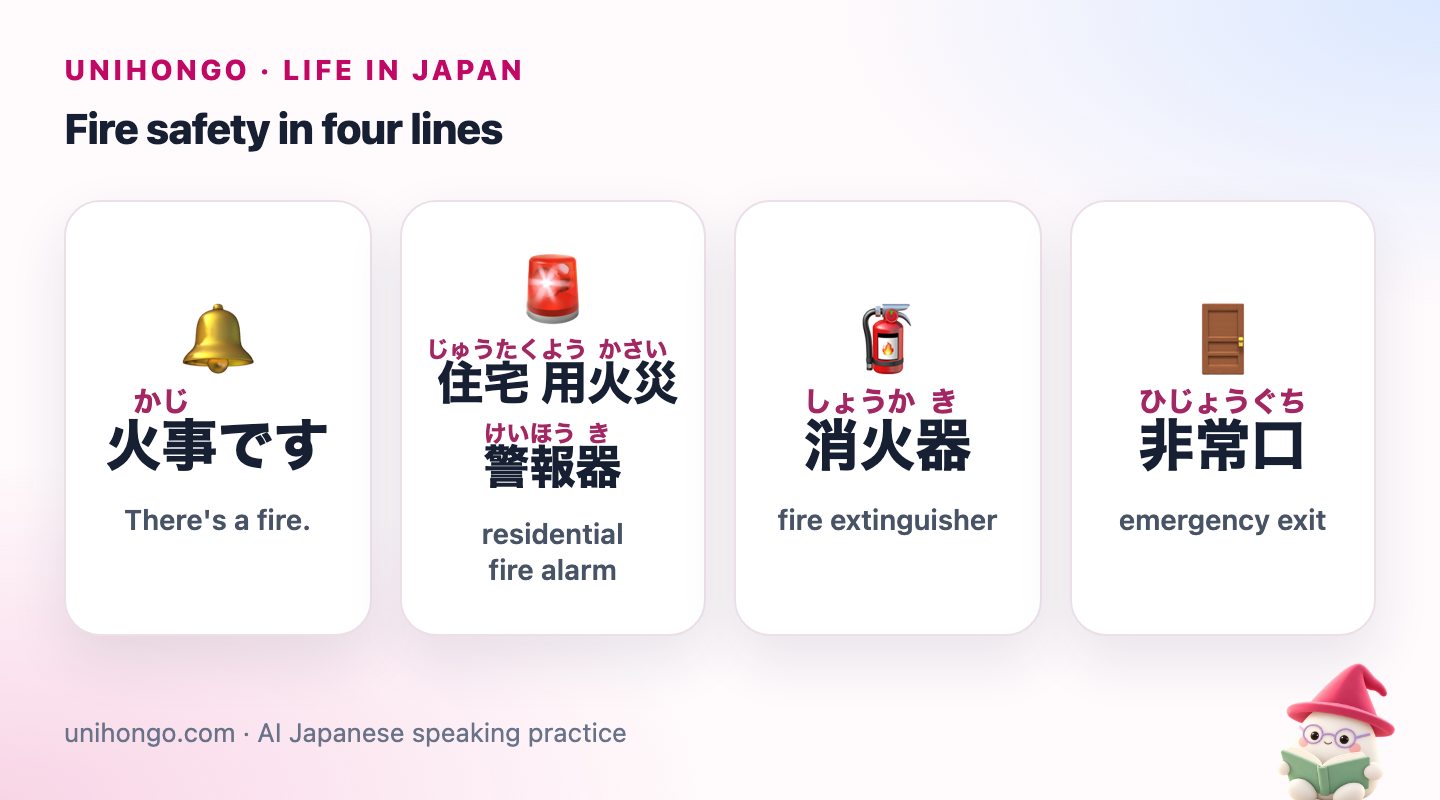
| Japanese | Romaji | Meaning |
|---|---|---|
| 火事です | Kaji desu. | There's a fire. |
| 住宅用火災警報器 | jūtakuyō kasai keihōki | residential fire alarm |
| 消火器 | shōkaki | fire extinguisher |
| 非常口 | hijōguchi | emergency exit |
Residential fire alarms and what they say
The Fire Service Act requires residential fire alarms, jūtakuyō kasai keihōki, often shortened to jūkeiki, in Japanese homes. Where exactly they must go is set by each municipality: bedrooms are standard, stairways are required in many layouts, and some areas also require them in kitchens. Most alarms detect smoke; kitchens often have heat detectors instead.
Many models speak. A real alarm typically sounds a tone and then kaji desu, kaji desu. A short beep at intervals or a voice saying the battery is empty means the battery is low or the unit has a fault. Fire departments generally recommend replacing alarms about ten years after installation; the date is often printed on the unit.
| Japanese | Romaji | Meaning |
|---|---|---|
| 電池切れです | denchi gire desu | the battery is empty |
| 警報を止める | keihō o tomeru | to stop the alarm |
| 交換の時期 | kōkan no jiki | time to replace |
| What you hear | Meaning | What to do |
|---|---|---|
| Tone + 火事です、火事です | Smoke or heat detected | Check for fire; if real, warn others and call 119 |
| Short beep at intervals | Low battery or fault, on many models | Replace battery or unit; tell the management company |
| Voice: 電池切れです | Battery empty, on some models | Replace battery or unit |
| Building bell or announcement | Building-wide alarm | Follow announcements; evacuate if told |
False alarms from cooking or steam
Grilling fish, burnt toast or steam from the bathroom can set off an alarm. If you are sure there is no fire, press the stop button or pull the cord on the alarm, open a window and turn on the extractor fan. Many alarms reset themselves when the smoke clears.
In an apartment building, a home alarm may be connected to the building's system or a security company, and staff may come to check. If a neighbour or staff member knocks, explain calmly.
| Japanese | Romaji | Meaning |
|---|---|---|
| 料理の煙で鳴ってしまいました。 | Ryōri no kemuri de natte shimaimashita. | It went off because of cooking smoke. |
| 火事ではありません。大丈夫です。 | Kaji de wa arimasen. Daijōbu desu. | There's no fire. Everything's fine. |
| お騒がせしてすみません。 | Osawagase shite sumimasen. | Sorry for the disturbance. |
Using a fire extinguisher
A small fire that has just started, such as a pan or a wastebasket, may be put out with an extinguisher. If flames reach the ceiling, or you are not sure, leave, close the door behind you and call 119. Many apartment buildings have extinguishers in the corridors; find yours before you need it.
| Japanese | Romaji | Meaning |
|---|---|---|
| 安全ピンを抜く | anzen pin o nuku | pull out the safety pin |
| 火元に向ける | himoto ni mukeru | aim at the source of the fire |
| 油に水をかけないで。 | Abura ni mizu o kakenaide. | Don't pour water on the oil. |
- Pull out the safety pin, anzen pin (安全ピン), at the top.
- Take the hose and aim at the base of the fire, not the flames or smoke.
- Squeeze the lever firmly and sweep from side to side.
- Keep your escape route behind you; back away if the fire grows.
Never pour water on burning cooking oil: it can make the fire explode outwards. Turn off the heat if you safely can and use an extinguisher, or cover the pan if you know how, then call 119.
Calling 119 for a fire
119 is for fire and ambulance. The operator asks questions in a fixed order, so you only need to answer one at a time. Speak slowly; the operator will ask again if needed.
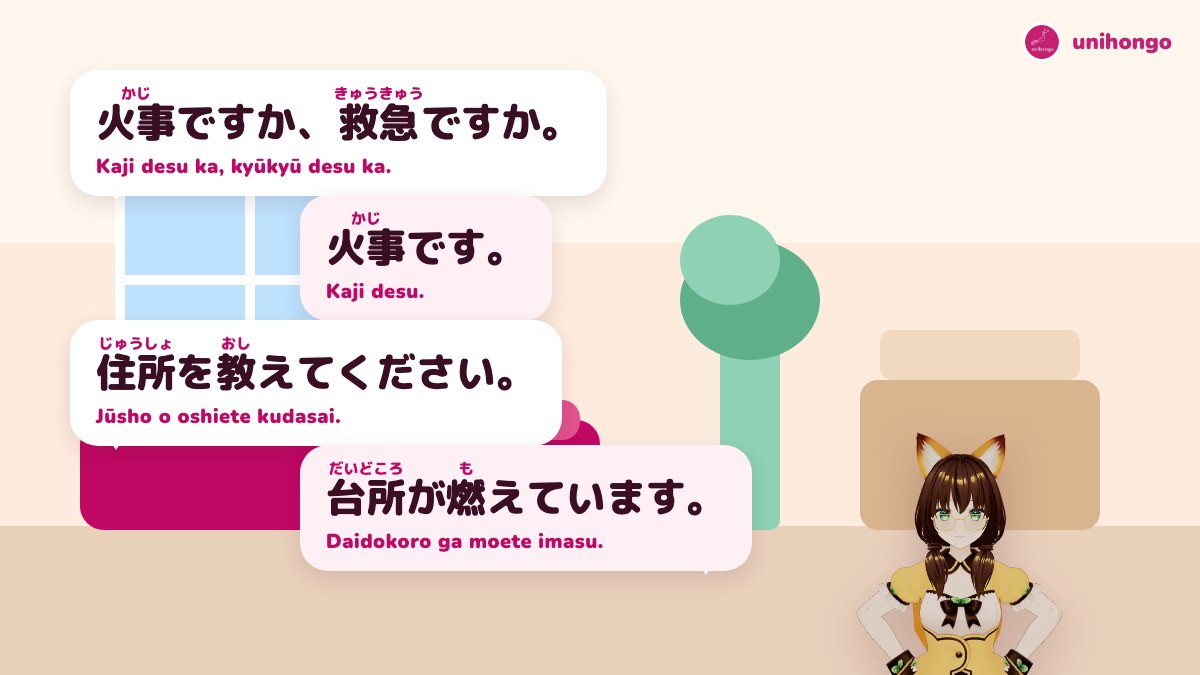
| Japanese | Romaji | Meaning |
|---|---|---|
| 火事ですか、救急ですか。 | Kaji desu ka, kyūkyū desu ka. | Operator: Fire or ambulance? |
| 火事です。 | Kaji desu. | You: It's a fire. |
| 住所を教えてください。 | Jūsho o oshiete kudasai. | Operator: Please tell me the address. |
| 台所が燃えています。 | Daidokoro ga moete imasu. | You: The kitchen is on fire. |
| 逃げ遅れた人はいますか。 | Nigeokureta hito wa imasu ka. | Operator: Is anyone trapped inside? |
| いいえ、みんな外に出ました。 | Iie, minna soto ni demashita. | You: No, everyone is outside. |
If you do not know the address, give a landmark: the building name, a nearby station, a convenience store or a school. Utility poles and vending machines in Japan often carry a small address sticker, which can help.
Preventing fires at home
Most home fires start with everyday things. Japanese fire departments regularly name a few common causes: cooking left unattended, heaters too close to washing or bedding, cigarettes, and electrical plugs. A few habits remove most of the risk.
| Japanese | Romaji | Meaning |
|---|---|---|
| コンロの火をつけたまま離れない | konro no hi o tsuketa mama hanarenai | don't leave the stove while it's on |
| ストーブの近くに物を置かない | sutōbu no chikaku ni mono o okanai | keep things away from the heater |
| コンセントのほこりを掃除する | konsento no hokori o sōji suru | clean the dust off the sockets |
- Stay in the kitchen while frying or grilling, and turn off the heat when you leave the stove, even for a moment.
- Keep heaters away from curtains, futons and drying laundry, and switch them off before sleeping or going out.
- Clean dust from behind plugs that stay in the socket for years, such as the fridge and TV; dust and moisture can cause tracking fires, called torakkingu genshō.
- Do not overload power strips, and replace cords that are cracked or hot to the touch.
- If you smoke, use a deep ashtray with water and never smoke in bed.
Fire drills and signs in apartment buildings
Larger apartment buildings hold fire drills, shōbō kunren (消防訓練) or hinan kunren (避難訓練), announced by a notice in the lobby. Joining once is the easiest way to learn where the stairs, extinguishers and exits are.
On many balconies, the thin partition between your balcony and the next is designed to be broken through in an emergency. It is marked with a sign meaning in an emergency, break through here to escape to the next unit. Some balconies also have an escape hatch with a ladder, hinan hacchi. Never block either with plants, storage or a washing machine.
| Japanese | Romaji | Meaning |
|---|---|---|
| 非常の際はここを破って隣戸へ避難できます | Hijō no sai wa koko o yabutte rinko e hinan dekimasu | In an emergency, break through to escape next door |
| 避難ハッチ | hinan hacchi | escape hatch on the balcony |
| 防火扉 | bōka tobira | fire door |
| 火気厳禁 | kaki genkin | no open flames |
Mistakes that make fires worse
- Removing the alarm's battery because of cooking smoke. Use the stop button instead and ventilate.
- Blocking the balcony partition or escape hatch with storage. Neighbours may need it as much as you.
- Using the lift during a fire. Use the stairs.
- Going back for belongings. Get out, close doors behind you and stay out.
- Assuming someone else has called 119. If you see a fire, call.
Make the 119 call automatic
Give Mocchi your address and ask for a 119 fire call script with the operator's questions and your answers. Come back later and ask to be quizzed on the call line by line until you no longer need to read it.
Then listen to how it sounds at speed: use /pronounce in the chat to practise saying your address and kaji desu clearly, because a calm, clear address is the most useful thing you can give the operator.