
How a marriage becomes legal in Japan
Japanese marriage is a registration, not a ceremony. The couple fill in the konin todoke, two witnesses sign it, and the couple, or one of them, or someone they ask, submits it at a municipal office. The office checks it, and once it is accepted the marriage counts from the date of submission. For Japanese nationals the marriage is then entered in the family register, the koseki; a foreign partner has no koseki of their own, and the marriage is noted in the Japanese partner's register.
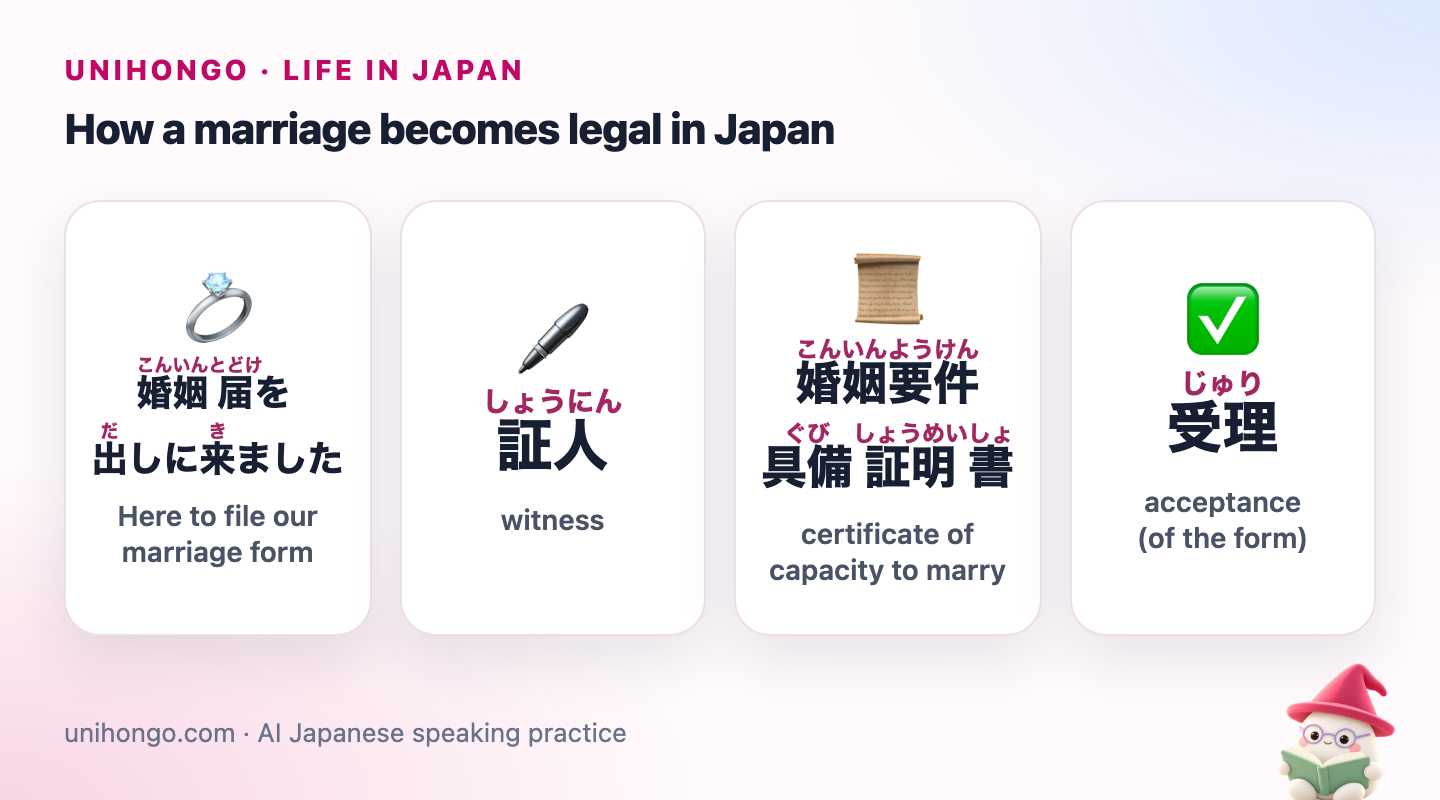
| Japanese | Romaji | Meaning |
|---|---|---|
| 婚姻届を出しに来ました | Kon'in todoke o dashi ni kimashita | Here to file our marriage form |
| 証人 | shōnin | witness |
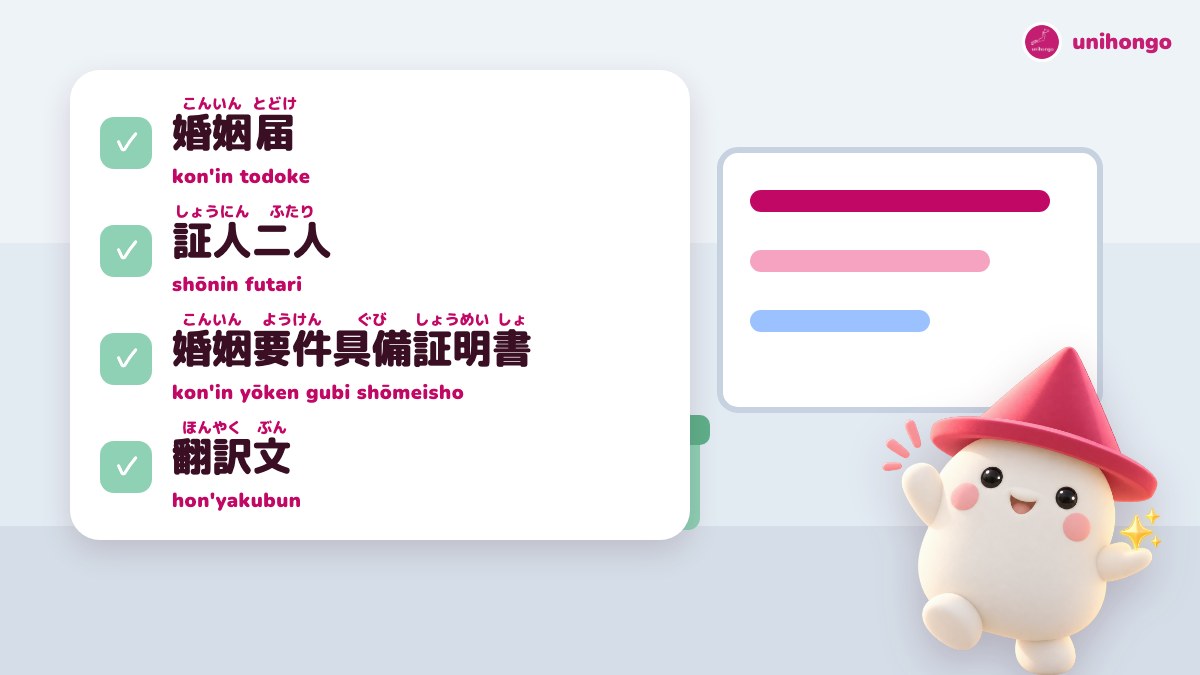
| 婚姻要件具備証明書 | kon'in yōken gubi shōmeisho | certificate of capacity to marry |
| 受理 | juri | acceptance (of the form) |
Where and when to submit
For a couple with a Japanese partner, the form can be filed at the office for the Japanese partner's registered domicile or where either partner lives, among other places. Many offices accept forms outside opening hours at a night or holiday window; the form is checked on the next working day, and if something is missing you may be asked to come back. If the date matters to you, file during opening hours a few days early to check the documents, or ask the office how they handle your chosen date.
| Japanese | Romaji | Meaning |
|---|---|---|
| どこに提出すればいいですか。 | Doko ni teishutsu sureba ii desu ka. | Where should we submit it? |
| 時間外でも受け付けていますか。 | Jikangai demo uketsukete imasu ka. | Do you accept it outside office hours? |
| 事前に書類を確認してもらえますか。 | Jizen ni shorui o kakunin shite moraemasu ka. | Could you check our documents in advance? |
| この日に提出したいんです。 | Kono hi ni teishutsu shitain desu. | We'd like to submit it on this date. |
Documents a foreign partner usually needs
Requirements differ by nationality and by office, so treat this as the common pattern and ask the family register section, the koseki-ka, for your case. The office wants to confirm that each partner is legally free to marry under their own country's law.
| Japanese | Romaji | Meaning |
|---|---|---|
| 外国人の配偶者の必要書類を教えてください。 | Gaikokujin no haigūsha no hitsuyō shorui o oshiete kudasai. | Please tell me what the foreign partner needs. |
| 翻訳は自分でしてもいいですか。 | Hon'yaku wa jibun de shite mo ii desu ka. | May I do the translation myself? |
| 大使館で証明書をもらいました。 | Taishikan de shōmeisho o moraimashita. | I got the certificate at the embassy. |
- A passport, to confirm identity and nationality.
- A certificate of legal capacity to marry, kon'in yōken gubi shōmeisho, issued by the embassy or consulate in Japan or by the home country. Some countries do not issue one; the office will tell you what can replace it, such as a sworn statement or a birth certificate with other papers.
- Japanese translations of every foreign-language document, with the translator's name. Anyone can usually translate, including you.
- For a Japanese partner, a family register certificate is often no longer needed at the office since the 2024 system change, but ask in advance.
The form, field by field
The form is one page in brown or a design version; any version with the standard layout is accepted. These headings are the ones international couples ask about most.
| Japanese | Romaji | Meaning |
|---|---|---|
| 夫になる人・妻になる人 | otto ni naru hito, tsuma ni naru hito | the person becoming husband / wife |
| 本籍(外国人は国籍) | honseki (gaikokujin wa kokuseki) | registered domicile (nationality for foreigners) |
| 父母の氏名 | fubo no shimei | names of your parents |
| 婚姻後の夫婦の氏 | kon'ingo no fūfu no uji | the couple's surname after marriage |
| 同居を始めたとき | dōkyo o hajimeta toki | when you started living together |
| 届出人署名 | todokedenin shomei | signatures of the people filing |
The surname box applies to couples who are both Japanese, who must choose one shared surname. In a marriage with a foreign national, the couple's surnames do not merge on the form, and the clerk will explain how to treat that part. The foreign partner writes their name as in their passport, usually in the Latin alphabet, and often a katakana reading.
Asking your witnesses
Two witnesses aged 18 or over sign the form. They can be friends, colleagues or family, of any nationality, and they do not have to come to the office. Asking is a small honour, so ask politely and bring the form to them, or post it with a return envelope.
| Japanese | Romaji | Meaning |
|---|---|---|
| 婚姻届の証人になってもらえませんか。 | Kon'in todoke no shōnin ni natte moraemasen ka. | You: Would you be a witness on our marriage form? |
| もちろん!おめでとう! | Mochiron! Omedetō! | Friend: Of course! Congratulations! |
| ここに署名をお願いします。 | Koko ni shomei o onegai shimasu. | You: Please sign here. |
| 住所も書けばいいんだよね? | Jūsho mo kakeba iin da yo ne? | Friend: I write my address too, right? |
At the counter: submission and the acceptance certificate
The clerk checks the form, the documents and your IDs, and may ask you to correct small mistakes on the spot, so bring a pen and the same IDs you used when preparing it. Once accepted, ask for a certificate of acceptance, the juri shōmeisho. Your embassy, immigration and your employer may each want proof of the marriage, and this certificate is the usual document for a couple where one partner has no koseki.
| Japanese | Romaji | Meaning |
|---|---|---|
| 婚姻届をお願いします。 | Kon'in todoke o onegai shimasu. | You: Our marriage form, please. |
| こちらの訂正をお願いできますか。 | Kochira no teisei o onegai dekimasu ka. | Clerk: Could you correct this part? |
| 受理証明書もお願いします。 | Juri shōmeisho mo onegai shimasu. | You: An acceptance certificate as well, please. |
| 受理されました。おめでとうございます。 | Juri saremashita. Omedetō gozaimasu. | Clerk: It has been accepted. Congratulations. |
Kekkon, kon'in and nyūseki: which word when
Three words for getting married turn up around the registration. Kekkon is the everyday word for marriage and weddings. Kon'in is the legal term on forms. Nyūseki literally means entering a family register, and many Japanese people use it loosely to mean registering a marriage, as in nyūseki shimashita, we made it official.
Strictly speaking, a foreign partner does not enter a Japanese family register, so some people avoid nyūseki for international marriages and say kon'in todoke o dashita instead. In casual conversation, friends will understand either; on forms and at the counter, use the legal terms.
| Japanese | Romaji | Meaning |
|---|---|---|
| 結婚しました。 | Kekkon shimashita. | We got married. (everyday) |
| 婚姻届を出しました。 | Kon'in todoke o dashimashita. | We filed our marriage registration. |
| 入籍しました。 | Nyūseki shimashita. | We made it official. (common, loose use) |
| 式はまだ先です。 | Shiki wa mada saki desu. | The ceremony is still a while away. |
What to do after the marriage is registered
Nothing below happens automatically. Make a list, and ask each office what it needs from you.
- Your embassy: report the marriage if your country requires it, and ask how it is recognised at home.
- Immigration: if you want the spouse status, apply for a change of status of residence. If your name changes in your passport, report the change on your residence card within the deadline.
- Surnames: a Japanese partner can file a surname change notice to use the foreign spouse's surname. The foreign partner's name follows their own country's rules and passport.
- Work: tell HR so that family allowances, health insurance dependants and tax deductions can be updated.
- Banks and cards: update the name if it has changed.
Learn the form before the big day
Ask Mocchi: Make flashcards for the fields on a Japanese marriage form, like kon'in todoke, shōnin and juri shōmeisho, and quiz me on them. Mocchi makes cards with pictures you pick, reviews them with spaced repetition and remembers the ones that keep tripping you up. You can also write your witness request in Japanese and ask Mocchi to correct it with /correct.
If you would like to practise the counter conversation, choose the city hall topic in AI Sensei and ask Yamada-sensei to play the family register clerk checking your documents.