
What a jūminhyō is, in four words
Your jūminhyō is created when you register your address at the city office, usually within 14 days of moving in. It records your name, date of birth, sex, address, the date you moved in, and the household you belong to. For Japanese nationals it can also show the registered domicile (honseki), and for foreign residents it carries items from the residence card.
When people say they need your jūminhyō, they almost always mean a certified copy printed today, not the record itself. The four words on the cards below are the ones you will meet first: the copy, the household option, the My Number option and the convenience store service.
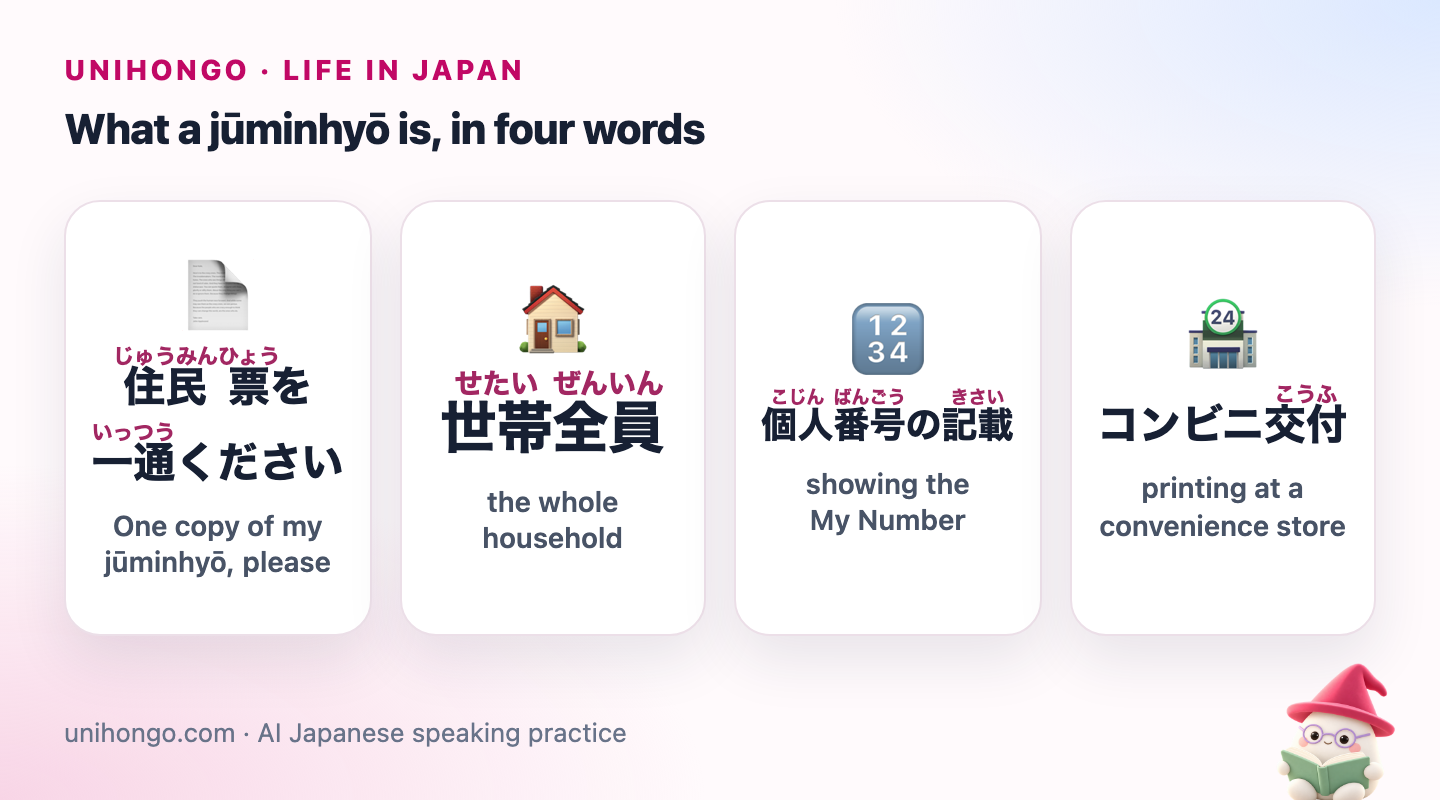
| Japanese | Romaji | Meaning |
|---|---|---|
| 住民票を一通ください | Jūminhyō o ittsū kudasai | One copy of my jūminhyō, please |
| 世帯全員 | setai zen'in | the whole household |
| 個人番号の記載 | kojin bangō no kisai | showing the My Number |
| コンビニ交付 | konbini kōfu | printing at a convenience store |
Who asks for one, and which version they usually want
The most common mistake is printing the wrong version and going back. Before you request it, ask the bank, school or office exactly which items must appear. The table shows typical patterns, not rules; each requester decides.
| Japanese | Romaji | Meaning |
|---|---|---|
| どの項目が必要ですか。 | Dono kōmoku ga hitsuyō desu ka. | Which items do you need on it? |
| 世帯全員のものですか。 | Setai zen'in no mono desu ka. | Should it show the whole household? |
| 発行から何か月以内ですか。 | Hakkō kara nankagetsu inai desu ka. | Within how many months of issue? |
| マイナンバーは省略していいですか。 | Mainanbā wa shōryaku shite ii desu ka. | May I leave the My Number off? |
| Who asks | Typical reason | What to check with them |
|---|---|---|
| Employer or HR | Payroll, commuting allowance, family allowances | Household members shown or not; My Number usually handled separately |
| Bank or card company | Proof of address when opening an account | Whether a recent copy is required and how recent |
| Immigration | Some applications, such as family or permanent residence | Whole household, and whether My Number must be left off |
| School or nursery | Enrolment and address checks | Whether the child and both parents must appear |
| Car dealer or vehicle office | Registering a car in your name | Exact address match with other documents |
The request form, box by box
At the window you fill in a request form, usually called a kōfu seikyūsho or shinseisho. Layouts differ by city, and many offices have an English or multilingual sample on the wall, but the same items appear almost everywhere.
| Japanese | Romaji | Meaning |
|---|---|---|
| 請求者(窓口に来た人) | seikyūsha (madoguchi ni kita hito) | requester (the person at the window) |
| 必要な人の氏名 | hitsuyō na hito no shimei | name of the person whose record you need |
| 使いみち・提出先 | tsukaimichi, teishutsusaki | purpose and where it will be submitted |
| 世帯全員・世帯の一部 | setai zen'in, setai no ichibu | whole household or some members |
| 世帯主・続柄 | setainushi, tsuzukigara | head of household and relationships |
| 本籍・筆頭者 | honseki, hittōsha | registered domicile and head of the family register |
| 個人番号(マイナンバー) | kojin bangō (mainanbā) | personal number (My Number) |
Honseki and hittōsha apply only to Japanese nationals, who have a family register, so a foreign resident living alone can ignore that line. In a mixed household, ask the clerk if you are unsure.
The My Number box deserves care. Your number is protected information, and many requesters do not want it printed on the copy; some actively refuse copies that show it. Tick it only when you have been told to.
What a foreign resident's copy shows
Since foreign residents were brought into the resident register, their records include items taken from the residence card. Depending on the office and the options chosen, a copy can show nationality or region, status of residence, period of stay and its expiry date, and the residence card number, together with any registered alias (tsūshō).
Some offices print these items automatically and do not allow them to be omitted; others offer choices at the window. If a requester wants a copy with or without them, ask the clerk what your office can do before you pay. Convenience store copies are fixed and offer fewer options than the window.
| Japanese | Romaji | Meaning |
|---|---|---|
| 国籍・地域 | kokuseki, chiiki | nationality or region |
| 在留資格 | zairyū shikaku | status of residence |
| 在留期間等の満了の日 | zairyū kikan tō no manryō no hi | expiry date of the period of stay |
| 在留カード等の番号 | zairyū kādo tō no bangō | residence card number |
| 在留資格も載せてもらえますか。 | Zairyū shikaku mo nosete moraemasu ka. | Could you include my status of residence too? |
At the window: what you say and what you hear
Take a numbered ticket if the office uses them, fill in the form, and bring photo ID, normally your residence card or My Number card. The clerk checks your ID, may confirm the purpose, and asks you to pay the fee, which is set by each municipality and shown on a board near the window. Small offices sometimes print it while you wait at the counter; big ones call your number again.
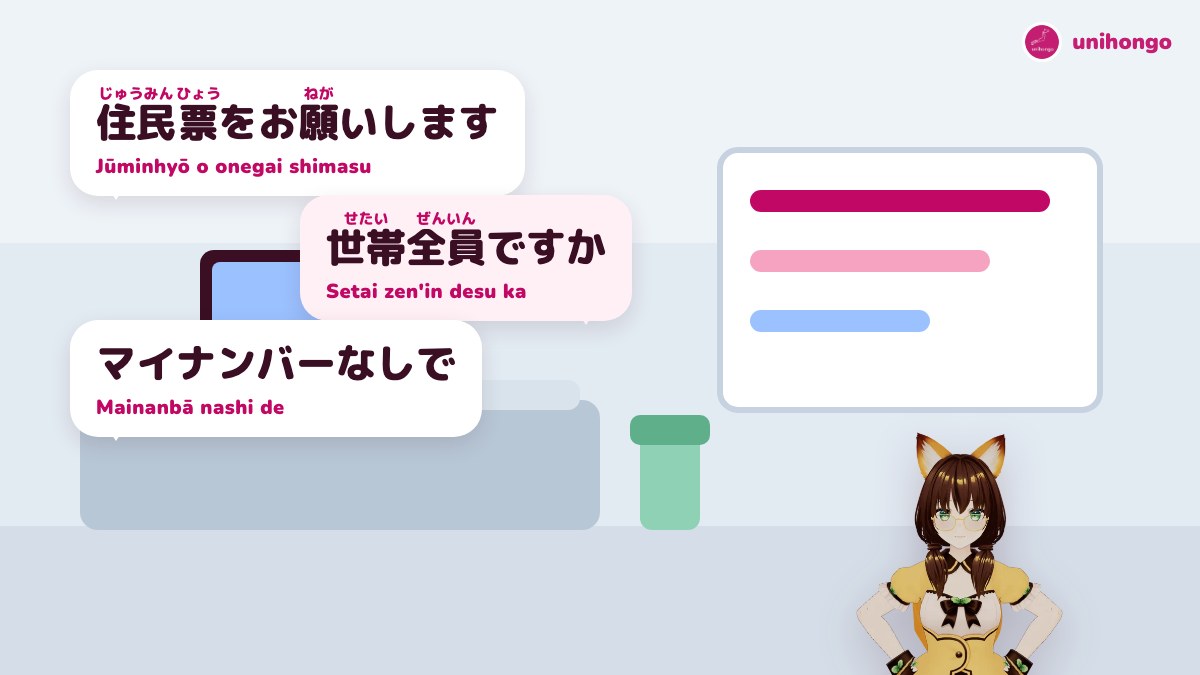
| Japanese | Romaji | Meaning |
|---|---|---|
| 住民票の写しをお願いします。 | Jūminhyō no utsushi o onegai shimasu. | You: A copy of my jūminhyō, please. |
| 世帯全員のものと、ご本人だけのもの、どちらですか。 | Setai zen'in no mono to, gohonnin dake no mono, dochira desu ka. | Clerk: The whole household, or just you? |
| 家族全員でお願いします。 | Kazoku zen'in de onegai shimasu. | You: All of my family, please. |
| マイナンバーの記載はどうされますか。 | Mainanbā no kisai wa dō saremasu ka. | Clerk: Shall we show your My Number? |
| なしでお願いします。 | Nashi de onegai shimasu. | You: Without it, please. |
| 本人確認書類をお願いします。 | Honnin kakunin shorui o onegai shimasu. | Clerk: Your ID, please. |
| 番号でお呼びしますので、お待ちください。 | Bangō de oyobi shimasu node, omachi kudasai. | Clerk: We'll call your number, please wait. |
Printing it at a convenience store
Most municipalities offer konbini kōfu: you print certificates on the multi-function copier in major convenience store chains using your My Number card. You need the card with its user certificate active and the four-digit PIN you set when you received it. Service hours are typically from early morning to late evening, and the system stops on some maintenance days; check your city's page.
The steps are similar on every machine: choose the government certificate service, place your card on the reader, enter the PIN, choose the certificate and options, check the screen and pay at the machine. Remember to take your card back. Convenience store copies carry anti-copy printing and are accepted like window copies, but the options are fewer, so use the window when you need something unusual.
| Japanese | Romaji | Meaning |
|---|---|---|
| 行政サービス | gyōsei sābisu | government services (menu on the copier) |
| 証明書交付サービス | shōmeisho kōfu sābisu | certificate issuing service |
| 暗証番号(数字4桁) | anshō bangō (sūji yonketa) | PIN (four digits) |
| カードをお取りください | kādo o otori kudasai | please take your card |
If you enter the four-digit PIN wrongly three times, it locks, and you have to reset it at the city office. If you moved recently, the convenience store service may not work until your address change is fully processed, so ask at the window.
Things that surprise newcomers
- The copy expires in practice. The document does not change, but many requesters accept only recent copies, so do not print a stack in advance.
- Your old address needs a different paper. After you move out of a city, that city issues a jūminhyō no joshō, a record of a removed registration, if you need proof of where you used to live.
- A certificate of entries is a separate document. Some requesters want a jūminhyō kisai jikō shōmeisho, which shows only selected items, often on their own form.
- Spelling must match. Your name appears as registered, usually as on your residence card. If a bank shows it differently, ask them which spelling they will accept.
- Proxies need paper. A friend or coworker cannot pick it up for you without a signed authorisation letter, and some offices require their own format.
Rehearse the counter before you go
The window conversation is short, but the clerk's questions arrive fast and in polite set phrases. Ask Mocchi something like: Make flashcards for the words on a jūminhyō request form, including setai zen'in, tsuzukigara and kojin bangō. Mocchi builds the cards with a picture you choose and brings them back for review on a spaced schedule, and it remembers which words you keep missing for the next session.
Then open AI Sensei, choose the city hall topic and ask Haru-sensei to play the clerk. Ask for a copy for your whole household without My Number, answer the purpose question, and ask whether your status of residence can be included. If the replies are too fast, ask the Sensei to speak more slowly; the session report afterwards lists the phrases to tidy up.