
Four sentences for the first visit
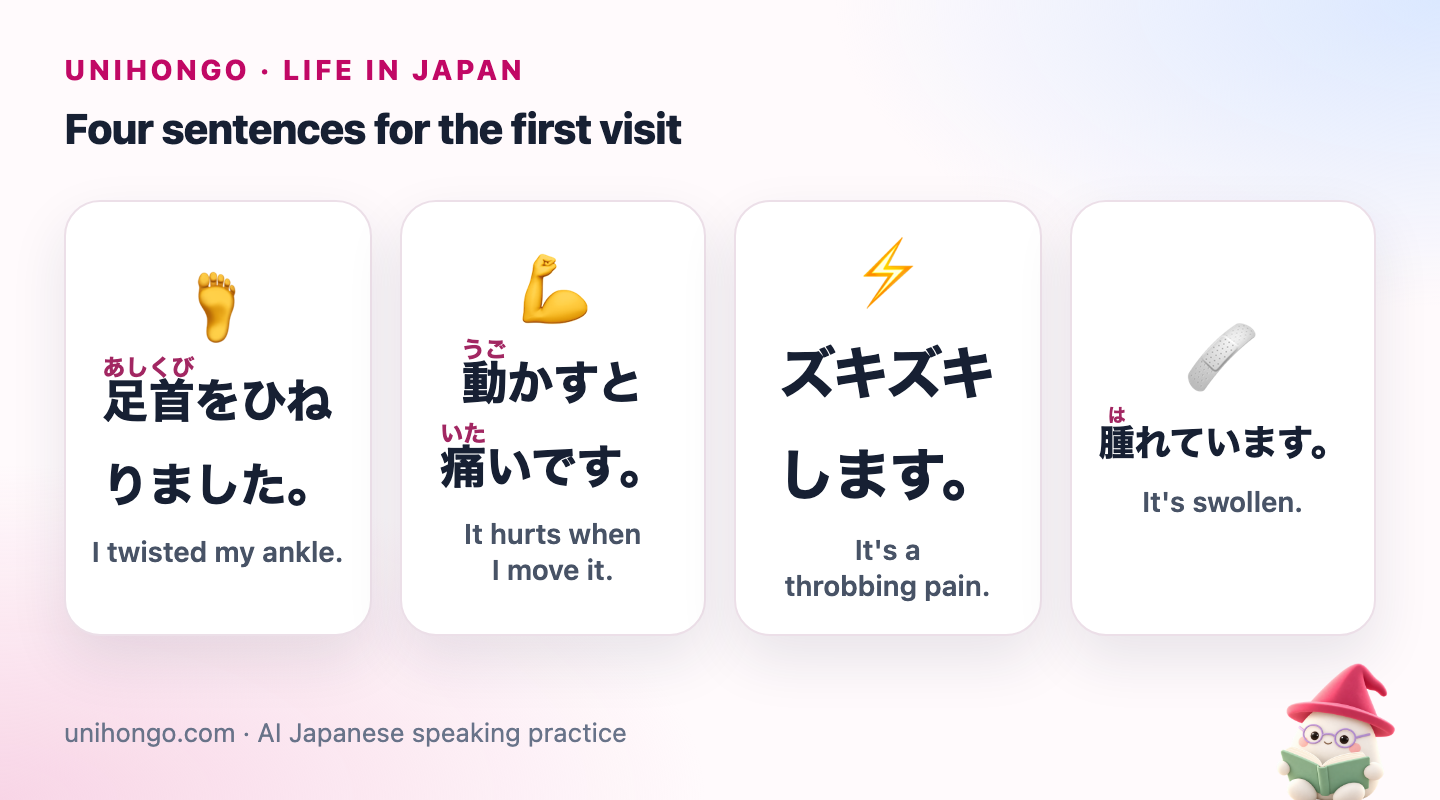
Most first visits start with what happened and how it feels now. Hineru means to twist; it is the everyday verb for ankles, wrists and necks. Ugokasu to itai (it hurts when I move it) and harete imasu (it's swollen) are the two details doctors check first.
| Japanese | Romaji | Meaning |
|---|---|---|
| 足首をひねりました。 | Ashikubi o hinerimashita. | I twisted my ankle. |
| 動かすと痛いです。 | Ugokasu to itai desu. | It hurts when I move it. |
| ズキズキします。 | Zukizuki shimasu. | It's a throbbing pain. |
| 腫れています。 | Harete imasu. | It's swollen. |
| 階段で転びました。 | Kaidan de korobimashita. | I fell on the stairs. |
Seikei geka, sekkotsuin or seitai?
You will see three kinds of signs on Japanese streets, and they are not the same thing. The table gives the general picture; individual clinics differ, and for any injury where a bone might be broken, a doctor's X-ray is the safe first step.
| Japanese | Romaji | Meaning |
|---|---|---|
| 整形外科はどこにありますか。 | Seikei geka wa doko ni arimasu ka. | Where is the orthopaedic clinic? |
| 骨折しているか心配です。 | Kossetsu shite iru ka shinpai desu. | I'm worried it might be broken. |
| レントゲンを撮りますか。 | Rentogen o torimasu ka. | Will you take an X-ray? |
| Sign | Who treats you | Typical use |
|---|---|---|
| 整形外科 (seikei geka) | A doctor, plus physical therapists | Diagnosis, X-rays, medicine, rehabilitation |
| 接骨院, 整骨院 (sekkotsuin, seikotsuin) | Licensed judo therapists | Some sprains, bruises and strains; insurance only in some cases |
| 整体 (seitai) | Practitioners without a national medical licence | Relaxation and body care; not insurance |
Injury words people actually use
Doctors use medical terms, but many everyday injuries have common names that everyone knows. Learn both the everyday word and the clinic word where they differ, because you will hear the clinic word on your receipt and prescription.
| Japanese | Romaji | Meaning |
|---|---|---|
| 捻挫 | nenza | sprain |
| 骨折 | kossetsu | fracture, broken bone |
| 打撲 | daboku | bruise from a knock |
| 突き指 | tsukiyubi | jammed finger |
| 肉離れ | nikubanare | pulled muscle |
| ぎっくり腰 | gikkurigoshi | sudden acute back pain |
| 五十肩 | gojūkata | frozen shoulder (everyday name) |
| 腰を痛めました。 | Koshi o itamemashita. | I hurt my lower back. |
Gikkurigoshi is the sudden, sharp back pain that comes from lifting or twisting; everyone in Japan knows the word. Gojūkata literally means fifty-shoulder, after the age it often appears, but people use it at other ages too.
When you explain how an injury happened, the verb often carries the meaning. Hineru is to twist, korobu is to fall over, butsukeru is to knock or bump something, and te o tsuku is to land on your hand when you fall. A sentence like koronde te o tsuita toki ni, tekubi o itamemashita (I hurt my wrist when I fell and landed on my hand) gives the doctor exactly the mechanism they want to hear.
Doctors also ask about timing and what you have done since. Useful short answers are kinō no yoru kara (since last night), sugu hiyashimashita (I iced it straight away) and ichinichi gaman shimashita (I put up with it for a day). The verb gaman suru, to put up with something, comes up often, and many doctors will gently tell you not to wait so long next time.
Describing the kind of pain
Japanese has a set of sound-symbolic words for pain, and doctors and therapists use them constantly. They are usually followed by suru: zukizuki suru. A doubled word describes a continuing feeling; a short form with tto describes a single moment, like a stab when you move.
| Japanese | Romaji | Meaning |
|---|---|---|
| 歩くとズキッとします。 | Aruku to zukitto shimasu. | I get a sharp twinge when I walk. |
| 夜になるとジンジンします。 | Yoru ni naru to jinjin shimasu. | It aches dully at night. |
| 指先がしびれます。 | Yubisaki ga shibiremasu. | My fingertips feel numb. |
| じっとしていれば痛くないです。 | Jitto shite ireba itaku nai desu. | It doesn't hurt if I keep still. |
| Word | Feeling | Example situation |
|---|---|---|
| ズキズキ (zukizuki) | Throbbing, pulsing | A swollen ankle the evening after |
| ズキッと (zukitto) | A sudden sharp twinge | Turning your back the wrong way |
| ピリピリ (piripiri) | Stinging, tingling | A graze, or a nerve feeling |
| ジンジン (jinjin) | A dull, spreading ache or numbness | A hand after a hard knock |
| しびれる (shibireru) | Pins and needles, numb | Fingers going numb |
Treatment words: X-rays, compresses and supports
After the examination you usually hear about an X-ray, then about treatment. Common treatments at a seikei geka include compresses, a support or a cast, painkillers, crutches, and electrical or heat therapy in the rehabilitation room. The doctor may say how many weeks to expect, often as a rough estimate.
| Japanese | Romaji | Meaning |
|---|---|---|
| 骨には異常がありませんね。 | Hone ni wa ijō ga arimasen ne. | Doctor: There's nothing wrong with the bone. |
| 湿布を出しておきます。 | Shippu o dashite okimasu. | Doctor: I'll prescribe some compresses. |
| しばらくサポーターをつけてください。 | Shibaraku sapōtā o tsukete kudasai. | Doctor: Wear a support for a while. |
| ギプスで固定します。 | Gipusu de kotei shimasu. | Doctor: We'll keep it still with a cast. |
| 松葉杖を貸してもらえますか。 | Matsubazue o kashite moraemasu ka. | Could I borrow crutches? |
| お風呂に入ってもいいですか。 | Ofuro ni haitte mo ii desu ka. | Can I take a bath? |
In the rehabilitation room
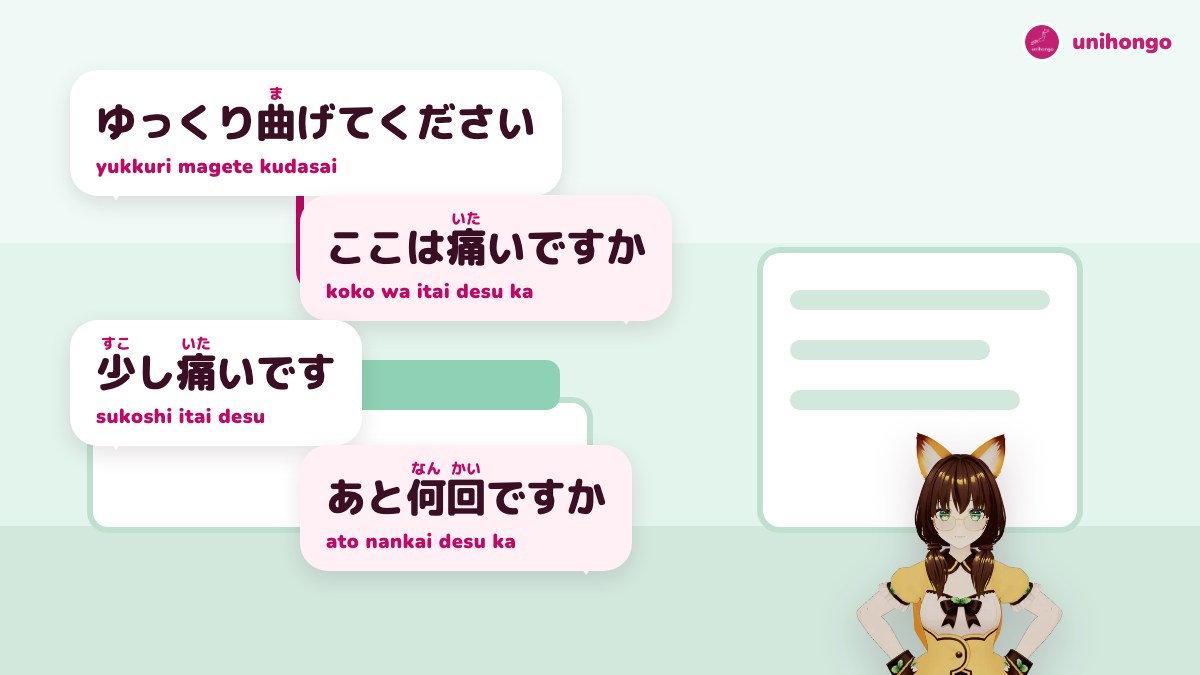
Rehabilitation sessions are often run by a physical therapist (理学療法士, rigaku ryōhōshi), usually called sensei or by name. The language is a stream of short instructions with 〜てください and the friendly 〜ましょう, plus regular checks on how it feels. Answer honestly: therapists adjust the exercise when you say it hurts.
| Japanese | Romaji | Meaning |
|---|---|---|
| ゆっくり曲げてください。 | Yukkuri magete kudasai. | Therapist: Bend it slowly. |
| 痛かったら言ってくださいね。 | Itakattara itte kudasai ne. | Therapist: Tell me if it hurts. |
| ここは痛いですか。 | Koko wa itai desu ka. | Therapist: Does this hurt? |
| 少し痛いですが、大丈夫です。 | Sukoshi itai desu ga, daijōbu desu. | You: It hurts a little, but I'm OK. |
| そこは痛いです。 | Soko wa itai desu. | You: That spot hurts. |
| あと何回ですか。 | Ato nankai desu ka. | You: How many more times? |
| もう十回やりましょう。 | Mō jukkai yarimashō. | Therapist: Let's do ten more. |
| 家でできる運動はありますか。 | Ie de dekiru undō wa arimasu ka. | You: Are there exercises I can do at home? |
Home exercises are often called jishu tore, short for self-directed training. Ask the therapist to write the steps down or to let you film a demonstration; both are common.
Common learner mistakes
- Using ashi for everything below the hip. Ashi covers leg and foot, so be precise: ashikubi (ankle), hiza (knee), kakato (heel), momo (thigh).
- Saying daijōbu to be polite when an exercise hurts. Therapists take your answers literally; say chotto itai desu.
- Going to a seitai shop for a suspected fracture. Seitai is body care, not medical treatment.
- Confusing koshi (lower back) with senaka (back in general). Lower back pain is koshi ga itai.
- Forgetting the frequency of visits. Ask Dono gurai no pēsu de kayoeba ii desu ka, how often should I come?
Practise the visit and the rehab session
Tell Mocchi about your injury in simple English and ask Write how I'd explain this to a Japanese orthopaedic doctor, and include a pain word. Mocchi gives you a short version and a fuller one, explains the pain word it chose, and can turn the new words into flashcards with /create-flashcards.
Then rehearse aloud. In AI Sensei, choose Yamada-sensei with the physical therapy topic and ask Yamada-sensei to run a rehab session: give instructions, ask whether things hurt and set home exercises. Answer every check honestly, and read the session report for the words to review.