
Four words for the first school year
Almost everything about starting school in Japan can be explained with four words. Nyūgaku is entrance into a school, and you hear it in nyūgakushiki (the entrance ceremony) and nyūgaku omedetō (congratulations on starting school). The randoseru is the stiff backpack that many children carry for six years. Uwabaki are the indoor shoes every child changes into at the entrance.
These words appear on notices from autumn onwards, and other parents will use them in small talk too. A friend who asks whether you have bought the randoseru yet is not prying; it is one of the most common conversations among parents of five-year-olds.
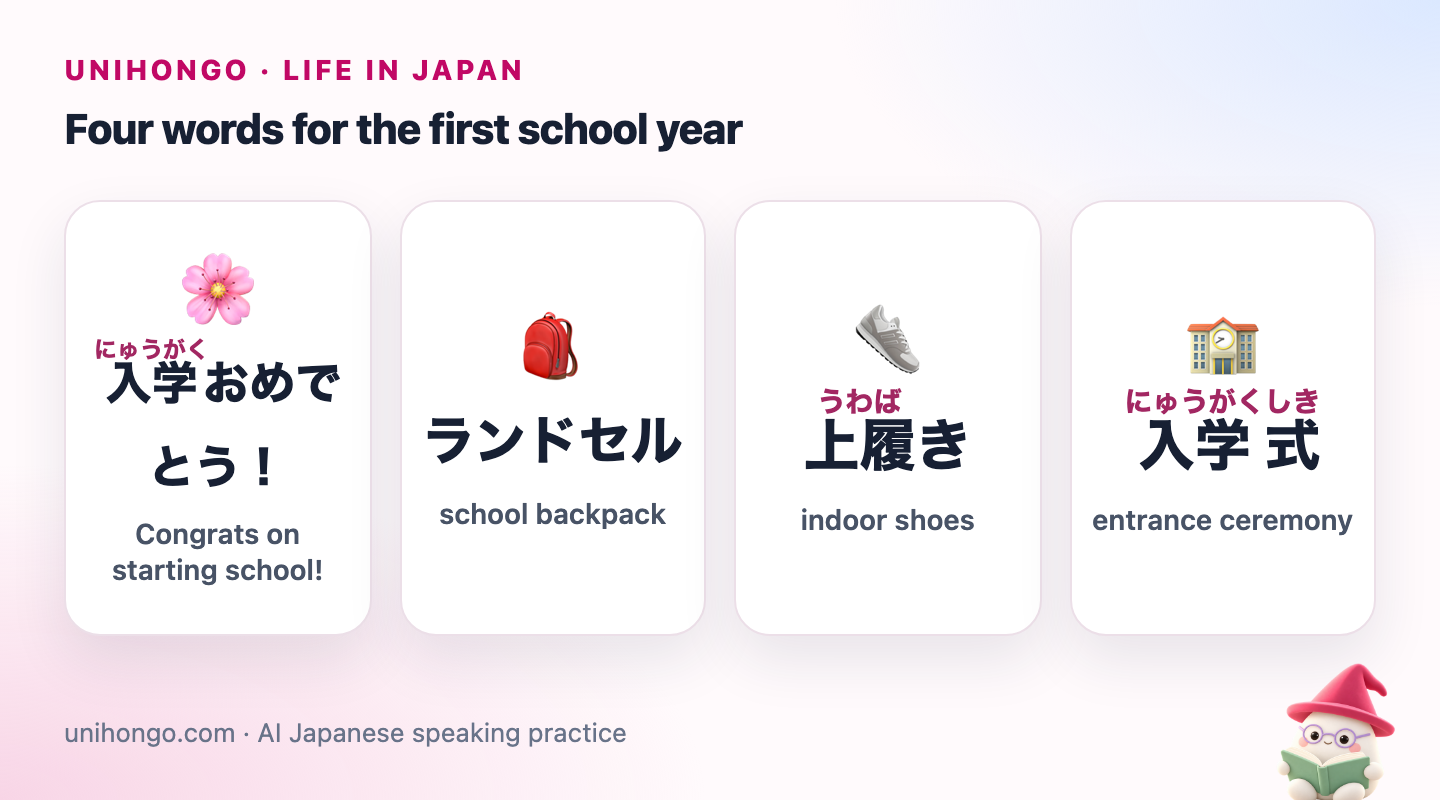
| Japanese | Romaji | Meaning |
|---|---|---|
| 入学おめでとう! | Nyūgaku omedetō! | Congrats on starting school! |
| ランドセル | randoseru | school backpack |
| 上履き | uwabaki | indoor shoes |
| 入学式 | nyūgakushiki | entrance ceremony |
The year before school: a timeline
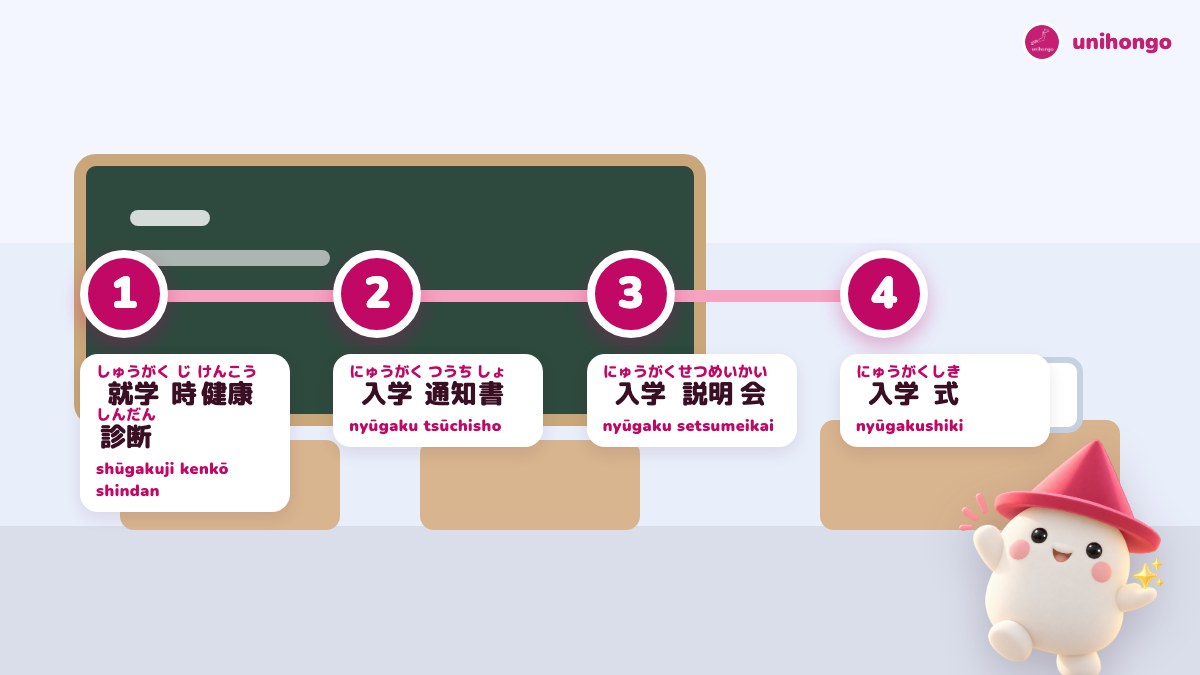
The steps below are the common pattern for a public elementary school. Your city decides the exact dates and sends notices by post, so keep every envelope from the city office (shiyakusho) or the board of education (kyōiku iinkai) until you know what it is.
| Japanese | Romaji | Meaning |
|---|---|---|
| 入学通知書が届きました。 | Nyūgaku tsūchisho ga todokimashita. | The school entry notice has arrived. |
| 説明会はいつですか。 | Setsumeikai wa itsu desu ka. | When is the briefing? |
| 通知がまだ来ていないんですが。 | Tsūchi ga mada kite inai n desu ga. | The notice hasn't arrived yet... (to the city office) |
| どの小学校になりますか。 | Dono shōgakkō ni narimasu ka. | Which elementary school will it be? |
| When (typical) | What happens | Word to look for |
|---|---|---|
| Spring to summer | Families compare and order backpacks | ラン活 (ran-katsu) |
| Autumn | Health check at the future school | 就学時健康診断 |
| January to February | Entry notice naming your school | 入学通知書 |
| January to March | Briefing for new parents, item lists | 入学説明会 |
| Early April | Entrance ceremony | 入学式 |
At the health check: shūgakuji kenkō shindan
The health check before entry, shūgakuji kenkō shindan (就学時健康診断), is usually held at the school your child will attend. You bring the questionnaire (monshinhyō) the city sent, and your child moves from station to station: sight, hearing, teeth, a general check and sometimes a short talk with a teacher. Parents often wait in a hall, and older pupils sometimes guide the children.
Bring indoor slippers for yourself (surippa) and a bag for your outdoor shoes, because you will take them off at the entrance. If your child has a medical condition or needs support, this is often the first chance to mention it. You do not have to explain everything in Japanese: say there is something you want to discuss and ask when you can talk.
| Japanese | Romaji | Meaning |
|---|---|---|
| 問診票を持ってきました。 | Monshinhyō o motte kimashita. | I've brought the questionnaire. |
| スリッパを持ってきてください。 | Surippa o motte kite kudasai. | Staff: Please bring slippers. |
| 子どもはここで待てばいいですか。 | Kodomo wa koko de mateba ii desu ka. | Should my child wait here? |
| 少し相談したいことがあるんですが。 | Sukoshi sōdan shitai koto ga aru n desu ga. | There's something I'd like to discuss. |
| 日本語がまだ少し苦手です。 | Nihongo ga mada sukoshi nigate desu. | My Japanese is still a bit weak. |
Words printed on the school forms
After the briefing you take home several forms: a family information sheet (katei chōsahyō), a health questionnaire (hoken chōsahyō) and often a form for emergency pick-up. The field names are the same on most of them, so learn them once.
| Japanese | Romaji | Meaning |
|---|---|---|
| 児童氏名 | jidō shimei | pupil's full name |
| ふりがな | furigana | reading of the name in hiragana |
| 生年月日 | seinengappi | date of birth |
| 保護者 | hogosha | parent or guardian |
| 続柄 | tsuzukigara | relationship to the child |
| 緊急連絡先 | kinkyū renrakusaki | emergency contact |
| アレルギーの有無 | arerugī no umu | allergies: yes or no |
| かかりつけ医 | kakaritsukei | family doctor |
Under tsuzukigara you write your relationship to the child, usually 父 (father) or 母 (mother). Umu means presence or absence, so the form wants you to circle 有 (yes) or 無 (no) and then give details. Many forms also ask for a work phone number and the name of the person who can pick the child up in an emergency, hikitori-sha.
If you are not sure how to write a foreign name, ask whether katakana is fine. Most schools accept it, and some will print the name in the form you give them on everything for six years, so choose a spelling you are happy with.
Randoseru, uwabaki and the name on everything
The briefing ends with a list of things to buy, mochimono. Some items are sold through the school on a set day, others in ordinary shops. Typical items are below, but every school's list is different, so follow yours exactly.
| Japanese | Romaji | Meaning |
|---|---|---|
| 体操服 | taisōfuku | gym clothes |
| 黄色い帽子 | kiiroi bōshi | yellow safety hat |
| 筆箱 | fudebako | pencil case |
| 防災頭巾 | bōsai zukin | padded disaster hood (some regions) |
| すべての持ち物に名前を書いてください。 | Subete no mochimono ni namae o kaite kudasai. | Please write the name on every item. |
| ひらがなで書いたほうがいいですか。 | Hiragana de kaita hō ga ii desu ka. | Should I write it in hiragana? |
The name rule, namae-tsuke, is serious: pencils, crayons, every single counting stick in the maths set. Parents use name stamps, iron-on labels and fine permanent markers. First-year children cannot read kanji yet, so many schools ask for the name in hiragana. Ask if you are unsure.
The entrance ceremony: what happens and what to say
The entrance ceremony is formal. Many parents wear a dark suit or a dress, and children often wear smart clothes. You find your child's class on a list near the entrance, the children go to their classroom or line up, and parents sit in the gym. There are speeches, the school song, a welcome from older pupils and a class photo. Some schools let parents meet the homeroom teacher briefly in the classroom afterwards.
With the teacher, a short and polite greeting is perfect. With other parents, the standard line is yoroshiku onegai shimasu: you will be seeing each other for six years.
| Japanese | Romaji | Meaning |
|---|---|---|
| はじめまして。リナの母です。 | Hajimemashite. Rina no haha desu. | Nice to meet you. I'm Rina's mother. |
| これからよろしくお願いします。 | Korekara yoroshiku onegai shimasu. | We look forward to the years ahead. |
| 担任の先生はどなたですか。 | Tannin no sensei wa donata desu ka. | Who is the homeroom teacher? |
| 家では英語を話しています。 | Ie de wa eigo o hanashite imasu. | We speak English at home. |
| 何かあれば連絡帳に書きますね。 | Nanika areba renrakuchō ni kakimasu ne. | Teacher: If anything comes up, I'll write in the contact book. |
Common mistakes in the first months
- Ignoring envelopes from the city office. The entry notice and health check notice look like ordinary letters and are easy to miss.
- Forgetting the uwabaki on Monday. Many schools send indoor shoes home on Friday for washing, and they must come back on Monday.
- Writing the name in romaji only. Small children and teachers find hiragana or katakana easier to read.
- Leaving forms until the deadline day. Teishutsu kigen, the deadline, is often only a few days after the form comes home.
- Applying late for after-school care. If you work, the application for gakudō, the after-school club, often closes in winter before school starts.
Rehearse the paperwork before it arrives
Type your draft answers into the chat with Mocchi and ask for a check, for example: /correct 続柄:母、緊急連絡先:父の会社. Mocchi corrects the Japanese, explains why, and can turn the field names above into flashcards with /create-flashcards so you can review them in spare minutes before the forms come home.
For the spoken part, the briefing and the first meeting with the teacher, open AI Sensei and ask Hana-sensei to play a homeroom teacher meeting you for the first time. Introduce yourself, mention the language you use at home and ask one practical question. The session report afterwards lists the corrections and new words.