
Four words that describe how you work
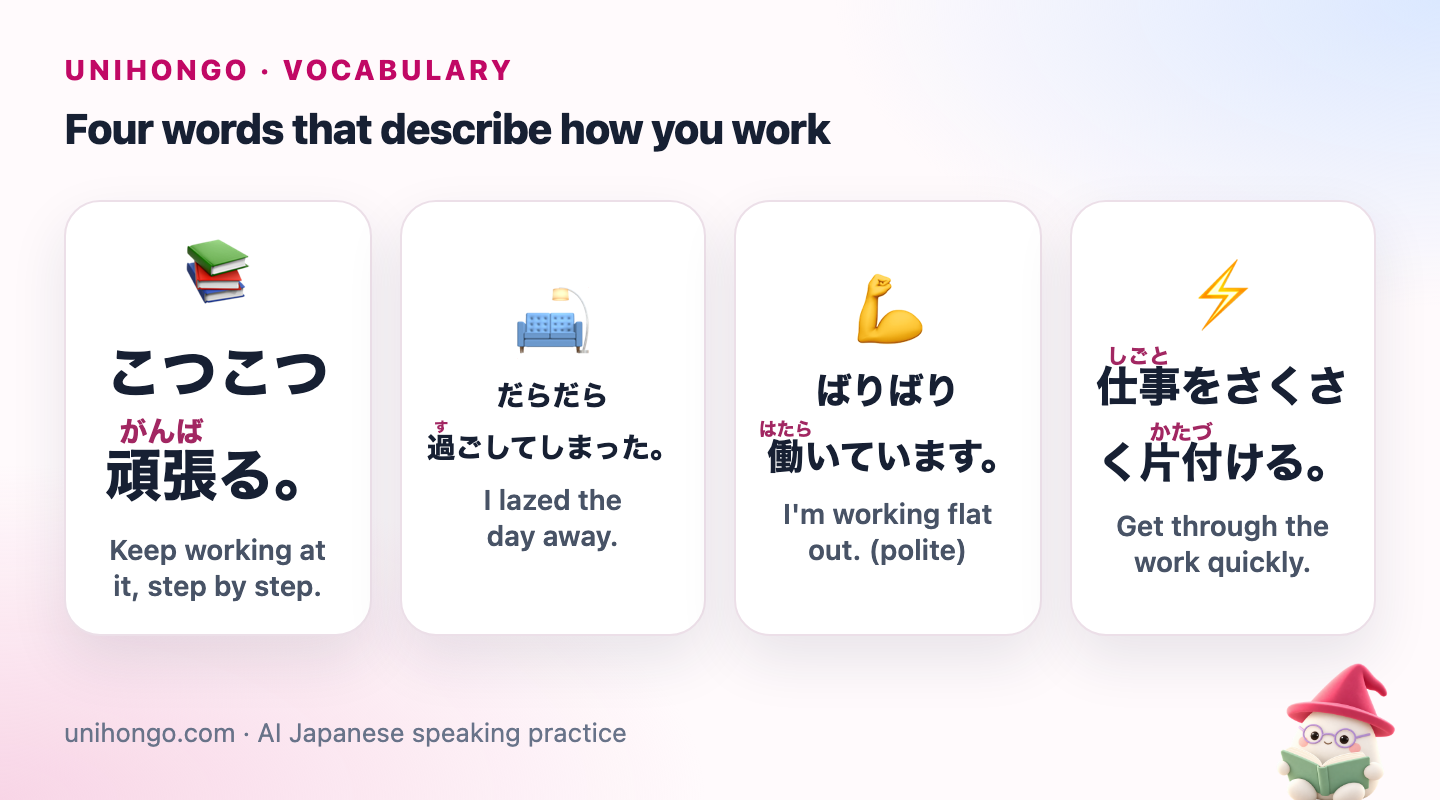
These four words cover the main ways people talk about effort: steady, lazy, energetic and fast. They are gitaigo, describing a manner rather than a sound, though kotsukotsu is also the sound of tapping or footsteps. Kotsukotsu, baribari and sakusaku are positive; daradara is negative.
| Japanese | Romaji | Meaning |
|---|---|---|
| こつこつ頑張る。 | Kotsukotsu ganbaru. | Keep working at it, step by step. |
| だらだら過ごしてしまった。 | Daradara sugoshite shimatta. | I lazed the day away. |
| ばりばり働いています。 | Baribari hataraite imasu. | I'm working flat out. (polite) |
| 仕事をさくさく片付ける。 | Shigoto o sakusaku katazukeru. | Get through the work quickly. |
All four go directly before a verb with no particle, which is typical for doubled mimetic words. Daradara also takes suru, as in daradara suru, to laze about, and sakusaku often pairs with susumu, to progress.
Steady effort: kotsukotsu and the idea behind it
Kotsukotsu has a special place in Japanese school and work culture. Teachers praise students who study kotsukotsu, and many people describe themselves as kotsukotsu taipu, the steady type, in interviews. It suggests patience, reliability and humility rather than talent. If you want to sound modest about an achievement, kotsukotsu yatte kimashita, I've kept at it steadily, is a natural line.
A close word is jikkuri, carefully and without rushing, which describes depth rather than consistency: jikkuri kangaeru, to think something through. Mitchiri means intensively, packed full: mitchiri benkyō suru is an intensive study session.
| Japanese | Romaji | Meaning |
|---|---|---|
| 毎日こつこつ漢字を覚えています。 | Mainichi kotsukotsu kanji o oboete imasu. | I'm learning kanji a little every day. |
| こつこつやってきた結果です。 | Kotsukotsu yatte kita kekka desu. | It's the result of steady work. (modest) |
| この問題はじっくり考えたい。 | Kono mondai wa jikkuri kangaetai. | I want to think this problem through. |
| 週末に三時間みっちり勉強した。 | Shūmatsu ni sanjikan mitchiri benkyō shita. | I studied hard for three hours at the weekend. |
Speed and efficiency: sakusaku, tekipaki, chatchato
Several words praise speed, each with a different flavour. Sakusaku is quick and smooth, as if nothing gets in the way. Tekipaki is brisk and efficient, often about how a person handles tasks or gives instructions; it is a common compliment for staff. Chatchato is very casual, meaning quickly, just get it done, and is often used in commands among family or close friends. Zatto means roughly or quickly, as in skimming a document.
| Japanese | Romaji | Meaning |
|---|---|---|
| 新しい人、てきぱきしてるね。 | Atarashii hito, tekipaki shiteru ne. | The new person is really efficient. (casual) |
| 宿題、ちゃっちゃとやっちゃおう。 | Shukudai, chatchato yatchaō. | Let's just get the homework done. (casual) |
| 資料にざっと目を通しました。 | Shiryō ni zatto me o tōshimashita. | I skimmed through the documents. (polite) |
| このパソコン、さくさく動くね。 | Kono pasokon, sakusaku ugoku ne. | This computer runs really smoothly. |
| 動画がかくかくする。 | Dōga ga kakukaku suru. | The video is choppy. |
| Word | Nuance | Typical sentence | Register |
|---|---|---|---|
| sakusaku | Quick and smooth | sakusaku susumu | Casual to neutral |
| tekipaki | Brisk, efficient, capable | tekipaki shigoto o suru | Neutral, a compliment |
| chatchato | Just get it done fast | chatchato yatchaō | Very casual |
| zatto | Roughly, at a glance | zatto me o tōsu | Neutral, fine at work |
Sakusaku has spread from food and work to technology: a phone or website that responds quickly is sakusaku, and a slow one is often mossari, sluggish, or kakukaku, jerky. These are common in reviews and casual tech talk, but too informal for a written report.
Energy and capability: baribari and its cousins
Baribari is the sound of something tearing or crunching, and as a mimetic word it describes someone working with energy and confidence. Baribari no kyaria ūman is an older set phrase for a high-flying career woman; you will still hear it, but it can sound dated. Mekimeki means noticeably improving, used for skills and progress. Mokumoku means silently, absorbed in work, without chatting, and is often written 黙々.
| Japanese | Romaji | Meaning |
|---|---|---|
| 先輩は営業でばりばり活躍している。 | Senpai wa eigyō de baribari katsuyaku shite iru. | My senior is doing brilliantly in sales. |
| 最近、日本語がめきめき上達している。 | Saikin, Nihongo ga mekimeki jōtatsu shite iru. | My Japanese is improving fast lately. |
| 彼は黙々と作業を続けた。 | Kare wa mokumoku to sagyō o tsuzuketa. | He kept working in silence. |
Slacking and deadlines: daradara, girigiri, bochibochi
Daradara is the classic word for unproductive time: studying with the television on, a meeting with no agenda, a day off that slips away. Girigiri is just barely, right at the limit, perfect for deadlines: girigiri ma ni atta, I made it just in time. Bochibochi means gradually, getting started, and in the Kansai region it is also a relaxed answer to how's business, meaning so-so.
| Japanese | Romaji | Meaning |
|---|---|---|
| 会議がだらだら続いた。 | Kaigi ga daradara tsuzuita. | The meeting dragged on and on. |
| 締め切りにぎりぎり間に合った。 | Shimekiri ni girigiri ma ni atta. | I just made the deadline. |
| じゃあ、ぼちぼち始めようか。 | Jā, bochibochi hajimeyō ka. | Shall we slowly get started? (casual) |
| だらだらしないで、早くやりなさい。 | Daradara shinaide, hayaku yarinasai. | Stop dawdling and do it now. (parent to child) |
Coffee break: talking about work with a coworker
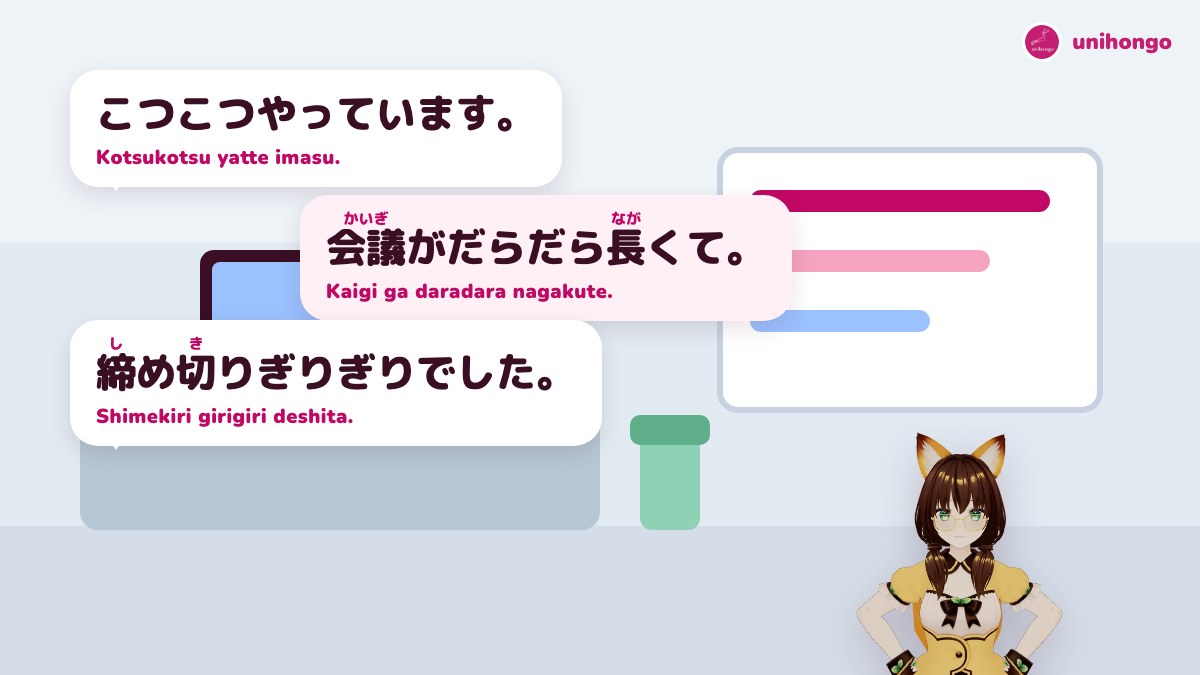
Two coworkers of similar rank talk during a break. They use friendly polite Japanese, a common middle register between colleagues who are not close friends: desu and masu, with a few softer endings.
| Japanese | Romaji | Meaning |
|---|---|---|
| プレゼンの準備、進んでいますか。 | Purezen no junbi, susunde imasu ka. | Sato: How's the presentation prep going? |
| はい、毎日こつこつやっています。 | Hai, mainichi kotsukotsu yatte imasu. | You: Fine, I'm working on it a bit every day. |
| さすがですね。私は昨日、会議がだらだら長くて。 | Sasuga desu ne. Watashi wa kinō, kaigi ga daradara nagakute. | Sato: Impressive. My meeting yesterday dragged on forever. |
| それは大変でしたね。 | Sore wa taihen deshita ne. | You: That sounds tough. |
| おかげで、報告書は締め切りぎりぎりでした。 | Okage de, hōkokusho wa shimekiri girigiri deshita. | Sato: So my report only just made the deadline. |
| 今日はさくさく終わるといいですね。 | Kyō wa sakusaku owaru to ii desu ne. | You: Hope today goes quickly for you. |
Which words are safe in a job interview
- Safe and positive: kotsukotsu, jikkuri, tekipaki. Kotsukotsu doryoku dekiru tokoro ga tsuyomi desu, my strength is steady effort, is a classic line.
- Use with care: baribari. It sounds energetic but casual; with a formal interviewer, say sekkyokuteki ni instead.
- Avoid: daradara and chatchato. Even in a joke about yourself, they can sound unprofessional.
- Girigiri is fine in stories but sounds risky when describing your habits: shimekiri girigiri ni naru koto ga ōi tells them you are often late.
- Bochibochi in an answer about progress. It sounds relaxed and vague; to say things are going well, use junchō ni susunde imasu.
- Mokumoku is positive about focus, but pair it with teamwork, or you may sound as though you never talk to colleagues.
Study kotsukotsu, not daradara
These words describe exactly the kind of habit that a study plan builds. Type /plan to Mocchi and say how many minutes a day you can study; Mocchi builds a 60-day path with small daily tasks and ticks them off as you finish them, which is kotsukotsu in practice. If a week goes daradara, /adjust-plan lets you change the pace instead of giving up.
For the office dialogue, open AI Sensei, choose Yamada-sensei and ask Yamada-sensei to play a coworker on a coffee break. Ask him to switch between friendly polite and casual speech so you hear where tekipaki and chatchato each belong.