
Four feelings in four words
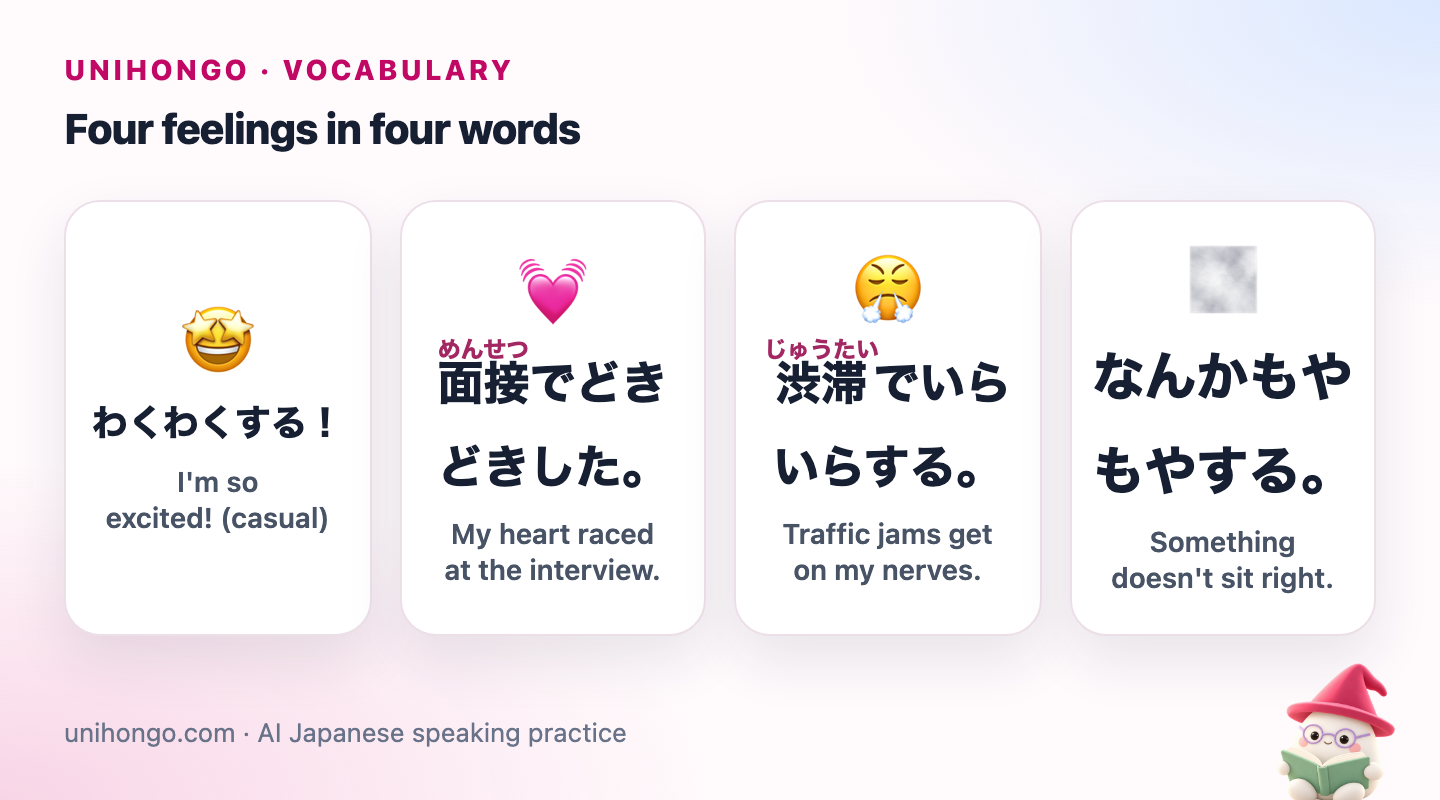
These four words cover a whole range: excitement, nerves, annoyance and a cloudy kind of unease. All are gitaigo, all take suru, and all are everyday words you will hear from friends, coworkers and characters in dramas.
| Japanese | Romaji | Meaning |
|---|---|---|
| わくわくする! | Wakuwaku suru! | I'm so excited! (casual) |
| 面接でどきどきした。 | Mensetsu de dokidoki shita. | My heart raced at the interview. |
| 渋滞でいらいらする。 | Jūtai de iraira suru. | Traffic jams get on my nerves. |
| なんかもやもやする。 | Nanka moyamoya suru. | Something doesn't sit right. |
Each word also works as a noun with no: wakuwaku no ryokō keikaku, an exciting travel plan, or iraira no gen'in, the cause of the irritation. That makes them flexible in writing as well as speech.
Happy feelings: wakuwaku, ukiuki, uttori
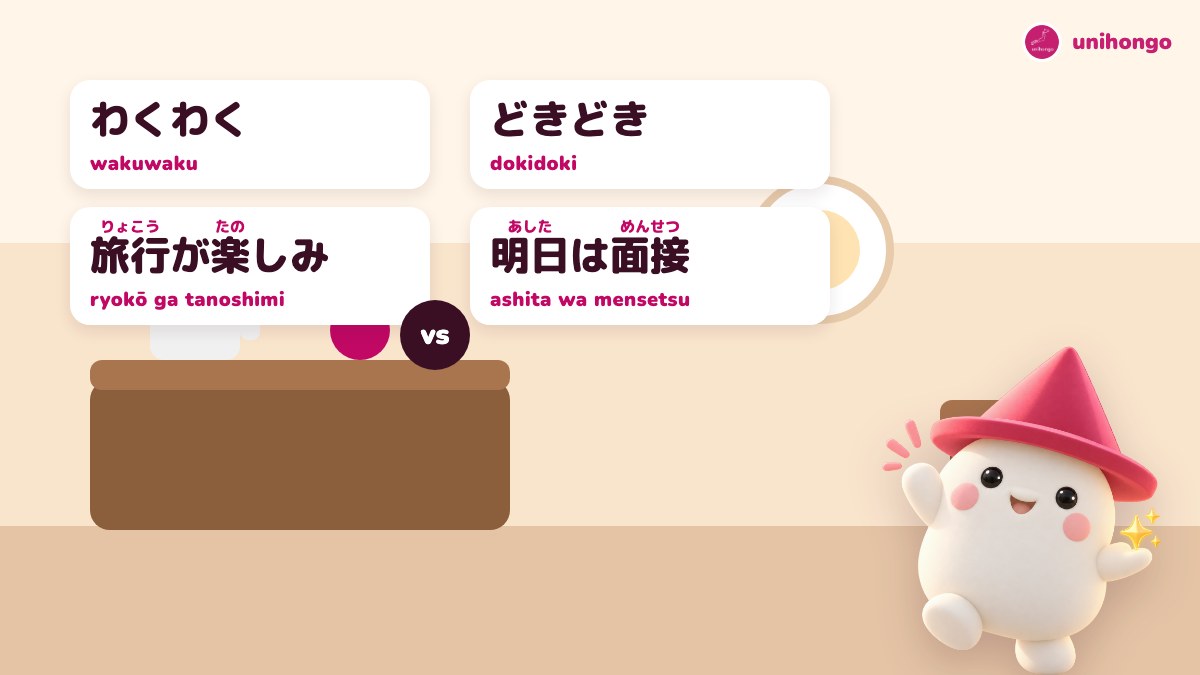
Wakuwaku is anticipation: the feeling before a trip, a concert or the first day of something. Ukiuki is a lighter, floating happiness you are already in, often noticeable to others. Uttori is being entranced by something beautiful, such as music, a view or a person. Nikoniko describes a beaming smile and is about your face, not your inner feeling.
| Japanese | Romaji | Meaning |
|---|---|---|
| 来週の旅行、わくわくする。 | Raishū no ryokō, wakuwaku suru. | I'm excited about next week's trip. |
| 彼女、朝からうきうきしているね。 | Kanojo, asa kara ukiuki shite iru ne. | She's been in high spirits since this morning. |
| きれいな夜景にうっとりした。 | Kirei na yakei ni uttori shita. | I was spellbound by the night view. |
| 春になると、気分がうきうきします。 | Haru ni naru to, kibun ga ukiuki shimasu. | Spring puts me in a cheerful mood. (polite) |
Nerves: dokidoki, harahara, sowasowa
Dokidoki is a heart beating fast, from nerves, excitement or attraction. Harahara is anxious worry while watching something risky happen, such as a child climbing or a close football match. Sowasowa is restless fidgeting when you cannot settle, often while waiting. Bikubiku is jumpy fear, always expecting something bad.
| Japanese | Romaji | Meaning |
|---|---|---|
| 子どもが木に登っていて、はらはらした。 | Kodomo ga ki ni nobotte ite, harahara shita. | The kids were climbing a tree; I was on edge. |
| 結果が気になって、そわそわしている。 | Kekka ga ki ni natte, sowasowa shite iru. | I keep wondering about the results and can't settle. |
| 怒られるかと思って、びくびくしていた。 | Okorareru ka to omotte, bikubiku shite ita. | I was jumpy, thinking I'd be told off. |
| Word | Where it is felt | Typical situation | Strength |
|---|---|---|---|
| dokidoki | Heart | Interview, first date, speech | Medium to strong |
| harahara | Watching others | A risky moment you cannot control | Medium |
| sowasowa | Whole body, restless | Waiting for results or a guest | Light to medium |
| bikubiku | Whole body, fearful | Afraid of being scolded or caught | Medium |
Irritation and anger: iraira, mukatto, mutto, kachin
Irritation builds up in iraira: waiting, noise, a slow computer. Mukatto and mutto are sudden flashes: mukatto is a jolt of anger, and mutto is a sulky, offended look on someone's face. Kachin to kuru means a remark gets on your nerves, as if something clicked. Punpun is a cute, almost childish way to describe someone who is visibly cross, common in manga and casual messages.
All of these are casual. In a meeting or with a customer, people express the same feelings with indirect phrases, for example sukoshi komatte orimasu, we are having some difficulty.
| Japanese | Romaji | Meaning |
|---|---|---|
| パソコンが遅くていらいらする。 | Pasokon ga osokute iraira suru. | My computer is so slow it's driving me mad. |
| その一言にむかっとした。 | Sono hitokoto ni mukatto shita. | That remark made me angry. |
| 注意されて、彼はむっとした顔をした。 | Chūi sarete, kare wa mutto shita kao o shita. | He looked offended when he was told off. |
| あの言い方、かちんと来た。 | Ano iikata, kachin to kita. | The way he said that really got to me. |
| そんなにぷんぷんしないでよ。 | Sonna ni punpun shinaide yo. | Don't be so grumpy. (casual, teasing) |
| 少し困っております。 | Sukoshi komatte orimasu. | We are having some difficulty. (formal) |
Quiet feelings: moyamoya, hotto, gakkari, shonbori
Some feelings are softer. Moyamoya is unresolved unease. Hotto is relief, the breath you let out when a worry disappears. Gakkari is disappointment when something falls short. Shonbori describes someone looking dejected and downcast, usually seen from the outside. Kuyokuyo is dwelling on things you cannot change, and is often used in advice: kuyokuyo shinaide, don't brood over it.
| Japanese | Romaji | Meaning |
|---|---|---|
| 無事に着いて、ほっとした。 | Buji ni tsuite, hotto shita. | I was relieved to arrive safely. |
| 試合に負けて、がっかりした。 | Shiai ni makete, gakkari shita. | I was disappointed we lost the match. |
| 弟がしょんぼりしている。 | Otōto ga shonbori shite iru. | My little brother looks down. |
| くよくよしないで。次があるよ。 | Kuyokuyo shinaide. Tsugi ga aru yo. | Don't dwell on it. There's always next time. |
Notice the short forms with a small tsu. Mukamuka becomes mukatto, and gakkuri has a cousin gakutto. The doubled or longer form describes a feeling that lasts; the small tsu form is a single moment. Hotto is already that kind of single moment: one breath of relief. This pattern helps you guess the meaning of new words.
Talking about a stressful week with a friend
Two friends catch up at a café. They speak casual Japanese and move between several feelings in a few lines, which is exactly how these words appear in real conversation.
| Japanese | Romaji | Meaning |
|---|---|---|
| 最近どう? | Saikin dō? | Mika: How have you been? |
| 月曜は締め切りでずっといらいらしてた。 | Getsuyō wa shimekiri de zutto iraira shiteta. | Yui: On Monday I was on edge all day over a deadline. |
| 大変だったね。もう終わった? | Taihen datta ne. Mō owatta? | Mika: That sounds rough. Is it finished? |
| うん、昨日出して、ほっとした。 | Un, kinō dashite, hotto shita. | Yui: Yeah, I handed it in yesterday. What a relief. |
| でも、まだ上司の返事がなくて、もやもやする。 | Demo, mada jōshi no henji ga nakute, moyamoya suru. | Yui: But my boss hasn't replied, so it's bugging me. |
| 大丈夫だよ。週末の旅行、わくわくするね! | Daijōbu da yo. Shūmatsu no ryokō, wakuwaku suru ne! | Mika: It'll be fine. Our weekend trip is so exciting! |
Common mistakes with feeling words
- Using wakuwaku for nervous excitement before an exam. If the feeling is mostly fear, dokidoki or kinchō fits better.
- Saying ukiuki about yourself all the time. It is often used about others, as in what someone looks like; for yourself, tanoshimi or ureshii are common too.
- Using mutto for your own anger. Mutto mostly describes someone's sulky face or reaction; for your own sudden anger, mukatto or kachin to kita sounds natural.
- Using iraira about a person to their face. Nanka iraira suru describes your mood; anata ni iraira suru is a direct accusation.
- Treating moyamoya as sadness. It is unresolved unease, not grief; for sadness, use kanashii or tsurai.
- Using these words in a formal apology or report. Switch to nouns such as fuan, kinchō or zannen.
Turn your feelings into practice
Keep a feelings line in your journal for a week and send it to Mocchi each evening. Try: /explain moyamoya suru and gakkari suru, and tell me which fits my day. Mocchi explains the difference with your own sentence, and because it keeps notes on the points you miss, it can bring back the pairs you confused in a later /review.
To say the words out loud, open AI Sensei, choose Hana-sensei and ask Hana-sensei to be a close friend who wants to hear about your week. Ask her to keep it casual, then try moving between at least three feeling families in one conversation.