
Four kinds of light, four words
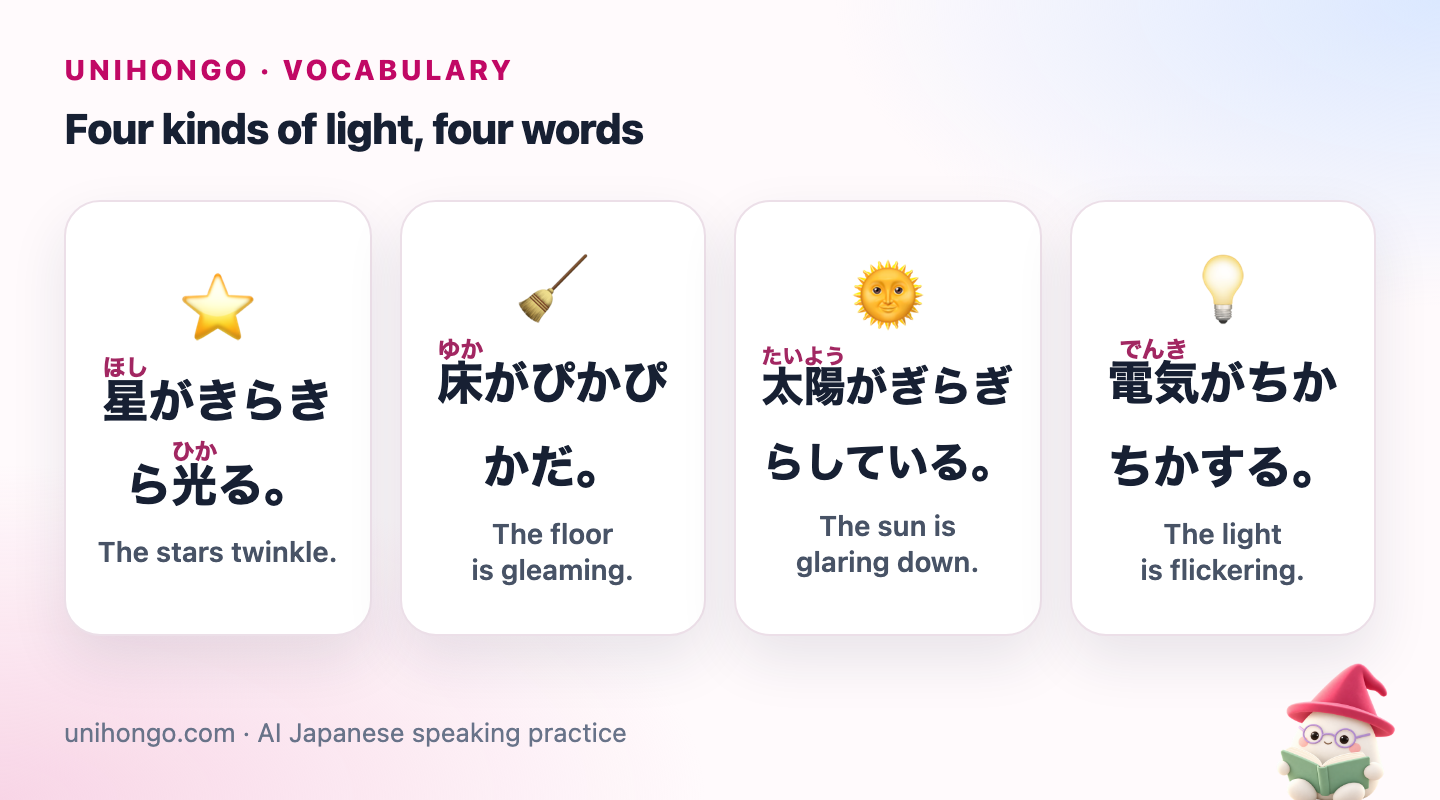
Start with four words that cover the main feelings of light: beautiful, clean and bright, harsh, and flickering. All four are gitaigo, and all four work with hikaru (to shine) or with suru.
| Japanese | Romaji | Meaning |
|---|---|---|
| 星がきらきら光る。 | Hoshi ga kirakira hikaru. | The stars twinkle. |
| 床がぴかぴかだ。 | Yuka ga pikapika da. | The floor is gleaming. |
| 太陽がぎらぎらしている。 | Taiyō ga giragira shite iru. | The sun is glaring down. |
| 電気がちかちかする。 | Denki ga chikachika suru. | The light is flickering. |
Kirakira and giragira show a pattern that runs through Japanese onomatopoeia: adding the voiced mark, changing k to g, makes a word heavier, rougher or less pleasant. Kirakira is pretty; giragira is too much. You see the same shift in korokoro (a small thing rolling) and gorogoro (something heavy rolling).
Stars, jewels and eyes: kirakira, kirari, kiratto
Kirakira is a continuous, beautiful twinkle: stars, a lake in the sun, sequins on a dress, Christmas lights. It is also used for eyes that shine with excitement or hope, and for a glamorous, dazzling image, as in a kirakira lifestyle. Kirari and kiratto are a single glint: a ring catching the light, a tear, or a moment when someone stands out. Kirari to hikaru is also used figuratively for a talent that shines briefly but clearly.
| Japanese | Romaji | Meaning |
|---|---|---|
| 子どもの目がきらきらしていた。 | Kodomo no me ga kirakira shite ita. | The children's eyes were shining. |
| 湖が夕日にきらきら輝いている。 | Mizuumi ga yūhi ni kirakira kagayaite iru. | The lake is sparkling in the sunset. |
| 指輪がきらりと光った。 | Yubiwa ga kirari to hikatta. | The ring glinted. |
| きらりと光る才能がある。 | Kirari to hikaru sainō ga aru. | She has a talent that really stands out. |
| キラキラした生活に憧れる。 | Kirakira shita seikatsu ni akogareru. | I dream of a glamorous life. |
Sun and heat: giragira, kankan, jirijiri
Summer light has its own vocabulary. Giragira is the harsh glare of a strong sun or of light bouncing off metal and water. Kankan, mostly in kankan-deri, is blazing sunshine. Jirijiri is the slow burn of the sun on your skin. These words often come with mabushii, dazzling, and atsui, hot. Giragira also describes things that are unpleasantly shiny or intense, such as a greasy surface or eyes full of ambition.
| Japanese | Romaji | Meaning |
|---|---|---|
| 真夏の太陽がぎらぎら照りつける。 | Manatsu no taiyō ga giragira teritsukeru. | The midsummer sun beats down harshly. |
| まぶしい!サングラス持ってくればよかった。 | Mabushii! Sangurasu motte kureba yokatta. | So bright! I should have brought sunglasses. |
| 彼は野心で目をぎらぎらさせていた。 | Kare wa yashin de me o giragira sasete ita. | His eyes were burning with ambition. |
Screens, signs and lightning: chikachika, pikapika, pikatto
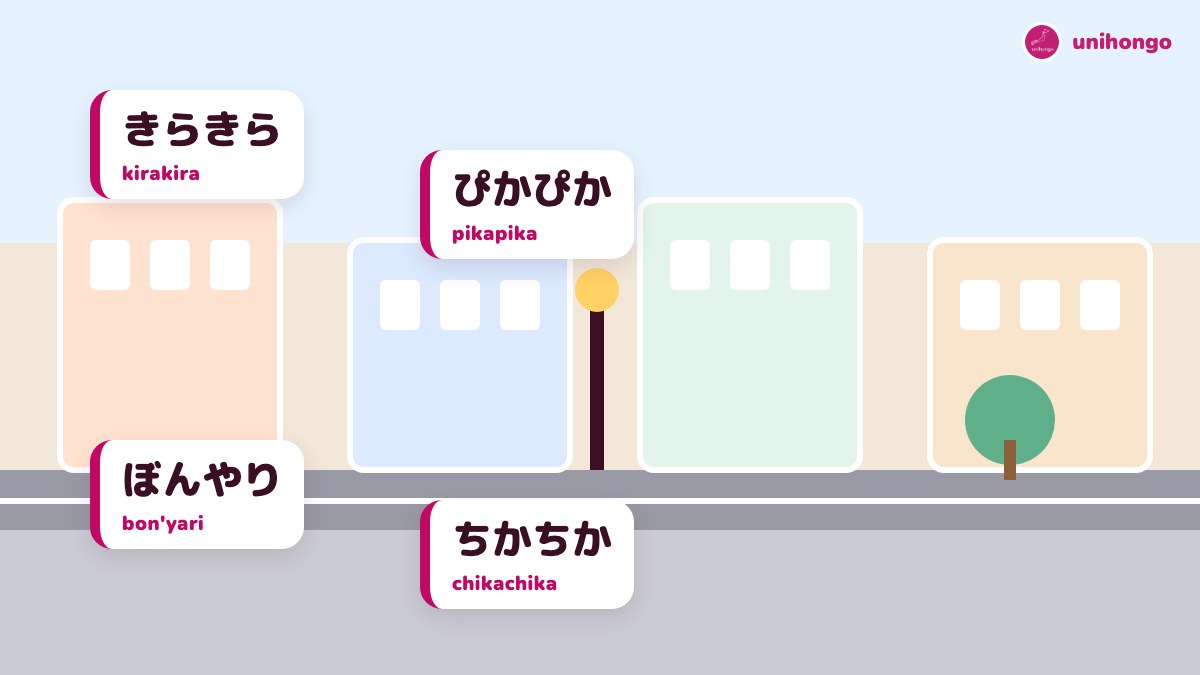
Artificial light gets its own set of words. Chikachika is flickering, small and irritating, or the stinging feeling in your eyes after too much screen time. Pikapika is used for lights that blink on and off, such as illuminations or a warning light, as well as for a clean shine. Pikatto, or pika, is one sudden flash: lightning, a camera flash, or an idea that suddenly comes to you. Bonyari is the opposite: a dim, hazy glow, like a lantern in fog.
| Japanese | Romaji | Meaning |
|---|---|---|
| スマホの見すぎで、目がちかちかする。 | Sumaho no misugi de, me ga chikachika suru. | My eyes sting from too much phone time. |
| ツリーのライトがぴかぴか光っている。 | Tsurī no raito ga pikapika hikatte iru. | The lights on the tree are blinking. |
| 空がぴかっと光った。 | Sora ga pikatto hikatta. | Lightning flashed across the sky. |
| ちょうちんの明かりがぼんやり見える。 | Chōchin no akari ga bon'yari mieru. | I can see the faint glow of lanterns. |
| ちょっとまぶしいですね。 | Chotto mabushii desu ne. | It's a bit bright, isn't it? (polite) |
| Word | Kind of light | Typical source | Feeling |
|---|---|---|---|
| chikachika | Small flicker; stinging eyes | Old fluorescent tube, screen | Annoying |
| pikapika | Blinking, or a clean shine | Illuminations, polished floor | Bright, cheerful |
| pikatto | One sudden flash | Lightning, camera flash | Sudden |
| bonyari | Dim, hazy glow | Paper lantern, fog | Soft, vague |
To ask about a light that bothers you, keep it simple and polite: chotto mabushii desu ne, or denki o keshite mo ii desu ka, may I turn off the light? Mentioning the problem gently is often enough, and the other person will usually offer to fix it.
Shiny surfaces: tekateka, tsuyatsuya, pikapika
Surfaces shine in different ways too. Tsuyatsuya is a healthy, glossy shine and is a compliment: shiny hair, glossy skin, fresh rice. Tekateka is an oily shine and is usually negative, as with a shiny forehead in summer or a worn suit shining at the elbows. Pikapika on a surface means clean and polished. Choosing between them is a good way to sound kind rather than rude.
| Japanese | Romaji | Meaning |
|---|---|---|
| 髪がつやつやですね。 | Kami ga tsuyatsuya desu ne. | Your hair is so glossy. (polite compliment) |
| 暑くて、おでこがてかてかだ。 | Atsukute, odeko ga tekateka da. | It's so hot my forehead is shiny. |
| 炊きたてのご飯がつやつやしている。 | Takitate no gohan ga tsuyatsuya shite iru. | The freshly cooked rice is glossy. |
An evening at the winter illuminations
Many Japanese cities hold illuminations in winter, with streets, parks and station squares lit by thousands of small lights. It is a classic date or friends' outing, and light words come up in every sentence. The lines below are casual, as between friends.
| Japanese | Romaji | Meaning |
|---|---|---|
| わあ、木がきらきらしてる! | Wā, ki ga kirakira shiteru! | Nana: Wow, the trees are sparkling! |
| 本当だ。青いライトがきれいだね。 | Hontō da. Aoi raito ga kirei da ne. | You: They are. The blue lights are lovely. |
| あそこのハート、ぴかぴか光ってるよ。 | Asoko no hāto, pikapika hikatteru yo. | Nana: That heart over there is blinking. |
| ずっと見てたら、目がちかちかしてきた。 | Zutto mitetara, me ga chikachika shite kita. | You: I've been staring so long my eyes are stinging. |
| じゃあ、カフェで温かいもの飲もう。 | Jā, kafe de atatakai mono nomō. | Nana: Then let's get something warm at a café. |
Common mistakes with light words
- Using kirakira for harsh sun. Kirakira is pretty; harsh sunlight is giragira or mabushii.
- Calling someone's skin tekateka as a compliment. Tekateka is oily; tsuyatsuya is the kind word.
- Using pikapika for stars. Stars twinkle kirakira; pikapika suggests blinking or polish.
- Forgetting to with single flashes. Say pikatto hikaru and kirari to hikaru; doubled words such as kirakira can drop it.
- Writing every light word in katakana. Hiragana is normal in everyday writing; katakana makes the light feel more dramatic or cartoon-like.
- Using chikachika for a pleasant sparkle. It suggests flicker or eye strain, not beauty.
Light up your vocabulary review
Ask Mocchi for /kanji 光, the kanji for light and shine, and you will get its readings and common words such as hikaru and nikkō. Then ask Mocchi to match each light onomatopoeia from this post with a picture you choose in /create-flashcards: a starry sky for kirakira, a desert sun for giragira, an old office light for chikachika.
Once the cards exist, play Mocchi Flight on the games page with your own flashcards. Recognising the words at speed helps you choose between kira and gira without stopping to think.