
Four words for sleep and exhaustion
Start with these four. Two describe sleep and two describe being tired, and together they let you answer the two questions you hear most: did you sleep well, and are you tired. All four are gitaigo, words for a state rather than a sound.
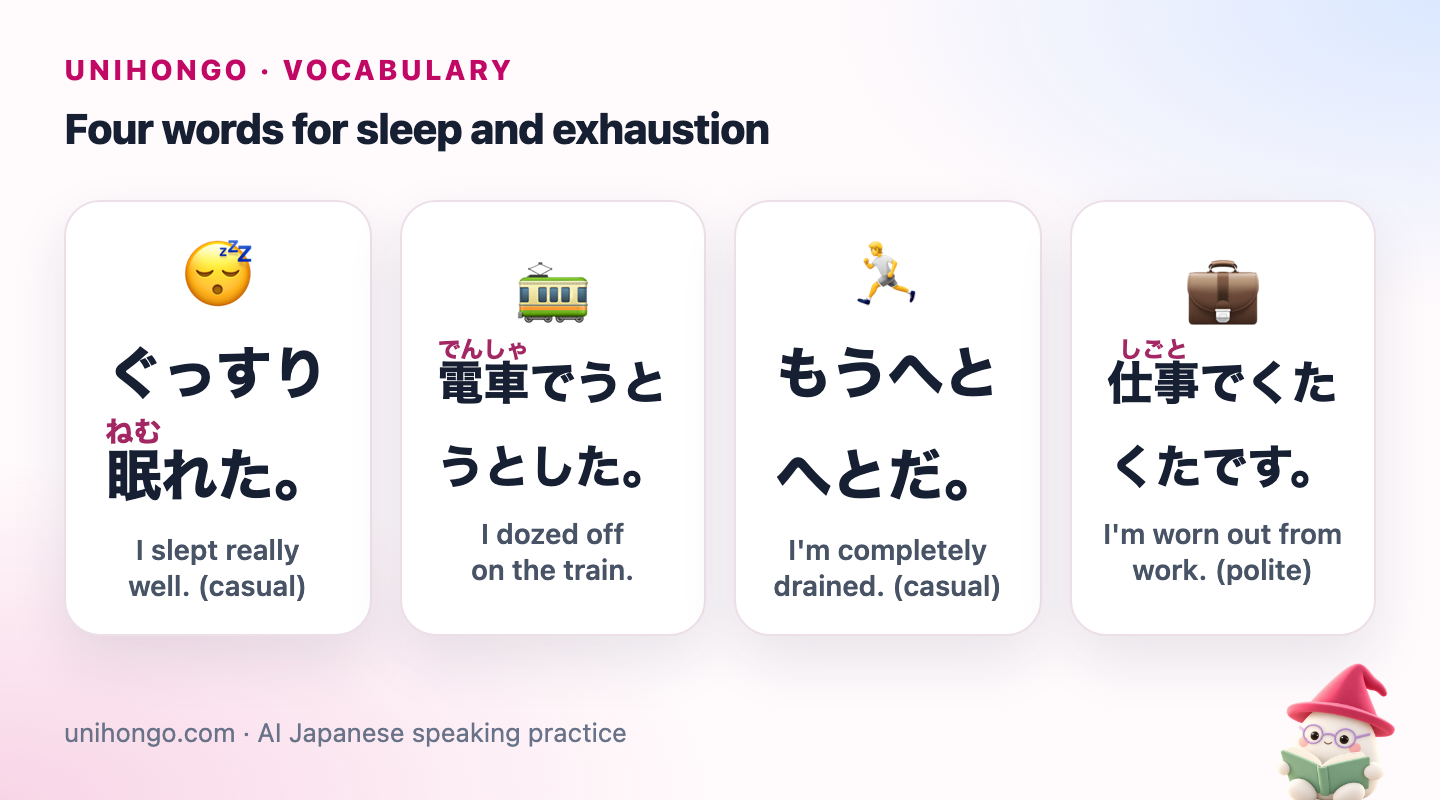
| Japanese | Romaji | Meaning |
|---|---|---|
| ぐっすり眠れた。 | Gussuri nemureta. | I slept really well. (casual) |
| 電車でうとうとした。 | Densha de utouto shita. | I dozed off on the train. |
| もうへとへとだ。 | Mō hetoheto da. | I'm completely drained. (casual) |
| 仕事でくたくたです。 | Shigoto de kutakuta desu. | I'm worn out from work. (polite) |
Notice the grammar. Gussuri goes before the verb with no particle. Utouto takes suru. Hetoheto and kutakuta work like no-adjectives: hetoheto da, kutakuta ni naru, kutakuta no karada (a worn-out body).
Drowsy and dozing: utouto, utsurautsura, kokkuri
Japanese distinguishes between feeling sleepy and actually nodding off. Nemui is just sleepy. Utouto is drifting into a light, short sleep. Utsurautsura is a slightly more literary word for the same half-asleep state, common in writing. Kokkuri kokkuri describes your head nodding forward as you fall asleep sitting up, a familiar sight on Japanese trains.
Dozing off is usually something that happens to you, so these words often appear with ~te shimau or its casual form ~chau, which adds a feeling of without meaning to.
| Japanese | Romaji | Meaning |
|---|---|---|
| 授業中にうとうとしちゃった。 | Jugyōchū ni utouto shichatta. | I dozed off in class. (casual) |
| こたつでうつらうつらしていた。 | Kotatsu de utsurautsura shite ita. | I was half asleep under the kotatsu. |
| おじいさんがこっくりこっくりしている。 | Ojiisan ga kokkuri kokkuri shite iru. | The old man is nodding off. |
| 会議中、少しうとうとしてしまいました。 | Kaigichū, sukoshi utouto shite shimaimashita. | I nodded off a little in the meeting. (polite) |
Sleeping sounds: gūgū, sūsū and sleeping like a log
Gūgū is giongo, the sound of snoring or heavy breathing in deep sleep. In casual speech gūgū nete ita means someone was sound asleep, not necessarily snoring loudly. The real word for snoring is ibiki, and a loud snore is gōgō. Sūsū is the soft sound of quiet breathing in sleep, and for babies people usually use suyasuya, peacefully asleep.
Gussuri, by contrast, makes no sound: it describes how deep the sleep is. A related casual phrase is batankyū, falling flat on your bed and out like a light. It is playful slang, a little dated, and best kept for friends.
| Japanese | Romaji | Meaning |
|---|---|---|
| 弟はぐうぐう寝ている。 | Otōto wa gūgū nete iru. | My little brother is fast asleep. |
| 父のいびきがごうごううるさい。 | Chichi no ibiki ga gōgō urusai. | My dad's snoring is really loud. |
| 赤ちゃんがすやすや寝ている。 | Akachan ga suyasuya nete iru. | The baby is sleeping peacefully. |
| 帰ったらバタンキューだった。 | Kaettara batankyū datta. | I crashed as soon as I got home. (slangy) |
Waking up: patchiri, sukkiri, bōtto
How you wake up has its own set of words. Me ga patchiri sameru means your eyes pop wide open and you are fully awake. Sukkiri is the refreshed, clear-headed feeling after a good sleep, also used after a shower or after tidying up. Bōtto and bonyari describe a foggy, not-quite-awake head, and nebokete iru means you are still half asleep and confused.
| Japanese | Romaji | Meaning |
|---|---|---|
| 今朝は目がぱっちり覚めた。 | Kesa wa me ga patchiri sameta. | I woke up wide awake this morning. |
| よく寝たから、すっきりした。 | Yoku neta kara, sukkiri shita. | I slept well, so I feel refreshed. |
| まだ頭がぼーっとしている。 | Mada atama ga bōtto shite iru. | My head is still foggy. |
| 寝不足で頭がぼーっとする。 | Nebusoku de atama ga bōtto suru. | I'm foggy from lack of sleep. |
| 寝坊して、目覚ましにも気づかなかった。 | Nebō shite, mezamashi ni mo kizukanakatta. | I overslept and didn't even hear the alarm. |
| Word | Type | Feeling | Pattern |
|---|---|---|---|
| patchiri | Gitaigo | Eyes wide open, wide awake | me ga patchiri sameru |
| sukkiri | Gitaigo | Refreshed and clear | sukkiri mezameru, sukkiri suru |
| bōtto | Gitaigo | Foggy, spaced out | atama ga bōtto suru |
| gussuri | Gitaigo | Deep, sound sleep | gussuri nemuru |
Japanese also has plain words for a bad morning. Nebō suru is to oversleep, and nebusoku is lack of sleep. Nebokete iru means still half asleep; nebokete ru no? is affectionate teasing for someone talking nonsense just after waking up. Combine these with sound words and you can describe almost any morning.
Degrees of tired, from a little to completely
Tired has many shades in Japanese, and onomatopoeia sit at the strong end. Use the scale below to choose the right word for the situation and the listener. At work, people often soften with chotto or sukoshi even when they feel very tired.
| Japanese | Romaji | Meaning |
|---|---|---|
| 一日中歩いて、へとへとになった。 | Ichinichijū aruite, hetoheto ni natta. | I walked all day and got exhausted. |
| 残業続きで、くたくたです。 | Zangyō tsuzuki de, kutakuta desu. | I'm worn out from overtime day after day. |
| 暑さでみんなぐったりしている。 | Atsusa de minna guttari shite iru. | Everyone is wilting in the heat. |
| Strength | Expression | Nuance | Register |
|---|---|---|---|
| Light | sukoshi tsukareta | A bit tired | Neutral, safe anywhere |
| Medium | darui | Heavy and sluggish, no energy | Casual |
| Strong | kutakuta | Worn out and limp | Casual to neutral |
| Strong | hetoheto | Drained, nothing left | Casual to neutral |
| Very strong | guttari | Collapsed, wiped out | Neutral, often about others |
Guttari is often used about how someone looks: kare wa guttari shite iru, he looks completely wiped out. Hetoheto and kutakuta are more often about yourself.
Monday morning: how did you sleep?
A quick chat between two friendly coworkers before work starts. They use casual Japanese with a few polite touches, which is typical between colleagues of similar age who know each other well. With a senior colleague, switch to desu and masu.
| Japanese | Romaji | Meaning |
|---|---|---|
| おはよう。週末はゆっくりできた? | Ohayō. Shūmatsu wa yukkuri dekita? | Aya: Morning. Did you get some rest at the weekend? |
| うん、土曜日は十時間ぐっすり寝たよ。 | Un, doyōbi wa jūjikan gussuri neta yo. | Ken: Yeah, I slept like a log for ten hours on Saturday. |
| いいなあ。私はハイキングでへとへと。 | Ii nā. Watashi wa haikingu de hetoheto. | Aya: Lucky you. I'm exhausted from hiking. |
| それで、さっきうとうとしてたんだ。 | Sorede, sakki utouto shiteta n da. | Ken: So that's why you were dozing just now. |
| ばれた?コーヒー飲んでくる。 | Bareta? Kōhī nonde kuru. | Aya: You noticed? I'll go get a coffee. |
Common mistakes with sleep words
- Using gussuri without a sleep verb. Gussuri tabeta is wrong; gussuri belongs with nemuru or neru.
- Saying utouto shimashita to your boss without softening. It sounds like a confession; sukoshi utouto shite shimaimashita sounds more apologetic.
- Using batankyū in polite conversation. It is playful slang; at work say sugu nete shimaimashita, I fell asleep straight away.
- Mixing up sukkiri and patchiri. Sukkiri is how you feel; patchiri is mostly about your eyes being wide open.
- Using hetoheto for stress from people or worries. It works, but kutakuta or seishinteki ni tsukareta often sounds more natural for mental tiredness.
- Treating gūgū as a polite word. It is fine in casual talk and stories, but in a doctor's office say ibiki o kakimasu, I snore.
A sleep diary that teaches vocabulary
For one week, end each day by telling Mocchi in one sentence how you slept and how tired you are, then type /create-flashcards and pick a photo for each new word, such as a sleeping cat for gussuri or a crowded train for utouto. Mocchi keeps track of the words you add, and /review-flashcards brings them back with spaced repetition just before you would forget them.
When the deck has eight or more cards, open the games page and play Flashcard Flip with your own cards. Matching the sleeping-cat photo to gussuri is a quick way to check you remember the feeling, not only the translation.