
Four ways people talk
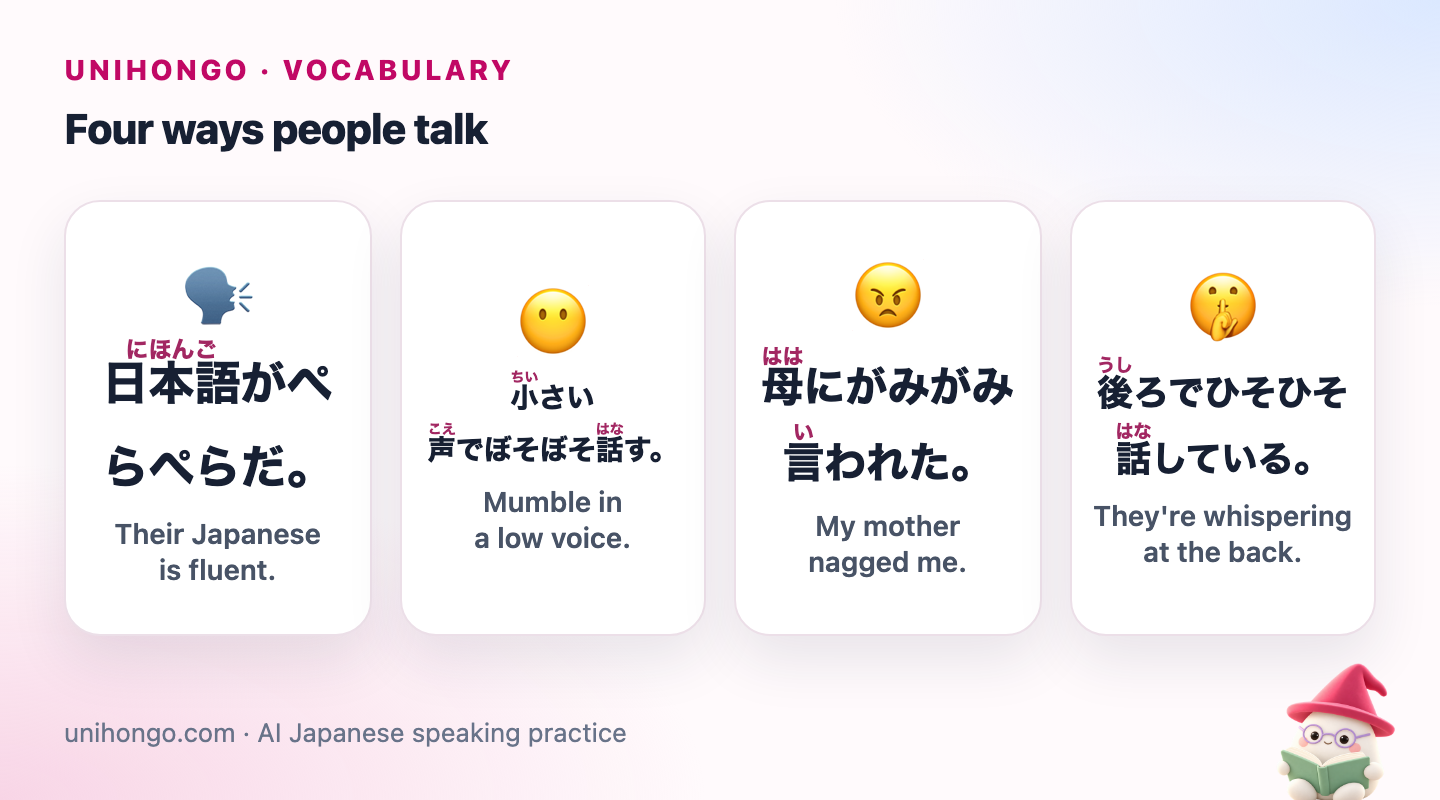
These four words describe four very different voices: fluent, mumbling, nagging and whispering. All of them go before verbs such as hanasu (to speak), iu (to say) or okoru (to get angry), and none needs to. Perapera also works with da: Nihongo ga perapera da.
| Japanese | Romaji | Meaning |
|---|---|---|
| 日本語がぺらぺらだ。 | Nihongo ga perapera da. | Their Japanese is fluent. |
| 小さい声でぼそぼそ話す。 | Chiisai koe de bosoboso hanasu. | Mumble in a low voice. |
| 母にがみがみ言われた。 | Haha ni gamigami iwareta. | My mother nagged me. |
| 後ろでひそひそ話している。 | Ushiro de hisohiso hanashite iru. | They're whispering at the back. |
Perapera and hisohiso are both giongo and gitaigo at once: they suggest a sound, but also a manner. Bosoboso is low, unclear and a little gloomy. Gamigami is the most emotional of the four: it suggests repeated, sharp scolding, often from a parent, teacher or boss.
Fluency: perapera, surasura, hakihaki
Perapera is about overall fluency in a language. Surasura is about doing something smoothly without stopping, such as reading a text aloud, answering a question or writing: surasura yomeru, to read fluently. Hakihaki is about clear, crisp, confident speech, a quality Japanese teachers and interviewers often praise. Tsukaetsukae, haltingly, is the opposite of surasura, and its root is the verb tsukaeru, to get stuck.
| Japanese | Romaji | Meaning |
|---|---|---|
| 彼は英語も中国語もぺらぺらです。 | Kare wa eigo mo chūgokugo mo perapera desu. | He's fluent in English and Chinese. (polite) |
| この文章、すらすら読めた。 | Kono bunshō, surasura yometa. | I could read this text smoothly. |
| 質問にはきはき答えてください。 | Shitsumon ni hakihaki kotaete kudasai. | Please answer the questions clearly. |
| 緊張して、つかえつかえ話した。 | Kinchō shite, tsukaetsukae hanashita. | I was nervous and spoke haltingly. |
When people praise someone's Japanese, you may also hear jōzu, skilled, as in Nihongo ga o-jōzu desu ne. Many learners notice that this compliment comes early and often, even after simple phrases. It is usually meant as encouragement, so a modest, friendly reply works best, and you can turn the conversation back to the other person with a question.
Quiet voices: hisohiso, bosoboso, mogomogo, bosotto
Japanese has several words for quiet or unclear speech, and they are not interchangeable. Hisohiso is deliberate whispering. Bosoboso is low and unclear, often because the speaker is shy, tired or gloomy. Mogomogo is mumbling with your mouth barely open, as if talking with food in it. Bosotto is a short, quiet remark dropped almost to yourself, sometimes a surprisingly sharp one.
| Japanese | Romaji | Meaning |
|---|---|---|
| 図書館ではひそひそ声で話そう。 | Toshokan de wa hisohiso goe de hanasō. | Let's whisper in the library. |
| 口の中でもごもご言わないで。 | Kuchi no naka de mogomogo iwanaide. | Don't mumble. (casual) |
| 彼がぼそっと本音を言った。 | Kare ga bosotto honne o itta. | He quietly let slip what he really thought. |
| Word | What it sounds like | Usual reason | Tone |
|---|---|---|---|
| hisohiso | A deliberate whisper | Secrets, gossip, quiet places | Neutral to negative |
| bosoboso | Low and unclear | Shyness, tiredness, mood | Slightly negative |
| mogomogo | Muffled, mouth half closed | Food in mouth, hesitation | Neutral |
| bosotto | One quiet remark | Thinking aloud, a dry comment | Neutral |
Chatter and gossip: pechakucha, waiwai, berabera
Talking a lot has several shades. Pechakucha is nonstop chatter, often light and noisy, and sounds a little critical. Waiwai is a lively, cheerful group atmosphere and is usually positive: minna de waiwai tanoshinda, we all had a lively, fun time. Berabera is talking too much, especially letting slip things you should not: himitsu o berabera shaberu, to blab a secret. Kyākyā is high-pitched excited squealing, often of children or fans.
| Japanese | Romaji | Meaning |
|---|---|---|
| 授業中にぺちゃくちゃしゃべらないで。 | Jugyōchū ni pechakucha shaberanaide. | Don't chatter during class. |
| みんなでわいわい鍋を食べた。 | Minna de waiwai nabe o tabeta. | We had a lively hotpot together. |
| 秘密をべらべらしゃべらないでね。 | Himitsu o berabera shaberanaide ne. | Don't go blabbing my secret. |
| ファンがきゃーきゃー叫んでいる。 | Fan ga kyākyā sakende iru. | The fans are screaming excitedly. |
Complaints and anger: butsubutsu, gamigami, gyāgyā
Butsubutsu is muttering, either talking to yourself or grumbling about something: butsubutsu monku o iu, to grumble. Gamigami is repeated scolding. Gyāgyā is loud shouting or crying, such as a tantrum or a noisy argument. All three are casual and mostly used to describe other people.
| Japanese | Romaji | Meaning |
|---|---|---|
| 父がずっとぶつぶつ文句を言っている。 | Chichi ga zutto butsubutsu monku o itte iru. | My dad keeps grumbling. |
| 何をぶつぶつ言ってるの? | Nani o butsubutsu itteru no? | What are you muttering about? (casual) |
| 子どもがぎゃーぎゃー泣いている。 | Kodomo ga gyāgyā naite iru. | The child is screaming and crying. |
| ぶつぶつ言ってないで、手伝って。 | Butsubutsu ittenaide, tetsudatte. | Stop grumbling and help. (casual) |
When someone says your Japanese is perapera
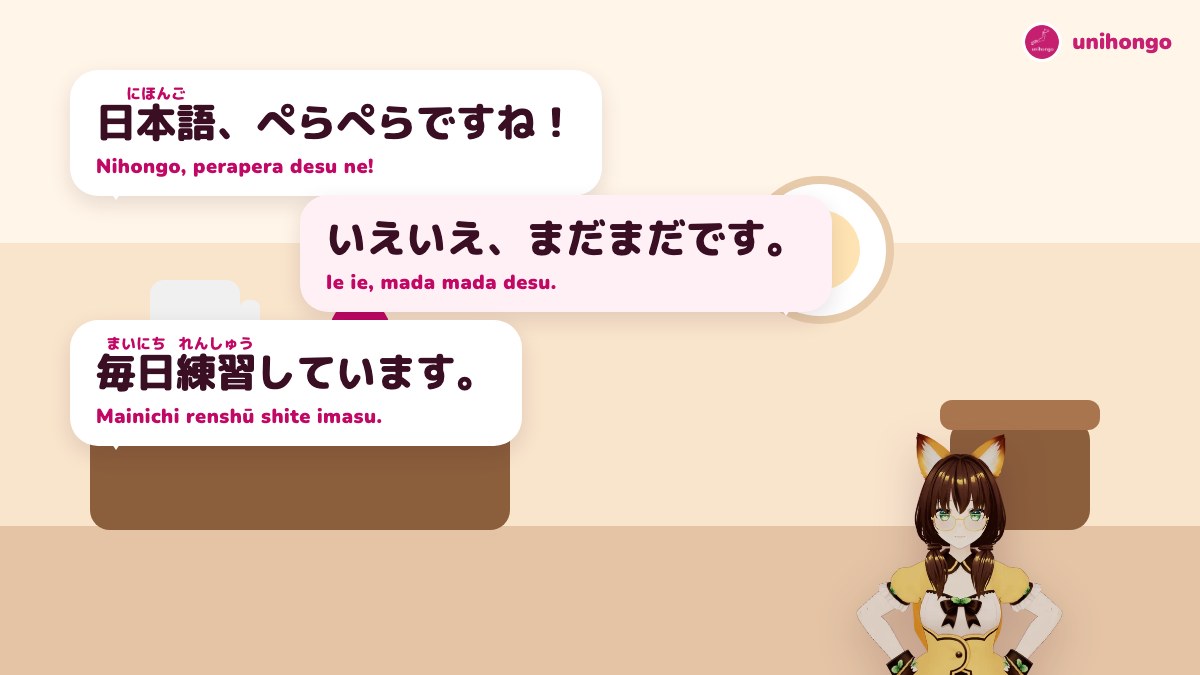
You will hear this compliment often, sometimes after a single sentence. The natural response is modest but friendly. The exchange below is at a café, between a learner and a Japanese acquaintance, in polite Japanese.
| Japanese | Romaji | Meaning |
|---|---|---|
| 日本語、ぺらぺらですね! | Nihongo, perapera desu ne! | Kenji: Your Japanese is so fluent! |
| いえいえ、まだまだです。 | Ie ie, mada mada desu. | You: Oh no, I still have a long way to go. |
| 発音もはきはきしていて、聞きやすいです。 | Hatsuon mo hakihaki shite ite, kikiyasui desu. | Kenji: Your pronunciation is clear and easy to follow. |
| ありがとうございます。毎日練習しています。 | Arigatō gozaimasu. Mainichi renshū shite imasu. | You: Thank you. I practise every day. |
| どうやって勉強しているんですか。 | Dō yatte benkyō shite iru n desu ka. | Kenji: How do you study? |
| ドラマを見て、セリフをまねしています。 | Dorama o mite, serifu o mane shite imasu. | You: I watch dramas and copy the lines. |
Common mistakes with voice words
- Calling yourself perapera. Watashi wa Nihongo ga perapera desu can sound boastful; sukoshi hanasemasu or nichijō kaiwa nara daijōbu desu is safer.
- Mixing up perapera and berabera. One is fluent, the other blabbing.
- Using hisohiso for a polite quiet voice. In a meeting, chiisai koe de, in a small voice, sounds neutral; hisohiso suggests secrets.
- Using gamigami about yourself. People do not normally say they nag; it is a word for how others treat you.
- Using pechakucha for a fun party. It sounds like noisy chatter you disapprove of; for a lively, happy group, use waiwai.
- Reading bosoboso as merely quiet. It also suggests gloom or lack of confidence, so it can be a mild criticism.
Work on how you sound, not just what you say
Write a two-line self-introduction and ask Mocchi to /correct it, then ask: does this sound hakihaki or too stiff? Mocchi points out wording that sounds unclear, suggests a simpler alternative, and keeps a note so a later quiz checks the same points.
Then work on the sound itself. On the pronunciation coach, choose a sentence intonation drill, listen at normal and slow speed, record yourself and read the scores for accuracy, rhythm and pitch. Clear rhythm and a steady pitch are a big part of what Japanese listeners hear as hakihaki.