
Four money words to learn first
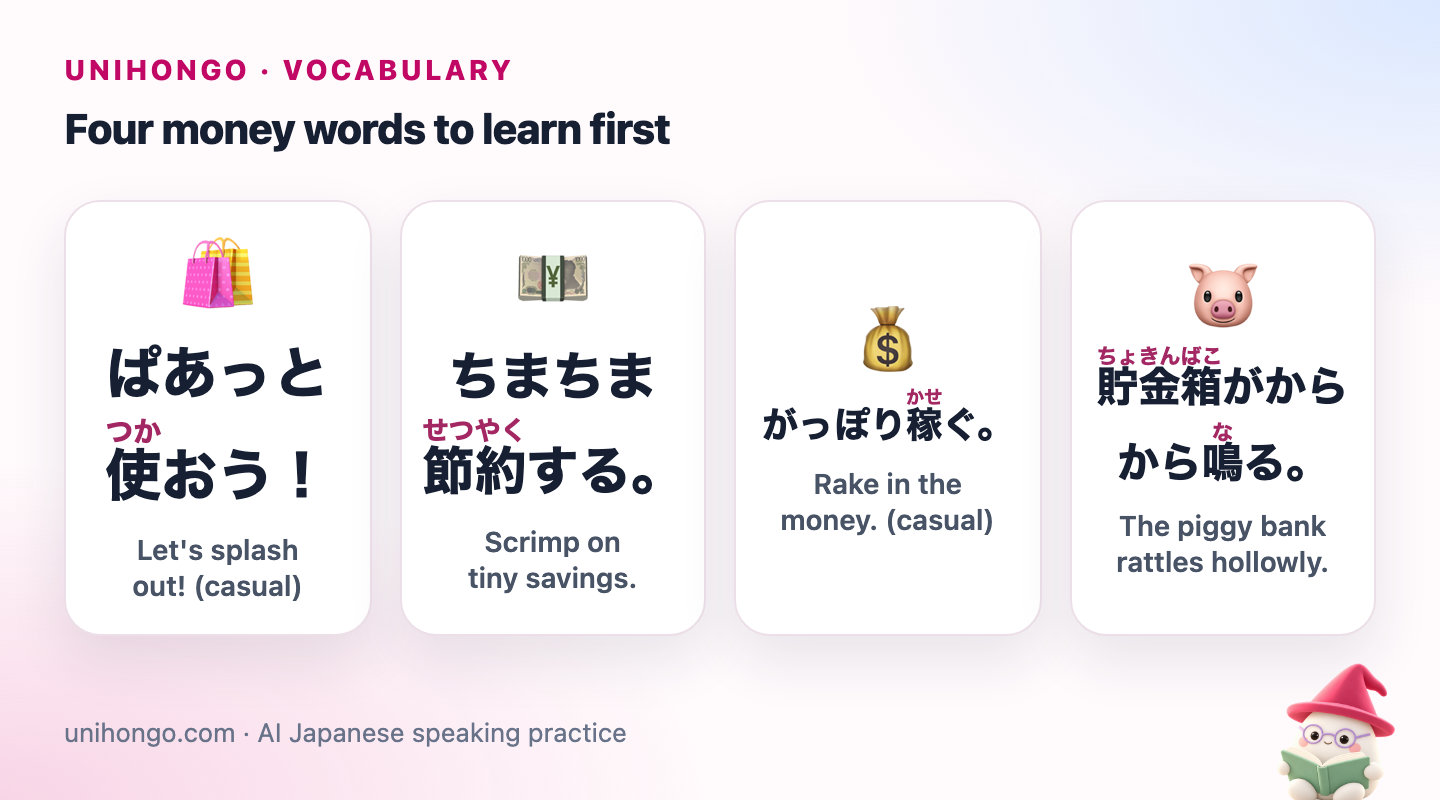
These four cover the full money cycle: payday, scrimping, a windfall and the empty piggy bank at the end of the month. Pātto, chimachima and gappori are gitaigo, describing a manner. Karakara is giongo here: the rattle of a few coins in something mostly empty.
All four are casual. Use them with friends and family, and in relaxed chat with coworkers you know well.
| Japanese | Romaji | Meaning |
|---|---|---|
| ぱあっと使おう! | Pātto tsukaō! | Let's splash out! (casual) |
| ちまちま節約する。 | Chimachima setsuyaku suru. | Scrimp on tiny savings. |
| がっぽり稼ぐ。 | Gappori kasegu. | Rake in the money. (casual) |
| 貯金箱がからから鳴る。 | Chokinbako ga karakara naru. | The piggy bank rattles hollowly. |
Splashing out: pātto and pon to
Pātto is the word for spending freely, all at once, without counting. It often has a feeling of release: after a hard week, after a bonus, after exams. People use it for going out for a big meal or drinks, for shopping and for celebrations. It also describes things spreading widely and suddenly, such as a rumour or a smile.
Pon to describes handing over a large sum casually, as if it were nothing. It suggests generosity or surprising ease: a grandparent who hands over money for a gift, or a customer who pays for something expensive in cash on the spot. It is often used with admiration or surprise.
| Japanese | Romaji | Meaning |
|---|---|---|
| 給料日だから、ぱあっと飲みに行こう。 | Kyūryōbi dakara, pātto nomi ni ikō. | It's payday, so let's go out drinking. (casual) |
| ボーナスでぱあっと買い物した。 | Bōnasu de pātto kaimono shita. | I splurged on shopping with my bonus. |
| 祖父がぽんと十万円出してくれた。 | Sofu ga pon to jūman'en dashite kureta. | My grandfather just handed over 100,000 yen. |
| その時計を現金でぽんと買ったの? | Sono tokei o genkin de pon to katta no? | You just bought that watch in cash, like that? (casual) |
Earning or losing a lot: gappori and hokuhoku
Gappori describes a large amount taken in one go, and it works in both directions. You can earn gappori, which sounds like raking it in, or have money taken gappori, by tax, fees or a pricey restaurant. It is casual and slightly vivid, the kind of word you see in gossip and headlines.
Hokuhoku is a food word for steaming, fluffy potatoes and chestnuts, but it has a second life in money talk: feeling warm and pleased after a gain. Hokuhokugao, a satisfied face, is what someone wears after a great bargain or a win.
| Japanese | Romaji | Meaning |
|---|---|---|
| あの人、株でがっぽり儲けたらしい。 | Ano hito, kabu de gappori mōketa rashii. | I hear they made a killing on shares. (casual) |
| 税金でがっぽり持っていかれた。 | Zeikin de gappori motte ikareta. | Tax took a huge chunk. |
| セールで安く買えて、ほくほくだ。 | Sēru de yasuku kaete, hokuhoku da. | I got it cheap in the sale, I'm so pleased. |
| 姉がほくほく顔で帰ってきた。 | Ane ga hokuhokugao de kaette kita. | My sister came home looking very pleased. |
Saving in small amounts: chimachima
Chimachima describes something small, fiddly and narrow in scale. In money talk it means saving or spending in tiny amounts: cutting coupons, switching off every light, choosing the cheaper drink every time. It can sound affectionate when you talk about yourself, but it often carries a little criticism: petty, small-minded, not seeing the bigger picture.
If you want to praise steady saving, use kotsukotsu instead, which means steadily and patiently, bit by bit. Kotsukotsu chokin suru, to save steadily, is positive; chimachima setsuyaku suru, to scrimp on tiny things, is more mixed.
| Japanese | Romaji | Meaning |
|---|---|---|
| ちまちま節約するのは疲れる。 | Chimachima setsuyaku suru no wa tsukareru. | Scrimping on little things is tiring. |
| ちまちまポイントを集めている。 | Chimachima pointo o atsumete iru. | I'm collecting loyalty points bit by bit. |
| こつこつ貯金して旅行に行った。 | Kotsukotsu chokin shite ryokō ni itta. | I saved steadily and went on a trip. |
Coins, wallets and empty shops
Coins have their own sounds. Charin is the clink of one coin, dropping on the floor or into a vending machine slot. Jarajara is the jingle of many coins together, and Japan's one-yen and five-yen coins mean many wallets are full of it. Karakara, a hollow rattle, is what a nearly empty piggy bank sounds like, and sukkarakan means completely empty: the wallet at the end of the month.
Garagara is a related word for places that are almost empty, such as a shop, a restaurant or a train. Shop staff and customers use it all the time. Note that garagara has other meanings too: gargling, and a baby's rattle toy.
| Japanese | Romaji | Meaning |
|---|---|---|
| 自動販売機にちゃりんと百円を入れる。 | Jidō hanbaiki ni charin to hyakuen o ireru. | Drop a 100-yen coin into the vending machine. |
| 小銭がじゃらじゃらして財布が重い。 | Kozeni ga jarajara shite saifu ga omoi. | My wallet is heavy with jingling change. |
| 貯金箱を振ったら、からからと音がした。 | Chokinbako o futtara, karakara to oto ga shita. | When I shook the piggy bank, it rattled. |
| 月末で財布がすっからかんだ。 | Getsumatsu de saifu ga sukkarakan da. | It's the end of the month and my wallet is empty. |
| 雨の日は店ががらがらですね。 | Ame no hi wa mise ga garagara desu ne. | The shop is almost empty on rainy days, isn't it? |
Grammar and register at a glance
Most money words go straight before a verb. Gappori and pātto are typical: gappori kasegu, pātto tsukau. Charin and karakara often take to when they describe a sound. States such as sukkarakan, garagara and hokuhoku take da or desu, or no before a noun.
| Japanese | Romaji | Meaning |
|---|---|---|
| がらがらの電車で座れた。 | Garagara no densha de suwareta. | I got a seat on the nearly empty train. |
| 財布がすっからかんになった。 | Saifu ga sukkarakan ni natta. | My wallet ended up completely empty. |
| Word | Type | Typical pattern | Register and feeling |
|---|---|---|---|
| pātto | Gitaigo | pātto tsukau, pātto nomu | Casual; fun, a treat |
| pon to | Gitaigo | pon to dasu, pon to kau | Neutral; surprise or admiration |
| gappori | Gitaigo | gappori kasegu, gappori torareru | Casual; vivid |
| chimachima | Gitaigo | chimachima setsuyaku suru | Casual; can sound petty |
| charin | Giongo | charin to ochiru | Neutral |
| jarajara | Giongo | jarajara suru, jarajara aru | Neutral |
| sukkarakan | Gitaigo | sukkarakan da, sukkarakan ni naru | Casual; humorous |
| garagara | Gitaigo | garagara da, garagara no densha | Neutral |
Payday conversation between friends
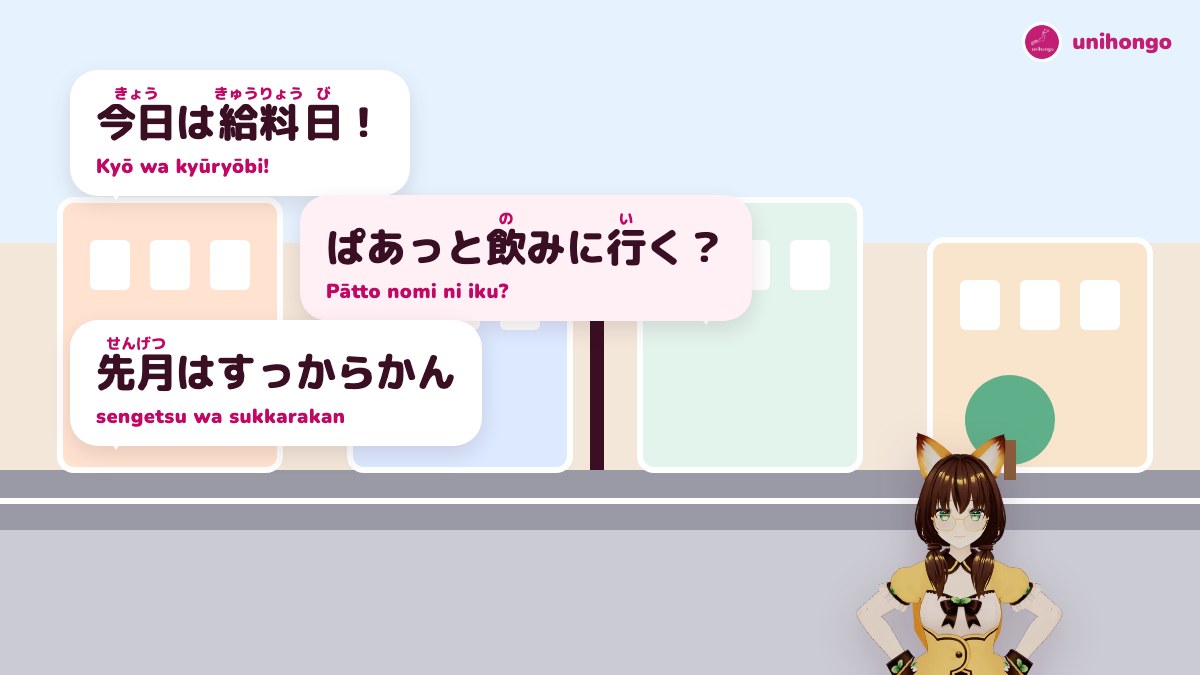
Here the words come together in one short chat. Two friends meet on payday and decide how to celebrate without repeating last month's mistakes. The talk is casual throughout, which is where these words belong.
| Japanese | Romaji | Meaning |
|---|---|---|
| やった、今日は給料日! | Yatta, kyō wa kyūryōbi! | Friend: Yes, it's payday today! |
| じゃあ、今夜はぱあっと飲みに行く? | Jā, kon'ya wa pātto nomi ni iku? | You: So shall we go out and celebrate tonight? |
| 行きたいけど、先月使いすぎて、すっからかんになったんだよね。 | Ikitai kedo, sengetsu tsukaisugite, sukkarakan ni natta n da yo ne. | Friend: I'd love to, but last month I overspent and ended up broke. |
| 今月はちまちま節約するの? | Kongetsu wa chimachima setsuyaku suru no? | You: So are you scrimping this month? |
| ちまちまはいやだけど、ほどほどにね。 | Chimachima wa iya da kedo, hodohodo ni ne. | Friend: I hate scrimping, but I'll keep it moderate. |
| じゃあ、安い居酒屋にしよう。 | Jā, yasui izakaya ni shiyō. | You: Then let's pick a cheap izakaya. |
Common learner mistakes
- Using gappori in a business setting. In a meeting or email, say kanari no rieki, a considerable profit, instead.
- Praising someone's saving as chimachima. It can sound like you are calling them petty; kotsukotsu is the compliment.
- Using pātto for a sensible purchase. Pātto implies a fun, generous splurge; for a planned purchase, just say katta.
- Saying sukkarakan to a shop clerk or a landlord. It is a joke among friends; in polite talk, say chotto kibishii desu.
- Confusing garagara with gyūgyū. Garagara is nearly empty; gyūgyū is packed tight, like a rush-hour train.
Rehearse a payday chat
Money words live in conversation, so practise them out loud. Start in the chat with Mocchi: paste the payday dialogue above and type /explain, and Mocchi breaks each line down, from the casual n da yo ne ending to why ni natta follows sukkarakan. Ask for two new lines that reuse the words, and Mocchi will add them to the notes it keeps on your vocabulary.
Then speak it. Ask Ibuki-sensei in AI Sensei to play a friend planning a payday night out, or a clerk at a busy sale, and try to fit in pātto, chimachima and garagara naturally. Ask the Sensei to switch to polite speech halfway, so you also practise saying the same thing without the casual words.