
Four traffic words to learn first
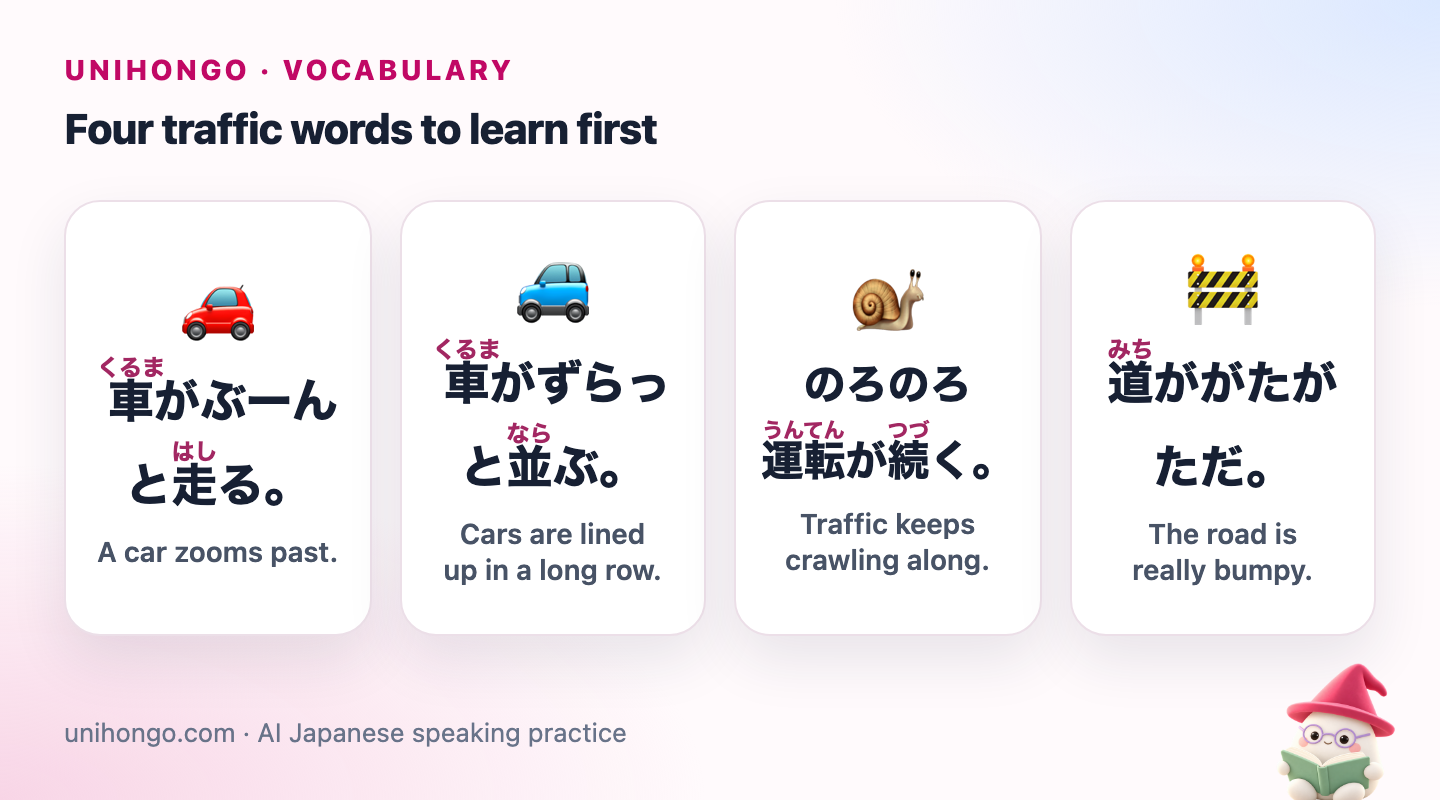
These four describe the main situations on any road: a car speeding by, a long queue, slow crawling traffic and a rough ride. All are common in conversation and on the radio.
Būn is giongo, the hum or roar of an engine. Zuratto and noronoro are gitaigo, describing a scene and a manner. Gatagata is both: you hear the rattle and feel the shaking.
| Japanese | Romaji | Meaning |
|---|---|---|
| 車がぶーんと走る。 | Kuruma ga būn to hashiru. | A car zooms past. |
| 車がずらっと並ぶ。 | Kuruma ga zuratto narabu. | Cars are lined up in a long row. |
| のろのろ運転が続く。 | Noronoro unten ga tsuzuku. | Traffic keeps crawling along. |
| 道ががたがただ。 | Michi ga gatagata da. | The road is really bumpy. |
Fast and smooth: būn, byunbyun, suisui
Būn is the low, droning hum of an engine or a motorbike accelerating past; children use the same sound when they play with toy cars. Byunbyun is sharper and faster: many vehicles whizzing past one after another, like cars on a motorway. Suisui is about flow rather than noise: traffic moving smoothly without stopping, the dream of every commuter.
Suisui works well in taxi talk. A driver who knows a quicker route might say uramichi nara suisui ikemasu, the side streets will be clear.
| Japanese | Romaji | Meaning |
|---|---|---|
| バイクがぶーんと通り過ぎた。 | Baiku ga būn to tōrisugita. | A motorbike roared past. |
| 高速道路では車がびゅんびゅん走っている。 | Kōsoku dōro de wa kuruma ga byunbyun hashitte iru. | On the motorway, cars are whizzing by. |
| 朝早いと道がすいすいだ。 | Asa hayai to michi ga suisui da. | Early in the morning, the roads are clear. |
| 裏道ならすいすい行けますよ。 | Uramichi nara suisui ikemasu yo. | Driver: The side streets will be quick. (polite) |
Slow and stuck: noronoro and zuratto
Noronoro is slow, sluggish movement, and noronoro unten, crawling driving, is a set phrase used on traffic reports for stop-and-go traffic. It can also criticise a driver who is going too slowly. Zuratto describes many things lined up in a long row, and its slightly more formal twin zurari works the same way. On the road, it paints a picture of a queue of cars stretching ahead.
When traffic is not moving at all, Japanese usually switches to a plain sentence: zenzen ugokanai, it is not moving at all, or pittari tomatte iru, it has come to a complete stop.
| Japanese | Romaji | Meaning |
|---|---|---|
| 事故でのろのろ運転になっている。 | Jiko de noronoro unten ni natte iru. | Traffic is crawling because of an accident. |
| 渋滞で車がずらっと並んでいる。 | Jūtai de kuruma ga zuratto narande iru. | Cars are lined up in a long jam. |
| 駐車場の前に車がずらりと並んでいた。 | Chūshajō no mae ni kuruma ga zurari to narande ita. | There was a long line of cars outside the car park. |
| さっきから全然動かないね。 | Sakki kara zenzen ugokanai ne. | We haven't moved at all for a while. (casual) |
Bumpy roads and rattling cars: gatagata and gatan
Gatagata is repeated rattling and shaking: an uneven mountain road, an old car, a loose part. Gatagata iu means the car is making rattling noises, which may be worth mentioning to a mechanic. The single-event form gatan, or gatan to, is one jolt, such as driving over a step in the road or a train starting suddenly.
Outside the car, gatagata iu has a rough figurative meaning: to grumble or complain. Gatagata iu na, stop moaning, is blunt and best avoided.
| Japanese | Romaji | Meaning |
|---|---|---|
| 山道でがたがた揺れた。 | Yamamichi de gatagata yureta. | We bounced along the mountain road. |
| この車、なんかがたがたいってる。 | Kono kuruma, nanka gatagata itteru. | This car is making a rattling noise. (casual) |
| 段差でがたんとなった。 | Dansa de gatan to natta. | We jolted over a step in the road. |
| タイヤから変な音がするんですが。 | Taiya kara hen na oto ga suru n desu ga. | There's a strange noise from the tyre. (polite, to a mechanic) |
Sounds of the street: brakes, horns, indicators and sirens
Mechanical and electronic sounds are usually written in katakana. Kikī is the squeal of hard braking, often with a small tsu at the end for a sudden stop. Puppū is a car horn, playful and slightly childish; adults usually say kurakushon o narasu. Kachikachi is the tick of an indicator. Pīpō pīpō is the ambulance siren, and ū ū is often used for police cars and fire engines.
Horns are generally used sparingly in Japan, so a long blast can feel aggressive. A short, light tap is sometimes used as a thank-you, though habits vary by region and driver.
| Japanese | Romaji | Meaning |
|---|---|---|
| キキーッとブレーキの音がした。 | Kikītto burēki no oto ga shita. | There was a screech of brakes. |
| 後ろの車にプップーと鳴らされた。 | Ushiro no kuruma ni puppū to narasareta. | The car behind honked at us. |
| ウインカーがカチカチ鳴っている。 | Uinkā ga kachikachi natte iru. | The indicator is ticking. |
| 救急車がピーポーピーポーと走っていった。 | Kyūkyūsha ga pīpō pīpō to hashitte itta. | An ambulance went by with its siren wailing. |
Grammar at a glance
Traffic words follow the usual onomatopoeia patterns, with a few set phrases worth learning whole.
| Japanese | Romaji | Meaning |
|---|---|---|
| 車がキキーッと止まった。 | Kuruma ga kikītto tomatta. | The car screeched to a stop. |
| のろのろ進んでいる。 | Noronoro susunde iru. | We're inching forward. |
| Word | Type | Common pattern | Register |
|---|---|---|---|
| būn | Giongo | būn to hashiru, būn to tōrisugiru | Casual |
| byunbyun | Giongo | byunbyun hashiru | Casual |
| suisui | Gitaigo | suisui susumu, michi ga suisui da | Neutral |
| noronoro | Gitaigo | noronoro unten, noronoro susumu | Neutral |
| zuratto | Gitaigo | zuratto narabu | Neutral |
| gatagata | Both | gatagata yureru, gatagata iu | Neutral |
| kikī | Giongo | kikītto tomaru | Casual |
In a taxi stuck in traffic
Taxi rides are where many visitors first hear these words. Drivers in Japan are usually polite, and many are happy to chat about the route. Here is a typical exchange on a busy evening.
| Japanese | Romaji | Meaning |
|---|---|---|
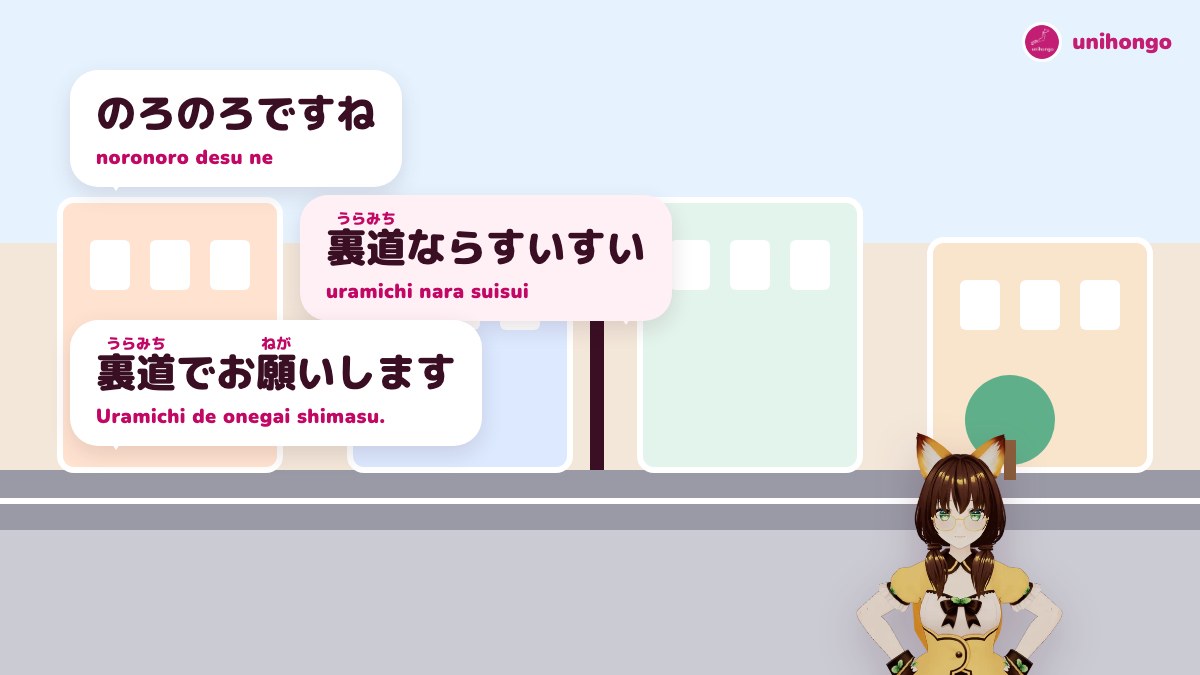
| 今日は道が混んでいて、のろのろですね。 | Kyō wa michi ga konde ite, noronoro desu ne. | Driver: The roads are busy today, it's crawling. |
| 時間がかかりそうですか。 | Jikan ga kakarisō desu ka. | You: Will it take long? |
| 裏道ならすいすい行けますよ。ちょっとがたがたしますけど。 | Uramichi nara suisui ikemasu yo. Chotto gatagata shimasu kedo. | Driver: The side streets will be quick, though a bit bumpy. |
| 大丈夫です。裏道でお願いします。 | Daijōbu desu. Uramichi de onegai shimasu. | You: That's fine. The side streets, please. |
| あ、この先も車がずらっと並んでますね。 | A, kono saki mo kuruma ga zuratto narandemasu ne. | Driver: Oh, there's a long line of cars ahead here too. |
| じゃあ、次の角で止めてください。歩きます。 | Jā, tsugi no kado de tomete kudasai. Arukimasu. | You: Then please stop at the next corner. I'll walk. |
Kakarisō desu ka, will it take long?, uses sō for a guess based on what you can see. It is a useful pattern for any situation where you ask someone to estimate.
Common learner mistakes
- Using noronoro for traffic that is not moving at all. Noronoro means slow but moving; for a full stop, say zenzen ugokanai.
- Saying puppū in a serious situation, such as reporting an incident. Use kurakushon o narasareta instead.
- Using suisui for speed alone. Suisui is about smooth, unobstructed flow; a car racing past is būn or byun.
- Forgetting that gatagata iu can mean complaining. In the car it is about noise; about a person it is a criticism.
- Writing mechanical sounds such as kikī and pīpō in hiragana. It is not wrong, but katakana is the normal choice.
Ride along with a Japanese driver
To make these words part of your listening, start with the taxi dialogue above. Paste it into the chat with Mocchi and type /explain, and Mocchi walks through each line: why the driver uses desu ne, how kakarisō desu ka works, and what the sound words add. Ask for two more lines in which the driver warns about a jam on the expressway.
Then take the ride out loud. In AI Sensei, ask Yamada-sensei to play a taxi driver on a busy evening and to describe the traffic with sound words while you choose a route, ask how long it will take and ask to stop at a corner. Ask the Sensei to speak at normal speed once you are comfortable, so the words come at you the way they do in a real taxi.