
Four sports words to learn first
These four cover speed, a hit, a jump and the end of the game. You will hear them in commentary, at school sports days, in the gym and in casual chat with teammates.
Gungun and pyonpyon describe movement, so they are gitaigo. Bashitto copies the sound and feel of a sharp hit. Herohero describes a state of exhaustion and is pure gitaigo.
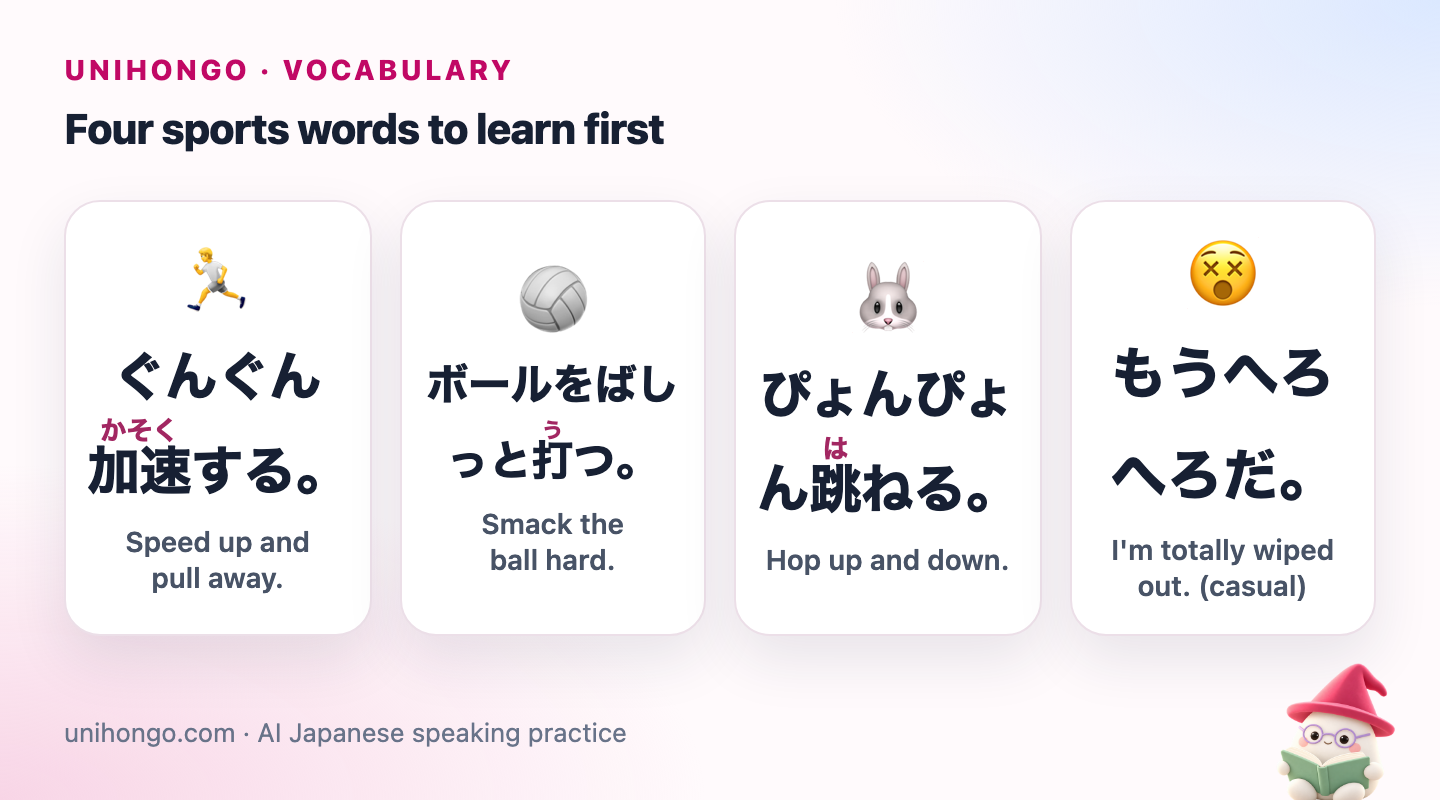
| Japanese | Romaji | Meaning |
|---|---|---|
| ぐんぐん加速する。 | Gungun kasoku suru. | Speed up and pull away. |
| ボールをばしっと打つ。 | Bōru o bashitto utsu. | Smack the ball hard. |
| ぴょんぴょん跳ねる。 | Pyonpyon haneru. | Hop up and down. |
| もうへろへろだ。 | Mō herohero da. | I'm totally wiped out. (casual) |
Hitting and catching: bashitto and pashitto
Japanese often uses a pair of sounds that differ only in the first consonant: a voiced one such as ba and an unvoiced one such as pa. The voiced version feels heavier and more powerful, the unvoiced one lighter and crisper. Bashitto is a hard smack: a volleyball spike, a strong shot, a firm slap on the back. Pashitto is a clean, light snap: a ball landing neatly in a glove or a hand.
The small tsu at the end marks one quick action. The repeated form, bashibashi, means hitting again and again, and is used for intense training or for slapping someone's back several times.
| Japanese | Romaji | Meaning |
|---|---|---|
| スパイクをばしっと決めた。 | Supaiku o bashitto kimeta. | Nailed the spike with a hard smack. |
| ボールをぱしっとキャッチした。 | Bōru o pashitto kyatchi shita. | Caught the ball cleanly. |
| コーチにばしばし鍛えられた。 | Kōchi ni bashibashi kitaerareta. | The coach drilled us hard. |
| キャプテンにばしっと言われた。 | Kyaputen ni bashitto iwareta. | The captain told me straight. |
Bashitto iu, to say something firmly and directly, is a common figurative use. It is neutral to positive: it suggests clear words that needed saying, not rudeness.
A ball in flight: byun, pōn, korokoro
Byun is the whoosh of something fast cutting through the air: a fastball, a smash, a car racing past. Pōn is a ball flying up high and lightly, with a long ō that you can almost hear rising; it is common for a ball popped up into the air or kicked far. Korokoro is a small, round object rolling along the ground, from a golf ball on a green to a ball rolling slowly out of play.
Pōn also appears outside sport for something done lightly and easily, such as patting someone on the shoulder, pōn to kata o tataku.
| Japanese | Romaji | Meaning |
|---|---|---|
| 速い球がびゅんと飛んできた。 | Hayai tama ga byun to tonde kita. | A fast ball came whizzing at me. |
| ボールがぽーんと高く上がった。 | Bōru ga pōn to takaku agatta. | The ball popped up high. |
| ボールがころころ転がっていった。 | Bōru ga korokoro korogatte itta. | The ball rolled away. |
| 肩をぽんとたたかれた。 | Kata o pon to tatakareta. | Someone patted me on the shoulder. |
Moving bodies: pyonpyon and gungun
Pyonpyon is light, springy, repeated hopping: a rabbit, a child jumping with excitement, a skipping-rope warm-up. A single hop is pyon or pyon to. Because it sounds light, pyonpyon is not used for a powerful high jump; for that, Japanese uses the plain verb tobu or describes the height.
Gungun is strong, steady progress forward or upward. In a race, it describes a runner or swimmer pulling away or closing the gap; in training, it describes skills improving quickly. It almost always sounds positive and energetic.
| Japanese | Romaji | Meaning |
|---|---|---|
| 子どもがうれしくてぴょんぴょん跳ねている。 | Kodomo ga ureshikute pyonpyon hanete iru. | The child is hopping about with joy. |
| 縄跳びでぴょんぴょん跳ぶ。 | Nawatobi de pyonpyon tobu. | Hop over a skipping rope. |
| 最後の百メートルでぐんぐん追い上げた。 | Saigo no hyaku mētoru de gungun oiageta. | In the last 100 metres, the runner closed the gap fast. |
| 練習を続けて、ぐんぐん上達した。 | Renshū o tsuzukete, gungun jōtatsu shita. | I kept practising and improved quickly. |
Out of breath and wiped out: hāhā, zēzē, herohero
Hāhā is panting, quick and audible breathing after running or climbing stairs. Zēzē is heavier, rasping breathing, when you are really struggling for air. Herohero is the state after it all: limp, wobbly and too tired to do anything. Kutakuta and hetoheto are close relatives; herohero adds a sense of being unsteady on your feet.
Bateru, a common verb from sports and summer, means to run out of energy, especially in heat. It is casual and very useful: natsubate is the tiredness of a hot summer.
| Japanese | Romaji | Meaning |
|---|---|---|
| 走り終わって、はあはあしている。 | Hashiriowatte, hāhā shite iru. | I've finished running and I'm panting. |
| 坂道でぜえぜえ言った。 | Sakamichi de zēzē itta. | I was gasping on the hill. |
| 試合の後はもうへろへろ。 | Shiai no ato wa mō herohero. | After the match I'm completely wiped out. |
| 暑さでばてた。 | Atsusa de bateta. | The heat wore me out. (casual) |
Grammar: the small tsu, to and repeated forms
Sports words show a pattern that works across Japanese onomatopoeia. The base sound is short: bashi, pashi, pyon, byun. Adding a small tsu or n and to marks one sharp action: bashitto, pyon to, byun to. Repeating the base marks something that keeps happening: bashibashi, pyonpyon, byunbyun. Long vowels stretch the action: pōn sounds higher and longer than pon.
| Japanese | Romaji | Meaning |
|---|---|---|
| カエルがぴょんと跳んだ。 | Kaeru ga pyon to tonda. | The frog gave one hop. |
| 車がびゅんびゅん通る。 | Kuruma ga byunbyun tōru. | Cars whizz past one after another. |
| Word | Type | One action | Repeated or ongoing |
|---|---|---|---|
| bashi | Giongo | bashitto utsu, a hard hit | bashibashi, hitting again and again |
| pyon | Gitaigo | pyon to tobu, one hop | pyonpyon haneru, hopping about |
| byun | Giongo | byun to tobu, whoosh past | byunbyun, whizzing past one after another |
| korokoro | Gitaigo | Not used | korokoro korogaru, rolling along |
| herohero | Gitaigo | Not used | herohero da, wiped out |
A weekend game at the park
Picture a casual Saturday game of football or softball in a city park. You hear the hit, the shouts from the sideline and the panting players at half-time. Here is the chat between two teammates on the bench after the game, followed by a few cheering phrases you will hear at any amateur match or school sports day.
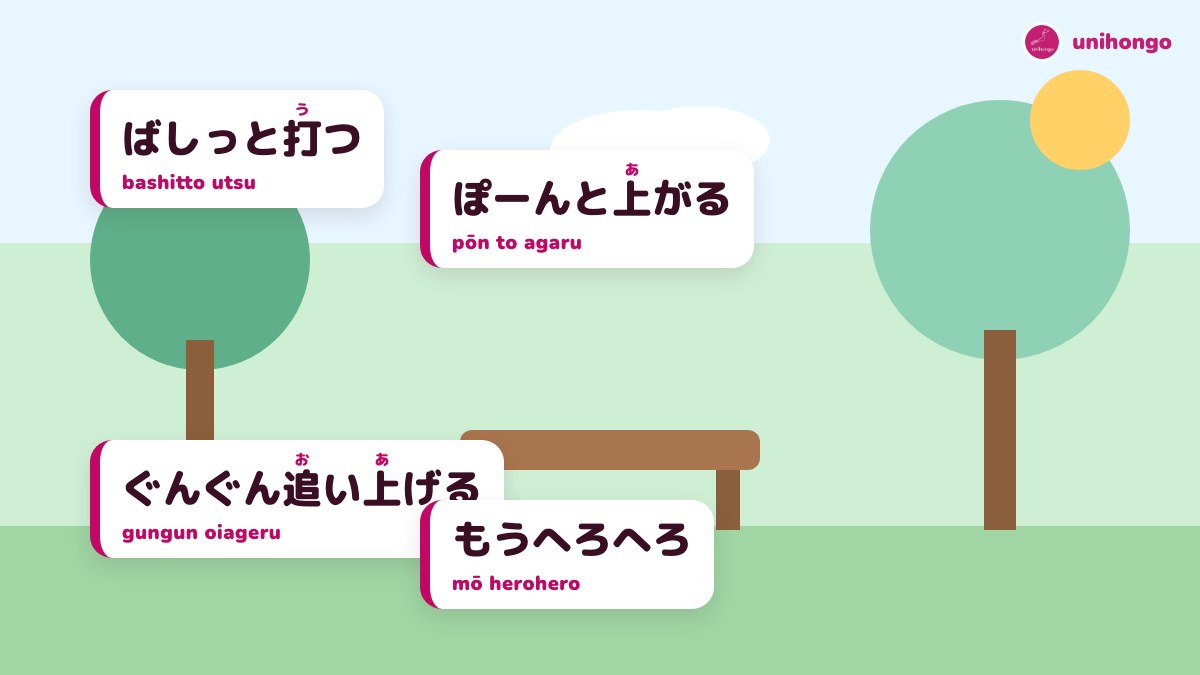
| Japanese | Romaji | Meaning |
|---|---|---|
| さっきのシュート、ばしっと決まったね! | Sakki no shūto, bashitto kimatta ne! | Teammate: That shot went in with a bang! |
| ありがとう。でも、もうへろへろだよ。 | Arigatō. Demo, mō herohero da yo. | You: Thanks. But I'm completely wiped out. |
| 後半、ぐんぐん走ってたじゃん。 | Kōhan, gungun hashitteta jan. | Teammate: You were tearing around in the second half. |
| 最後ははあはあ言ってたけどね。 | Saigo wa hāhā itteta kedo ne. | You: I was panting by the end, though. |
| いけー! | Ikē! | Spectator: Go, go! |
| ナイスキャッチ! | Naisu kyatchi! | Spectator: Nice catch! |
| ドンマイ! | Donmai! | Teammate: Don't worry about it! |
Jan at the end of a sentence is a casual tag meaning isn't it or you know, common among younger speakers in and around Tokyo and now widely used. Donmai comes from English don't mind and is the standard word for shaking off a mistake in Japanese sport.
Common learner mistakes
- Using pyonpyon for a powerful jump. Pyonpyon is light and bouncy; for a big jump, say takaku tobu.
- Mixing up bashitto and pashitto. If it is hard and powerful, use the voiced bashitto; for a clean, light catch, pashitto.
- Using herohero in a formal report to a coach or manager. Say tsukaremashita or taryoku ga nokotte imasen instead.
- Using gungun for slow progress. Gungun is fast and strong; for slow but steady progress, use jiwajiwa or sukoshi zutsu.
- Forgetting to with single-action forms when they describe a sound. Byun to tonde kita sounds more natural than byun tonde kita.
Take the sound words onto the field
Sports words come fast, so practise them at the speed of real talk. In the chat, ask Mocchi to /quiz you: give it a list of movements, such as a hard hit, a high ball and a hop, and ask for the matching word each time. Mocchi explains wrong answers and remembers which pairs, like bashitto and pashitto, need another round later.
Then talk about a game out loud. Ask Haru-sensei in AI Sensei to play a teammate after a match and to ask you about your best moment, how tired you are and what went wrong. Ask the Sensei to cheer you on in Japanese too, so you hear the sideline phrases at a natural speed.