
Four water words to learn first
These four cover the situations you meet most: a drip, washing by hand, a bath and getting caught in the rain. All are common at home and none are slang.
Potapota is giongo and gitaigo at once: you hear the drops and see them fall. Jabujabu and chapuchapu copy the sound of water being moved, one big and busy, the other small and gentle. Bishobisho is pure gitaigo; it describes how wet something is, not a noise.
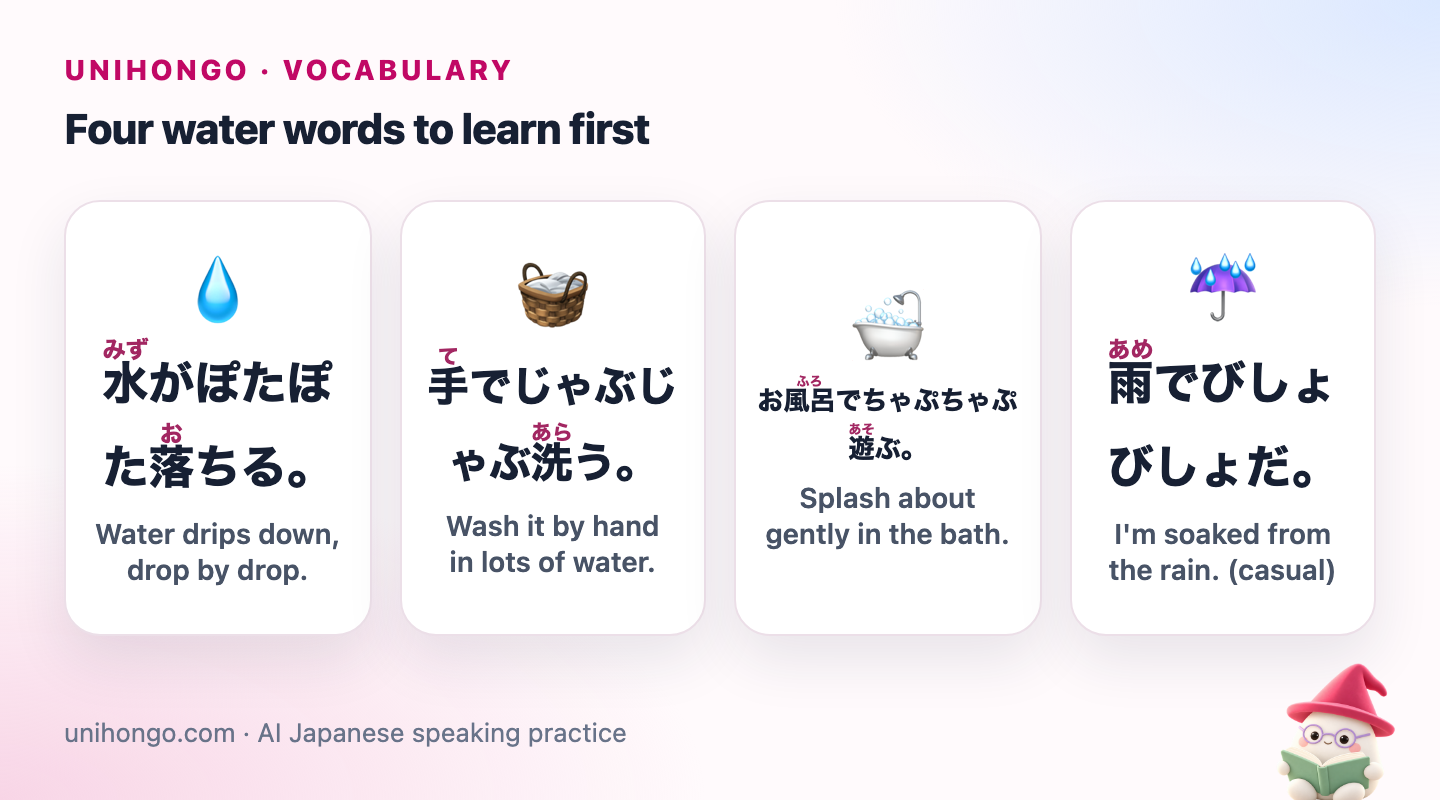
| Japanese | Romaji | Meaning |
|---|---|---|
| 水がぽたぽた落ちる。 | Mizu ga potapota ochiru. | Water drips down, drop by drop. |
| 手でじゃぶじゃぶ洗う。 | Te de jabujabu arau. | Wash it by hand in lots of water. |
| お風呂でちゃぷちゃぷ遊ぶ。 | Ofuro de chapuchapu asobu. | Splash about gently in the bath. |
| 雨でびしょびしょだ。 | Ame de bishobisho da. | I'm soaked from the rain. (casual) |
Drops and trickles: potapota, pochan, chorochoro, jā
The smallest water words describe drops and thin streams. Potapota is a steady drip, the kind you notice from a tap that is not quite closed or from an umbrella by the door. Pochan, or pochatto, is one drop or one small object landing in water. Chorochoro is a thin trickle, such as weak water pressure or a small stream. At the other end, jā, often written ジャー in katakana, is the gush of a tap turned on full or a toilet flushing.
Notice how the form tells you about frequency. Repeated words like potapota describe something that keeps going. Forms ending in n or a small tsu, like pochan or jātto, describe a single event.
| Japanese | Romaji | Meaning |
|---|---|---|
| 蛇口から水がぽたぽた垂れている。 | Jaguchi kara mizu ga potapota tarete iru. | Water is dripping from the tap. |
| 傘からしずくがぽたぽた落ちる。 | Kasa kara shizuku ga potapota ochiru. | Drops fall from the umbrella. |
| 石が池にぽちゃんと落ちた。 | Ishi ga ike ni pochan to ochita. | A stone plopped into the pond. |
| 水がちょろちょろしか出ない。 | Mizu ga chorochoro shika denai. | Only a trickle of water comes out. |
| 水をじゃーっと流す。 | Mizu o jātto nagasu. | Run the water hard. / Flush it away. |
Washing and sloshing: jabujabu and zabuzabu
Jabujabu is the sound of plenty of water being moved with energy, so it suits hand washing, rinsing in a full basin and wading. Zabuzabu is a close cousin, a little heavier, and is common for rinsing lots of vegetables or for washing with buckets of water. Both are neutral and appear in recipes, cleaning tips and children's stories.
When a recipe says jabujabu arawanaide, do not wash it vigorously, it usually means delicate food like strawberries or mushrooms that would go soggy. In cleaning, jabujabu araeru, you can wash it freely in water, is a selling point printed on washable rugs and cushions.
| Japanese | Romaji | Meaning |
|---|---|---|
| タオルをたらいでじゃぶじゃぶ洗う。 | Taoru o tarai de jabujabu arau. | Wash the towel in a tub, sloshing it around. |
| 野菜をざぶざぶ洗ってください。 | Yasai o zabuzabu aratte kudasai. | Rinse the vegetables in plenty of water. (polite) |
| このラグはじゃぶじゃぶ洗えます。 | Kono ragu wa jabujabu araemasu. | This rug is fully washable. |
| いちごはじゃぶじゃぶ洗わないで。 | Ichigo wa jabujabu arawanaide. | Don't wash the strawberries roughly. (casual) |
Splashing in play: chapuchapu, bashabasha, pichapicha
These three describe water being disturbed, from small to large. Chapuchapu is gentle lapping: water moving in a bath, a small wave against a boat, a hand trailing in a pool. Bashabasha is louder and messier, such as a child kicking in a pool or someone splashing water on their face. Pichapicha is the light slap of steps in shallow puddles, or a fish flapping, and is often heard when talking with children on rainy days.
Parents and nursery staff use these words a lot, so they are good to know if you spend time with families. They are not baby talk, though; adults describe their own swimming or puddle-walking with them too.
| Japanese | Romaji | Meaning |
|---|---|---|
| 波がちゃぷちゃぷ船に当たる。 | Nami ga chapuchapu fune ni ataru. | Little waves lap against the boat. |
| 子どもがプールでばしゃばしゃ遊んでいる。 | Kodomo ga pūru de bashabasha asonde iru. | The kids are splashing around in the pool. |
| 顔をばしゃばしゃ洗う。 | Kao o bashabasha arau. | Splash water on your face. |
| 水たまりをぴちゃぴちゃ歩く。 | Mizutamari o pichapicha aruku. | Walk through the puddles, splish-splash. |
| Word | Size of splash | Typical scene | Grammar |
|---|---|---|---|
| chapuchapu | Small, gentle | Bath, small waves, a hand in water | chapuchapu suru, chapuchapu asobu |
| pichapicha | Light, shallow | Puddles, a fish flapping | pichapicha aruku, pichapicha haneru |
| bashabasha | Big, noisy | Kicking in a pool, splashing your face | bashabasha suru, bashabasha arau |
Wet through: bishobisho, gushogusho, zubunure
When you get caught in a sudden summer shower, these are the words you need. Bishobisho means very wet all over, clothes and hair dripping. Gushogusho is wetter and heavier, the soggy state of shoes full of water or a towel that could be wrung out. Zubunure, drenched, is a regular compound word rather than onomatopoeia, but it sits in the same family and is very common.
Bishonure, a compound of bisho and nureru, to get wet, is also common, and so is the verb phrase bishobisho ni naru. With a coworker or a shop clerk, keep the sentence polite: Ame de bishobisho ni natte shimaimashita.
| Japanese | Romaji | Meaning |
|---|---|---|
| 急に降ってきて、びしょびしょになった。 | Kyū ni futte kite, bishobisho ni natta. | It started pouring and I got soaked. |
| 靴の中までぐしょぐしょだ。 | Kutsu no naka made gushogusho da. | My shoes are soggy right through. (casual) |
| 傘を忘れてずぶ濡れです。 | Kasa o wasurete zubunure desu. | I forgot my umbrella and I'm drenched. (polite) |
| タオル、使ってください。 | Taoru, tsukatte kudasai. | Coworker: Please, use this towel. |
Grammar: to, suru, ni naru and nouns
Water words use the same patterns as other sound words, but a few habits are worth noting. Repeated words go straight before a verb, with to optional: potapota ochiru, jabujabu arau. Single-event forms ending in n or a small tsu usually take to: pochan to ochiru, jātto nagasu. States of wetness work with da, ni naru and no before a noun.
| Japanese | Romaji | Meaning |
|---|---|---|
| びしょびしょの服を着替える。 | Bishobisho no fuku o kigaeru. | Change out of soaked clothes. |
| しずくがぽちゃんと落ちる。 | Shizuku ga pochan to ochiru. | A drop plops down. |
- Before a verb: potapota tareru, bashabasha arau, pichapicha aruku.
- With suru, as a verb on its own: chapuchapu suru, bashabasha suru.
- States with da or ni naru: bishobisho da, gushogusho ni natta.
- Before a noun with no: bishobisho no fuku, soaked clothes; gushogusho no kutsu, soggy shoes.
Water words around the house
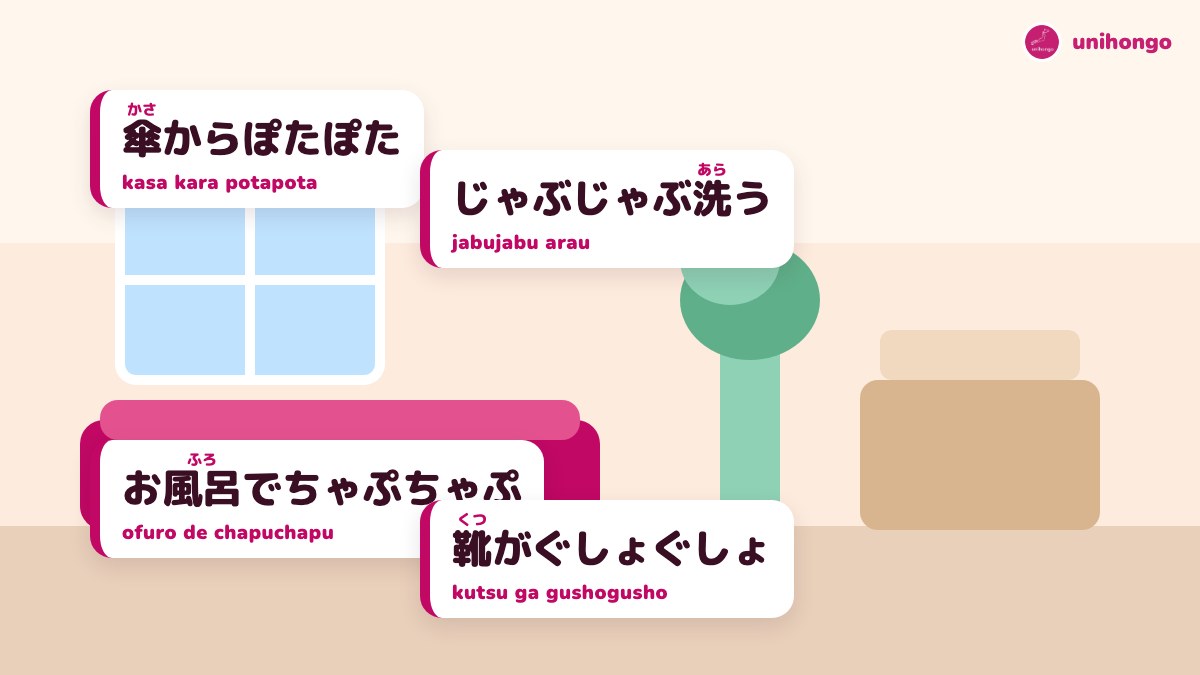
A Japanese home on a rainy evening is a good place to collect these words: the umbrella dripping in the genkan, washing in the sink, a child in the bath and a pair of soggy shoes by the door. Here is a short exchange between a parent and a child arriving home in the rain.
| Japanese | Romaji | Meaning |
|---|---|---|
| ただいま!びしょびしょになっちゃった。 | Tadaima! Bishobisho ni nacchatta. | Child: I'm home! I got soaked. |
| あらら、靴もぐしょぐしょだね。 | Arara, kutsu mo gushogusho da ne. | Parent: Oh dear, your shoes are soggy too. |
| 水たまりでぴちゃぴちゃしたの。 | Mizutamari de pichapicha shita no. | Child: I was splashing in puddles. |
| 傘はそこに置いてね。ぽたぽた垂れるから。 | Kasa wa soko ni oite ne. Potapota tareru kara. | Parent: Leave the umbrella there. It's dripping. |
| 先にお風呂入っておいで。 | Saki ni ofuro haitte oide. | Parent: Go and get in the bath first. |
Nacchatta is the casual contraction of natte shimatta, ended up becoming. You hear it constantly in family speech, and it adds a feeling of oops to the sentence.
Common learner mistakes
- Using potapota for a single drop. One drop is pochan or potan; potapota means it keeps dripping.
- Saying bishobisho for something just a little damp. For slightly damp, use shimetta or chotto nureta; bishobisho means very wet.
- Using jabujabu for gentle rinsing. Jabujabu is vigorous; for a quick light rinse, satto arau is more accurate.
- Treating chapuchapu and bashabasha as the same. Chapuchapu is calm and small; bashabasha is noisy and big.
- Forgetting ni naru for a change of state. Say bishobisho ni natta, I got soaked, not bishobisho shita.
A rainy-day routine for these words
Water words are visual, so pictures help them stick. Ask Mocchi to make cards for them with /create-flashcards: send the ten words with an example each, and pick a photo for every card, such as a dripping tap for potapota or wet sneakers for gushogusho. Then review them with /review-flashcards, which spaces the cards so the ones you miss come back sooner.
On a rainy day, play Flashcard Flip on the games page with that same deck, and say each sentence aloud as the card turns. Mocchi remembers which words you have already learned, so next time you can ask for a short rainy-day story that reuses them.