
Four nature sounds to learn first
These four cover wind, water, trees and snow, the things you meet on almost any walk outside the city. Each is common in conversation and in songs, and none of them is slang.
Hyūhyū and sarasara are mostly giongo, copying a whistle and a light murmur. Zawazawa is both a sound and a movement. Chirachira is gitaigo: it describes a few flakes falling here and there, not a noise.
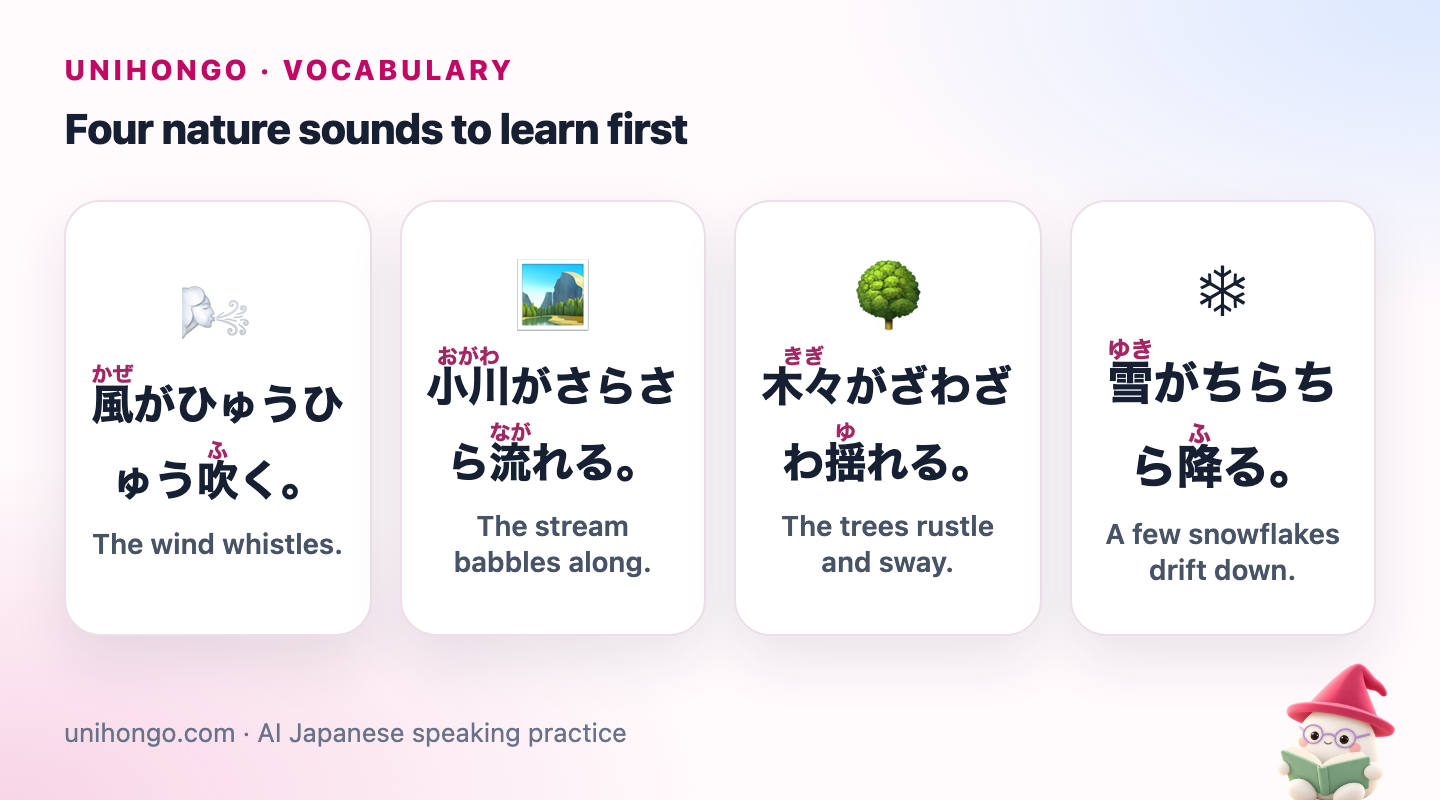
| Japanese | Romaji | Meaning |
|---|---|---|
| 風がひゅうひゅう吹く。 | Kaze ga hyūhyū fuku. | The wind whistles. |
| 小川がさらさら流れる。 | Ogawa ga sarasara nagareru. | The stream babbles along. |
| 木々がざわざわ揺れる。 | Kigi ga zawazawa yureru. | The trees rustle and sway. |
| 雪がちらちら降る。 | Yuki ga chirachira furu. | A few snowflakes drift down. |
Wind from a breeze to a gale
Wind words form a clear scale, and choosing the right one tells the listener how the wind feels. Soyosoyo is a light, pleasant breeze that barely moves the leaves, the kind you enjoy on a spring afternoon. Hyūhyū is a thin, high whistling, often cold, the wind through a gap in a window or across an open field in winter. Byūbyū is strong and howling, and gōgō is a roaring gale or storm.
| Japanese | Romaji | Meaning |
|---|---|---|
| 春風がそよそよ吹いている。 | Harukaze ga soyosoyo fuite iru. | A gentle spring breeze is blowing. |
| 窓の隙間から風がひゅうひゅう入ってくる。 | Mado no sukima kara kaze ga hyūhyū haitte kuru. | The wind whistles in through a gap in the window. |
| 台風で風がごうごう鳴っている。 | Taifū de kaze ga gōgō natte iru. | The typhoon wind is roaring. |
| Word | Strength | Feeling | Typical season |
|---|---|---|---|
| soyosoyo | Light breeze | Pleasant, calm | Spring, early summer |
| hyūhyū | Moderate, whistling | Cold, lonely | Autumn, winter |
| byūbyū | Strong, howling | Rough, hard to walk in | Winter, storms |
| gōgō | Roaring | Dramatic, a little frightening | Typhoons, storms |
Leaves and trees: sawasawa, zawazawa, kasakasa
Sawasawa is a soft, light rustle of leaves in a breeze, calm and pleasant. Zawazawa is louder and busier, many leaves moving at once in a strong wind, and it can carry a slightly uneasy feeling. That is why zawazawa is also used for a crowd murmuring and for a restless, uneasy feeling inside you: mune ga zawazawa suru. Kasakasa is the dry crackle of fallen leaves underfoot in autumn, and also describes dry skin.
| Japanese | Romaji | Meaning |
|---|---|---|
| 葉っぱがさわさわ鳴っている。 | Happa ga sawasawa natte iru. | The leaves are softly rustling. |
| 風で竹林がざわざわしている。 | Kaze de chikurin ga zawazawa shite iru. | The bamboo grove is rustling in the wind. |
| 落ち葉をかさかさ踏んで歩く。 | Ochiba o kasakasa funde aruku. | Walk crunching through fallen leaves. |
| なんだか胸がざわざわする。 | Nandaka mune ga zawazawa suru. | I have an uneasy feeling somehow. |
Water in nature: sarasara, zabūn, gōgō
Sarasara is a light, clear murmur, a shallow stream running over pebbles. It feels clean and refreshing. Zabūn is a big wave crashing onto the shore, one heavy splash, with the long ū showing the wave rolling in. Gōgō is a roar: a waterfall, a river swollen by heavy rain, or a strong wind. The same word for wind and water reminds you that gōgō is about the loudness, not the thing.
Sarasara also describes dry, smooth things, such as fine sand, silky hair and a light powder. In all its meanings it suggests something light that flows without sticking.
| Japanese | Romaji | Meaning |
|---|---|---|
| 小川がさらさら流れている。 | Ogawa ga sarasara nagarete iru. | A little stream is flowing gently. |
| 波がざぶーんと打ち寄せる。 | Nami ga zabūn to uchiyoseru. | A wave comes crashing in. |
| 滝がごうごうと音を立てている。 | Taki ga gōgō to oto o tatete iru. | The waterfall is roaring. |
| 大雨の後で、川がごうごう流れている。 | Ōame no ato de, kawa ga gōgō nagarete iru. | After the heavy rain, the river is roaring. |
| 砂がさらさらしている。 | Suna ga sarasara shite iru. | The sand is fine and dry. |
Things that fall: hirahira, harahara, chirachira
Japanese distinguishes how things fall. Hirahira is fluttering, light things waving and dancing in the air: cherry petals swirling, a butterfly, a ribbon. Harahara is light things falling one after another, quietly: leaves in autumn, petals at the end of the cherry season, tears down a face. It sounds a little more literary and often appears with to and the verb chiru, to scatter.
Chirachira describes a few small things appearing here and there: snowflakes in a light snow, a light flickering through trees, or someone glancing at you again and again. Chirachira miru, to keep glancing, is very common in conversation.
| Japanese | Romaji | Meaning |
|---|---|---|
| 桜の花びらがひらひら舞う。 | Sakura no hanabira ga hirahira mau. | Cherry petals flutter down. |
| 蝶がひらひら飛んでいる。 | Chō ga hirahira tonde iru. | A butterfly is fluttering about. |
| 紅葉がはらはらと散る。 | Kōyō ga harahara to chiru. | The autumn leaves fall one by one. (slightly literary) |
| 雪がちらちら降ってきた。 | Yuki ga chirachira futte kita. | A few snowflakes have started falling. |
| さっきからこっちをちらちら見ている。 | Sakki kara kotchi o chirachira mite iru. | Someone keeps glancing over here. |
Harahara has a second, unrelated meaning: being on edge while watching something risky, such as a child climbing a tree or a close game. Harahara suru, to be on tenterhooks, is common in conversation.
Grammar and register
Nature words follow the usual patterns. They go before a verb with or without to, such as hyūhyū fuku or sarasara to nagareru, and many become verbs with suru, such as zawazawa suru or sarasara shite iru. Adding to often makes a sentence sound a little more careful or written, so you see it more in descriptions, poems and narration than in quick chat.
| Japanese | Romaji | Meaning |
|---|---|---|
| 風がそよそよと頬をなでる。 | Kaze ga soyosoyo to hoho o naderu. | The breeze gently strokes my cheek. (literary) |
- Everyday and casual: hyūhyū, zawazawa, kasakasa, chirachira, gōgō.
- Neutral and gentle: soyosoyo, sawasawa, sarasara, hirahira.
- Slightly literary when used with to: harahara to chiru, sarasara to nagareru.
- Nouns from sound words: zawameki, a murmuring, is a related noun you will meet in writing.
A walk from the river to the hills
Here are the words in a real setting: a walk on a cool autumn day, starting by a river, through a wood and up to a windy hilltop. The first lines narrate the walk; the last few are a short exchange with a friend at the top.
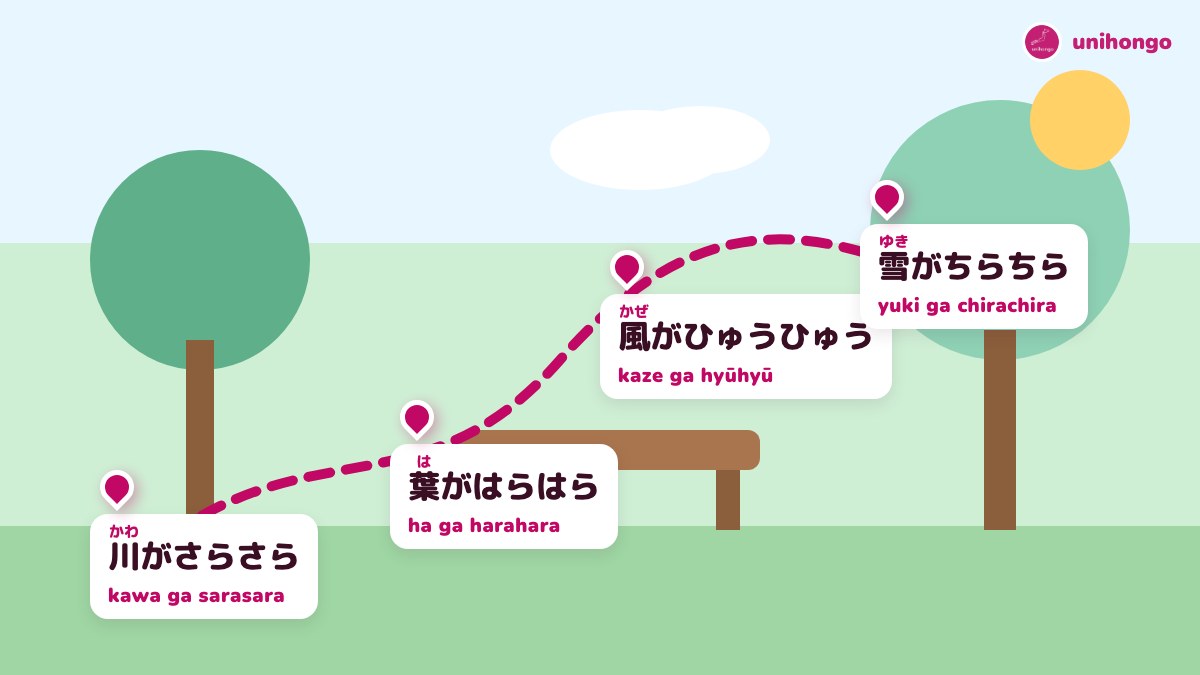
| Japanese | Romaji | Meaning |
|---|---|---|
| 川沿いを歩くと、水がさらさら流れている。 | Kawazoi o aruku to, mizu ga sarasara nagarete iru. | Along the river, the water flows gently. |
| 林に入ると、葉っぱがはらはら落ちてくる。 | Hayashi ni hairu to, happa ga harahara ochite kuru. | In the wood, leaves drift down one by one. |
| 頂上では風がひゅうひゅう吹いている。 | Chōjō de wa kaze ga hyūhyū fuite iru. | At the top, the wind is whistling. |
| 寒い!風がすごいね。 | Samui! Kaze ga sugoi ne. | Friend: It's cold! The wind is something. |
| 見て、雪がちらちら降ってきた。 | Mite, yuki ga chirachira futte kita. | You: Look, a few snowflakes are falling. |
| もう冬だね。そろそろ下りようか。 | Mō fuyu da ne. Sorosoro oriyō ka. | Friend: Winter's here. Shall we head down? |
Common learner mistakes
- Using byūbyū or gōgō for a pleasant breeze. They sound like a storm; soyosoyo is the gentle one.
- Using hirahira for leaves simply falling. Hirahira is fluttering and dancing; for quiet falling one by one, use harahara.
- Using chirachira for heavy snow. Chirachira means only a few flakes; for heavy snow, say yuki ga takusan futte iru or dondon futte iru.
- Forgetting zawazawa can sound uneasy. For a calm, pleasant rustle, sawasawa fits better.
- Using sarasara for a rushing river. Sarasara is light and shallow; a full, fast river is gōgō or zāzā.
Collect the sounds of the season
Nature words are visual, so build a small picture deck. Ask Mocchi to make cards with /create-flashcards and pick a photo for each word: a stream for sarasara, cherry petals for hirahira, a snowy street for chirachira. Review them with /review-flashcards over the next week; the spacing brings back the cards you miss sooner, and Mocchi keeps track of which words you already know.
For a quick, playful round, load the same deck into Kotoba Tank on the games page. Say each word aloud as you aim, and try to picture the scene before you shoot.