
Four speed words to learn first
These four give you a fast word, a slow word and two kinds of change. They are common in conversation, on the news and in workplace chat, and they are a good base for the finer words later in this guide.
Sassato and noronoro describe the manner of an action, so they are close to gitaigo. Dandan and gungun describe how something changes over time.
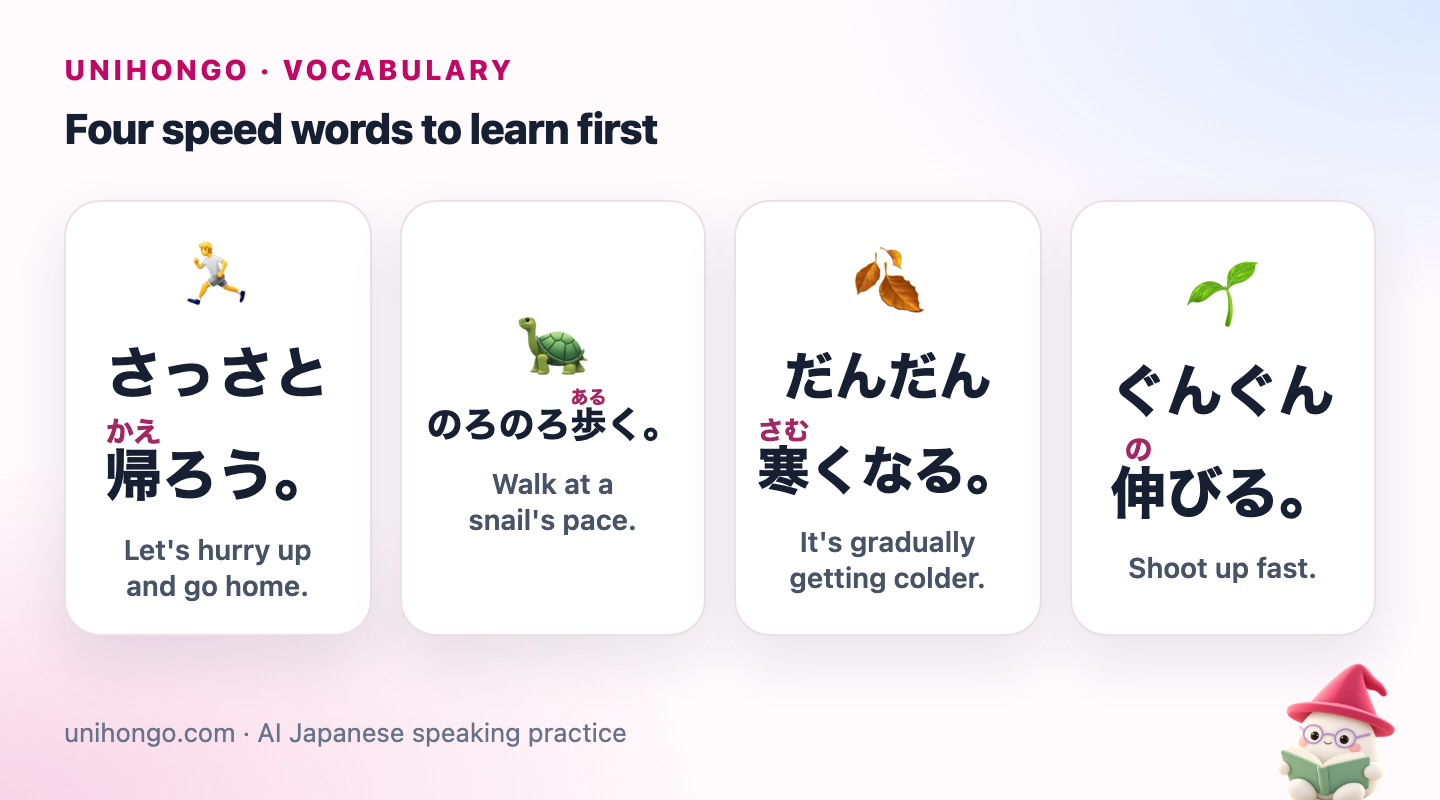
| Japanese | Romaji | Meaning |
|---|---|---|
| さっさと帰ろう。 | Sassato kaerō. | Let's hurry up and go home. |
| のろのろ歩く。 | Noronoro aruku. | Walk at a snail's pace. |
| だんだん寒くなる。 | Dandan samuku naru. | It's gradually getting colder. |
| ぐんぐん伸びる。 | Gungun nobiru. | Shoot up fast. |
Fast: sassato, chatchato, patto
Sassato means doing something quickly and efficiently, without wasting time or hesitating. When you use it about yourself or your group, it sounds brisk and practical. When you tell someone else to do something sassato, it sounds impatient, which is why it is a favourite of scolding parents. Chatchato is a casual, livelier version, common in kitchen and housework talk: chatchato katazukeyō, let's tidy up in no time.
Patto is different: it means in a flash, instantly, all at once. You use it for quick decisions, sudden changes and first impressions. Patto mi, at a glance, is a very common set phrase.
| Japanese | Romaji | Meaning |
|---|---|---|
| さっさと宿題を終わらせよう。 | Sassato shukudai o owaraseyō. | Let's get the homework done quickly. |
| さっさとしなさい! | Sassato shinasai! | Parent: Hurry up! (scolding) |
| ちゃっちゃと片付けちゃおう。 | Chatchato katazukechaō. | Let's tidy up in no time. (casual) |
| ぱっと決めて。 | Patto kimete. | Just decide, quick. (casual) |
| ぱっと見、違いがわからない。 | Patto mi, chigai ga wakaranai. | At a glance, I can't see the difference. |
| 電気がぱっとついた。 | Denki ga patto tsuita. | The lights came on all at once. |
Slow: noronoro, motamota and the neutral yukkuri
Japanese has a polite slow and two impatient slows. Yukkuri is neutral and often warm: speak slowly, take your time, relax. Noronoro is sluggish, crawling slowness, said of buses in traffic, a queue that hardly moves or someone dragging their feet. Motamota is clumsy, fumbling slowness: someone who cannot find their wallet at the register or takes ages to get ready.
Both noronoro and motamota criticise. Use them freely about traffic, machines or yourself, but think twice before using them about a person in front of them.
| Japanese | Romaji | Meaning |
|---|---|---|
| バスがのろのろ進んでいる。 | Basu ga noronoro susunde iru. | The bus is crawling along. |
| のろのろしないで。 | Noronoro shinaide. | Don't dawdle. (casual) |
| レジでもたもたしてしまった。 | Reji de motamota shite shimatta. | I fumbled around at the register. |
| もう少しゆっくり話してください。 | Mō sukoshi yukkuri hanashite kudasai. | Please speak a little more slowly. (polite) |
| どうぞゆっくりしていってください。 | Dōzo yukkuri shite itte kudasai. | Please make yourself at home. (polite) |
Change over time: dandan, dondon, gungun, jiwajiwa, mirumiru
This is the group learners mix up most, because English often uses one word, gradually or quickly, where Japanese has five. The difference is in the speed and the feeling. Dandan is step by step and neutral. Dondon is fast and has momentum, things piling up one after another. Gungun is energetic forward or upward movement, usually positive. Jiwajiwa is slow and steady, like water soaking in, and often describes something worrying, such as rising prices or a spreading problem. Mirumiru, often with uchi ni, is change so fast you can see it happening in front of you.
| Japanese | Romaji | Meaning |
|---|---|---|
| だんだん日本語がわかってきた。 | Dandan Nihongo ga wakatte kita. | I'm gradually starting to understand Japanese. |
| お客さんがどんどん増えている。 | Okyakusan ga dondon fuete iru. | More and more customers keep coming. |
| 子どもの背がぐんぐん伸びる。 | Kodomo no se ga gungun nobiru. | The child is shooting up. |
| 物価がじわじわ上がっている。 | Bukka ga jiwajiwa agatte iru. | Prices are creeping up. |
| 氷がみるみるうちに溶けた。 | Kōri ga mirumiru uchi ni toketa. | The ice melted before our eyes. |
| Word | Speed | Feeling | Typical subject |
|---|---|---|---|
| dandan | Gradual, steady | Neutral | Weather, skills, feelings |
| dondon | Fast, with momentum | Neutral to dramatic | Numbers, people, work piling up |
| gungun | Fast and vigorous | Positive, energetic | Growth, speed, improvement |
| jiwajiwa | Slow but constant | Often worrying | Prices, pain, damage, pressure |
| mirumiru | Visibly fast | Surprise | Melting, colour changing, recovery |
Grammar: pairing speed words with verbs
Speed and change words usually sit straight before the verb, without to. Sassato and patto already end in to or a small tsu, so nothing is added. Change words love the endings te kuru and te iku: te kuru for change that has been happening up to now, te iku for change that will continue from now. They also pair naturally with naru, to become.
| Japanese | Romaji | Meaning |
|---|---|---|
| だんだん慣れてきた。 | Dandan narete kita. | I'm slowly getting used to it. |
| これからどんどん忙しくなっていく。 | Kore kara dondon isogashiku natte iku. | Things will keep getting busier from here. |
| どんどん食べてね。 | Dondon tabete ne. | Host: Help yourself, eat plenty. (casual) |
- Manner before a verb: sassato kaeru, noronoro aruku, patto kimeru.
- As a verb with suru: noronoro suru, motamota suru.
- Change with naru: dandan samuku naru, mirumiru genki ni naru.
- Change up to now with te kuru: dandan narete kita, dandan wakatte kita.
- Change from now on with te iku: dondon fuete iku, jiwajiwa hirogatte iku.
Fast or slow? Choosing the right word
Most mistakes with these words come from picking the right speed but the wrong feeling. The comparison below sets the fast words against the slow ones and the vigorous change against the creeping one, so you can see which pairs belong on opposite sides.
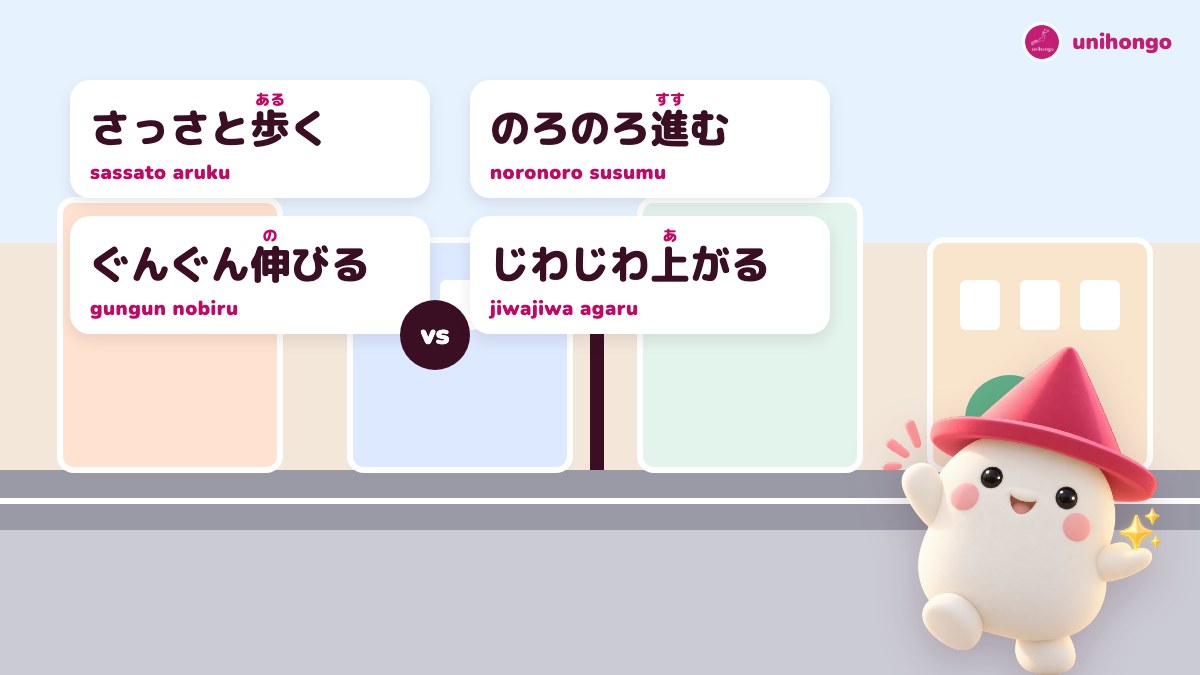
| Japanese | Romaji | Meaning |
|---|---|---|
| さっさと歩いて駅に向かう。 | Sassato aruite eki ni mukau. | Walk briskly to the station. |
| 渋滞で車がのろのろ進む。 | Jūtai de kuruma ga noronoro susumu. | Cars crawl along in the traffic jam. |
| 成績がぐんぐん上がった。 | Seiseki ga gungun agatta. | My grades shot up. |
| 不安がじわじわ広がる。 | Fuan ga jiwajiwa hirogaru. | Worry slowly spreads. |
Mini dialogue: talking about your progress
A classic small-talk moment for learners is a Japanese friend or teacher praising your progress. Japanese manners favour a modest answer, and these words make it easy to sound natural.
| Japanese | Romaji | Meaning |
|---|---|---|
| 最近、日本語がぐんぐん上手になってますね。 | Saikin, Nihongo ga gungun jōzu ni nattemasu ne. | Teacher: Your Japanese has really taken off lately. |
| いえいえ、まだまだです。 | Ieie, madamada desu. | You: Oh no, I still have a long way to go. |
| でも、だんだん聞き取れるようになってきました。 | Demo, dandan kikitoreru yō ni natte kimashita. | You: But I'm gradually able to catch more. |
| 単語はどんどん忘れちゃうんですけど。 | Tango wa dondon wasurechau n desu kedo. | You: Though I keep forgetting words as fast as I learn them. |
| 毎日続ければ、じわじわ力がつきますよ。 | Mainichi tsuzukereba, jiwajiwa chikara ga tsukimasu yo. | Teacher: If you keep it up every day, your skills will build steadily. |
Here jiwajiwa is positive: progress you cannot see from day to day but that adds up. The word itself is about slow seeping; whether it sounds worrying or hopeful depends on what is creeping.
Common learner mistakes
- Using noronoro to ask someone to slow down. Say yukkuri; noronoro would sound like criticism.
- Using dondon when you mean a gentle change. Dondon samuku naru sounds dramatic; for an ordinary change of season, dandan is natural.
- Using gungun for something bad. Gungun is energetic and usually positive; for debt or problems growing, dondon or jiwajiwa fits.
- Leaving out uchi ni after mirumiru in a full sentence. Mirumiru on its own works, but mirumiru uchi ni is the most common pattern.
- Telling a coworker sassato shite. It reads as a scolding; use a polite request instead.
Practise the feeling, not just the meaning
Because these words differ in feeling more than in meaning, feedback on your own sentences helps most. Write a short paragraph about how something in your life has changed this year, using four of the words, and send it to Mocchi with /correct. Mocchi points out where a word carries the wrong feeling, for example dondon where dandan would sound calmer, and suggests a fix. Mocchi keeps notes on the mix-ups you make, so they come back in later reviews.
Then build speed of recall with Vocabulary Dash on the games page, using a JLPT word pack or your own flashcards of these words: the game rewards quick answers, which suits words about speed.