
Four words every parent uses
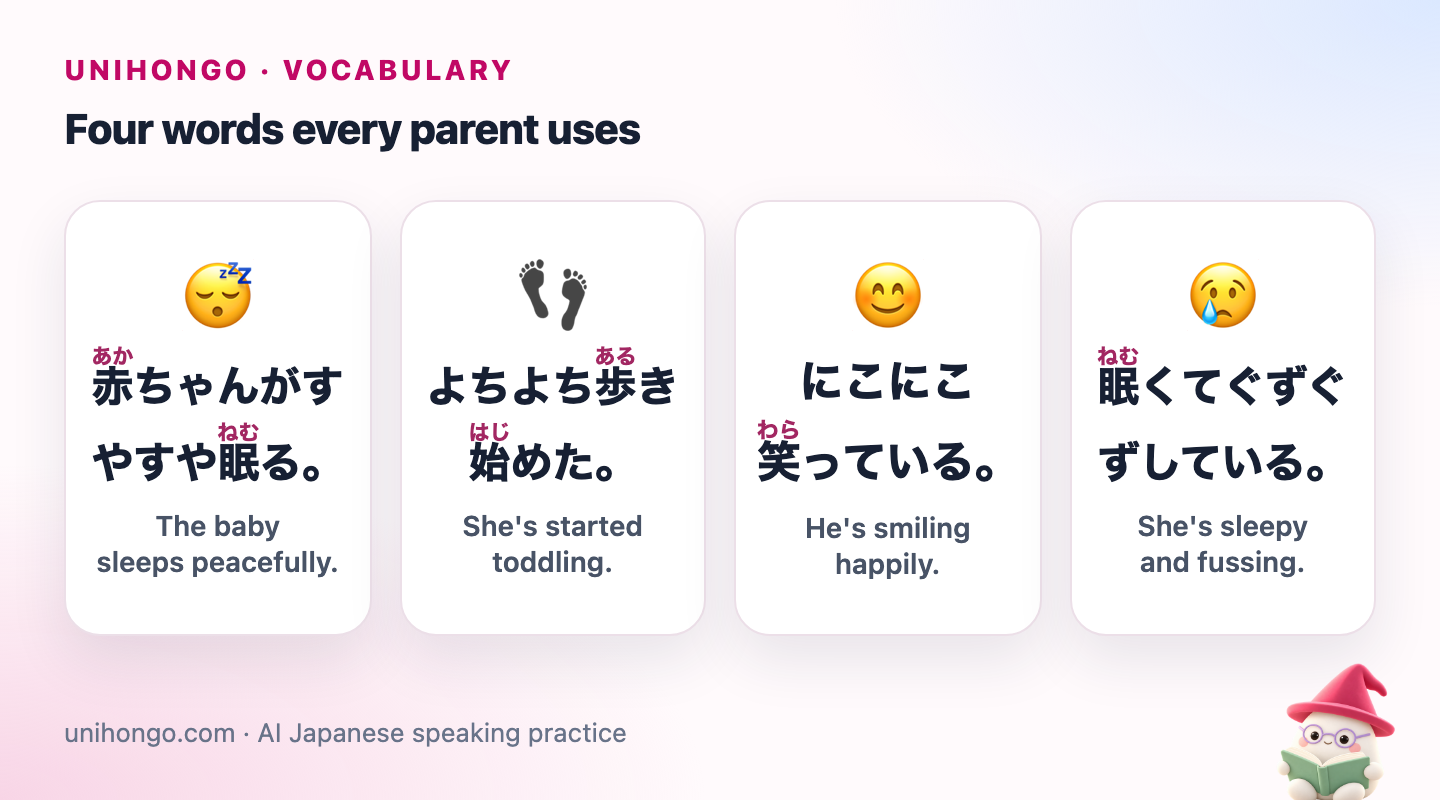
These four describe the moments parents talk about most: a baby finally asleep, the first wobbly steps, a happy smile and a tired, fussy child. You will hear them at home, at the clinic, at daycare and in children's books.
All four are gitaigo: they describe how something looks or feels rather than a sound. They are neutral in register, so you can use them with other parents, with teachers and with your own family.
| Japanese | Romaji | Meaning |
|---|---|---|
| 赤ちゃんがすやすや眠る。 | Akachan ga suyasuya nemuru. | The baby sleeps peacefully. |
| よちよち歩き始めた。 | Yochiyochi arukihajimeta. | She's started toddling. |
| にこにこ笑っている。 | Nikoniko waratte iru. | He's smiling happily. |
| 眠くてぐずぐずしている。 | Nemukute guzuguzu shite iru. | She's sleepy and fussing. |
Sleep: suyasuya and nenne
Suyasuya is the sweetest sleep word in Japanese: quiet, regular breathing and a peaceful face. Parents say it with relief when a baby finally drops off, and daycare staff use it when reporting on nap time. Nenne is a baby-talk word for sleep or going to bed, used when speaking to a small child and sometimes between parents. Nenne suru means to go to sleep; nenne no jikan is bedtime.
For adults, suyasuya sounds affectionate or teasing, so it is better to use gussuri, deeply, for your own sleep.
| Japanese | Romaji | Meaning |
|---|---|---|
| やっとすやすや寝てくれた。 | Yatto suyasuya nete kureta. | She's finally sleeping peacefully. |
| そろそろねんねしようね。 | Sorosoro nenne shiyō ne. | Parent: Time to go to sleep soon, OK? (to a child) |
| ねんねの時間だよ。 | Nenne no jikan da yo. | Parent: It's bedtime. (to a child) |
| お昼寝のとき、すやすや寝ていましたよ。 | Ohirune no toki, suyasuya nete imashita yo. | Staff: At nap time, he slept soundly. (polite) |
Smiles, giggles and soft cheeks
Nikoniko is a warm, happy smile that lasts, and it describes a cheerful child or a cheerful adult. Kyakkya is the high squeal of a small child laughing with delight, typically when tickled or playing peekaboo. Punipuni is soft and squishy to the touch, the classic word for a baby's cheeks, and pukupuku describes plump, chubby arms and legs in an affectionate way.
These words are compliments when used about a baby, and parents enjoy hearing them. Avoid pukupuku about an older child or an adult, where it can sound like a comment on weight.
| Japanese | Romaji | Meaning |
|---|---|---|
| いつもにこにこしてるね。 | Itsumo nikoniko shiteru ne. | You're always smiling, aren't you? (casual) |
| くすぐったら、きゃっきゃと笑った。 | Kusuguttara, kyakkya to waratta. | When I tickled him, he squealed with laughter. |
| ほっぺがぷにぷにだね。 | Hoppe ga punipuni da ne. | Your cheeks are so squishy. (to a baby) |
| 手足がぷくぷくしてかわいい。 | Teashi ga pukupuku shite kawaii. | The chubby little arms and legs are adorable. |
Crawling and toddling: haihai, yochiyochi, chokochoko
Haihai, from the verb hau, to crawl, is the standard word for a baby crawling, usually written in katakana. Yochiyochi is the unsteady, wide-legged walk of a new walker, and yochiyochi aruki works as a noun for the toddling stage. Chokochoko is small, quick steps, a little child trotting busily around the room, and it is also used for small animals.
Parents often use these words to describe milestones, so they come up in conversations at baby check-ups, with doctors and with other parents.
| Japanese | Romaji | Meaning |
|---|---|---|
| もうハイハイするようになった。 | Mō haihai suru yō ni natta. | She can crawl now. |
| よちよち歩きが始まりました。 | Yochiyochi aruki ga hajimarimashita. | He has started toddling. (polite) |
| 部屋の中をちょこちょこ歩き回っている。 | Heya no naka o chokochoko arukimawatte iru. | She's trotting around the room. |
| 何か月ですか。 | Nankagetsu desu ka. | How many months old is the baby? (polite) |
Crying, fussing and soothing: ēn ēn, guzuguzu, yoshiyoshi
Japanese has a range of crying words. Ēn ēn is the classic sound of a small child crying, the one you see in picture books. Gyāgyā is loud, screaming crying, as in a full tantrum. Guzuguzu is the unsettled, whiny state before or around crying, typically when a child is tired, hungry or unwell; the verb guzuru is very common among parents. Yoshiyoshi is what you say to soothe a child: there, there.
Guzuguzu has an adult meaning too. Said to an older child or to an adult, guzuguzu suru means to dawdle or dither, and guzuguzu shinaide is a mild scolding: stop dragging your feet.
| Japanese | Romaji | Meaning |
|---|---|---|
| 転んで、えーんえーんと泣いている。 | Koronde, ēn ēn to naite iru. | She fell over and she's crying. |
| 眠いとすぐぐずるんです。 | Nemui to sugu guzuru n desu. | He gets fussy as soon as he's sleepy. (polite) |
| よしよし、もう大丈夫だよ。 | Yoshiyoshi, mō daijōbu da yo. | There, there, you're all right now. |
| ぐずぐずしないで、早く着替えて。 | Guzuguzu shinaide, hayaku kigaete. | Parent: Stop dawdling and get dressed. (to an older child) |
Grammar and baby talk
Most of these words behave like other gitaigo. Suyasuya, nikoniko and yochiyochi go straight before a verb: suyasuya nemuru, nikoniko warau, yochiyochi aruku. With suru they become verbs on their own: nikoniko suru, guzuguzu suru, haihai suru. Sound words for crying and laughing, such as ēn ēn and kyakkya, usually take to before naku or warau.
Parents speaking to small children also use a softer vocabulary overall: nenne for sleep, anyo for feet or walking, and otete for hands. These vary by family and region, so do not worry about learning them all; recognising nenne and yoshiyoshi covers most situations.
| Japanese | Romaji | Meaning |
|---|---|---|
| 赤ちゃんがにこにこしている。 | Akachan ga nikoniko shite iru. | The baby is all smiles. |
| Word | Type | Pattern | Who uses it |
|---|---|---|---|
| suyasuya | Gitaigo | suyasuya nemuru, suyasuya neru | Anyone, about a child |
| nikoniko | Gitaigo | nikoniko warau, nikoniko suru | Anyone |
| yochiyochi | Gitaigo | yochiyochi aruku, yochiyochi aruki | Anyone |
| kyakkya | Giongo | kyakkya to warau | Anyone |
| guzuguzu | Gitaigo | guzuguzu suru, guzuru | Anyone |
| nenne | Baby talk | nenne suru | Mostly to small children |
A toddler's day at daycare pickup
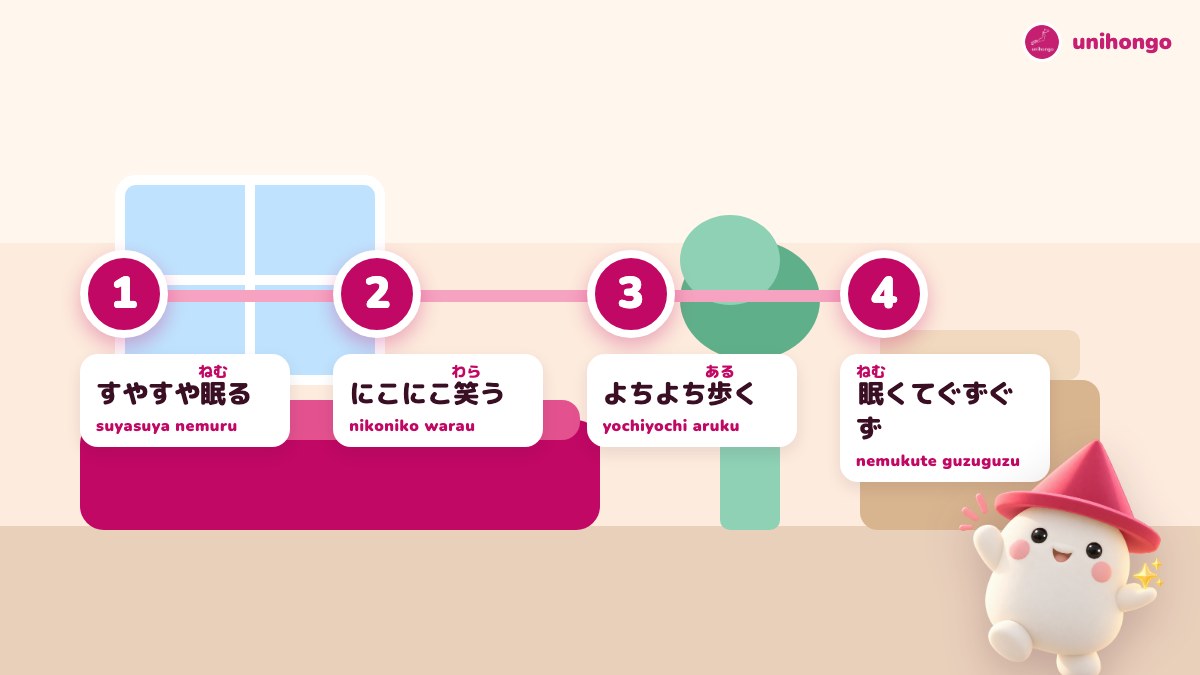
Many foreign parents in Japan first need these words at hoikuen or kindergarten pickup, when staff give a quick report on the day. The report is polite but warm, and full of gentle sound words. Here is a typical exchange, followed by the timeline of a toddler's day in four words.
| Japanese | Romaji | Meaning |
|---|---|---|
| お帰りなさい。今日はお昼寝のとき、すやすや寝てましたよ。 | Okaerinasai. Kyō wa ohirune no toki, suyasuya netemashita yo. | Staff: Welcome back. She slept soundly at nap time today. |
| よかったです。最近、夜はぐずぐずしていて。 | Yokatta desu. Saikin, yoru wa guzuguzu shite ite. | You: That's good. She's been fussy at night lately. |
| お散歩でもよちよち歩いて、ずっとにこにこしていました。 | Osanpo demo yochiyochi aruite, zutto nikoniko shite imashita. | Staff: On our walk she toddled along and smiled the whole time. |
| 帰りは眠くてぐずるかもしれません。 | Kaeri wa nemukute guzuru kamo shiremasen. | Staff: She might get fussy on the way home, she's sleepy. |
| ありがとうございます。また明日よろしくお願いします。 | Arigatō gozaimasu. Mata ashita yoroshiku onegai shimasu. | You: Thank you. See you tomorrow. |
Yoroshiku onegai shimasu at the end has no exact English equivalent here; it is a polite way of saying please continue to look after my child. It is the standard closing at daycare.
Common learner mistakes
- Saying suyasuya about your own adult sleep. It sounds childish or cute; use gussuri nemureta, I slept well.
- Using pukupuku about an older child or adult. It is a compliment for babies but can sound like a comment on weight later on.
- Hearing guzuguzu only as crying. To an older child or adult, it means dawdling, and it can be a mild criticism.
- Using baby-talk words with adults. Nenne and otete are for speaking to small children; with other adults, say neru and te.
- Touching or photographing someone else's baby without asking. Ask first, and praise with words instead.
Practise the pickup conversation
These words are easiest to remember when you hear them in a real exchange. Ask Mocchi for /vocab on Japanese words parents use for babies, and Mocchi builds a short list with example sentences at your level; ask for a tiny picture-book style story using five of them, then have Mocchi quiz you on it a few days later, picking up from the notes it keeps on what you already know.
For the spoken side, open AI Sensei and ask Sakura-sensei to play a daycare teacher giving you the end-of-day report. Ask the Sensei to include words such as suyasuya, nikoniko and guzuru, and to speak a little more slowly at first. The session report afterwards lists the phrases you used and the ones to practise again.