
Four body words to learn first
These four cover what people talk about most: being hungry, a stomach that feels off, legs that will not stop shaking, and shivering. All four follow the same simple pattern: body part, ga, sound word, and then suru, da or a verb.
Pekopeko and gakugaku are gitaigo: they describe a state rather than a noise. Gorogoro is partly giongo, the rumble you can hear, and buruburu describes a visible tremble.
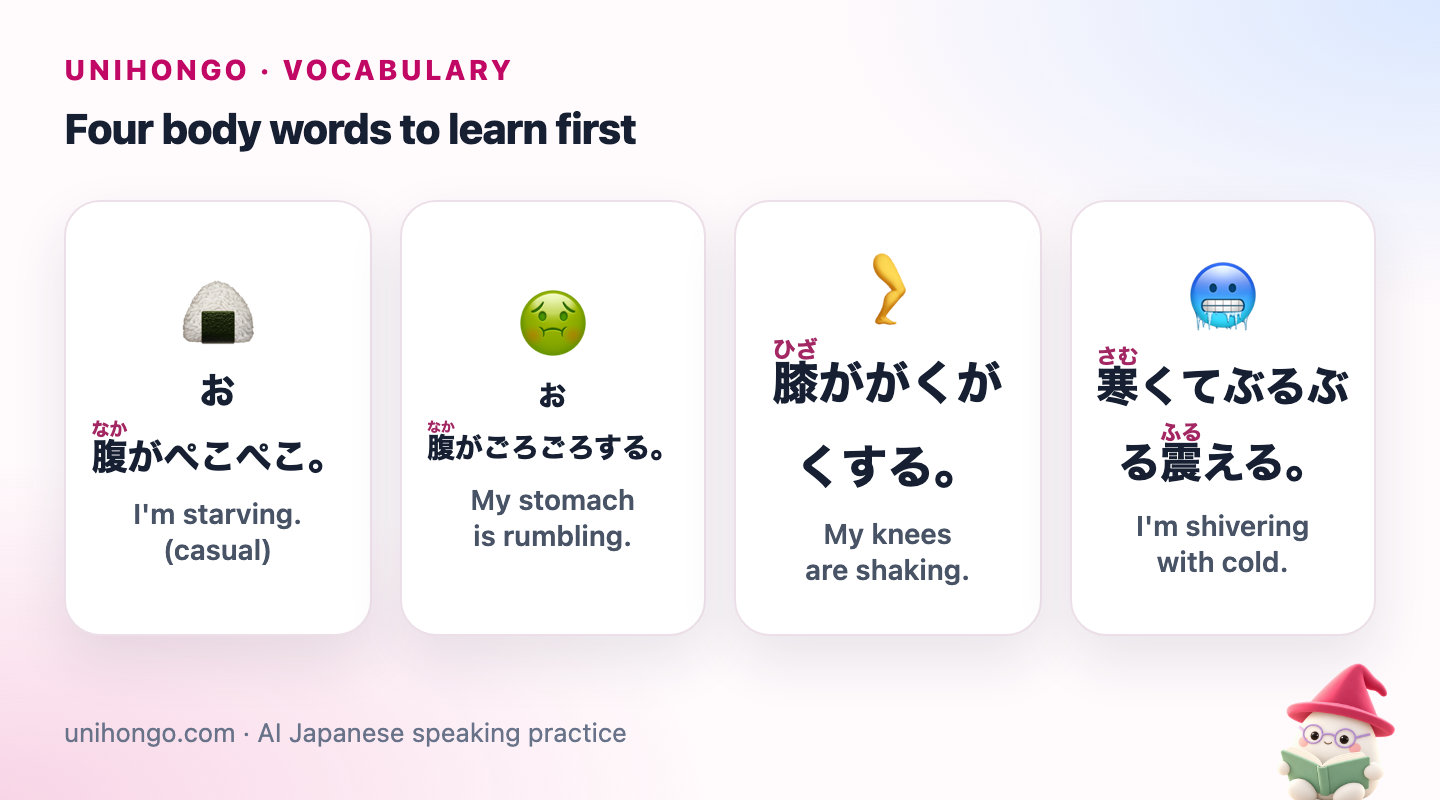
| Japanese | Romaji | Meaning |
|---|---|---|
| お腹がぺこぺこ。 | Onaka ga pekopeko. | I'm starving. (casual) |
| お腹がごろごろする。 | Onaka ga gorogoro suru. | My stomach is rumbling. |
| 膝ががくがくする。 | Hiza ga gakugaku suru. | My knees are shaking. |
| 寒くてぶるぶる震える。 | Samukute buruburu furueru. | I'm shivering with cold. |
Hunger and fullness: pekopeko, gū, panpan
Pekopeko comes from the idea of something thin and empty that dents in, and it has become the standard word for being very hungry. It works as a noun-like word with da or desu, so you do not need suru. Gū, or gūtto, is the single growl an empty stomach makes, and the verb is naru, to sound. Panpan describes something stuffed full to bursting, so onaka ga panpan means you have eaten far too much.
Pekopeko has a second meaning that has nothing to do with food: bowing again and again, often in an overly humble way. Pekopeko atama o sageru, to keep bowing, can sound a little critical, as if someone is grovelling.
| Japanese | Romaji | Meaning |
|---|---|---|
| もうお腹ぺこぺこだよ。 | Mō onaka pekopeko da yo. | I'm absolutely starving. (casual) |
| 会議中にお腹がぐうっと鳴った。 | Kaigichū ni onaka ga gūtto natta. | My stomach growled during the meeting. |
| 食べすぎてお腹がぱんぱんです。 | Tabesugite onaka ga panpan desu. | I ate too much, I'm stuffed. |
| 上司にぺこぺこ頭を下げる。 | Jōshi ni pekopeko atama o sageru. | Bow and scrape to the boss. |
An unsettled stomach: gorogoro
Gorogoro is a low, rolling rumble. In the body it describes gurgling or churning in the stomach or intestines, and people use it when their stomach feels uneasy, after eating something that did not agree with them, after a cold drink, or when they are nervous. It is a polite enough word to use at work or at a clinic, because it describes a sensation without going into detail.
Gorogoro has several other meanings, so context matters. Kaminari ga gorogoro is thunder rumbling. Ie de gorogoro suru is lazing around at home. Me ga gorogoro suru is the gritty feeling of something in your eye.
| Japanese | Romaji | Meaning |
|---|---|---|
| 冷たいものを飲んだら、お腹がごろごろしてきた。 | Tsumetai mono o nondara, onaka ga gorogoro shite kita. | After a cold drink, my stomach started rumbling. |
| ちょっとお腹がごろごろするので、先に帰ります。 | Chotto onaka ga gorogoro suru node, saki ni kaerimasu. | My stomach feels a bit off, so I'll head home first. (polite) |
| 目がごろごろする。 | Me ga gorogoro suru. | My eye feels gritty. |
| 休みの日は家でごろごろしている。 | Yasumi no hi wa ie de gorogoro shite iru. | On days off I laze around at home. |
Shaking and trembling: gakugaku, buruburu, bakubaku
Japanese separates kinds of shaking quite precisely. Gakugaku is a jerky, unsteady shake of a joint, especially knees and legs after a long climb, or a jaw chattering with fear. Buruburu is a fast tremble or shiver of the whole body or of a hand, from cold, fear or excitement. Bakubaku is a heart pounding hard, from running, nerves or a scare; it is casual and very common among younger speakers. Gachigachi is teeth chattering, and also muscles or shoulders that are stiff as a board.
| Japanese | Romaji | Meaning |
|---|---|---|
| 山を下りたら足ががくがくになった。 | Yama o oritara ashi ga gakugaku ni natta. | After coming down the mountain, my legs went wobbly. |
| 緊張して手がぶるぶる震える。 | Kinchō shite te ga buruburu furueru. | My hands are trembling with nerves. |
| 発表の前は心臓がばくばくする。 | Happyō no mae wa shinzō ga bakubaku suru. | My heart is pounding before the presentation. (casual) |
| 寒くて歯ががちがち鳴る。 | Samukute ha ga gachigachi naru. | My teeth are chattering with cold. |
| 肩ががちがちだ。 | Kata ga gachigachi da. | My shoulders are really stiff. (casual) |
| Word | Body part | Usual cause | Register |
|---|---|---|---|
| gakugaku | Knees, legs, jaw | Tiredness, fear, nerves | Neutral |
| buruburu | Whole body, hands | Cold, fear | Neutral |
| bakubaku | Heart | Running, nerves, a scare | Casual |
| gachigachi | Teeth, shoulders | Cold; stiffness | Neutral to casual |
Small movements: pikupiku, pokipoki, boribori and gukitto
Some of the most useful body words describe small, annoying things. Pikupiku is a small twitch, typically an eyelid or a cheek muscle that will not stop. Pokipoki is the crack of knuckles or a stiff neck, and the verb is narasu, to make it sound. Boribori is scratching an itch firmly, and also the crunch of hard snacks. Gukitto is a sudden painful twist, mostly in the set expression koshi o gukitto yatta, I put my back out.
| Japanese | Romaji | Meaning |
|---|---|---|
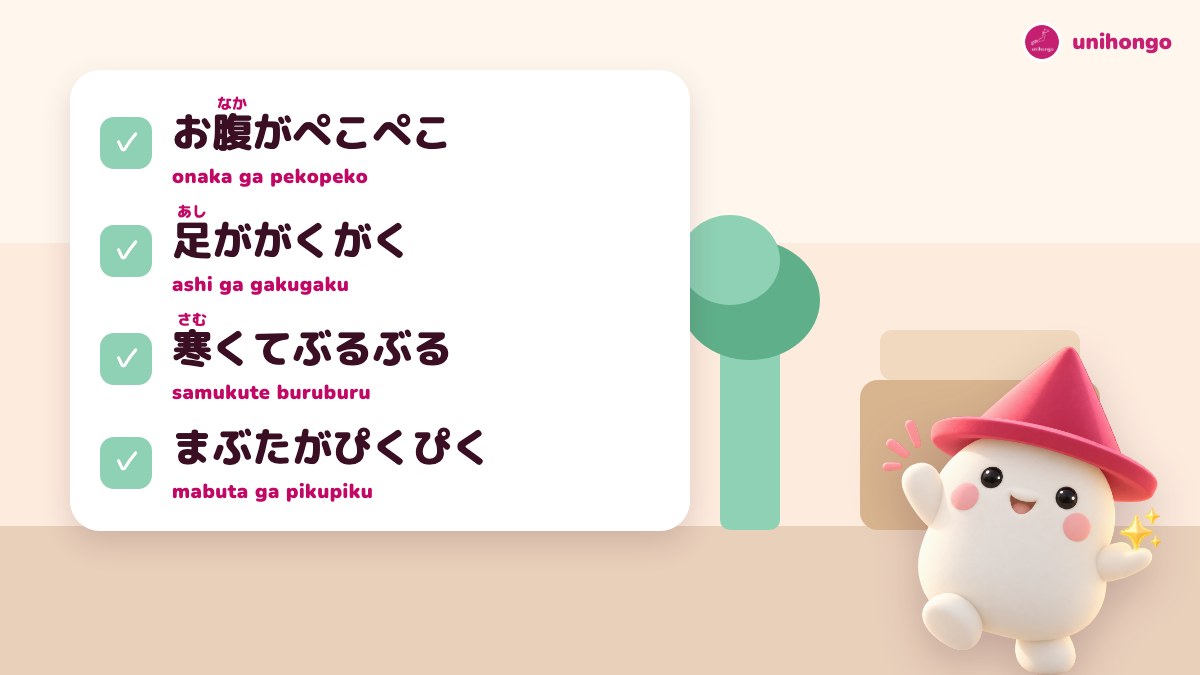
| さっきからまぶたがぴくぴくする。 | Sakki kara mabuta ga pikupiku suru. | My eyelid has been twitching for a while. |
| 指をぽきぽき鳴らさないで。 | Yubi o pokipoki narasanaide. | Please don't crack your knuckles. (casual) |
| 蚊に刺されて腕をぼりぼりかいた。 | Ka ni sasarete ude o boribori kaita. | I got bitten by a mosquito and scratched my arm hard. |
| 重い箱を持ったら腰をぐきっとやった。 | Omoi hako o mottara koshi o gukitto yatta. | I lifted a heavy box and put my back out. |
Yatta in koshi o gukitto yatta is the casual verb yaru, to do, used for hurting yourself. It sounds natural with friends; with a doctor you might say koshi o itamemashita, I hurt my lower back, and then describe it.
Grammar: ga, suru, da and ni naru
Almost every body sentence starts with the body part and ga: onaka ga, hiza ga, mabuta ga. After that, the sound word takes one of a few endings, and choosing the right one is the main grammar point.
| Japanese | Romaji | Meaning |
|---|---|---|
| 足ががくがくになった。 | Ashi ga gakugaku ni natta. | My legs went shaky. |
| ぶるぶると震えている。 | Buruburu to furuete iru. | Trembling all over. |
| お腹がぐうっと鳴る。 | Onaka ga gūtto naru. | My stomach gives a growl. |
- Suru turns a sensation into a verb: gorogoro suru, gakugaku suru, pikupiku suru.
- Da or desu works with states that are already complete: pekopeko da, panpan desu, gachigachi da.
- Ni naru describes changing into a state: ashi ga gakugaku ni natta, my legs went shaky.
- To or nothing goes before a separate verb: buruburu furueru, boribori kaku, pokipoki narasu.
- A small tsu ending, as in gukitto or gūtto, marks one sudden event rather than something repeated.
Telling someone how you feel
The words are most useful when you need to explain why you are slowing down, leaving early or skipping a meal. Here is a short exchange after a long hike with a friend, followed by the polite version you might use with a coworker. The checklist below shows four lines worth having ready for any long day out.
| Japanese | Romaji | Meaning |
|---|---|---|
| 大丈夫?顔色悪いよ。 | Daijōbu? Kaoiro warui yo. | Friend: Are you OK? You look pale. |
| 足ががくがくで、もう歩けない。 | Ashi ga gakugaku de, mō arukenai. | You: My legs are wobbly, I can't walk any more. |
| それに、お腹もぺこぺこ。 | Sore ni, onaka mo pekopeko. | You: And I'm starving, too. |
| じゃあ、あそこで休んで何か食べよう。 | Jā, asoko de yasunde nanika tabeyō. | Friend: Then let's rest over there and eat something. |
| すみません、少しお腹がごろごろするので、休ませてください。 | Sumimasen, sukoshi onaka ga gorogoro suru node, yasumasete kudasai. | You: Sorry, my stomach feels a bit off, so may I take a break? (polite) |
Common learner mistakes
- Using gorogoro for ordinary hunger. Many speakers will think your stomach is upset; say pekopeko for hunger and gū for the growl.
- Saying onaka ga pekopeko suru. Pekopeko normally takes da or desu, not suru.
- Using buruburu for tired legs. After a long hike, gakugaku is the natural word; buruburu suggests cold or fear.
- Mixing up dokidoki and bakubaku in the wrong setting. Dokidoki can sound sweet or romantic; for a heart pounding after a sprint, bakubaku fits better.
- Forgetting that hara hetta is rough. It is fine among close friends, but onaka ga suita is safer in most company.
Make these body words automatic
Body words are best learned as tiny reports you can give without thinking. Ask Mocchi to drill them with you: type /quiz and add Japanese sound words for the body, with the body part as a hint. Mocchi asks one at a time, explains any answer you get wrong, and keeps track of the pairs you confuse, such as gakugaku and buruburu, so they come back in a later review.
For extra repetition, save the ten sentences from this guide as flashcards with /create-flashcards, picking a photo for each, then play Kotoba Stack with your own cards on the games page. Seeing the picture and the sound word together is a quick way to link the feeling to the Japanese.