
Sound pairs that change the meaning
Japanese counts time in beats called mora. Each short vowel is one beat, a long vowel is two, and the n sound and the small tsu are a beat each. A word with one extra beat can be a different word entirely. These four cards show two of the most famous pairs, which every Japanese teacher in Vietnam knows well.
If you say obasan when you mean obāsan, people will usually work it out from context, but in a clinic, a shop or a phone call, context is not always enough. That is why long vowels come first in this guide.
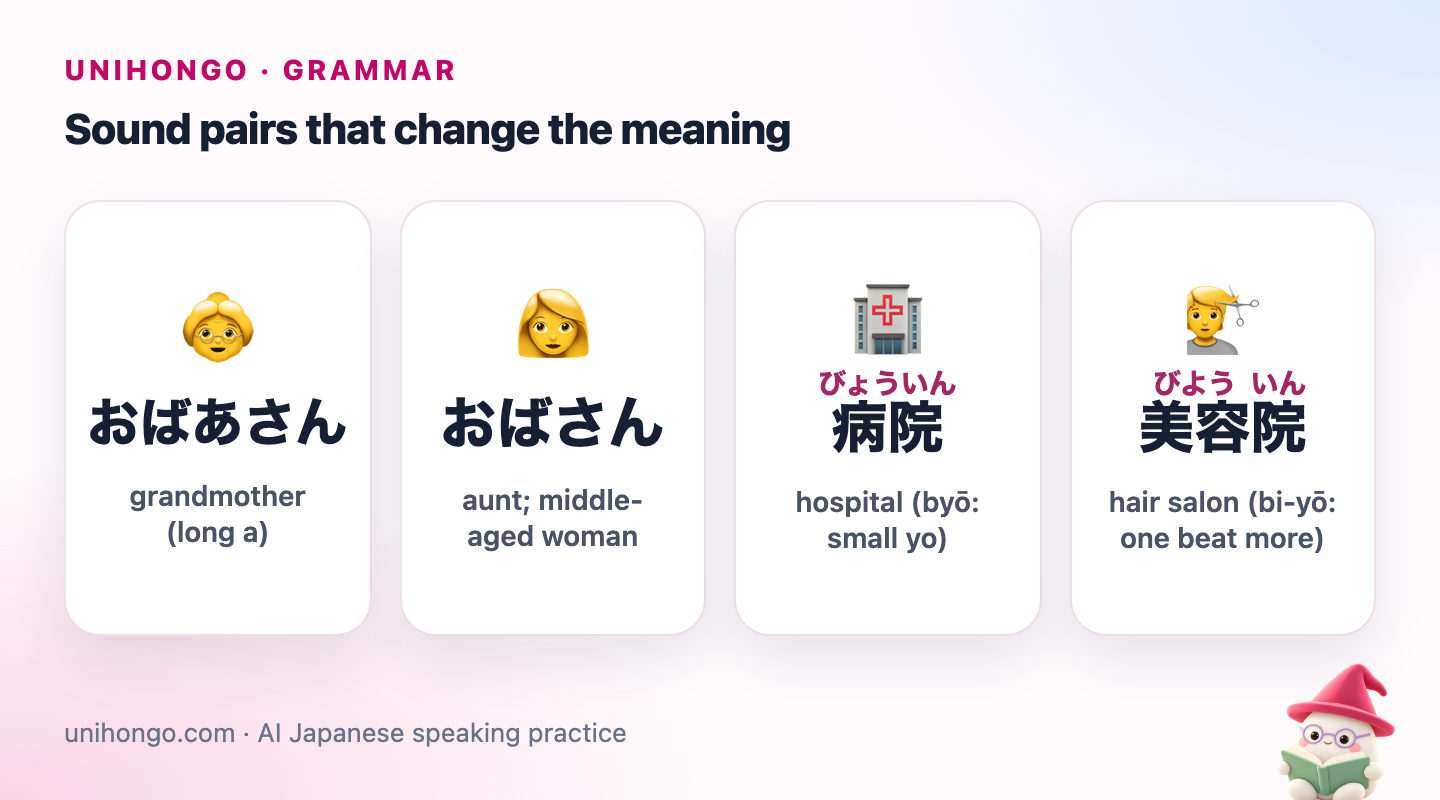
| Japanese | Romaji | Meaning |
|---|---|---|
| おばあさん | obāsan | grandmother (long a) |
| おばさん | obasan | aunt; middle-aged woman |
| 病院 | byōin | hospital (byō: small yo) |
| 美容院 | biyōin | hair salon (bi-yō: one beat more) |
Long vowels: count the beats
In Vietnamese, the difference between many syllables is carried by tone and vowel quality. In Japanese, length itself is meaningful. Many Vietnamese speakers hear a Japanese long vowel as a normal vowel said with a falling or level tone, and then reproduce the tone instead of the length. The result is a word that sounds one beat short.
The fix is physical. Tap a finger or clap once per beat while you speak. Kōkō, high school, is ko-o-ko-o: four taps. Koko, here, is two. Say each pair slowly at first, then at normal speed, keeping the taps. Also learn how long vowels are written: ou and ei in hiragana are usually read as long ō and long e, so gakkou is gakkō and sensei is a long e.
| Japanese | Romaji | Meaning |
|---|---|---|
| ここ | koko | here (2 beats) |
| 高校 | kōkō | high school (4 beats) |
| 主人 | shujin | husband (3 beats) |
| 囚人 | shūjin | prisoner (4 beats) |
| 来て | kite | come (2 beats) |
| 切手 | kitte | postage stamp (3 beats, small tsu) |
Tones versus pitch accent
Vietnamese has six tones in the northern standard, and each syllable carries its own: rising, falling, broken, and so on. Japanese has pitch accent instead. In standard Tokyo Japanese, each beat is simply high or low, and the pattern belongs to the whole word. There are no glides inside one beat.
Many Vietnamese speakers have a very good ear for pitch, which is a real advantage. The trap is applying Vietnamese contours to Japanese syllables: a rising or falling glide on a single beat, or a heavy tone on every syllable of a long word. That makes Japanese sound sing-song or choppy. Aim for level beats and one clear drop. In the pairs below, the high beats are where the voice sits higher; listen to native audio to confirm, because pitch also varies by region.
| Japanese | Romaji | Meaning |
|---|---|---|
| 雨 | ame | rain (Tokyo: high then low) |
| 飴 | ame | candy (Tokyo: low then high) |
| 箸 | hashi | chopsticks (Tokyo: high then low) |
| 橋 | hashi | bridge (Tokyo: low then high) |
Do not panic about pitch. Native speakers understand words with the wrong pitch almost all the time, because context decides. Spend more effort on length and rhythm, which affect understanding much more.
The moraic n and the small tsu
Vietnamese words can end in n, ng or m, and those endings are short and clean. The Japanese n, written ん, is a whole beat of its own, and its sound shifts with what follows: closer to m before b, p or m, closer to ng before k or g. Before a vowel or y it should not join the next syllable. Many learners say funiki for fun-i-ki, atmosphere, or tani for tan-i, a unit or credit, which is a different word: tani means valley.
The small tsu is a pause of one full beat before a consonant. Vietnamese has unreleased final stops such as -p, -t and -c, so many Vietnamese speakers make the stop easily. The usual problem is timing: the pause is too short, and kitte, stamp, comes out like kite, come. Hold the silence as long as a normal beat.
| Japanese | Romaji | Meaning |
|---|---|---|
| 雰囲気 | fun'iki | atmosphere (fu-n-i-ki, 4 beats) |
| 単位 | tan'i | unit; course credit (3 beats) |
| 谷 | tani | valley (2 beats) |
| 学校 | gakkō | school (ga-k-ko-o) |
| ちょっと待ってください。 | Chotto matte kudasai. | Please wait a moment. |
Particles: what word order cannot do
Vietnamese marks meaning mainly with word order and separate words. Japanese uses small particles after each noun. Many Vietnamese-speaking learners either leave particles out or pick a familiar one for everything, often ni.
Casual Japanese does drop o and wa in quick speech, and sometimes the ni of direction, as in gakkō iku. But de for the place of action, to for with, kara for from and made for until cannot be dropped, and in polite speech you should keep them all. The most common swap is ni and de with places: ni for where something is or where you go, de for where an action happens.
| Japanese | Romaji | Meaning |
|---|---|---|
| 大阪に住んでいます。 | Ōsaka ni sunde imasu. | I live in Osaka. (ni: where you are) |
| 大阪で働いています。 | Ōsaka de hataraite imasu. | I work in Osaka. (de: where you act) |
| 友達と映画を見ました。 | Tomodachi to eiga o mimashita. | I watched a film with a friend. |
| Particle | Job | Example meaning |
|---|---|---|
| ni | Existence, destination, time | I'm going to Osaka; I live in Osaka |
| de | Place where an action happens; tool | I work in Osaka; by train |
| to | Together with someone | With a friend |
| o | Direct object | Eat rice |
| kara / made | From / until | From 9 until 5 |
Wrong vs right: put the past on the verb
Vietnamese verbs do not change form. Time is shown by words such as hôm qua, yesterday, or đã, a past marker, and often only by context. In Japanese, the verb itself must change: ikimasu becomes ikimashita. Many learners say the time word correctly and then forget the past ending, because in their first language the time word was enough.
Make a rule for yourself: if your sentence has kinō, senshū or kyonen, the verb must end in mashita or ta. Check it before you finish speaking. The scene below sums up the two slips from this part of the guide.
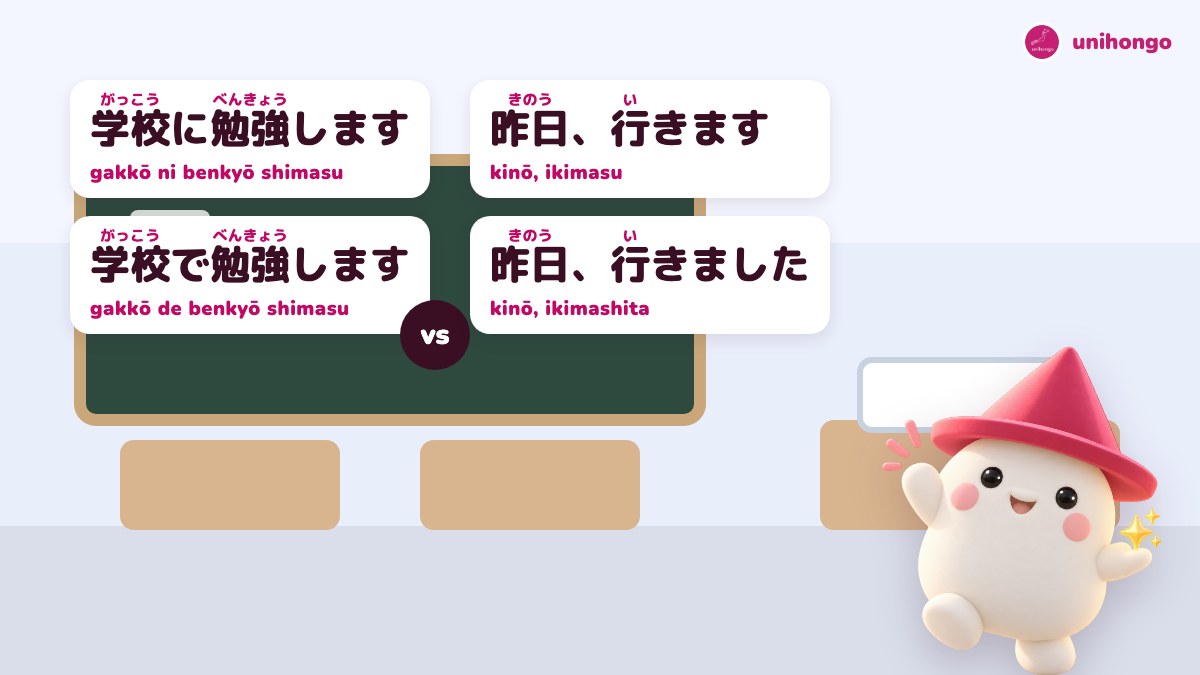
| Japanese | Romaji | Meaning |
|---|---|---|
| 学校に勉強します | gakkō ni benkyō shimasu | Wrong: ni for where you study |
| 学校で勉強します | gakkō de benkyō shimasu | Right: de marks the place of action |
| 昨日、行きます | kinō, ikimasu | Wrong: no past ending |
| 昨日、行きました | kinō, ikimashita | Right: the verb is past too |
Sino-Vietnamese words: a head start with traps
Your Sino-Vietnamese vocabulary is a genuine shortcut. Many two-kanji words share their meaning, and the sounds often correspond in patterns you can learn to spot. Treat the Vietnamese reading as a hint, though, never as the answer: you must still learn the Japanese reading, which can look quite different, and a few words are used differently.
| Japanese | Romaji | Meaning |
|---|---|---|
| 大学生です。 | Daigakusei desu. | I'm a university student. |
| 高校の生徒です。 | Kōkō no seito desu. | I'm a high school pupil. |
| 足元に注意してください。 | Ashimoto ni chūi shite kudasai. | Please watch your step. |
| Kanji word | Sino-Vietnamese | Japanese reading | Note |
|---|---|---|---|
| 準備 | chuẩn bị | junbi | Same meaning: preparation |
| 結婚 | kết hôn | kekkon | Same meaning: marriage |
| 注意 | chú ý | chūi | Japanese often means caution or warning |
| 経済 | kinh tế | keizai | Same meaning: economy |
| 学生 | học sinh | gakusei | Japanese usually means a university student |
Mini dialogue: hospital or hair salon?
A classic mix-up that many teachers tell as a story: a learner asks for directions to the hospital and is sent to a hair salon. Here is the conversation done right, with long vowels, particles and past tense in place.
| Japanese | Romaji | Meaning |
|---|---|---|
| すみません、病院はどこですか。 | Sumimasen, byōin wa doko desu ka. | You: Excuse me, where is the hospital? |
| 病院ですか、美容院ですか。 | Byōin desu ka, biyōin desu ka. | Passer-by: The hospital or the hair salon? |
| 病院です。昨日、足をけがしました。 | Byōin desu. Kinō, ashi o kega shimashita. | You: The hospital. I hurt my leg yesterday. |
| それは大変ですね。駅の前にありますよ。 | Sore wa taihen desu ne. Eki no mae ni arimasu yo. | Passer-by: Oh no. It's in front of the station. |
| ありがとうございます。 | Arigatō gozaimasu. | You: Thank you very much. |
A week of sound and particle practice
Split the week: sounds on odd days, grammar on even days. For grammar, ask Mocchi: quiz me on de and ni with places, ten questions, and explain each mistake. Then try /correct on a short diary entry about yesterday. Mocchi notes which particle or ending you keep missing, so the next quiz focuses there instead of starting from zero.
For sounds, use the pronunciation coach on unihongo.com/pronunciation. Choose the long vowels or small tsu focus, listen at slow speed, record yourself and look at the rhythm score: that is the one that shows whether your beats are the right length.