
Four habits that give you away
These are not random errors. They are English grammar wearing Japanese words. English needs a subject in every sentence, puts the verb second, uses you for everyone, and builds politeness out of separate words. Japanese does none of these things, so the English settings keep producing the same four slips.
The four cards below are the corrected versions. Learn them as models: verb at the end, no watashi when it is obvious, a name instead of anata, and the polite masu ending instead of desu on a verb.
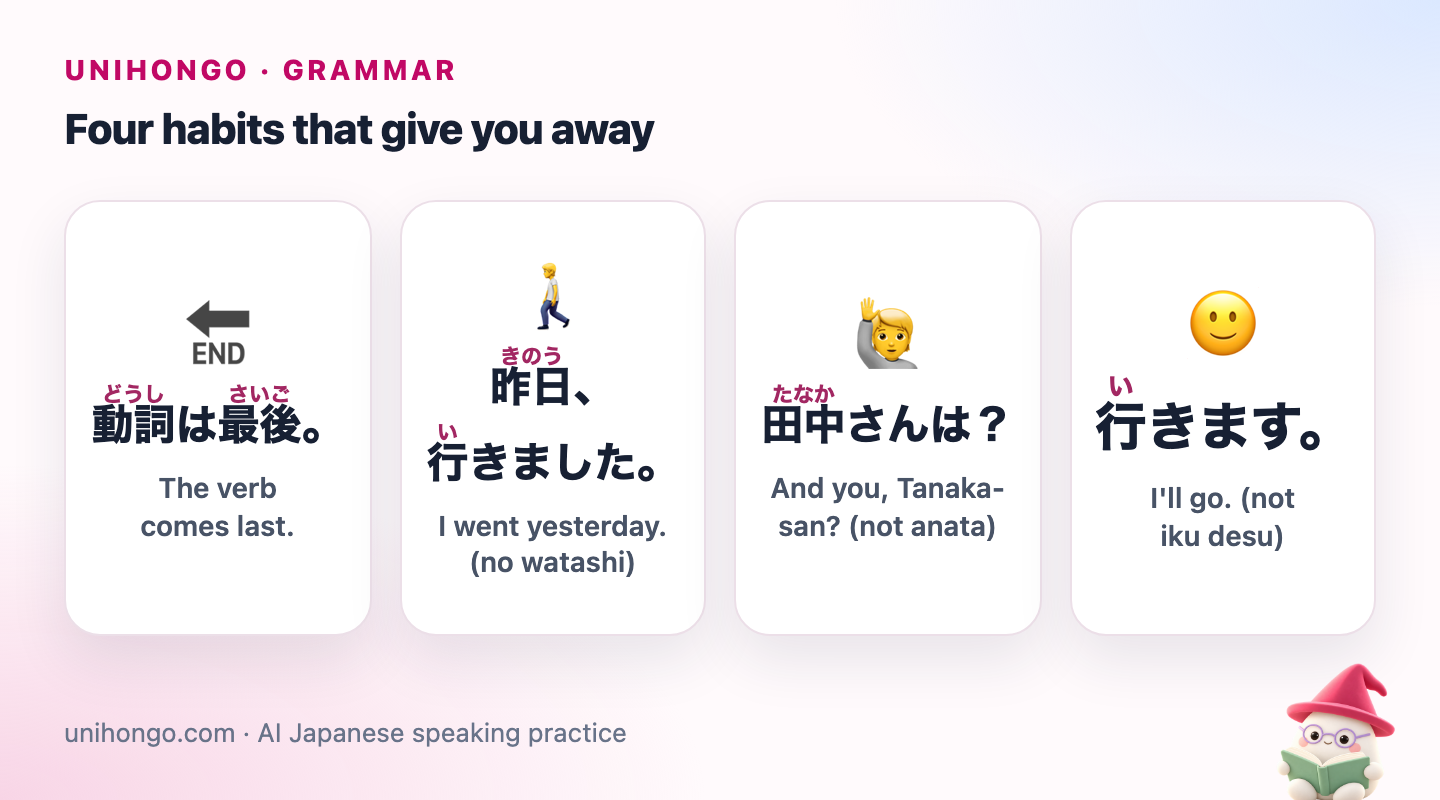
| Japanese | Romaji | Meaning |
|---|---|---|
| 動詞は最後。 | Dōshi wa saigo. | The verb comes last. |
| 昨日、行きました。 | Kinō, ikimashita. | I went yesterday. (no watashi) |
| 田中さんは? | Tanaka san wa? | And you, Tanaka-san? (not anata) |
| 行きます。 | Ikimasu. | I'll go. (not iku desu) |
Word order: the verb waits until the end
In English, word order tells you who did what: the dog bit the man is not the man bit the dog. In Japanese, particles do that job. Wa marks the topic, o marks the object, ni marks a destination or a time, de marks a place of action or a tool. Because the particles carry the meaning, the words before the verb can move around quite freely, but the verb itself stays at the end of the clause.
Many English speakers start well, then panic halfway and push the verb forward: watashi wa ikimasu Tōkyō ni ashita. A listener will probably understand, but it sounds like a translation. A useful trick is to build the sentence backwards in your head: decide the verb first, then add the pieces in front of it.
The same rule applies to descriptions. English puts relative clauses after the noun, as in the book that I bought yesterday. Japanese puts the whole description before the noun, with no word for that or which: kinō katta hon, yesterday-bought book.
| Japanese | Romaji | Meaning |
|---|---|---|
| 明日、東京に行きます。 | Ashita, Tōkyō ni ikimasu. | Right: I'm going to Tokyo tomorrow. |
| 行きます東京に明日。 | Ikimasu Tōkyō ni ashita. | Wrong: English order, verb too early |
| 駅で友達に会いました。 | Eki de tomodachi ni aimashita. | I met a friend at the station. |
| 昨日買った本です。 | Kinō katta hon desu. | It's the book I bought yesterday. |
| 母が作ったカレーが好きです。 | Haha ga tsukutta karē ga suki desu. | I like the curry my mother makes. |
Dropping the subject, and why watashi wa every line sounds odd
English grammar demands a subject: you cannot say went to the shop in a normal sentence. Japanese does not. Once the topic is clear, it simply disappears until something changes. If someone asks what you did at the weekend, the answer is about you, so you leave yourself out.
Learners who say watashi wa in every sentence are not making a grammar error, but they sound like they are giving a formal presentation about themselves. Worse, watashi wa often adds contrast: as for me, unlike others. Repeated three times, it can sound as if you are comparing yourself with everyone in the room.
Keep watashi wa for three jobs: introducing yourself, switching the topic back to yourself, and contrasting yourself with someone else. The same applies to other people: once you have said Tanaka san wa, you do not need it again until the topic changes.
| Japanese | Romaji | Meaning |
|---|---|---|
| 週末は何をしましたか。 | Shūmatsu wa nani o shimashita ka. | Colleague: What did you do at the weekend? |
| 映画を見ました。 | Eiga o mimashita. | Right: I watched a film. |
| 私は映画を見ました。 | Watashi wa eiga o mimashita. | Possible, but sounds like as for me, I… |
| 私はコーヒーにします。 | Watashi wa kōhī ni shimasu. | I'll have coffee. (others ordered tea) |
| 私はスミスです。 | Watashi wa Sumisu desu. | I'm Smith. (introduction: fine) |
Stop saying anata
Textbooks translate you as anata, so English speakers use it the way they use you: constantly, with everyone. In real conversation, many Japanese speakers rarely say anata to someone in front of them. It can sound distant, a little cold, or, to a teacher or a boss, presumptuous. You will see it in written instructions, advertising and song lyrics, and some married couples use it, but those are special cases.
The natural choices are the person's name with san, a role or title, or nothing at all. In a shop, the clerk calls you okyakusama, the customer. At school, the teacher is sensei. Among friends, people use first names or nicknames. Most of the time you do not need a word for you, because the question already shows who you are asking.
| Japanese | Romaji | Meaning |
|---|---|---|
| 田中さんはどう思いますか。 | Tanaka san wa dō omoimasu ka. | What do you think, Mr Tanaka? |
| 先生、質問してもいいですか。 | Sensei, shitsumon shite mo ii desu ka. | Teacher, may I ask a question? |
| お名前は? | Onamae wa? | And your name is? (no anata needed) |
| あなたは何が好きですか。 | Anata wa nani ga suki desu ka. | Textbook-style; sounds stiff in a chat |
| 何が好きですか。 | Nani ga suki desu ka. | Right: What do you like? |
Desu after verbs, and past tense on desu
English speakers learn early that desu makes things polite, then reasonably add it to everything. With nouns and adjectives that works: gakusei desu, oishii desu. With verbs it does not. A verb has its own polite form, the masu form, and desu does not follow a plain verb: iku desu and taberu desu are wrong in standard Japanese.
The second slip is the past tense of i-adjectives. English puts the past on the verb to be: it was delicious. So learners say oishii deshita. In Japanese, the past belongs to the adjective itself: oishikatta, and you add desu for politeness: oishikatta desu. Na-adjectives and nouns are different: they do take deshita, as in kirei deshita.
| Japanese | Romaji | Meaning |
|---|---|---|
| 毎朝コーヒーを飲みます。 | Maiasa kōhī o nomimasu. | Right: I drink coffee every morning. |
| ラーメンはおいしかったです。 | Rāmen wa oishikatta desu. | Right: The ramen was delicious. |
| 部屋はきれいでした。 | Heya wa kirei deshita. | Right: The room was clean. |
| English-shaped | Natural | Rule |
|---|---|---|
| iku desu | ikimasu | Verbs take masu, not desu |
| tabeta desu | tabemashita | Past polite verb is mashita |
| oishii deshita | oishikatta desu | I-adjectives carry their own past |
| takai ja nai desu | takaku nai desu | I-adjectives negate with ku nai |
| kirei katta desu | kirei deshita | Na-adjectives use deshita |
Wrong vs right: the pairs to memorise
If you only keep one page from this guide, keep these pairs. Say the right version aloud three times each, and say the wrong one once, slowly, noticing exactly where the English pulled you. Contrast is what makes the correction stick.
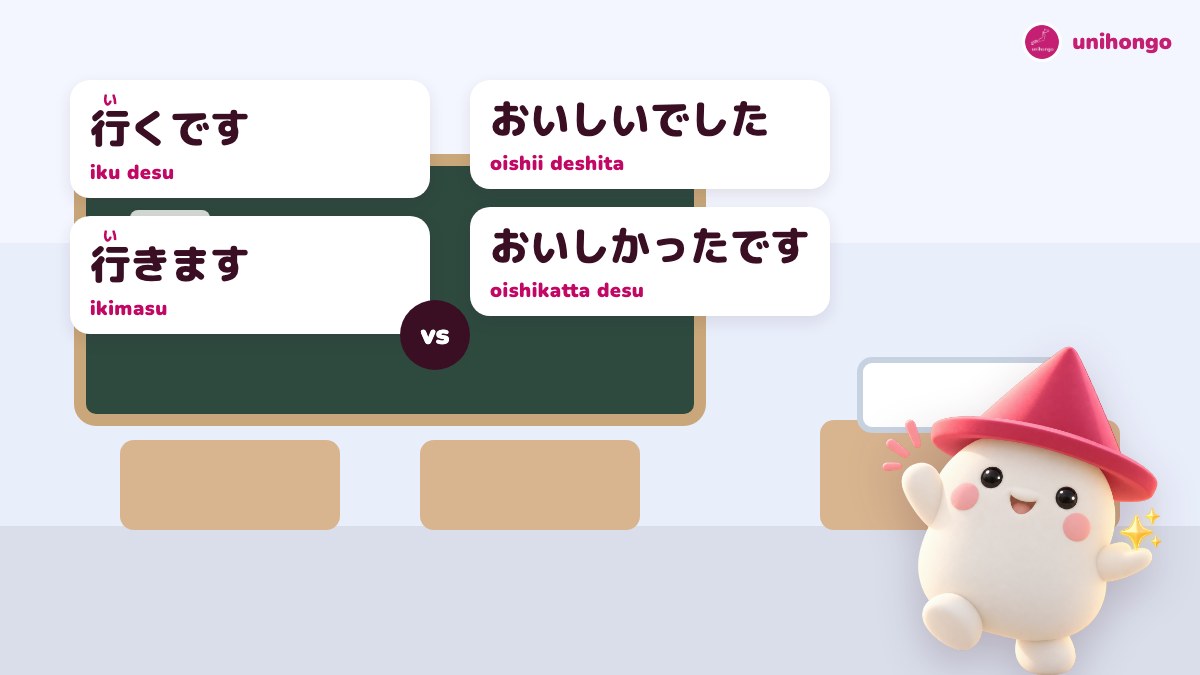
| Japanese | Romaji | Meaning |
|---|---|---|
| 行くです | iku desu | Wrong: desu after a plain verb |
| 行きます | ikimasu | Right: polite verb with masu |
| おいしいでした | oishii deshita | Wrong: past tense on desu |
| おいしかったです | oishikatta desu | Right: past on the adjective |
| 私は私の母と行きました。 | Watashi wa watashi no haha to ikimashita. | Wrong: two watashi, sounds translated |
| 母と行きました。 | Haha to ikimashita. | Right: I went with my mother. |
Smaller traps: yes and no, kare, and plurals
| Japanese | Romaji | Meaning |
|---|---|---|
| 行かないんですか。 | Ikanai n desu ka. | Friend: Aren't you going? |
| はい、行きません。 | Hai, ikimasen. | Right: That's right, I'm not going. |
| いいえ、行きますよ。 | Iie, ikimasu yo. | Right: No, I am going. |
- Answering negative questions. To ikanai n desu ka, aren't you going?, Japanese hai means yes, that's right, I'm not going. English speakers often say hai meaning yes, I am going. Answer the statement, not the English feeling: hai, ikimasen or iie, ikimasu.
- Kare and kanojo. They do mean he and she, but in daily talk they very often mean boyfriend and girlfriend. Saying kanojo wa while pointing at a colleague can sound odd; use her name instead.
- Plural endings. Japanese nouns do not need a plural. Hon can be one book or ten. The ending tachi is mostly for people, as in watashitachi or kodomotachi, so avoid hontachi.
- Translating I think everywhere. To omoimasu softens opinions, but adding it to plain facts, as in Nihonjin da to omoimasu about yourself, sounds strange. Use it for opinions and guesses.
- Using motto, more, with a noun alone. More water is mizu o motto kudasai or mō sukoshi mizu o kudasai, not motto mizu desu.
Mini dialogue: your first morning at a new job
Here is a short exchange with all four fixes in place. Notice how rarely anyone says watashi or anata, and that every polite verb ends in masu.
| Japanese | Romaji | Meaning |
|---|---|---|
| はじめまして。スミスです。 | Hajimemashite. Sumisu desu. | You: Nice to meet you. I'm Smith. |
| 田中です。どちらから来ましたか。 | Tanaka desu. Dochira kara kimashita ka. | Colleague: I'm Tanaka. Where are you from? |
| イギリスから来ました。 | Igirisu kara kimashita. | You: I'm from the UK. |
| 日本は長いんですか。 | Nihon wa nagai n desu ka. | Colleague: Have you been in Japan long? |
| いいえ、先月来ました。 | Iie, sengetsu kimashita. | You: No, I came last month. |
| 田中さんはこの会社、長いですか。 | Tanaka san wa kono kaisha, nagai desu ka. | You: Have you been with the company long? |
| 五年です。よろしくお願いします。 | Gonen desu. Yoroshiku onegai shimasu. | Colleague: Five years. Nice to work with you. |
Replace the habits with new ones
Habits are replaced, not deleted. Write five sentences about your day, then type /correct followed by them in Mocchi's chat and add: point out anything that sounds translated from English. Mocchi explains each change in plain English, and because Mocchi remembers the slips you keep making, the next quiz can bring back the ones that are still alive.
Then say the same sentences out loud. In AI Sensei, ask Haru-sensei to play a new coworker on your first day and to stop you every time you say anata or watashi wa without a reason. The session report afterwards lists the corrections, so you can see whether the four habits are fading week by week.