
Four questions every plan answers
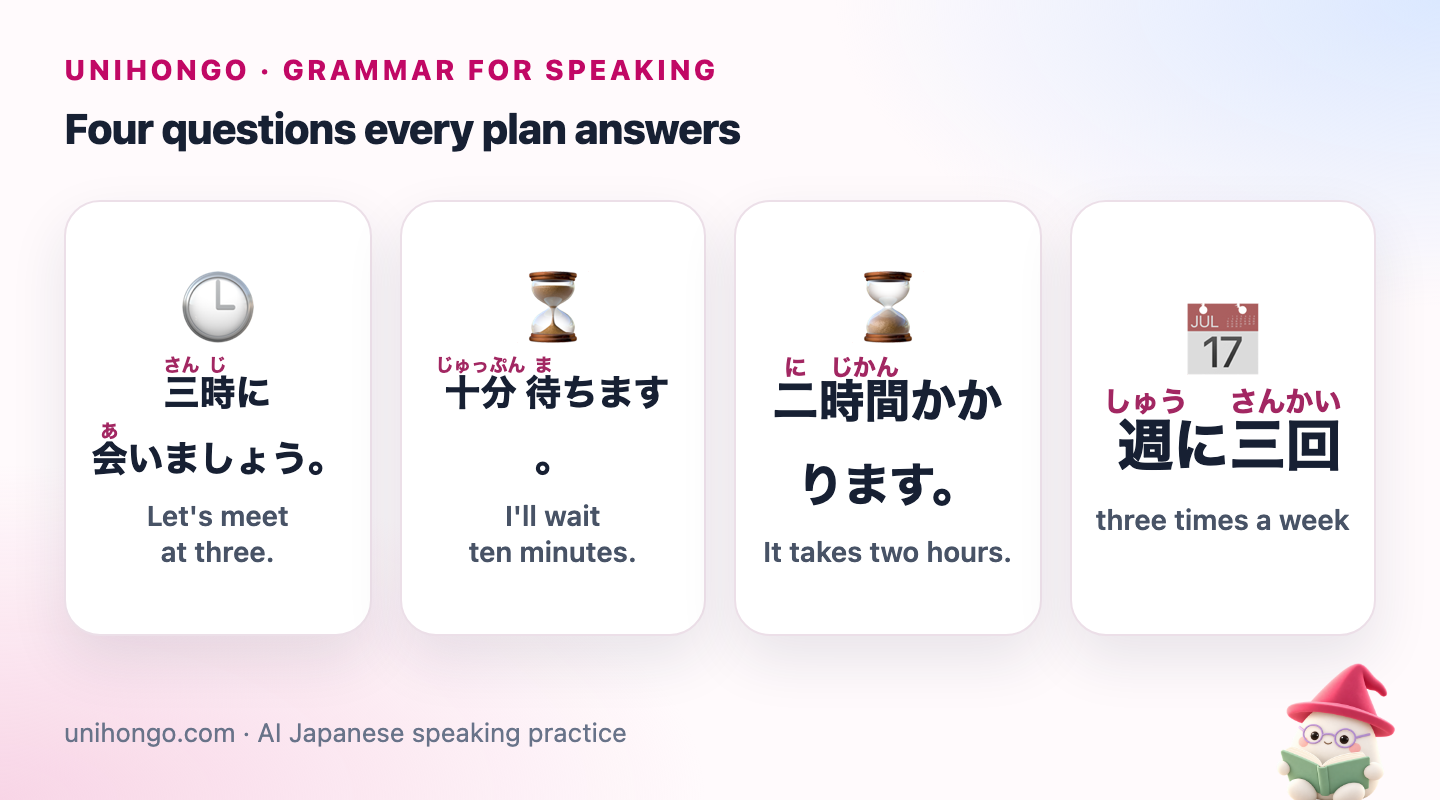
Every plan answers four questions: what time, how long, which day and how often. Japanese gives each a different counter, and confusing them is the most common way a meeting goes wrong. These four lines are your anchors.
| Japanese | Romaji | Meaning |
|---|---|---|
| 三時に会いましょう。 | Sanji ni aimashō. | Let's meet at three. |
| 十分待ちます。 | Juppun machimasu. | I'll wait ten minutes. |
| 二時間かかります。 | Nijikan kakarimasu. | It takes two hours. |
| 週に三回 | shū ni sankai | three times a week |
What time? 時 and 分
Clock times use 時 (ji) with three irregular forms: yoji for four, shichiji for seven and kuji for nine. Half past is han: sanji han. Minutes use 分, which becomes pun after 1, 3, 4, 6, 8 and 10. Gozen and gogo mean a.m. and p.m. and come before the time; in timetables and many offices you will also hear the 24-hour clock, such as jūgoji for 3 p.m.
The particle ni marks a point in time: sanji ni. Goro after a time means about: sanji goro, around three. Use goro ni or just goro; both are common.
| Japanese | Romaji | Meaning |
|---|---|---|
| 今、何時ですか。 | Ima, nanji desu ka. | What time is it now? |
| 九時半に始まります。 | Kuji han ni hajimarimasu. | It starts at half past nine. |
| 四時十五分に駅で。 | Yoji jūgofun ni eki de. | At the station at 4:15. |
| 七時ごろ着きます。 | Shichiji goro tsukimasu. | I'll arrive around seven. |
| Number | 時 (o'clock) | 分 (minutes) |
|---|---|---|
| 1 | ichiji | ippun |
| 3 | sanji | sanpun |
| 4 | yoji | yonpun |
| 6 | rokuji | roppun |
| 7 | shichiji | nanafun |
| 8 | hachiji | happun |
| 9 | kuji | kyūfun |
| 10 | jūji | juppun |
How long? 時間, 分 and the kan ending
For a length of time, add 間 (kan), meaning interval. 時間 is hours, and it is always needed: sanjikan, three hours. 分 works for both a clock time and a length, so juppun can be ten past or ten minutes; add kan, juppunkan, when you want to stress the length, though many people leave it out.
The verb kakarimasu, it takes, is the natural partner of a length. Dono gurai kakarimasu ka, how long does it take, is one of the most useful questions in daily life.
| Japanese | Romaji | Meaning |
|---|---|---|
| どのぐらいかかりますか。 | Dono gurai kakarimasu ka. | How long does it take? |
| 電車で一時間半です。 | Densha de ichijikan han desu. | An hour and a half by train. |
| 会議は三時から二時間です。 | Kaigi wa sanji kara nijikan desu. | The meeting is from three, for two hours. |
| あと五分で終わります。 | Ato gofun de owarimasu. | It'll finish in five minutes. |
| 毎日三十分勉強しています。 | Mainichi sanjuppun benkyō shite imasu. | I study thirty minutes every day. |
Which day, and for how many days?
Days are the hardest counter in this guide, because days 2 to 10 use old native readings. The same word gives the date and the number of days: futsuka is the second of the month and also two days. Day one is the exception: tsuitachi is the first of the month, but ichinichi is one day. Fourteen, twenty and twenty-four are irregular as well.
Weeks use 週間 (shūkan) and months use か月 (kagetsu), and both have small tsu changes. Do not confuse months as names with months as lengths: sangatsu is March, sankagetsu is three months.
| Japanese | Romaji | Meaning |
|---|---|---|
| 五日は空いていますか。 | Itsuka wa aite imasu ka. | Are you free on the fifth? |
| 三日間休みます。 | Mikkakan yasumimasu. | I'm taking three days off. |
| 二十日に引っ越します。 | Hatsuka ni hikkoshimasu. | I'm moving on the twentieth. |
| 一週間ぐらいかかります。 | Isshūkan gurai kakarimasu. | It takes about a week. |
| 日本に来て六か月です。 | Nihon ni kite rokkagetsu desu. | I've been in Japan for six months. |
| Number | Day of month or days | Weeks (週間) | Months (か月) |
|---|---|---|---|
| 1 | tsuitachi (1st) / ichinichi (1 day) | isshūkan | ikkagetsu |
| 2 | futsuka | nishūkan | nikagetsu |
| 3 | mikka | sanshūkan | sankagetsu |
| 4 | yokka | yonshūkan | yonkagetsu |
| 5 | itsuka | goshūkan | gokagetsu |
| 6 | muika | rokushūkan | rokkagetsu |
| 7 | nanoka | nanashūkan | nanakagetsu |
| 8 | yōka | hasshūkan | hachikagetsu |
| 9 | kokonoka | kyūshūkan | kyūkagetsu |
| 10 | tōka | jusshūkan | jukkagetsu |
Hachikagetsu and hakkagetsu are both heard for eight months. For half a year, people usually say hantoshi rather than rokkagetsu.
How often? 回 and 度
回 (kai) counts occurrences: ikkai, nikai, sankai, rokkai, jukkai. To say how often, put the period first with ni: shū ni sankai, three times a week. 度 (do) means the same in many phrases, such as mō ichido, once more, and it sounds a little softer or more formal; 回 is the everyday choice for schedules.
回 also means round or session. Dai ikkai is the first session, and nankaime is which time, as in nankaime desu ka, how many times have you been here?
| Japanese | Romaji | Meaning |
|---|---|---|
| ジムには週に二回行きます。 | Jimu ni wa shū ni nikai ikimasu. | I go to the gym twice a week. |
| 一日に三回飲んでください。 | Ichinichi ni sankai nonde kudasai. | Please take it three times a day. |
| 月に一回、会議があります。 | Tsuki ni ikkai, kaigi ga arimasu. | There's a meeting once a month. |
| 日本は何回目ですか。 | Nihon wa nankaime desu ka. | How many visits to Japan is this for you? |
| もう一度お願いします。 | Mō ichido onegai shimasu. | Once more, please. |
Mini dialogue: setting up a meeting
Two coworkers arrange a meeting in polite Japanese. Listen for the difference between the clock times, the length and the days.
| Japanese | Romaji | Meaning |
|---|---|---|
| 来週、打ち合わせできますか。 | Raishū, uchiawase dekimasu ka. | Coworker: Could we meet next week? |
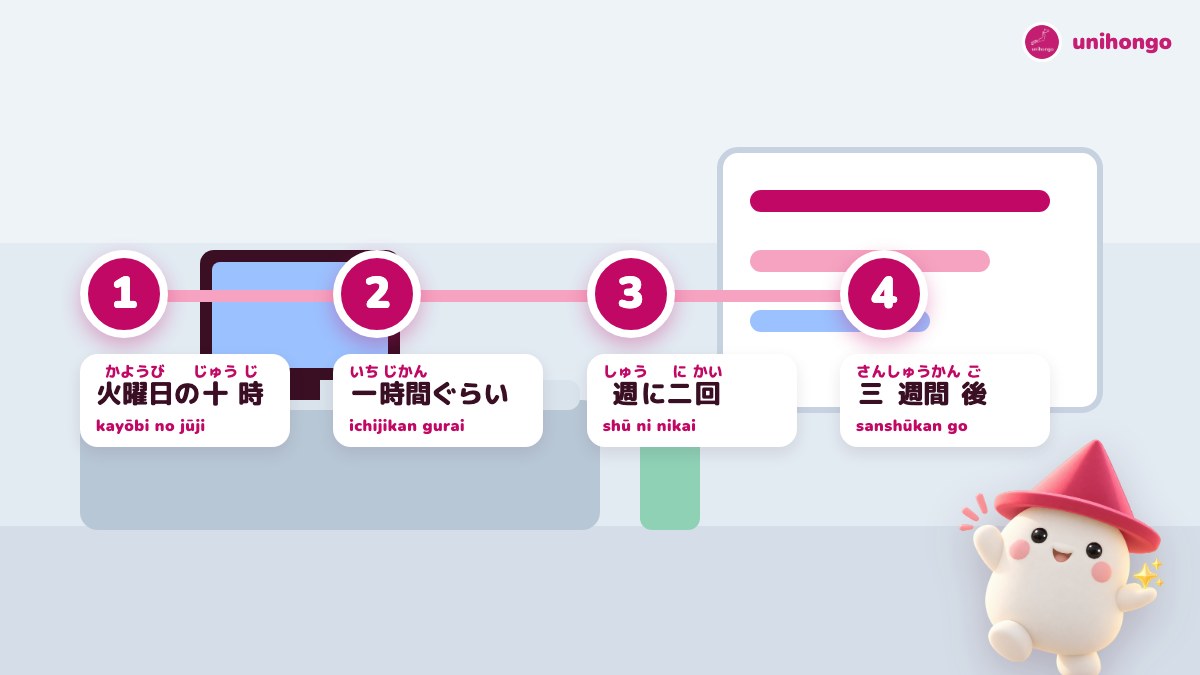
| はい。火曜日の十時はどうですか。 | Hai. Kayōbi no jūji wa dō desu ka. | You: Yes. How about Tuesday at ten? |
| 大丈夫です。どのぐらいかかりますか。 | Daijōbu desu. Dono gurai kakarimasu ka. | Coworker: That works. How long will it take? |
| 一時間ぐらいです。 | Ichijikan gurai desu. | You: About an hour. |
| そのあと、週に二回確認しましょう。 | Sono ato, shū ni nikai kakunin shimashō. | Coworker: After that, let's check in twice a week. |
| 締め切りは三週間後ですね。 | Shimekiri wa sanshūkan go desu ne. | You: The deadline is in three weeks, right? |
| はい、二十日です。 | Hai, hatsuka desu. | Coworker: Yes, the twentieth. |
Go after a length means after or later: sanshūkan go, three weeks from now. Mae means before or ago: mikka mae, three days ago. Both attach directly to the counter.
Deadlines and time ranges
Plans at work and school depend on a few small words that attach to time counters. Made ni means by a deadline, made means until, ikō means from a point onwards and inai ni means within a length of time. They are polite enough for emails and common in spoken Japanese too.
Approximate numbers are also common. Ni, san nichi, two or three days, and san, yon jikan, three or four hours, are said as one smooth phrase, and goro and gurai soften a time or a length. Being vague on purpose is often polite in Japanese, especially when you are not sure, but give a clear date when someone asks for a deadline.
| Japanese | Romaji | Meaning |
|---|---|---|
| 金曜日までに送ります。 | Kin'yōbi made ni okurimasu. | I'll send it by Friday. |
| 三時以降なら空いています。 | Sanji ikō nara aite imasu. | I'm free any time after three. |
| 二、三日お待ちください。 | Nisannichi omachi kudasai. | Please wait two or three days. |
| 一週間以内に返事をします。 | Isshūkan inai ni henji o shimasu. | I'll reply within a week. |
Mistakes that make you miss a meeting
- Saying sanji when you mean three hours. Kaigi wa sanji desu means the meeting is at three, not that it lasts three hours.
- Saying sangatsu for three months. That is the month of March; three months is sankagetsu.
- Saying shiji or kyūji for four and nine o'clock. They are yoji and kuji.
- Answering itsu, when, with a length. If someone asks itsu, give a point: raishū no kayōbi.
- Hearing yōka as yokka. Yokka is the fourth and yōka is the eighth; the long ō is the only difference, so confirm dates in writing when it matters.
A short daily drill with Mocchi
Ask Mocchi: give me a weekly schedule in English and let me say it in Japanese, one line at a time. Mocchi checks each time, length and day, explains the sound change when you say shiji instead of yoji, and keeps track of which date readings you keep missing so they come up again next time.
For the long-vowel pairs such as yokka and yōka, the pronunciation coach at unihongo.com/pronunciation has long-vowel drills: listen to the model, slow it down, record yourself and check the score and tip.