
Four office counters you will use in your first week
Most office counters describe what a thing is doing rather than what it looks like. A copy is a copy, a message is a message, a machine is a machine. These four lines come up almost every day in a Japanese workplace.
| Japanese | Romaji | Meaning |
|---|---|---|
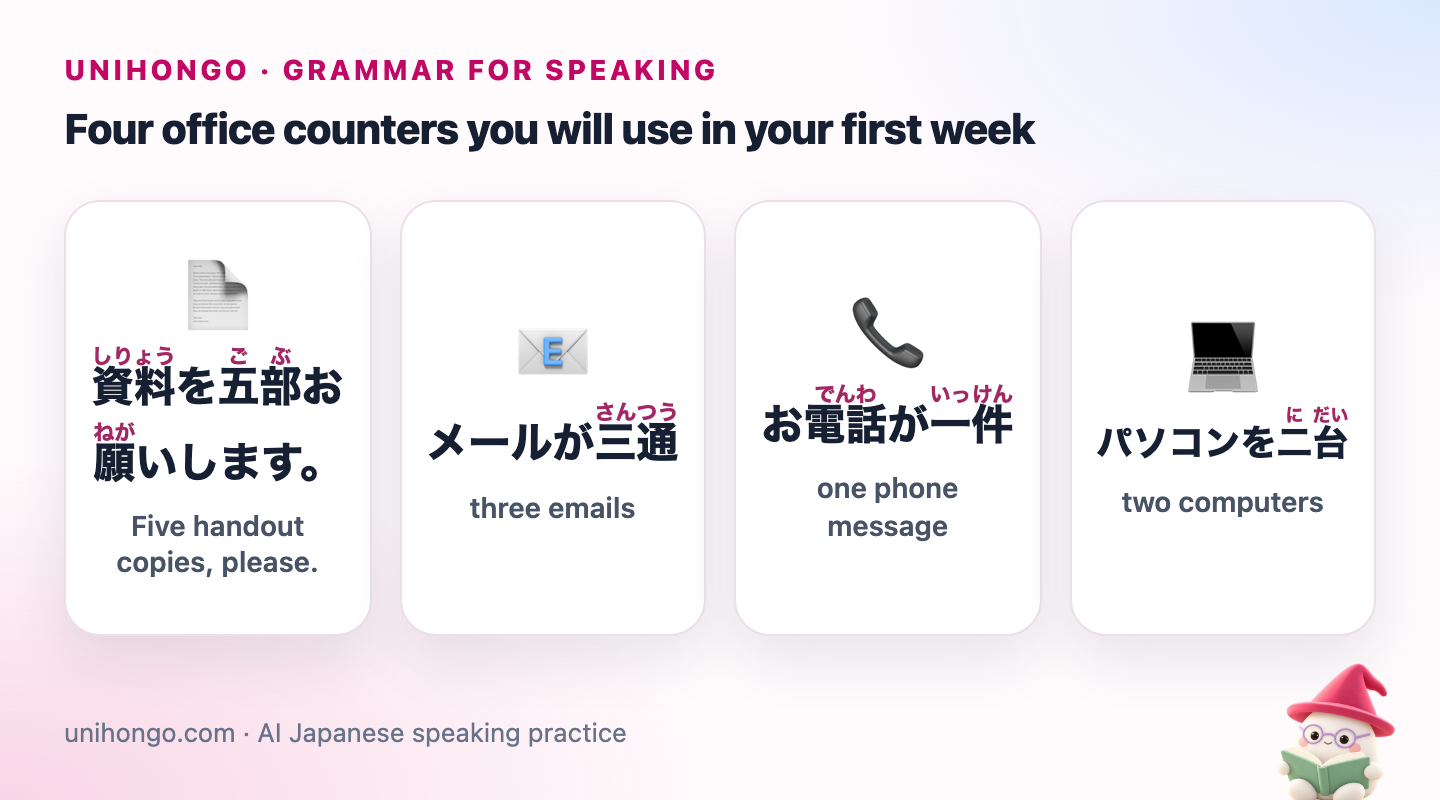
| 資料を五部お願いします。 | Shiryō o gobu onegai shimasu. | Five handout copies, please. |
| メールが三通 | mēru ga santsū | three emails |
| お電話が一件 | odenwa ga ikken | one phone message |
| パソコンを二台 | pasokon o nidai | two computers |
部 and 枚: copies and pages
部 (bu) counts sets or copies of printed material: handouts, reports, brochures, newspapers and magazines as issues. It has no sound changes: ichibu, nibu, sanbu, yonbu, gobu, up to jūbu. 枚 (mai) counts sheets: pages of a document, forms, business cards and receipts. A ten-page handout printed for six people is jūmai no shiryō o rokubu.
Ichibu also means a part, as in ichibu no hito, some people. In the office, context makes it clear: shiryō ichibu is one copy.
| Japanese | Romaji | Meaning |
|---|---|---|
| 会議の資料を十部コピーしてもらえますか。 | Kaigi no shiryō o jūbu kopī shite moraemasu ka. | Could you copy ten sets of the meeting handout? |
| 一部ずつ配ってください。 | Ichibu zutsu kubatte kudasai. | Please hand out one copy each. |
| 全部で何枚ですか。 | Zenbu de nanmai desu ka. | How many pages is it altogether? |
| 両面で三枚です。 | Ryōmen de sanmai desu. | Three sheets, double-sided. |
| 名刺を一枚いただけますか。 | Meishi o ichimai itadakemasu ka. | May I have one of your business cards? |
通 and 件: emails, letters and matters
通 (tsū) counts letters, emails, documents sent by post and other communications. The forms are ittsū, nitsū, santsū, yontsū, and for ten jittsū or juttsū. 件 (ken) counts items that need handling: cases, enquiries, orders, appointments and messages. It has the familiar small tsu changes: ikken, rokken, hakken, jukken.
The two overlap for messages. A person who sent you three emails sent santsū, but if you are listing tasks, sanken no mēru, three email items, also sounds natural. Screens and apps usually show 件.
| Japanese | Romaji | Meaning |
|---|---|---|
| 田中さんからメールが二通来ています。 | Tanaka san kara mēru ga nitsū kite imasu. | There are two emails from Mr Tanaka. |
| お電話が二件ありました。 | Odenwa ga niken arimashita. | There were two calls for you. |
| 問い合わせが五件あります。 | Toiawase ga goken arimasu. | We have five enquiries. |
| 見積もりの件でお電話しました。 | Mitsumori no ken de odenwa shimashita. | I'm calling about the quotation. |
| もう一件いいですか。 | Mō ikken ii desu ka. | May I raise one more thing? |
| Number | 通 (letters, emails) | 件 (cases, messages) |
|---|---|---|
| 1 | ittsū | ikken |
| 2 | nitsū | niken |
| 3 | santsū | sanken |
| 6 | rokutsū | rokken |
| 8 | hattsū | hakken |
| 10 | jittsū or juttsū | jukken |
| How many? | nantsū | nanken |
台 and 名: machines and people on a list
台 (dai) counts machines and vehicles: computers, printers, projectors, monitors, phones on desks and company cars. It is regular: ichidai, nidai, sandai. 名 (mei) counts people in a formal way. Use it when you book a room, list attendees or write an email, and you will hear staff at restaurants and hotels use it with sama for guests.
Between colleagues in a relaxed chat, 人 is normal. Choose 名 when you would also choose polite written language.
| Japanese | Romaji | Meaning |
|---|---|---|
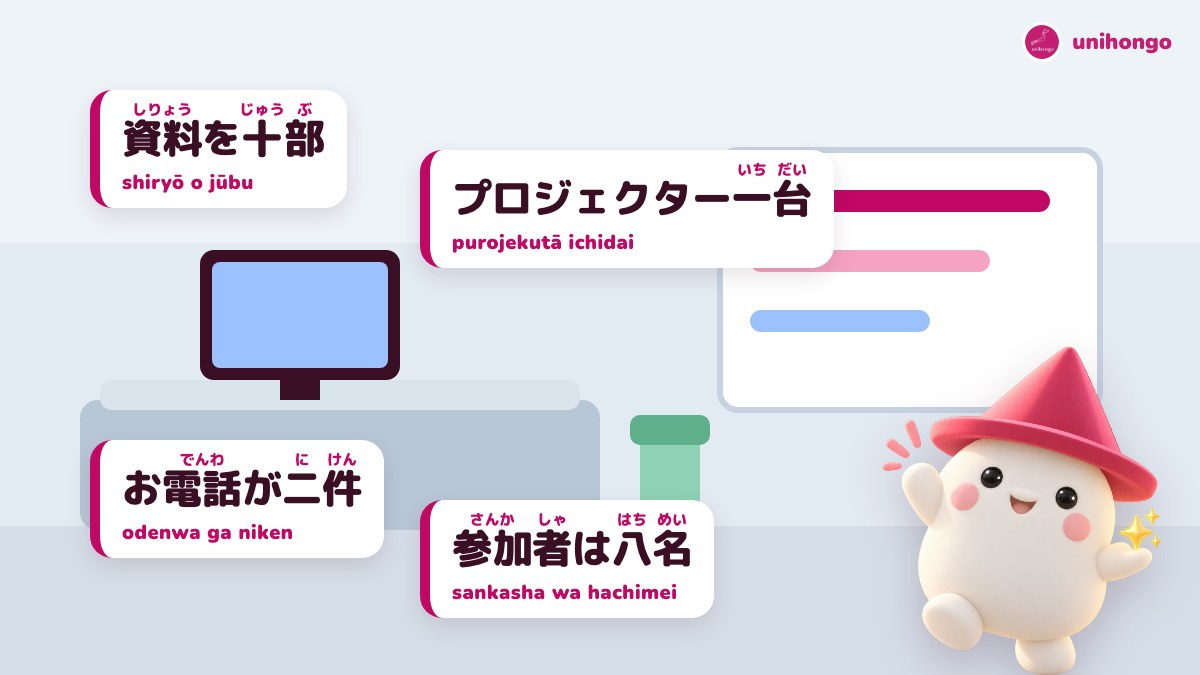
| プロジェクターを一台お借りしたいです。 | Purojekutā o ichidai okari shitai desu. | I'd like to borrow a projector. |
| プリンターが一台故障しています。 | Purintā ga ichidai koshō shite imasu. | One of the printers is broken. |
| 参加者は八名です。 | Sankasha wa hachimei desu. | There are eight attendees. |
| 六名で会議室を予約しました。 | Rokumei de kaigishitsu o yoyaku shimashita. | I booked a meeting room for six. |
| お客様が二名いらっしゃいました。 | Okyakusama ga nimei irasshaimashita. | Two visitors have arrived. (polite) |
Mini dialogue: getting ready for a meeting
Your manager asks you to prepare for an afternoon meeting. Both speak polite Japanese, and the manager uses slightly more casual forms, which is common from a senior to a junior colleague.
| Japanese | Romaji | Meaning |
|---|---|---|
| 午後の会議、何名ですか。 | Gogo no kaigi, nanmei desu ka. | Manager: How many are coming to the afternoon meeting? |
| 八名です。 | Hachimei desu. | You: Eight. |
| じゃあ、資料を十部用意してください。 | Jā, shiryō o jūbu yōi shite kudasai. | Manager: Then please prepare ten copies of the handout. |
| はい。プロジェクターも一台予約しておきます。 | Hai. Purojekutā mo ichidai yoyaku shite okimasu. | You: Sure. I'll book a projector too. |
| ありがとう。あと、何か連絡はあった? | Arigatō. Ato, nanika renraku wa atta? | Manager: Thanks. Any messages? |
| はい、お電話が二件と、メールが一通ありました。 | Hai, odenwa ga niken to, mēru ga ittsū arimashita. | You: Yes, two calls and one email. |
Shite okimasu, I will do it in advance, is a useful form for showing initiative. Combined with a counter it gives a clear, competent report: ichidai yoyaku shite okimasu.
When the fallback is fine, and when it is not
The native series hitotsu, futatsu also appears at work, especially for abstract things: hitotsu shitsumon ga arimasu, I have one question, and futatsu ten ga arimasu, I have two points. It is natural and polite in meetings.
It is less natural for copies, machines and messages. Shiryō o futatsu is understood, but sounds vague: two documents, or two copies? In the office, precision is part of politeness, so use 部, 台 and 件 when they apply.
| Japanese | Romaji | Meaning |
|---|---|---|
| 一つ質問があります。 | Hitotsu shitsumon ga arimasu. | I have one question. |
| ポイントは二つです。 | Pointo wa futatsu desu. | There are two points. |
| 三つ提案があります。 | Mittsu teian ga arimasu. | I have three proposals. |
Counters in emails and on the phone
Business emails and phone calls use the same counters, often with humble or polite verbs. When you send documents, 部 counts printed copies and 点 counts separate files or items, as in shiryō santen, three documents. When you announce how many people will attend a visit, 名 is the natural counter, paired with the humble ukagaimasu, we will visit.
Ken appears in subject lines and on the phone as a way to name the topic: kaigi no ken, about the meeting. It tells the listener at once what the call or email is about, which is considered considerate in a busy office.
| Japanese | Romaji | Meaning |
|---|---|---|
| 資料を二部お送りします。 | Shiryō o nibu ookuri shimasu. | I'll send you two copies of the documents. |
| 資料三点を添付いたします。 | Shiryō santen o tenpu itashimasu. | I'm attaching three documents. (formal email) |
| 当日は三名で伺います。 | Tōjitsu wa sanmei de ukagaimasu. | Three of us will visit on the day. (humble) |
| 会議の件でご連絡しました。 | Kaigi no ken de gorenraku shimashita. | I'm contacting you about the meeting. |
Common office counter mistakes
- Saying jūmai when you mean ten copies. Ten copies of a multi-page document is jūbu; jūmai is ten sheets.
- Using 人 in a formal email about attendance. Write sanmei instead of sannin.
- Using 個 for computers or printers. Machines take 台: pasokon nidai.
- Saying ichiken or rokuken. They are ikken and rokken.
- Counting yourself with sama, as in watashitachi wa nimeisama desu. Sama is for others; say nimei or futari.
Practise the office day with Mocchi and Yamada-sensei
Write your manager a short status report in Japanese, with messages, copies and a room booking, and paste it into Mocchi with /correct. Mocchi corrects the counters and the politeness level, explains why mei fits better than nin in a report, and remembers the office counters you find tricky.
Then rehearse it aloud with Yamada-sensei in AI Sensei. Ask Yamada-sensei to play your manager on a busy morning, asking how many people are coming and what messages arrived, and switch to more formal Japanese when the Sensei becomes a client.