
Your family in four short lines
When someone asks about your family in Japan, the answer usually comes in a small, set shape: the size of the family, who is in it, the ages and any pets. Each part uses a different counter. These four lines show the pattern, and the rest of this guide fills in the forms.
In Japanese you usually say the number after the person or animal with ga imasu, there is: ane ga hitori imasu, I have one older sister. Imasu is used because people and animals are living things; for objects you would say arimasu.
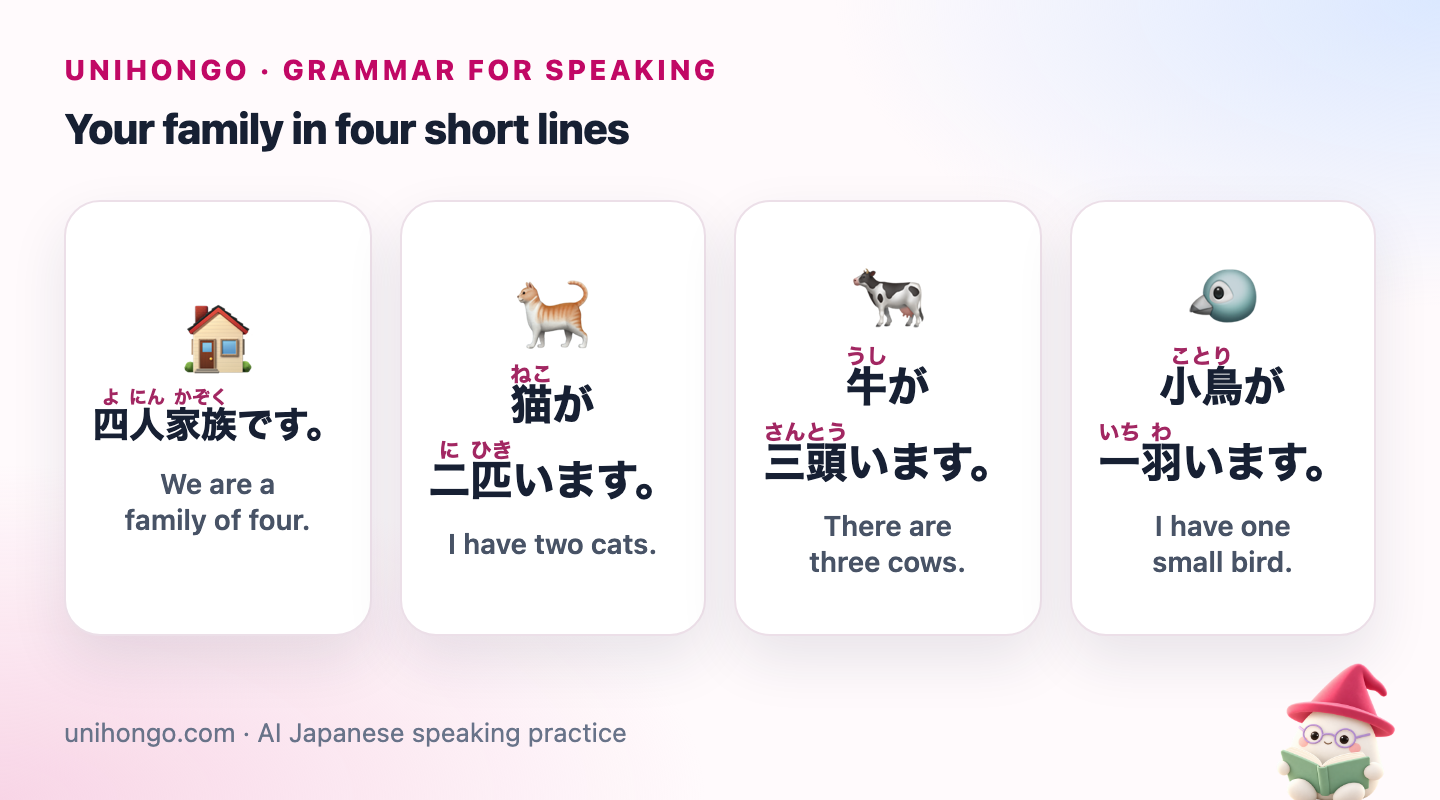
| Japanese | Romaji | Meaning |
|---|---|---|
| 四人家族です。 | Yonin kazoku desu. | We are a family of four. |
| 猫が二匹います。 | Neko ga nihiki imasu. | I have two cats. |
| 牛が三頭います。 | Ushi ga santō imasu. | There are three cows. |
| 小鳥が一羽います。 | Kotori ga ichiwa imasu. | I have one small bird. |
人 for family members
人 counts people. One and two are irregular, hitori and futari, and four is yonin. Seven is usually shichinin, and nananin is also heard. Use it for the family as a whole, for siblings and for children.
Japanese has separate words for older and younger siblings, so the counter often appears with them: ani, older brother; ane, older sister; otōto, younger brother; imōto, younger sister. Kyōdai means siblings in general, and hitorikko means an only child.
| Japanese | Romaji | Meaning |
|---|---|---|
| 何人家族ですか。 | Nannin kazoku desu ka. | How many people are in your family? |
| 兄が一人と妹が二人います。 | Ani ga hitori to imōto ga futari imasu. | I have one older brother and two younger sisters. |
| 三人兄弟の真ん中です。 | Sannin kyōdai no mannaka desu. | I'm the middle of three siblings. |
| 一人っ子です。 | Hitorikko desu. | I'm an only child. |
| 子どもが二人います。 | Kodomo ga futari imasu. | I have two children. |
匹 for pets, with its sound changes
匹 (hiki) is the counter for cats, most dogs, hamsters, fish, insects and other small or medium animals. Its h sound changes to p after 1, 6, 8 and 10, and to b after 3 and in the question word. These changes are the same ones you find with 本 and 杯, so learning them once helps three counters.
| Japanese | Romaji | Meaning |
|---|---|---|
| 犬を一匹飼っています。 | Inu o ippiki katte imasu. | I have one dog. |
| 金魚が三匹います。 | Kingyo ga sanbiki imasu. | There are three goldfish. |
| 猫は何匹いますか。 | Neko wa nanbiki imasu ka. | How many cats do you have? |
| 子猫が六匹生まれました。 | Koneko ga roppiki umaremashita. | Six kittens were born. |
| Number | 匹 (hiki) | Example |
|---|---|---|
| 1 | ippiki | a cat |
| 2 | nihiki | two dogs |
| 3 | sanbiki | three goldfish |
| 4 | yonhiki | four hamsters |
| 6 | roppiki | six kittens |
| 8 | happiki | eight fish |
| 10 | juppiki | ten fish |
| How many? | nanbiki | how many animals |
Katte imasu, from kau, to keep an animal, is the verb for having a pet. It is written 飼う and is a different word from 買う, to buy, though they sound the same.
頭 and 羽: big animals and birds
頭 (tō) counts large animals: cows, horses, elephants, whales and bears. You will hear it on farms, at the zoo and in the news. Very large dogs, such as guide dogs or police dogs, are sometimes counted with 頭 in formal contexts, but at home most people just say ippiki. The forms are ittō, nitō, santō, yontō, gotō, rokutō, nanatō, hattō, kyūtō and juttō.
羽 (wa) counts birds: chickens, sparrows, parrots and pet budgies. The modern forms are mostly regular, ichiwa, niwa, sanwa, but you will also hear older variants such as sanba and roppa. Rabbits were traditionally counted with 羽 as well. Many people now count pet rabbits with 匹, and using 羽 for them sounds old-fashioned or like a fun piece of trivia.
| Japanese | Romaji | Meaning |
|---|---|---|
| 牧場に馬が五頭います。 | Bokujō ni uma ga gotō imasu. | There are five horses on the farm. |
| 象が二頭いました。 | Zō ga nitō imashita. | There were two elephants. |
| インコを二羽飼っています。 | Inko o niwa katte imasu. | I keep two budgies. |
| にわとりが十羽います。 | Niwatori ga jūwa imasu. | There are ten chickens. |
| うさぎを一匹飼っています。 | Usagi o ippiki katte imasu. | I have a rabbit. |
歳 for ages, and the special twenty
Ages use 歳 (sai), often written 才 in casual writing and on signs. One, eight and ten change their sound: issai, hassai, jussai. Twenty has its own word, hatachi, which is what people actually say. From twenty-one, it is regular again: nijūissai.
Asking an adult's age directly can feel personal, so many people wait until it comes up. Oikutsu desu ka is the polite question; nansai desu ka is fine for children and friends. For children, oikutsu is also kind and polite when you ask the parent.
| Japanese | Romaji | Meaning |
|---|---|---|
| 娘は八歳です。 | Musume wa hassai desu. | My daughter is eight. |
| 弟は二十歳です。 | Otōto wa hatachi desu. | My younger brother is twenty. |
| お子さんはおいくつですか。 | Okosan wa oikutsu desu ka. | How old is your child? (polite) |
| うちの猫はもう十五歳です。 | Uchi no neko wa mō jūgosai desu. | Our cat is already fifteen. |
| Age | Reading | Note |
|---|---|---|
| 1 | issai | small tsu |
| 3 | sansai | regular |
| 8 | hassai | small tsu |
| 10 | jussai | jissai is also correct |
| 20 | hatachi | special word |
| How old? | nansai or oikutsu | oikutsu is more polite |
Mini dialogue: family small talk at work
A short exchange between two coworkers during a lunch break. Both speak polite Japanese, and the counters carry all the facts.
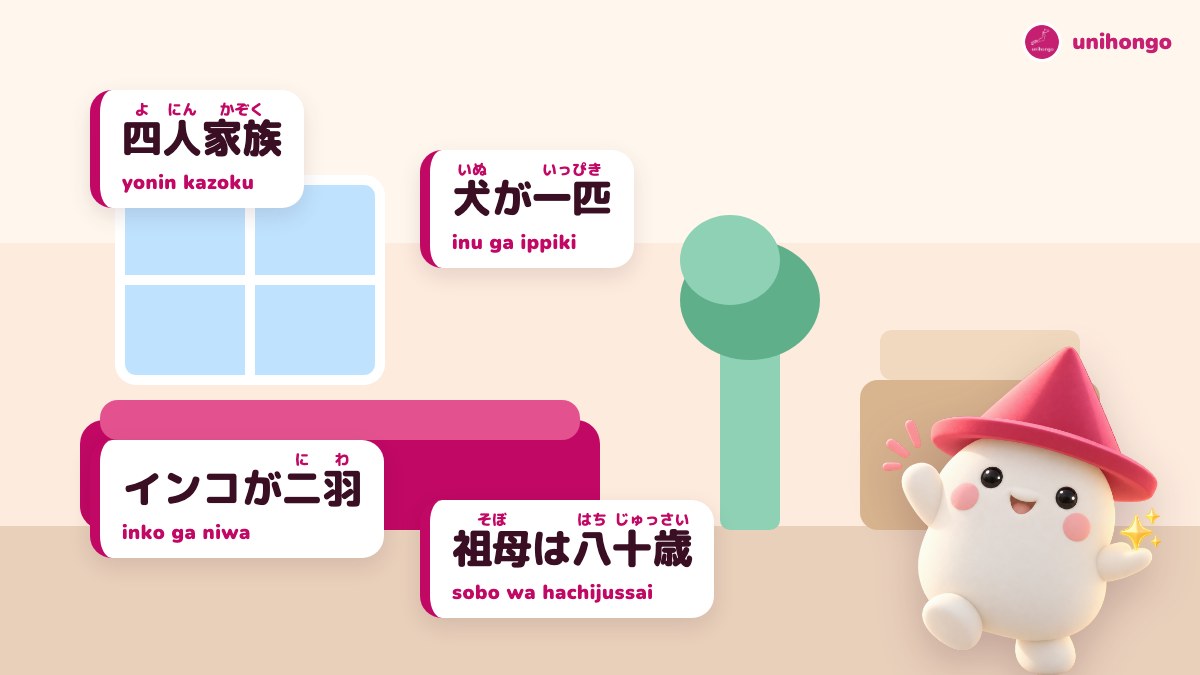
| Japanese | Romaji | Meaning |
|---|---|---|
| 何人家族ですか。 | Nannin kazoku desu ka. | Coworker: How many are in your family? |
| 五人家族です。両親と姉が二人います。 | Gonin kazoku desu. Ryōshin to ane ga futari imasu. | You: Five. My parents and two older sisters. |
| ペットは飼っていますか。 | Petto wa katte imasu ka. | Coworker: Do you have any pets? |
| 実家に犬が一匹と、インコが二羽います。 | Jikka ni inu ga ippiki to, inko ga niwa imasu. | You: At my parents' house there's a dog and two budgies. |
| にぎやかですね。犬はおいくつですか。 | Nigiyaka desu ne. Inu wa oikutsu desu ka. | Coworker: Lively! How old is the dog? |
| もう十二歳のおじいちゃんです。 | Mō jūnisai no ojiichan desu. | You: He's twelve already, an old man. |
Using oikutsu for a pet sounds affectionate and slightly playful, and calling an old dog ojiichan, grandpa, is a common, fond way to talk about senior pets. Jikka means the family home you grew up in, a word you will use a lot if you live away from your parents.
Asking about someone else's family politely
When you ask about other people's families, Japanese adds respect in two places: the family words and the verb. Gokyōdai is the polite word for someone else's siblings, and irasshaimasu is the respectful form of imasu. The counter itself stays the same, so okosan wa nannin desu ka is both natural and polite.
School years have their own counter, 年生 (nensei): ichinensei, ninensei, sannensei. Parents often answer a question about age with the school year instead, so be ready to hear shōgaku ninensei, second year of primary school. Questions about family can feel personal for some people, so follow the other person's lead and do not push if they answer briefly.
| Japanese | Romaji | Meaning |
|---|---|---|
| ご兄弟はいらっしゃいますか。 | Gokyōdai wa irasshaimasu ka. | Do you have any brothers or sisters? (polite) |
| お子さんは何人ですか。 | Okosan wa nannin desu ka. | How many children do you have? |
| 上の子は小学二年生です。 | Ue no ko wa shōgaku ninensei desu. | My eldest is in the second year of primary school. |
| わんちゃんは何歳ですか。 | Wanchan wa nansai desu ka. | How old is your dog? (friendly) |
The fallback, and where it does not work
The native series hitotsu, futatsu, mittsu counts things, not people, and it sounds odd for animals too. Neko ga futatsu would sound like two cat ornaments. For people, there is no fallback: hitori, futari and then sannin are essential. For animals, 匹 is the safe default for almost anything smaller than a person.
For ages, small children sometimes say their age with the native series, such as mittsu for three, and you may hear grandparents use it too. It is warm and natural for very young children only.
| Japanese | Romaji | Meaning |
|---|---|---|
| 三つになりました。 | Mittsu ni narimashita. | She's turned three. (about a small child) |
| いくつ? | Ikutsu? | How old are you? (to a small child) |
| 五つ! | Itsutsu! | Child: Five! |
Make your family introduction stick
Write your own family introduction in four or five sentences and send it to Mocchi with /correct. Mocchi points out counter and politeness mistakes, explains why ani becomes oniisan for someone else's family, and remembers which counters you missed so they come back in a later quiz.
To practise the vocabulary in a lighter way, add each family word and animal to your flashcards and play Kotoba Stack or Flashcard Flip with your own deck; seeing ippiki next to a picture of a cat helps the sound change stick.